
Ever stared at your growth metrics, wondering why the line has gone flat? The answer probably isn’t buried in some complex marketing funnel. It’s hiding in plain sight, right there in your user feedback. This is the Voice of the Customer (VoC)—the art of capturing, understanding, and actually acting on what your customers are telling you.
Why Listening Is Your Best Growth Strategy
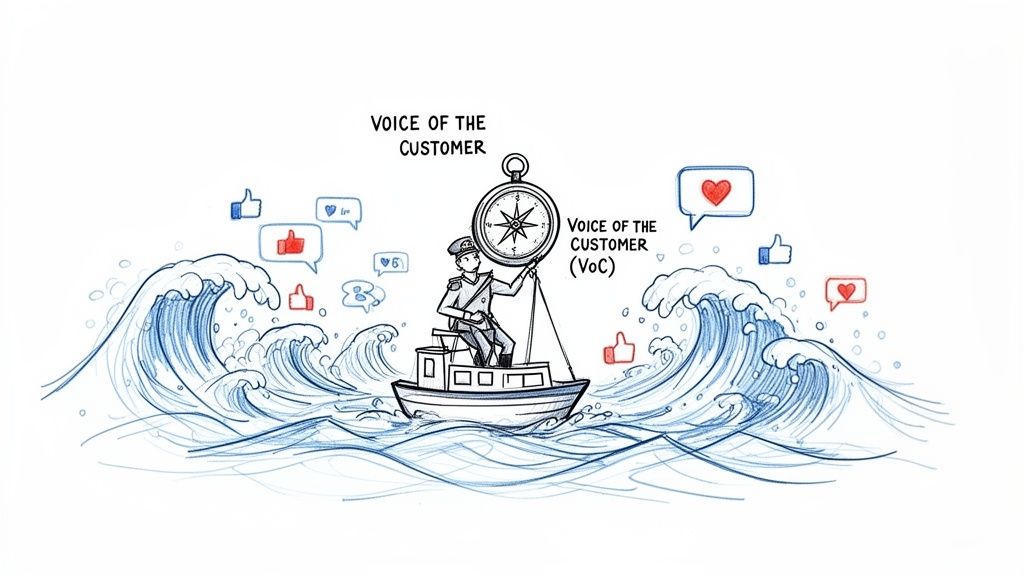
For a SaaS founder, especially a bootstrapper, a term like “voice of the customer” can sound like another bit of corporate jargon you don’t have time for. But in reality, it’s your most powerful and cost-effective tool for growth. It’s the raw, unfiltered truth about what your users love, what drives them crazy, and what they desperately wish your product could do.
Trying to build your SaaS without a clear VoC programme is like being the captain of a ship in a storm, trying to find a distant shore without a compass. You can guess which way to turn the wheel, but every decision is a gamble. The waves of user feedback—support tickets, social media mentions, survey responses—are constantly crashing against your hull. Without a system to interpret them, they just feel like noise.
A structured voice of the customer approach is your compass. It turns that chaotic noise into clear signals that guide your every move.
From Scattered Feedback to a Unified Strategy
Let’s be honest, most founders are already collecting feedback, whether they realise it or not. The problem is that it lives in disconnected pockets all over the business. You’ve got support emails in one inbox, feature requests on a public board, Net Promoter Score (NPS) results in another tool, and stray comments on social media.
This fragmented approach creates some serious headaches:
- Wasted Time: You spend hours manually stitching together feedback from different places just to spot a single trend.
- Missed Opportunities: A game-changing feature request from a high-value customer gets lost in a sea of low-priority bug reports.
- Informed Guesses: Your product roadmap ends up being based more on gut feelings than on solid, aggregated data.
A unified VoC strategy pulls all these scattered channels into one coherent view. It’s the difference between having a dozen random maps and one clear GPS that shows you exactly where you are and the best route forward.
By systematically capturing and analysing feedback, you’re not just collecting opinions. You’re building a data-driven foundation that sharpens your product development, cuts down churn, and clarifies your marketing message.
The Real Cost of Not Listening
Ignoring the voice of the customer doesn’t just stall your growth; it actively costs you money. Every hour your dev team spends building a feature nobody asked for is a direct hit to your bottom line. Every customer who churns because of a persistent bug represents lost recurring revenue.
On the flip side, a SaaS built on a foundation of customer feedback gains a massive competitive edge. You build what users have explicitly told you they need, you fix the issues that truly matter, and you create a product experience that feels like it was designed just for them.
This creates a powerful cycle of loyalty and advocacy that no amount of marketing spend can buy. This, right here, is the heart of product-led growth.
Your Secret Weapon in a Crowded SaaS Market
Let’s be honest. You’re not going to outspend the venture-backed giants with their massive marketing budgets. While they’re stuck in boardroom meetings, you have a massive advantage: you can actually talk to your customers. Your agility is your superpower, and a solid voice of the customer (VoC) programme is how you wield it.
This isn’t about some vague goal to “reduce churn.” It’s about stopping real, paying customers from leaving by fixing the small but infuriating bugs they took the time to report. It’s the difference between guessing what to build next and knowing with absolute certainty.
A good VoC programme cuts through the noise and gives you incredible clarity. It stops you from sinking months of precious dev time into features nobody ever asked for. Instead, you get a direct line from customer pain to product roadmap, helping you build a sticky, indispensable product much faster.
Shape a Roadmap People Actually Want
Without clear signals from your users, your product roadmap is basically a collection of educated guesses. A founder sees a competitor launch something shiny, feels the pressure to keep up, and suddenly the team is burning resources on a “me-too” feature that doesn’t solve a real problem for their customers.
The voice of the customer slices right through that. When you systematically track feature requests and pull insights from support tickets, your roadmap becomes a reflection of evidence, not assumptions.
This feedback loop makes sure every development cycle is spent on work that adds real value for the people paying your bills. You can prioritise with confidence, focusing on the high-impact, low-effort fixes that make users stick around. For bootstrappers where every single hour of development counts, that kind of efficiency is a total game-changer. It’s how you outmanoeuvre the big, slow-moving competition.
Get Ahead of Churn Before It Happens
Customers rarely leave without dropping a few hints first. The warning signs are usually there—a bad satisfaction score, a frustrated support ticket, or a sudden drop in how often they use your tool. A proactive VoC system helps you catch these red flags early.
In today’s economy, this is non-negotiable. Take Southeast Asia’s dynamic market, where a staggering 43% of consumers scaled back non-essential spending in early 2025 because of affordability pressures. That means SaaS trials are under more scrutiny than ever; if your tool doesn’t deliver value immediately, users are gone. You can find more insights about this consumer shift on bain.com.
By actively listening, you can step in before a user even thinks about cancelling. Imagine getting an alert the moment a paying customer leaves a low Net Promoter Score. A quick, personal email from you, the founder, can transform a bad experience into a moment that builds serious loyalty.
This is how you build a business that lasts. You don’t just win customers; you fight to keep them by proving you’re listening and you actually care.
Build a Testimonial and Case Study Machine
Good feedback is just as valuable as the critical stuff. Your happiest customers are your best marketers, but most founders have no system for identifying them, let alone asking for a testimonial.
A strong VoC programme completely changes that. By tracking sentiment from surveys and in-app feedback, you can instantly pinpoint your biggest fans.
This screenshot from HappyPanda shows just how easy it is to pop a simple feedback collection widget right into your app.
Tools like this let you automate the process of finding happy users. It creates an effortless pipeline for the killer testimonials and case studies you need to build social proof and fuel your growth.
How to Capture Customer Voices Without Breaking the Bank
Alright, you’re sold on the idea of listening to your customers. But as a bootstrapper, the phrase “voice of the customer programme” probably sounds intimidating and, let’s be honest, expensive. Good news—you don’t need a massive budget or a dedicated research team to start gathering insights that can completely change your trajectory.
The key is to be scrappy and smart. We can split collection methods into two simple camps: active methods, where you go out and directly ask for feedback, and passive methods, where you analyse what customers are already telling you, whether they realise it or not.
Going on the Offensive: Actively Seeking Feedback
Active methods are your go-to when you have a specific, burning question. They’re perfect when you have a hunch you want to test, like, “Is our new pricing page scaring people away?” or “Do people actually understand this new feature?”
Here are the most effective, low-cost ways to do it:
-
Targeted Surveys: Forget those long, soul-crushing questionnaires. Think short, sharp, contextual surveys like Net Promoter Score (NPS) or Customer Satisfaction (CSAT). You could trigger a simple CSAT survey the moment a user finishes a chat with your support team to get an immediate read on the experience.
-
Focused Customer Interviews: This is a bootstrapper’s secret weapon. Seriously. Talking to just five customers for 15-20 minutes each can reveal more profound truths than a survey sent to 500 people. You’re not aiming for statistical significance here; you’re hunting for the “why” behind what they do.
Bootstrapper’s Tip: Skip the cash incentives for interviews. Offering money can attract professional survey-takers who don’t actually care about your product. Instead, offer a small product discount or a free month. This ensures you’re talking to users who are genuinely invested in seeing you succeed.
A smart way to streamline this whole process is to explore tools that can pull all this feedback into one place. For instance, consider integrating with customer feedback platforms like UserVoice to centralise your insights without adding a ton of manual work to your plate.
Listening In: Passively Tuning into Your Audience
Passive methods are all about tapping into the conversations and data that are already out there. This is where you find the raw, unfiltered truth, because customers aren’t being prompted—they’re just living their lives and talking about your product.
Here are the goldmines you should be tapping:
-
Support Tickets: Your support inbox is overflowing with treasure. Every single ticket is a piece of direct feedback about a pain point, a confusing feature, or a frustrating bug. Start looking for recurring themes to pinpoint the biggest sources of friction in your product.
-
Social Media and Community Mentions: Keep an ear to the ground on platforms like Twitter, Reddit, or industry-specific forums. Customers often share their brutally honest opinions—the good, the bad, and the ugly—in these public spaces. Setting up simple alerts can help you track brand mentions without having to live on social media 24/7.
-
User Analytics: Your product analytics tell a story, you just have to learn how to read it. Where are users getting stuck? Which features are they completely ignoring? A high drop-off rate on a particular page is a powerful form of passive feedback screaming that something is wrong.
This blend of active and passive collection is what gives you the complete picture. While passive methods show you what is happening, active methods help you finally understand why. For a deeper dive, check out our detailed guide on how to collect customer feedback for even more tactical ideas.
Choosing Your Voice of the Customer Method
So, where do you begin? The right method really depends on your current goals, your team’s bandwidth, and what you’re trying to figure out right now. To help you decide, think of it like choosing the right tool for a job—you wouldn’t use a hammer to saw a piece of wood.
This table breaks down which method to use and when.
| Method | Best For | Effort Level | Example Tool (HappyPanda Feature) |
|---|---|---|---|
| NPS/CSAT Surveys | Getting a quick, quantitative pulse on overall satisfaction and loyalty. | Low | Triggering an NPS survey 30 days after a user signs up. |
| Customer Interviews | Deeply understanding user needs, motivations, and hidden pain points. | Medium | Figuring out why trial users aren’t converting to paid plans. |
| In-App Widgets | Capturing contextual feedback right when a user experiences something. | Low | Using a feedback widget to let users report a bug on the spot. |
| Support Ticket Analysis | Identifying the most common bugs and points of product friction. | Low | Tallying up the top three most reported issues each month. |
| Social Listening | Gauging public brand perception and catching problems before they escalate. | Low to Medium | Setting up alerts for your brand name to catch customer complaints early. |
Ultimately, the best approach is a mix. Start with one or two low-effort methods, get comfortable with the process, and then expand as you grow. The goal isn’t to do everything at once, but to start building the habit of listening.
Turning Raw Feedback into an Actionable Roadmap
Collecting feedback is one thing. Actually using it is another beast entirely. It’s a common trap for SaaS founders: you end up with a mountain of raw, messy user comments and no clear way to turn it into a prioritised product roadmap. A thousand survey responses are useless if you can’t make sense of them. It’s like having all the pieces to a puzzle but no picture on the box to guide you.
This is where you shift from just hearing the voice of the customer to truly understanding it. The real goal is to transform every support ticket, feature request, and in-app rating into a structured, actionable insight. One that tells you exactly what to build next, who it’s for, and why it matters.
This simple flow shows how both active and passive feedback channels feed into your analysis system, forming the bedrock of a solid roadmap.
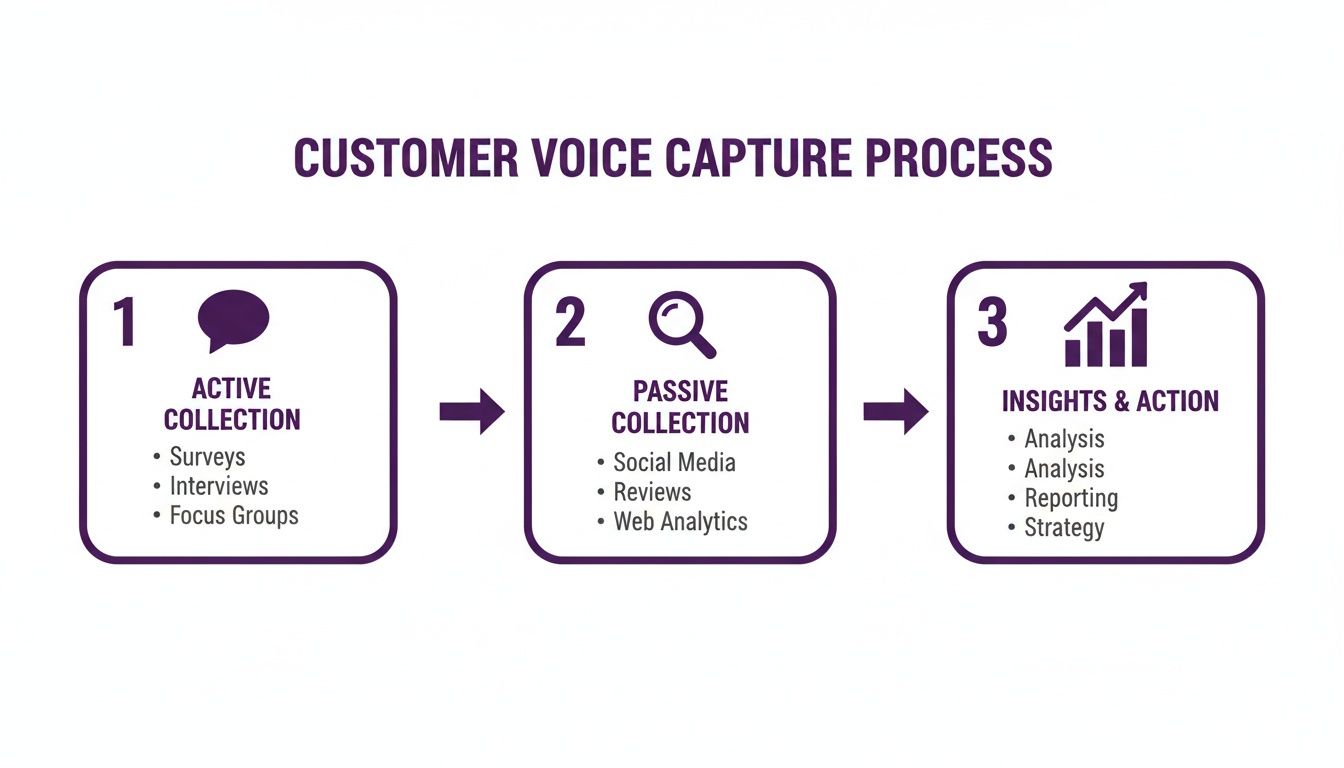
As you can see, both direct requests and indirect observations are crucial. You need both to get the full picture.
Creating a System for Triage and Tagging
Your first move is to build a simple framework for categorising every piece of feedback that comes your way. Think of it like a hospital’s triage system—you need to quickly sort incoming issues to see what’s on fire and what can wait. A basic tagging system is your best friend here.
Start with a few core categories to get going:
- Theme: What’s the feedback about? (e.g.,
bug-report,feature-request,UI-suggestion,pricing-feedback) - User Segment: Who is this person? (e.g.,
trial-user,paying-customer,enterprise-client) - Sentiment: What’s the emotional tone? (e.g.,
positive,negative,neutral,frustrated)
This initial sort prevents gold-standard insights from getting lost in a messy inbox. Suddenly, you have an organised database of customer needs that you can slice and dice to spot powerful trends.
The Impact Versus Effort Matrix
Okay, now for the toughest part every founder faces: deciding what to build. You have limited time and even more limited resources, so every single decision counts. The impact versus effort matrix is a brilliantly simple tool for making these hard calls.
It helps you map out every potential feature or fix on a four-quadrant grid:
- High Impact, Low Effort (Quick Wins): These are your top priorities. Think of a small bug fix that’s driving your paying customers mad. Get it done.
- High Impact, High Effort (Major Projects): These are your big, strategic bets. They’ll eat up resources but could fundamentally improve your product.
- Low Impact, Low Effort (Fill-ins): These are nice-to-haves. You might tackle them when you have some downtime, but they shouldn’t push bigger projects aside.
- Low Impact, High Effort (Time Sinks): Avoid these like the plague. They’re a black hole for resources with almost no payoff.
Pro-tip: when you’re weighing impact, give more weight to feedback from paying customers. A request that stops a loyal user from churning is almost always higher impact than a “cool” idea from a trial user.
A classic mistake is listening only to the loudest voices. A structured prioritisation framework ensures your roadmap is driven by data and strategy, not just the squeaky wheel.
Closing the Loop with Automation
The final—and most important—step is to actually act on the feedback and let customers know you’ve listened. Dropping the ball here is a huge risk. A shocking 38% of organisations in Indonesia, for instance, measure KPIs like NPS but never act on the feedback. Only 14% actually use it for product improvements. That inaction creates a massive churn risk, but it’s also a massive opportunity for founders who get it right.
This is where a tool like HappyPanda becomes your secret weapon. It automates the entire process, connecting feedback directly to action.
You can set up simple “if-then” rules to manage feedback without lifting a finger.
For example, you could create a rule that says, “If a user submits a negative CSAT score, automatically create a high-priority support ticket.” Or, “If a feature request gets more than 10 upvotes, add it to our product backlog in Jira.” And if you want to get really smart about it, you can explore conversation intelligence to automatically turn customer calls and chats into structured data.
This level of automation ensures nothing slips through the cracks. But more importantly, it lets you follow up with users, which is the whole point of closing the feedback loop. You’re not just collecting data; you’re building relationships and proving you’re a founder who actually listens.
Putting Your VoC System on Autopilot
Let’s be honest, manually sifting through every piece of feedback, trying to spot at-risk users, and hoping to find happy advocates is a soul-crushing grind. For a solo founder, it’s pretty much impossible to keep up.
Now, imagine a system that does the heavy lifting for you—a voice of the customer programme that basically runs on autopilot. It surfaces the critical moments, good and bad, so you can jump in and take high-impact actions instead of getting lost in the noise.
This isn’t some complex, enterprise-level pipe dream. With the right setup, you can build powerful little automation recipes that trigger actions based on customer feedback. You’re essentially creating a proactive and scalable VoC machine, and an all-in-one platform makes this kind of smart system accessible to any founder, no data science team required.
Here’s a quick look at how a simple automation builder, like the one in HappyPanda, connects triggers (like a survey response) to actions. It’s all visual, no coding needed.
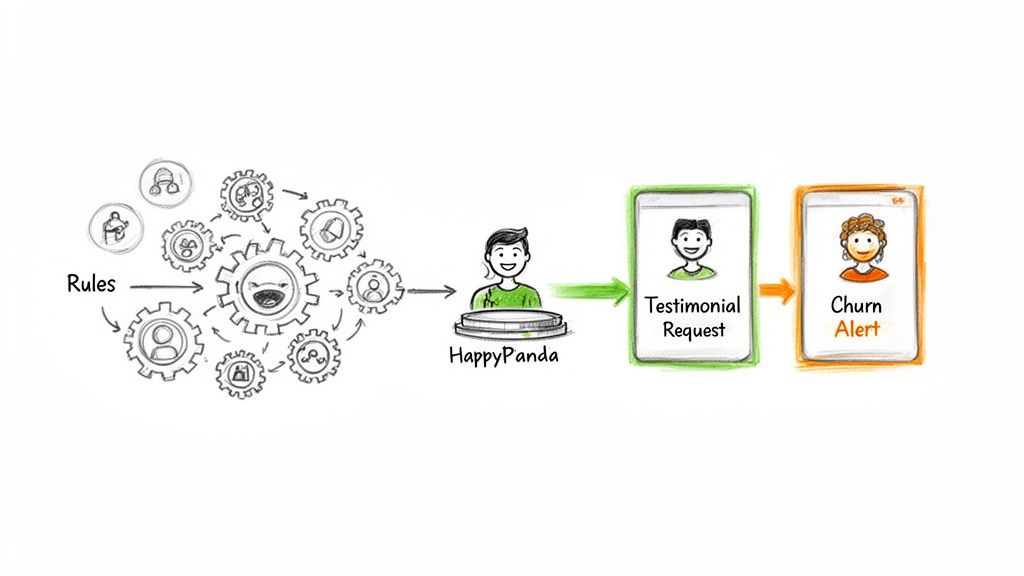
This kind of visual workflow lets you build powerful playbooks that react to customer signals in real-time. It’s about turning feedback into immediate, automated action.
The Happy Customer Pipeline Recipe
Your happiest users are your best marketing asset, but most founders are too swamped to ever ask them for help. This little recipe creates a pipeline of positive social proof without you lifting a finger. It finds your biggest fans and automatically asks them for a testimonial right when they’re feeling the love.
Here’s the simple logic behind it:
- The Trigger: A user fills out a Net Promoter Score (NPS) survey.
- The Condition: Their score is a 9 or 10 (meaning they’re a “Promoter”).
- The Action: The system waits 24 hours, then automatically sends a follow-up email asking if they’d be willing to share a short testimonial for your website.
This dead-simple workflow catches those moments of peak happiness to build a library of authentic customer stories that will help you land new sign-ups.
The Churn Prevention Alert Recipe
On the flip side, a negative piece of feedback is often a cry for help. A user who takes the time to tell you they’re unhappy is probably on the verge of churning, but they’re also giving you one last shot to make things right. This recipe flags these critical moments so you can step in personally.
A fast, personal response from a founder to a bad experience can do more than just save a customer. It can turn a hater into a fiercely loyal advocate who feels genuinely heard.
Let’s build the churn alert:
- The Trigger: A user submits a Customer Satisfaction (CSAT) survey after using your product.
- The Condition: They give a score of 1 or 2 (they’re seriously not happy).
- The Action: The system instantly creates a high-priority task in your project management tool and pings you—the founder—directly with the customer’s details and feedback for a personal follow-up.
This ensures no at-risk customer slips through the cracks, giving you the chance to dive in and save the relationship before it’s too late. To see what tools make this happen, you can check out our guide on the best voice of the customer software out there today.
The Onboarding Nudge Recipe
The first few days with your product are make-or-break. If new users get stuck, most will just ghost you without ever saying why. This proactive automation helps them overcome common hurdles by offering timely help right when they need it, which is a massive boost for activation and cuts down on that early-stage churn.
This recipe uses what users don’t do as a form of feedback:
- The Trigger: A new user signs up for a trial.
- The Condition: After three days, analytics show the user hasn’t completed a key activation step (like creating their first project).
- The Action: The system automatically sends a friendly, helpful email with a link to a short tutorial video or a relevant help doc to get them unstuck.
By setting up these simple-yet-powerful playbooks, you transform your voice of the customer programme from a passive data-gathering chore into an active, intelligent system. It works for you 24/7, building better relationships, stopping churn in its tracks, and fuelling your growth.
Right, theory is great, but it’s action that actually gets things moving. Let’s turn everything we’ve talked about into a simple, practical plan you can start today. Kicking off a voice of the customer programme doesn’t need a massive team or a strategy document the size of a novel—it just needs one focused first step.
Forget trying to do everything at once. That’s a recipe for burnout. The real goal here is to build a little momentum with a few high-impact actions. This checklist is designed for busy founders who want to get a basic VoC system up and running in less than an hour.
Your Five-Step Launch Plan
We’re not trying to boil the ocean here. This is all about creating a small, manageable system that gives you value right away and builds a solid habit of listening. Here’s how you can get started right now.
-
Define One Clear Goal: First things first, what’s the one metric you really want to move? Get specific. Instead of a vague goal like “improve retention,” aim for something like “reduce trial churn by 10% in the next quarter.” A sharp goal gives all your VoC efforts a clear purpose.
-
Pick One Collection Method: Start simple. Seriously. Don’t try to launch five different surveys at once. Just pick one primary method that lines up with your goal. A simple Net Promoter Score (NPS) survey sent after a trial ends is a perfect place to start.
-
Set Up One Automation: Your time is gold. Create your first automated workflow to handle the basics. For example, you could automatically send a personal email from you whenever a user leaves a low NPS score. This ensures you’re acting on critical feedback without having to manually check it every hour.
You don’t need a huge budget or a dedicated team to build a wildly successful, customer-centric product. You just need to start listening systematically and take consistent, small actions on what you hear.
-
Block 30 Minutes Weekly: Consistency beats intensity every time. Schedule a recurring 30-minute slot on your calendar each week dedicated only to reviewing customer feedback. Protect this time like it’s your last cup of coffee on a Monday morning.
-
Announce One Feedback-Driven Feature: You have to close the loop. In your next changelog or product update, make a point to call out a new feature or a fix that came directly from user suggestions. It’s the single best way to prove to your customers that you’re actually listening.
These five steps take the big, intimidating idea of “voice of the customer” and break it down into a simple, repeatable practice. By starting small and staying consistent, you’re laying the foundation for a product that customers don’t just use, but one they genuinely love.
Frequently Asked Questions
Jumping into a structured voice of the customer programme can feel like a massive commitment, especially when you’re bootstrapping. Let’s tackle some of the common questions founders have before diving in.
How Much Feedback Is Enough to Make Decisions?
You don’t need thousands of data points to spot a meaningful trend. The goal here is to find patterns, not chase sheer volume. Think of it like this: if one person tells you a button is broken, it might be a one-off glitch. But if five or ten people all report the same problem? You’ve got a clear, actionable signal.
Even a small cluster of similar comments is more than enough to justify taking action. For bootstrapped founders, these early patterns are pure gold—they point you straight to the highest-impact fixes and features without wasting time.
As a Solo Founder, How Can I Possibly Manage This?
The key is to start small and let your tools do the heavy lifting for you. Don’t try to roll out five different feedback channels all at once. Just begin with a single, automated method, like a simple survey that goes out after a user’s trial ends.
Block out just 30 minutes a week on your calendar for this. A focused half-hour is plenty of time to analyse what’s coming in, spot a trend, and decide on one small action to take. Automation makes this manageable, not another overwhelming task on your to-do list.
Isn’t VoC Just a Fancy Name for Reading Support Tickets?
Not at all. Reading support tickets is purely reactive; a true voice of the customer programme is proactive and systematic. Support tickets only ever give you the perspective of users who are motivated enough (or, let’s be honest, frustrated enough) to actually reach out for help.
VoC is designed to help you hear from the silent majority—the customers who would otherwise just churn without saying a word. By proactively asking for feedback, you get the complete picture of the user experience, not just the loudest complaints.
Ready to build a VoC system that practically runs on autopilot? HappyPanda brings feedback collection, email sequences, and automation together in one platform, so you can get back to building a product customers genuinely love. Get started for free at https://happypanda.ai.