
Voice of the customer software is a platform designed to collect, analyse, and act on user feedback from multiple sources. It centralises everything from support tickets and surveys to social media mentions, transforming unstructured customer opinions into clear, actionable insights for your team.
What Is Voice of the Customer Software
Let’s skip the dry, textbook definition. Think of voice of the customer (VoC) software as a central nervous system for user feedback. It gathers signals from every customer touchpoint—support chats, NPS surveys, app store reviews, social media mentions—and translates all that noise into something you can actually use.
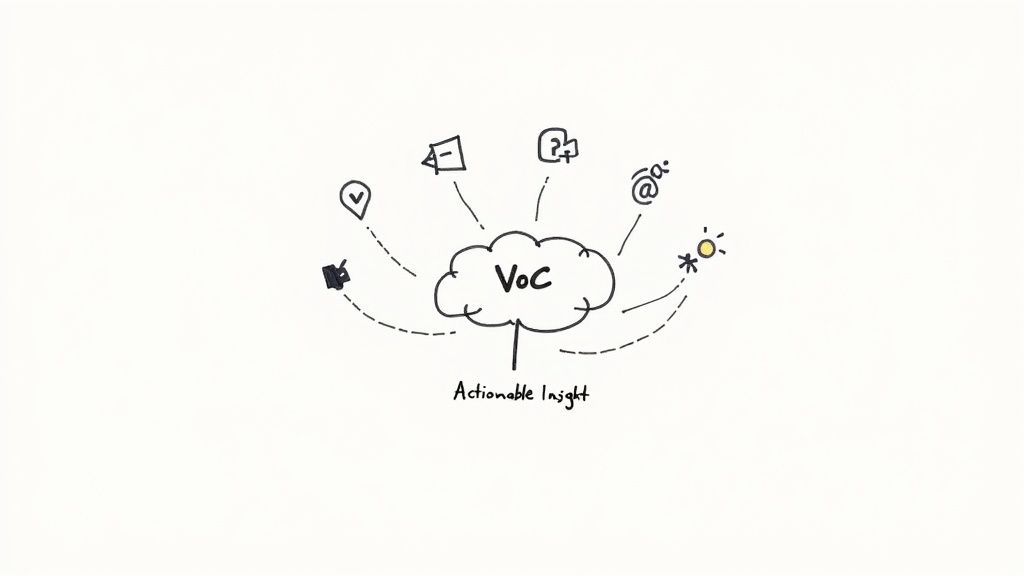
For SaaS teams, this isn’t just about collecting complaints. It’s a strategic tool for understanding what users truly want, moving you from guessing what to build next to knowing with confidence.
The Core Function of VoC Platforms
At its heart, a VoC platform automates the process of listening to your customers at scale. Instead of your team manually sifting through spreadsheets or disconnected inboxes, this software pulls everything into one place and helps you spot trends you would otherwise miss.
The real goal here is to create a closed-loop system. You don’t just listen; you act on the feedback and then tell customers about the changes you’ve made. This simple act builds immense trust and loyalty. By systematically unlocking growth with feedback from users, companies can turn customer insights into a serious competitive advantage.
Why It Matters Now More Than Ever
The need for a solid VoC solution is growing, especially in markets where customer service expectations are sky-high. In Southeast Asia, for example, the demand for this tech is exploding. The Contact Centre as a Service (CCaaS) market is projected to hit nearly USD 1 billion by 2027 across Asia and Oceania, with an expected 577% increase in cloud-based contact centre seats.
A VoC program provides a detailed understanding of the customer’s requirements and a common language for the team going forward in the product development process. It’s a highly useful springboard for product innovation.
This isn’t just a regional blip; it’s a global shift. Companies that invest in listening to their customers gain a huge edge. They make smarter, data-driven decisions that directly boost user satisfaction and keep people from churning. This guide will walk you through everything from the core benefits and essential features to building a VoC program that fuels sustainable growth.
Alright, let’s move beyond the textbook definition. Knowing what voice of the customer software is is one thing, but seeing what it can do for your business is where things get interesting. Rolling out a VoC program isn’t just about collecting data; it’s a fundamental shift in how your SaaS company operates, innovates, and grows.
For any SaaS business, the product is the customer relationship. That makes having a direct line to user sentiment absolutely essential. The numbers don’t lie: companies that actually invest in VoC programs generate a 10x greater year-over-year increase in annual company revenue compared to those that don’t. This isn’t about tweaking a few buttons; it’s about building a business that evolves right alongside its users.
This whole transformation rests on three pillars where a solid VoC program really shines: building a product roadmap that users actually want, getting ahead of customer churn, and creating marketing that speaks your customers’ language.
Shape a User-Centric Product Roadmap
Let’s be honest, without clear data, product roadmaps often become a battle of opinions. The loudest person in the room or a founder’s gut feeling can end up dictating the next six months of development—a massive gamble in a crowded market. Voice of the customer software takes the guesswork out of the equation and replaces it with cold, hard evidence.
Imagine your product team is stuck debating two big features. One seems flashy and innovative, while the other is a simple quality-of-life improvement a few users have mentioned. A VoC platform can pull together feedback from support tickets, surveys, and in-app suggestions, revealing that the “minor” improvement is actually a huge source of frustration for 30% of your power users.
Suddenly, the decision is obvious. By prioritising that fix, you’re not just smoothing out a rough edge for a valuable user segment; you’re also proving that you listen. That builds incredible loyalty. This is how you move from guessing to knowing.
A detailed understanding of the customer’s requirements provides a common language for the team going forward in the product development process and a highly useful springboard for product innovation.
This simple shift from assumption to insight ensures every development cycle delivers real, measurable value to the people who keep the lights on—your customers.
Proactively Reduce Customer Churn
Customer churn is the silent killer of SaaS. By the time a customer hits that “cancel subscription” button, it’s usually too late to change their mind. A proactive VoC program is your early warning system, helping you spot the smoke long before it turns into a fire.
Think about a customer success team trying to pinpoint at-risk accounts. Instead of just waiting for a bad NPS score to roll in, they can use voice of the customer software to track sentiment trends across every single interaction.
They might notice a sudden spike in tickets from a key account, all mentioning “bugs” or “slow performance.” That’s a massive red flag. The software can automatically tag and surface this trend, letting the team jump in with targeted support or a personalised email before the customer even thinks about looking elsewhere.
This heads-up approach has a huge financial upside. Companies that actively run a VoC program spend 25% less on customer retention than those that don’t, simply because they solve problems before they become reasons to leave.
Create Marketing That Actually Resonates
How do you talk about your product? It’s easy for SaaS companies to fall back on technical jargon and feature lists. But what if you could use the exact words your happiest customers use to describe why they love your tool?
This is where a VoC program becomes a marketer’s secret weapon. By digging into positive feedback, reviews, and testimonials, you uncover the authentic language that connects with your ideal audience. You might discover that while your homepage boasts about “AI-powered workflow automation,” your customers are just thrilled that your tool “saves them an hour every Friday.”
That kind of insight is pure gold. You can then weave this customer-generated language directly into your:
- Website Copy: Make your headline reflect the one benefit users rave about most.
- Ad Campaigns: Use direct quotes in your ad creative for some seriously powerful social proof.
- Case Studies: Build stories around the real-world headaches your software actually solves.
This approach ensures your marketing isn’t just you shouting into the void. It’s a reflection of real user experiences, making it far more believable and effective at turning curious prospects into loyal fans.
Essential Features of Modern VoC Software
Picking a Voice of the Customer (VoC) tool can feel like wading through a sea of buzzwords. Every platform promises to revolutionise your customer insights, but what does that actually mean? To cut through the noise, you need to ignore the flashy promises and focus on the features that will genuinely help your team.
The right tool doesn’t just collect data; it turns a messy pile of feedback into a strategic roadmap.
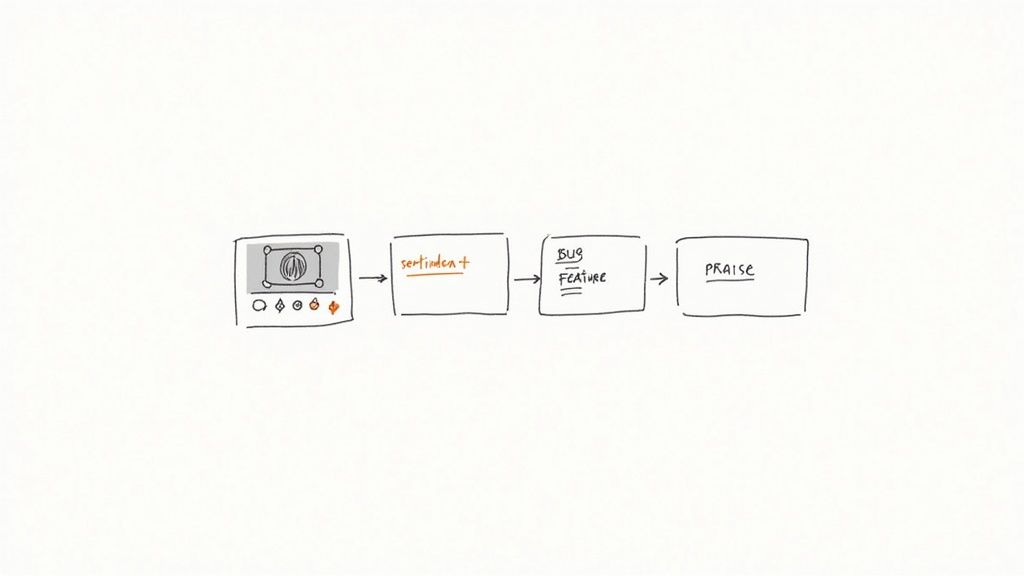
At its heart, a great VoC platform has to listen everywhere your customers are talking. It can’t just be another survey tool. It needs to be the central hub where every customer interaction, comment, and complaint comes together.
This is often called multi-channel data aggregation, and honestly, it’s non-negotiable. It’s the process of pulling feedback from all your different sources into one clean, unified view so you don’t miss a single piece of the story.
Core Data Collection and Analysis
First things first: you need to get the feedback and make sense of it. This is where raw, unfiltered customer thoughts start their journey to becoming something you can actually use. Without a solid foundation here, your VoC program is dead in the water.
Here’s what to look for:
- Diverse Survey Types: The software should handle everything from quick in-app polls to more detailed questionnaires. This flexibility lets you measure different things at different times. For instance, you might want to combine metrics like CSAT and NPS to get a much fuller picture of customer sentiment.
- Automated Feedback Tagging: Nobody has time to manually sort through thousands of comments. Look for a tool that automatically tags feedback based on themes (like “bug report,” “feature request,” or “UI/UX issue”). It’s a massive time-saver.
- AI-Powered Sentiment Analysis: This is more than just sorting comments into ‘positive’ or ‘negative’ buckets. Modern AI can pick up on nuance, sarcasm, and even urgency. It helps you zero in on what’s most important and understand the emotion driving the feedback.
If you want to get a better handle on how tools can pull such specific insights from open-ended comments, it’s worth understanding text mining and how the technology works behind the scenes.
Visualisation and Reporting Capabilities
Once the data is collected and analysed, it needs to be presented in a way that’s dead simple to understand. Your product managers, your marketing team, and even your CEO should be able to look at a dashboard and get the gist immediately.
A powerful VoC platform doesn’t just show you what customers are saying; it shows you why it matters. It connects feedback trends to business outcomes, making the value of listening undeniable.
Look for a platform with customisable dashboards that let you track the metrics that actually matter to your business. The ability to filter data by customer segment, date, or feedback source is crucial for digging into specific problems. Real-time reporting also ensures your team is always working with fresh information, so you can jump on emerging trends or issues before they blow up.
Comparing Voice of the Customer Software Tiers
Not all VoC tools are created equal. They range from simple survey apps to massive enterprise suites. The table below breaks down how features typically stack up across different tiers, which should help you figure out what level of firepower your team really needs.
| Feature Category | Basic (e.g., Simple Survey Tools) | Intermediate (e.g., HappyPanda) | Advanced (e.g., Enterprise Suites) |
|---|---|---|---|
| Data Collection | Limited to one or two channels, primarily manual surveys. | Aggregates feedback from multiple key sources like surveys, widgets, and integrations. | Connects to dozens of sources, including call transcripts and social media. |
| Analysis | Basic keyword counting and manual tagging. | AI-powered sentiment analysis and automated feedback categorisation. | Predictive analytics, churn forecasting, and deep topic modelling. |
| Reporting | Static, pre-built reports that are exported manually. | Customisable, real-time dashboards with filtering and segmentation. | Highly advanced business intelligence (BI) integrations and executive-level reporting. |
| Actionability | Requires manual data export to take action. | Direct integrations with tools like Slack and Jira to create automated workflows. | Complex, multi-step automated workflows across the entire organisation. |
Ultimately, choosing the right VoC software is about finding the sweet spot between functionality and simplicity. You need a tool that’s powerful enough to deliver real insights but not so complex that your team never uses it.
Integrating VoC Software with Your Tech Stack
A powerful Voice of the Customer platform is much more than just a listening tool; it should be the central hub that connects customer insights to real action. But here’s the catch: if it operates in a silo, completely disconnected from the rest of your tools, its value plummets. Its true power is only unleashed when it plugs seamlessly into the software your teams already live in every single day.
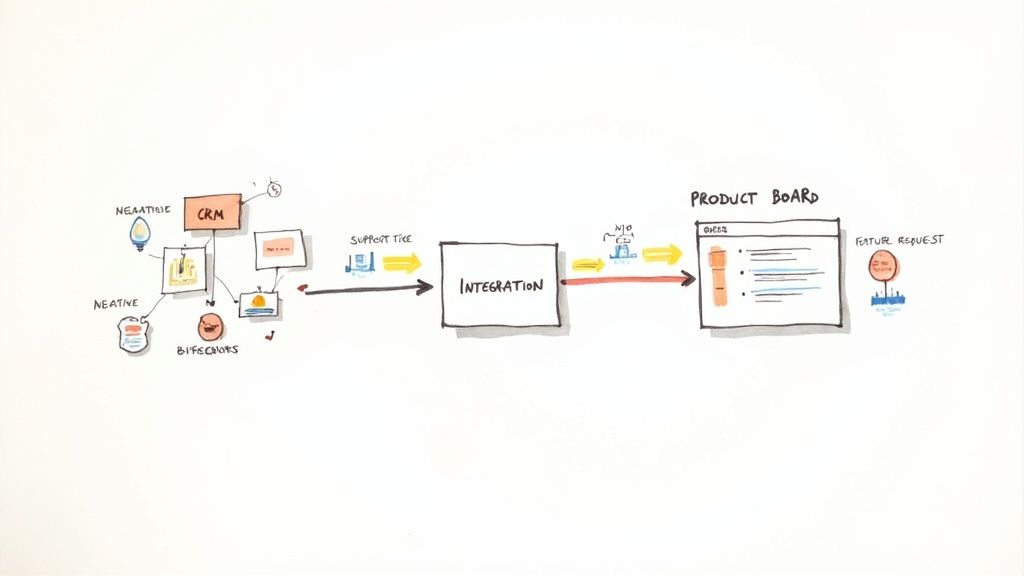
Think of integrations as bridges. They let customer feedback flow directly into your team’s existing workflows, which means no more manual data entry, no more insights getting lost in spreadsheets, and a dramatically faster response time. It’s about building a feedback ecosystem that pretty much runs itself.
This is especially true as more businesses move to the cloud. In Southeast Asia, the CRM market—which leans heavily on VoC data—is on track to be worth USD 2.27 billion in 2025. Cloud solutions already hold a massive 63.53% market share in the region, thanks to government incentives and a big push for API-first tech that makes connecting tools easier than ever.
Connecting Feedback to Your Helpdesk
One of the most critical integrations you can set up is with your customer support platform, whether that’s Zendesk, Intercom, or Help Scout. When your VoC software and helpdesk are in sync, you create a powerful, proactive support system that can tackle issues before they snowball.
Imagine this scenario: a customer fills out a survey, gives a low CSAT score, and mentions a frustrating bug.
- Without Integration: That feedback just sits in the VoC tool. It waits there until someone remembers to check, finds the comment, and then manually creates a support ticket. This could take hours, if not days.
- With Integration: The negative feedback instantly and automatically triggers a new, high-priority ticket in your helpdesk, already assigned to the right agent.
This kind of automation ensures every piece of negative feedback gets a prompt response, showing customers you’re not just listening—you’re actually doing something about it.
Pushing Insights into Product Management
Another game-changing connection is with your product and development tools like Jira, Linear, or Asana. This integration closes the gap between what customers are asking for and what your product team is building, making sure your roadmap is genuinely user-centric.
For example, a high-value customer might submit a brilliant feature idea through an in-app feedback widget. With a direct integration, that request can be automatically turned into a new issue or story in your product backlog. It shows up complete with the customer’s original comment and all the relevant context, like their subscription plan or company size.
This direct pipeline from customer request to development backlog eliminates the risk of great ideas being lost in translation or forgotten in an email chain. It ensures the most impactful feedback gets in front of the people who can build it.
Driving Action with Communication Tools
Finally, integrating your voice of the customer software with communication platforms like Slack or Microsoft Teams keeps the entire organisation in the loop. These integrations can push real-time notifications about feedback trends, glowing testimonials, or urgent problems directly into the right channels.
This creates a culture where everyone, from marketing to engineering, has a constant pulse on what users are thinking and feeling. You could set up a dedicated Slack channel that gets all your 5-star reviews, serving up a steady stream of motivation for the team. At the same time, an urgent issue flagged by sentiment analysis could trigger an alert in an engineering channel for immediate attention. It also makes other feedback methods more powerful, like when you embedded survey in email responses can be funnelled straight into these automated workflows.
How to Choose the Right VoC Software
Picking the right Voice of the Customer software can feel a bit like navigating a maze in the dark. But it doesn’t have to be. With a solid game plan, you can cut through the marketing noise and find a tool that actually clicks with your team’s workflow, goals, and budget. The secret? Start with your ‘why’, not with their features.
Before you even glance at a single demo, you need to nail down what success looks like for your business. Are you trying to slash customer churn, get a sanity check on your product roadmap, or boost feature adoption? Each goal needs a different toolkit.
A team hell-bent on reducing churn needs a platform that’s brilliant at real-time sentiment analysis and plugs right into their helpdesk. On the other hand, a product team gearing up for a big feature launch will probably be hunting for slick in-app survey tools.
Define Your Core Objectives
First things first, get your team in a room (virtual or otherwise) and ask some tough questions. Getting everyone on the same page here is the single most important step. It sets the scorecard you’ll use to judge every potential vendor.
Your main goals might look something like this:
- Improving Retention: Finding the exact friction points that make users hit the cancel button.
- Guiding Product Development: Using real feedback to decide what to build next, with confidence.
- Boosting Customer Loyalty: Measuring and improving stuff like your Net Promoter Score (NPS) over time.
- Enhancing the User Experience: Spotting and squashing usability bugs inside your app.
This little exercise makes sure you’re shopping for a solution to a real business problem, not just buying shiny new software for the sake of it.
Map Your Needs and Stakeholders
Once your objectives are crystal clear, it’s time to get practical. Think about who will actually be living in the voice of the customer software every day. Your customer success crew, product managers, and marketers all have different jobs to do and different ways of working.
Pull these key stakeholders in early. Ask them what their biggest feedback-related headaches are. Is it the soul-crushing manual effort of tagging support tickets? Or the struggle to share insights from surveys with the engineering team? Their answers are gold—they’ll help you build a list of must-have features.
Don’t get distracted by a long list of features you’ll never touch. Focus on the core stuff that solves your team’s most immediate and painful problems. A simpler tool that actually gets used is always better than a complex one that gathers digital dust.
This flowchart breaks down the simple, three-step approach to making a decision you won’t regret.
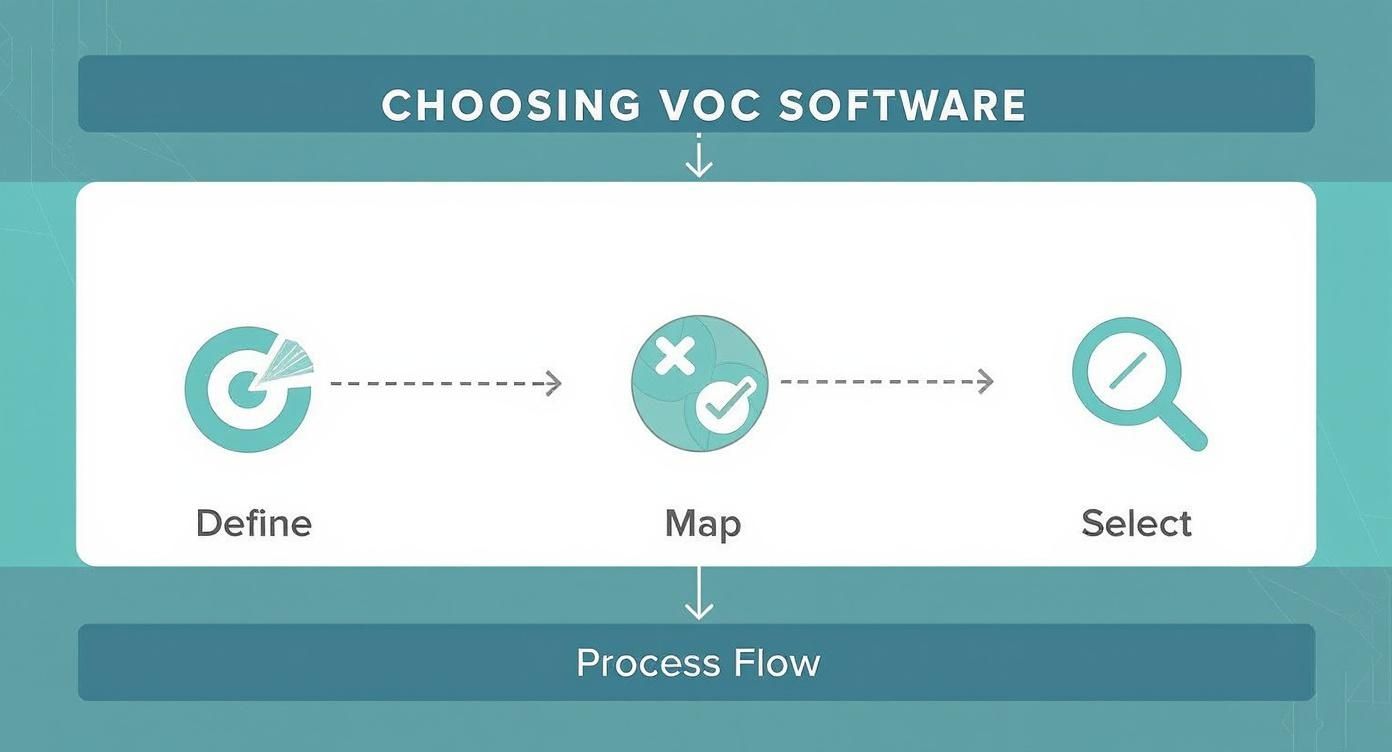
It boils the whole process down to defining goals, mapping needs, and then picking the right tool. Simple, structured, and stress-free.
Create Your Vendor Shortlist
Right, now you’re ready to actually look at some vendors. Armed with your objectives and a list of what your team needs, you can slice through the options and quickly filter out the ones that just aren’t a fit. Aim for a shortlist of three to five promising candidates.
When you book those demos, go in with a checklist. Don’t let the sales pitch run the show—you’re in the driver’s seat, making sure the software ticks your boxes.
Your evaluation checklist should cover:
- Ease of Implementation: How much heavy lifting is needed from your tech team to get this thing running?
- Core Integrations: Does it play nicely with your helpdesk, CRM, and product management tools?
- Data Security: How is customer data stored and protected? This is non-negotiable, especially with regional privacy laws.
- Scalability and Pricing: Will the tool and its price tag grow with you, or will it break the bank in a year?
- Support and Training: What kind of help is on offer to make sure your team actually succeeds with the tool?
Stick to this structured approach, and you’ll confidently pick a tool that empowers your team to turn customer feedback into your most valuable asset for growth.
Building Your First VoC Program Roadmap
Turning your big VoC strategy into an actual, working program can feel like a massive undertaking. But here’s the secret: you don’t need a huge organisational shake-up to get started. A simple, phased roadmap is all it takes to turn this powerful concept into a manageable project.
The trick is to start small. Nail a few early wins, build some momentum, and then expand.
Think of it like building a bridge. You don’t just string it all up at once. You start with the foundational pillars, connect them, and then lay the road. Your VoC program works the same way—you begin with the essentials and build out from there.
This first phase is all about getting your core feedback channels up and running. Don’t try to boil the ocean. Just pick one or two high-impact sources to start, like an in-app survey or a simple feedback widget. At the same time, set up the crucial integrations with your helpdesk or product tools so the feedback actually flows where it needs to go.
Establishing a Closed-Loop System
Once feedback starts trickling in, your next move is to create a closed-loop feedback system. This is just a fancy way of saying you have a formal process to analyse insights and get back to customers to let them know you’re listening. It’s the single most powerful way to show people their voice actually matters.
This process breaks down into a few key stages:
- Acknowledge: A quick, automated “got it!” message goes a long way.
- Route: Send the feedback to the right team. Bug report? That goes to engineering. Feature idea? Over to product.
- Act: The team looks at the feedback and decides what to do with it.
- Follow-up: This is the magic step. Circle back with the customer and tell them what happened. Even if the answer is “we aren’t building this right now,” closing the loop builds incredible trust.
This approach turns feedback from a one-way shout into the void into a genuine conversation. That’s how you build serious customer loyalty.
Defining Your Key Success Metrics
To prove your new program is worth the effort, you have to measure its impact from day one. Your success metrics should tie directly back to the business goals you set earlier. No vanity metrics allowed—focus on numbers that show a real return.
A VoC program without clear metrics is just a collection of opinions. Tying feedback directly to business outcomes is what elevates it from a ‘nice-to-have’ to an essential growth engine.
Start by tracking changes in core customer health scores like Customer Satisfaction (CSAT) or Net Promoter Score (NPS). You could also measure something more direct, like the number of product updates or bug fixes that came straight from user feedback. Down the line, you can connect these efforts to bigger goals, like a drop in customer churn.
The growth in this space shows just how important this is. In Malaysia, the contact centre software market, which is packed with voice of the customer software, is expected to jump from USD 368 million in 2024 to a staggering USD 4.29 billion by 2033. This explosion is driven by tools that streamline customer interactions and pull all that communication into one place. It’s clear that companies in the region are investing heavily in listening to their customers. You can read the full research on the Malaysian contact centre market to see the trends for yourself.
By following a clear roadmap, you can build a program that doesn’t just collect opinions—it delivers real, measurable results.
Got Questions About VoC Software? We’ve Got Answers
So, you’re looking into Voice of the Customer software and, naturally, a few questions are bubbling up. It’s a smart move to dig into the details—it helps you figure out what this tech can really do for your team and sets the right expectations from day one. Let’s tackle some of the most common queries we hear.
A lot of teams ask how this is any different from the survey tools they’re already using. It’s a great question, and the distinction is pretty important.
VoC Software vs. Regular Survey Tools
Think of your standard survey tool as a camera. It’s brilliant for taking a snapshot of what a customer thinks at a specific moment in time. But voice of the customer software is more like a 24/7 security camera system for your entire customer experience. It’s not just about one-off questionnaires.
A proper VoC platform pulls in feedback from all over the place—surveys, yes, but also support tickets, social media mentions, and App Store reviews. It then uses AI to sift through all that messy, unstructured data to spot sentiment and find out what people are really talking about.
The result? You get a continuous, holistic view of the entire customer journey, not just isolated glimpses from a single campaign. You see the whole picture.
How Much Does This Software Cost?
The price can vary wildly, which often catches people by surprise. You’ll find simple tools with low monthly fees right next to massive enterprise platforms that are a serious investment.
Usually, the price tag comes down to a few things:
- The feature set: The more advanced the analytics and automation, the higher the cost.
- User seats: How many people on your team need to log in?
- Feedback volume: How much data will the software need to crunch through each month?
The trick is to weigh the cost against what you stand to gain. A good VoC tool should pay for itself by helping you stop customers from leaving or pointing you toward smarter product updates. Most modern platforms offer tiered plans that grow with you. And hey, once you’ve identified common questions through your VoC program, you can streamline your support with dedicated FAQ management solutions to keep everyone happy.
How Long Until We See Results?
You can actually find some “quick wins” within the first couple of weeks. This often happens when you analyse feedback you already have, like from your helpdesk or online reviews. These early insights can shine a light on nagging issues you can fix right away.
But the bigger, more strategic payoffs—like a measurable drop in churn or a real jump in customer loyalty—tend to show up over three to six months. A successful VoC program isn’t a one-and-done project; it’s a constant cycle of listening, acting, and measuring. Stick with it, and that’s where you’ll unlock its true value.
Ready to turn customer feedback into your biggest growth driver? HappyPanda makes it simple to collect, analyse, and act on insights with our lightweight, integration-first platform. Start listening to your customers today.