
Are you building features that nobody seems to use? It happens. The Value Proposition Canvas isn’t just some business school diagram; it’s a practical, hands-on tool to make sure you’re building something customers will actually pay for.
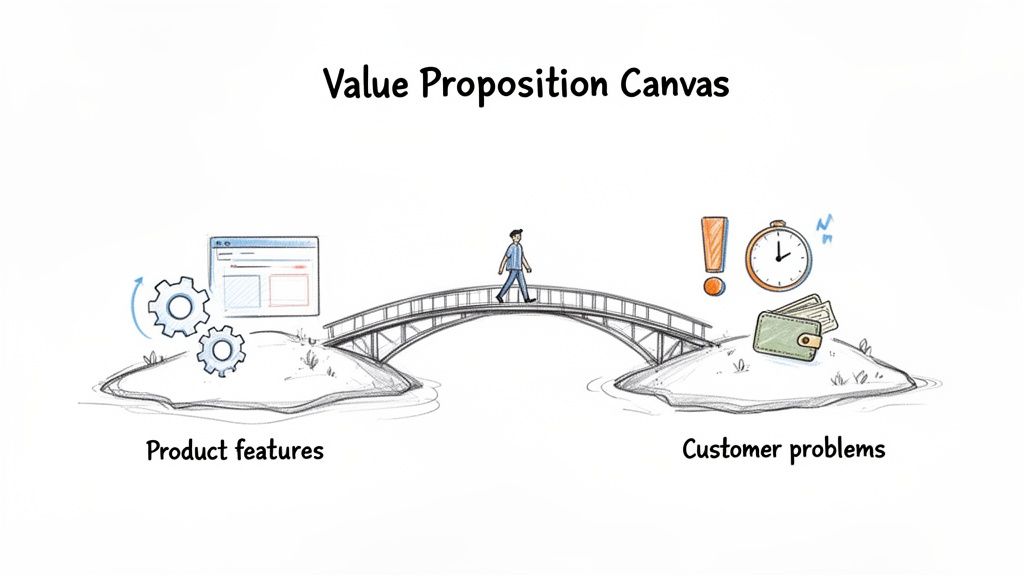
Think of it as the strategic bridge connecting what your product does with the real-world problems your customers have.
Why Your SaaS Needs a Value Proposition Canvas
When you’re a bootstrapped founder, building a SaaS product is a high-stakes game. Every line of code, every marketing pound, and every hour you pour into it has to solve a problem someone is willing to open their wallet for.
This is where so many founders stumble. It’s easy to fall in love with your own solution before you’ve truly understood the problem from the customer’s perspective.
The Value Proposition Canvas forces you to step outside your own bubble and into your customer’s world. It’s a systematic way to de-risk your development, ensuring there’s a rock-solid connection between what you’re building and what your audience desperately needs. It’s the difference between launching to the sound of crickets and launching a product that feels indispensable from day one.
It’s More Than Just a Unique Selling Point
A strong value proposition is definitely related to having a great unique selling point, but the canvas is what gives it teeth. It’s the “why” behind your marketing message.
Instead of just claiming your product is “easy to use,” the canvas pushes you to define exactly which customer pain that ease-of-use actually solves.
- Does it cut down the frustration of a complicated onboarding process?
- Does it get rid of the need for a dedicated IT person to manage things?
- Does it save a team 10 hours a month in training time?
Getting this specific transforms vague marketing fluff into compelling, evidence-based statements that really hit home. It’s the foundation for crafting a message that resonates because it’s built on a genuine understanding of your customer’s jobs, pains, and desired gains.
A classic trap for SaaS founders is building a vitamin instead of a painkiller. The Value Proposition Canvas is your diagnostic tool to make sure you’re creating a must-have solution, not just another nice-to-have feature.
A Practical Tool for Bootstrapped Founders
For indie hackers and small teams, this canvas is a total game-changer. You don’t have the luxury of big research budgets or massive user testing teams, so you need a framework that’s both efficient and effective.
It helps you prioritise your precious development resources, focusing them on the features that will actually move the needle on customer satisfaction and retention. This isn’t about writing a fifty-page business plan; it’s about a simple, visual tool that aligns your product roadmap with what the market truly wants.
Using the value proposition canvas gives you the confidence to invest your time and money into building a product people will not only use but actively champion.
Mapping Your Customer’s World with the Customer Profile
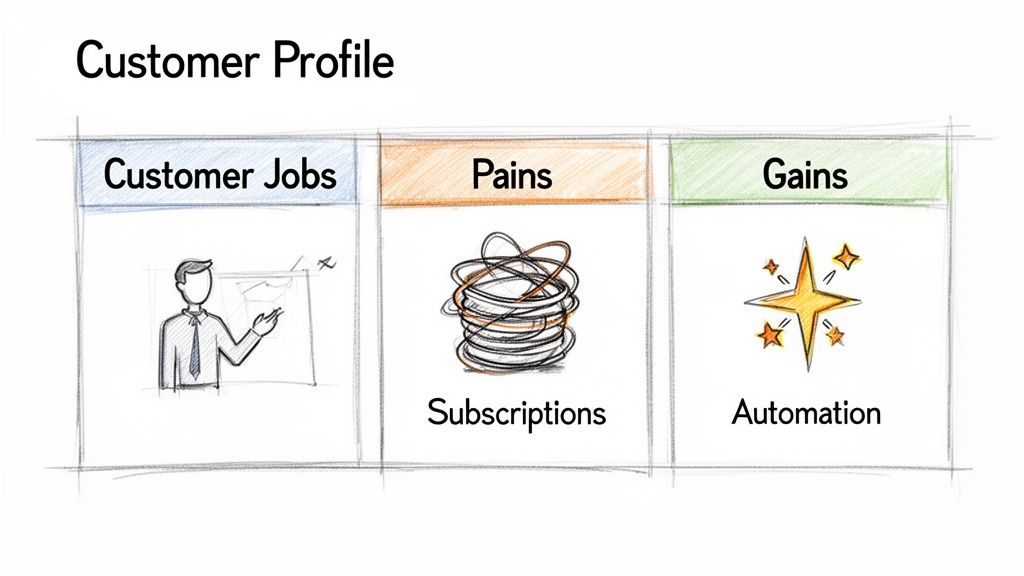
Before you can build a product people genuinely love, you first have to become an expert on their world. The right side of the value proposition canvas, the Customer Profile, is your treasure map for this journey. It’s where you finally step out of your own shoes as a founder and get inside the head of the person you’re trying to help.
This isn’t about slapping together another generic buyer persona filled with demographic fluff. This is about decoding the real, messy, human forces that drive your customer’s behaviour. You’re going to dissect their goals, their frustrations, and what a genuine “win” looks like for them. Get this right, and you’ll have the raw material for a product they can’t imagine living without.
Uncovering Customer Jobs
First up, let’s figure out your customer’s Jobs. These are simply the tasks they’re trying to get done in their work or personal life. But—and this is a big but—you have to think beyond the obvious. A “job” is almost never just about “sending an email” or “creating a report.”
You’ve got to dig deeper. Every customer is juggling three types of jobs:
- Functional Jobs: These are the practical, get-it-done tasks. For a micro-SaaS founder, this could be “track monthly recurring revenue” or “resolve a customer support ticket.” Simple enough.
- Social Jobs: This is all about perception. How do they want to be seen by others? That same founder might want to “look competent in front of investors” or “build a reputation as a reliable developer.”
- Emotional Jobs: This layer is about feelings. What state of mind are they chasing? It could be “feeling secure about the business’s cash flow” or just getting some “peace of mind knowing their customers are happy.”
So many founders get stuck on the functional stuff and completely miss the social and emotional gold. A founder isn’t just managing subscriptions; they’re trying to avoid the stomach-churning anxiety of a sudden churn spike. Digging into these deeper motivations is everything, and you can learn more in our guide on customer needs identification.
Pinpointing Customer Pains
Once you have a handle on their jobs, it’s time to zero in on the Pains. These are all the obstacles, risks, and negative feelings your customer runs into before, during, or after trying to get a job done. Think of them as the friction points that make their life just a little bit harder.
Don’t settle for vague descriptions like “it’s too expensive.” Get specific. For a bootstrapped founder, the pain isn’t just the cost; it’s the sheer frustration of “managing five different software subscriptions” that bleed their bank account with a $400/month bill. Now that’s a pain point.
Another one might be the “fear of a complex data migration” when switching tools, which feels completely overwhelming when you’re a one-person show. Or how about “worrying about missing a critical support email overnight”? That’s a pain that keeps people up at night.
Key Takeaway: Your customers aren’t just buying features; they are buying their way out of pain. The more specific and visceral the pain you identify, the more powerful your solution will feel.
Identifying Desired Gains
Finally, let’s look at the flip side: the Gains. These are the outcomes and benefits your customers are hoping for. It’s a subtle but crucial point—gains aren’t just the opposite of pains. Relieving pain is great, but creating genuine gains is how you achieve true customer delight.
Gains fall into a few different buckets:
- Required Gains: The absolute, non-negotiable basics. If you sell an email tool, it must send emails. Table stakes.
- Expected Gains: What customers anticipate, even if it’s not strictly necessary. They probably expect that email tool to have a clean, modern interface.
- Desired Gains: This is the stuff they’d love to have if they could voice it. Something like, “seamlessly integrating with my payment processor” to automatically trigger a welcome email sequence.
- Unexpected Gains: These are the delightful surprises that blow past expectations. Imagine an AI feature that not only suggests email copy but also “automates a tedious weekly performance report,” saving the founder hours of mind-numbing work.
By meticulously mapping out these jobs, pains, and gains, you create a rich, empathetic portrait of your customer. Let’s pull this together with a practical example.
Here’s a quick breakdown for a fictional micro-SaaS founder. This is exactly how you’d start filling out the customer side of your own canvas.
| Component | Description | Example for a Micro-SaaS Founder |
|---|---|---|
| Functional Jobs | The core tasks they need to accomplish. | Manage subscriptions, process payments, answer support tickets, track MRR. |
| Social Jobs | How they want to be perceived by others. | Appear professional to customers, look knowledgeable to peers, build a strong personal brand. |
| Emotional Jobs | The feelings they are trying to achieve. | Feel in control of the business, reduce anxiety about churn, gain peace of mind. |
| Pains | Frustrations and obstacles they face. | Juggling multiple tools, high monthly software costs, fear of losing data, time wasted on manual admin tasks. |
| Gains | The desired benefits and outcomes. | A single source of truth for all customer data, predictable monthly costs, automated workflows, feeling proud of their product. |
This profile isn’t a static document you create once and forget. It’s a living guide that should inform every single decision you make as you start designing the other half of the canvas—your value proposition.
Right, you’ve spent enough time playing detective and mapping out your customer’s world. Now it’s time to switch hats. Put on your engineer’s cap, because we’re about to design the solution that fits perfectly into that world.
This is where we slide over to the left side of the Value Proposition Canvas: the Value Map. Think of it as the blueprint for your product. If the Customer Profile was all about the “why,” the Value Map is your definitive “what” and “how.”
This side is organised into three interconnected parts. Nail these, and you’ll be building a product that doesn’t just have cool features, but features that customers actually need and will happily pay for.
Your Products and Services
Let’s start with the easy bit. This is a straightforward inventory of everything you offer or plan to build. Don’t overthink it—just get it all down.
For a tool like HappyPanda, the list would be pretty concrete:
- In-app NPS and CSAT survey widgets
- Automated email sequences for onboarding
- An interactive product changelog
- A “Wall of Love” for collected testimonials
- An automation engine to connect triggers and actions
This list is your toolkit. It’s what you have at your disposal to solve problems. The real magic happens when you start connecting these tools to the specific pains and gains you’ve already uncovered.
Crafting Powerful Pain Relievers
Next up, the Pain Relievers. This is where your features stop being just features and start becoming solutions. Your job here is to spell out exactly how your products and services solve the specific customer pains you found earlier.
Generic claims won’t cut it. “Saves time” is weak. “A single dashboard that replaces three separate tools”—now that’s a powerful pain reliever. It directly targets the frustration of a messy, expensive software stack.
Let’s go back to our micro-SaaS founder persona and their pains:
- Pain: The gut-punch of a $400/month bill from juggling multiple subscriptions.
- Pain Reliever: A single, affordable subscription that rolls five tools into one predictable monthly cost.
- Pain: The dread of a complex data migration and hours of setup.
- Pain Reliever: A simple script tag installation that gets you up and running in under 10 minutes.
- Pain: Wasting precious hours on manual, soul-crushing admin tasks.
- Pain Reliever: An automation engine that lets you create “if-then” rules, like “If an NPS score is 9 or 10, then automatically send a testimonial request.”
Each pain reliever should be a direct counter-attack on a specific customer frustration. The more precisely you can neutralise a pain, the more essential your product becomes. This kind of focused problem-solving is a key principle in frameworks like the Double Diamond design process, which is all about solving the right problem before you even start building.
This one-to-one mapping is a brilliant gut check. If you have a feature that you can’t link to a real pain, you need to ask yourself if it’s truly worth the effort.
Engineering Delightful Gain Creators
Finally, we have the Gain Creators. This is where you go beyond just fixing problems and start creating moments of pure delight. Gain creators show how your product delivers the outcomes and benefits your customers are secretly hoping for—and maybe even a few they hadn’t thought of.
While pain relievers are about subtraction (removing negatives), gain creators are all about addition (adding positives). They’re tied directly to the functional, social, and emotional gains you mapped out earlier.
Let’s look at some examples for our SaaS founder:
- Gain: Wants to “look professional and organised to customers.”
- Gain Creator: A sleek, customisable “What’s New” changelog widget that builds trust and shows customers you’re constantly improving.
- Gain: Wants to “feel in control and confident about their business.”
- Gain Creator: A central dashboard with real-time customer satisfaction analytics, giving them an instant pulse check on user sentiment.
- Gain: Hopes to “automate tedious weekly reporting.”
- Gain Creator: An AI-powered feature that whips up client-ready reports in seconds, turning an hour of work into a single click.
A truly great gain creator often delivers an unexpected perk that makes the customer feel smart and ahead of the game. It’s the feature they can’t wait to show a colleague. By carefully designing these elements, you complete your side of the canvas, creating a crystal-clear picture of the value your product is built to deliver.
Finding Your Fit Between Problem and Solution
Alright, you’ve done the hard work of mapping both sides of the value proposition canvas. On one side, you have a rich, empathetic portrait of your customer’s world—their jobs, their frustrations, and what they hope to achieve. On the other, you have the blueprint for your product, detailing its features and how they promise to make life better.
Now for the moment of truth. This is where you connect the dots and find your “fit”—that magical alignment between what your customer desperately needs and what your product brilliantly delivers. It’s the step that turns your canvas from a neat diagram into a powerful, strategic tool for building a SaaS business that actually lasts.
The whole process boils down to one brutally honest question: does your value map really solve the problems and create the gains you identified in your customer profile?
The Two Crucial Stages of Fit
Achieving fit isn’t a one-and-done deal; it’s a journey with two major milestones. Getting this wrong is a classic founder mistake, often leading to scaling a product before it’s ready—a costly error for any bootstrapped venture.
First up is problem-solution fit. This is when you have solid evidence that your customers genuinely care about the jobs, pains, and gains you’ve listed. Think of it as the “on paper” validation. It confirms you’re targeting a real need and that your proposed pain relievers and gain creators would actually mean something to them.
This stage is all about qualitative feedback. It’s that head-nodding agreement you get during customer interviews when they say, “Yes, that’s exactly my problem!”
Next, you’ve got to hit product-market fit. This is a much higher bar to clear. It’s when you have hard evidence—cold, hard data—that your actual product is creating tangible value for customers, and that they’re willing to pay for it. This isn’t just about people liking your idea; it’s about them using your product, sticking around, and telling their friends about it.
Hitting this second stage is the holy grail for any SaaS founder and the ultimate proof that your value proposition canvas was on the money.
A Real-World Example with HappyPanda
Let’s make this less abstract by mapping the fit for HappyPanda, our all-in-one customer communication platform for indie hackers.
The real power of the canvas comes alive when you can draw direct lines from one side to the other. You can literally see that for every significant customer pain, there’s a matching pain reliever, and for every desired gain, there’s a gain creator. This diagram breaks down how the “value map” side of the equation works.
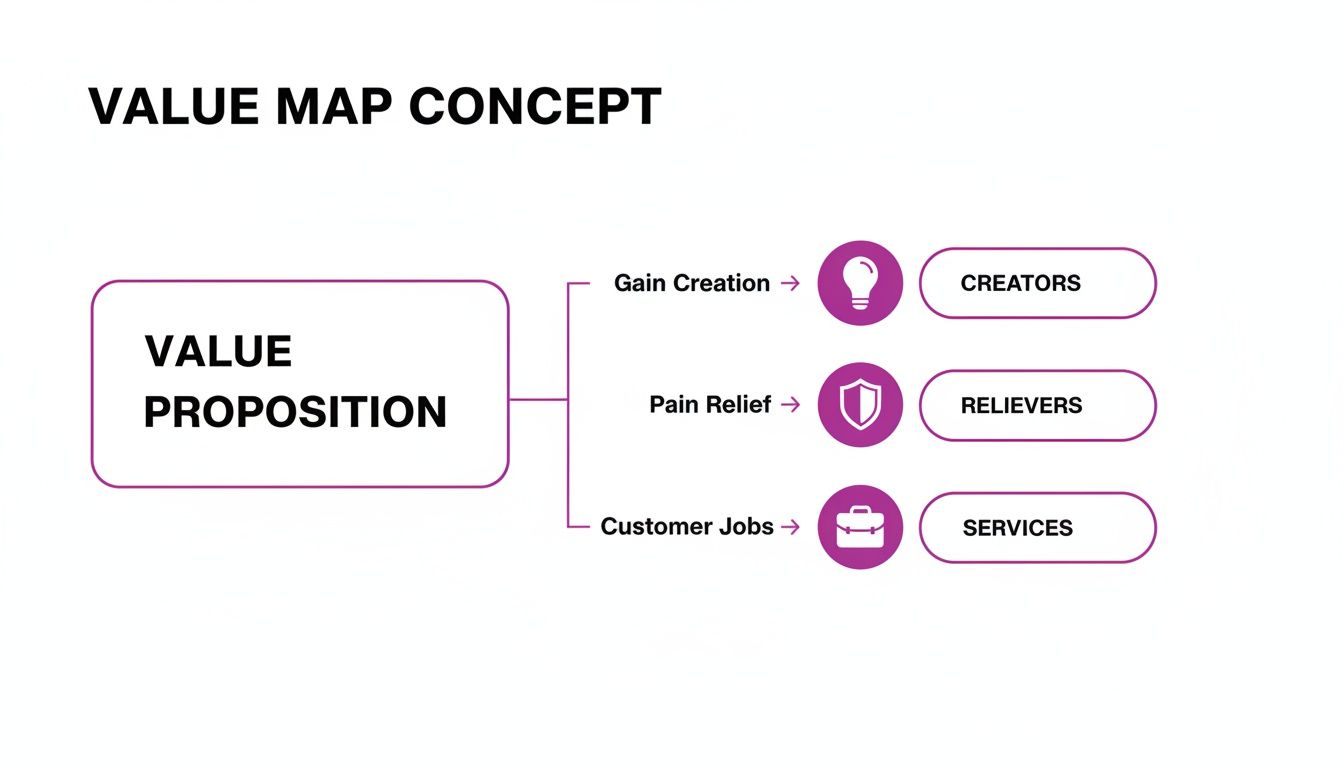
As the visual shows, it’s all about engineering your services into specific relievers and creators that directly tackle what your customers are going through.
In Southeast Asia’s buzzing startup scene, the Value Proposition Canvas (VPC) has become a go-to tool for bootstrapped SaaS founders. It helps them precisely align customer needs with tailored solutions. Since 2019, the region has seen nominal GDP growth averaging 6% annually, and a market-cap-weighted Total Shareholder Return (TSR) hitting an impressive 12%. But here’s the catch: the median TSR was just 4%, showing that value creation isn’t evenly spread. This gap is exactly why tools like the VPC are so vital for indie hackers—they ensure your product creates real, monetisable value. You can dive deeper into these trends in the Asia-Pacific Value Creators Collection.
To show you what a strong fit looks like, we’ve mapped some of HappyPanda’s core features directly to the needs of a typical indie hacker.
HappyPanda Value Proposition Canvas Example
This table breaks down that direct connection, showing how each part of the customer’s reality is met by a specific aspect of the product.
| Customer Profile (Jobs, Pains, Gains) | Value Map (Pain Relievers, Gain Creators) | Achieving Fit |
|---|---|---|
| Pain: A fragmented $300-500/month communication stack is bleeding my bootstrapped budget dry. | Pain Reliever: A single, all-in-one subscription at a predictable, affordable price (starting at $29/mo). | The value map directly neutralises a major financial pain, creating an immediate and compelling reason to switch. This is a strong fit. |
| Gain: I want an effortless setup process so I can focus on building my product, not integrating tools. | Gain Creator: A 10-minute installation with a single script tag and pre-built “Recipes” for common SaaS needs. | The gain creator delivers on the desired outcome of speed and simplicity, making the product highly attractive to time-poor founders. This is a clear fit. |
| Pain: I fear missing a critical support ticket or negative feedback while I’m focused on development. | Pain Reliever: A unified dashboard for all customer feedback (NPS, CSAT) and communication channels. | This feature directly alleviates a key anxiety, providing the emotional gain of “peace of mind.” Another strong fit. |
This side-by-side analysis moves you beyond just guessing and gives you concrete evidence of fit. Every connection you can make strengthens the business case for your product.
A common pitfall is falling in love with a clever feature that doesn’t actually relieve a significant pain or create a desired gain. The value proposition canvas forces you to be brutally honest: if a feature doesn’t have a clear line connecting it to the customer profile, it’s a candidate for the chopping block.
Ultimately, this mapping exercise becomes your strategic compass. It guides your product roadmap, sharpens your marketing message, and gives you the confidence to put your limited resources where they’ll make the biggest impact. It ensures you’re not just building features, but crafting genuine value that people will actually pay for.
Turning Your Canvas into an Actionable Growth Plan
So, you’ve finished your Value Proposition Canvas. It looks great, all filled out with neat sticky notes and sharp insights. But here’s the thing: a completed canvas isn’t the finish line. It’s the starting pistol.
The real magic happens when you stop treating it as a static document and start using it as a dynamic engine for growth. This is where you roll up your sleeves and turn all those well-researched assumptions into tangible actions that actually move the needle.
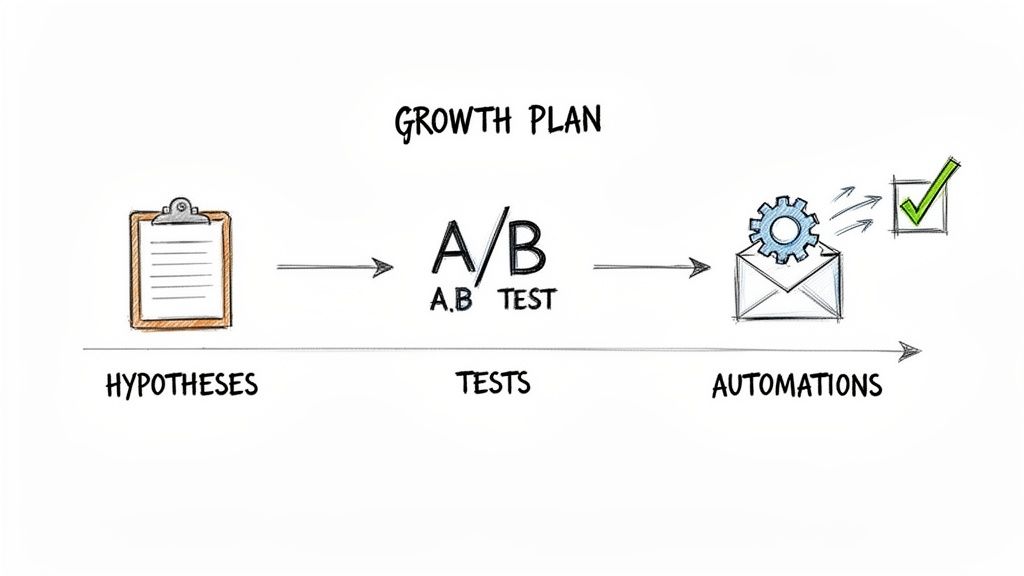
Think of it this way: your canvas is really just a series of educated guesses about your customers and your product. Your next job is to systematically prove (or disprove) them. Every pain, gain, and job-to-be-done is a question begging for an answer, and the best answers come directly from your users.
From Hypotheses to Live Experiments
Let’s get practical and break down how to put your canvas to work. Instead of getting stuck in endless internal debates, you can get definitive feedback by running small, targeted experiments right inside your product. Your app becomes a living laboratory for continuous improvement.
For example, let’s take a core assumption about a customer ‘Pain’. You believe users get frustrated by how long it takes to set up their accounts. That’s your hypothesis.
To test it, you don’t need a massive feature overhaul. You can use a tool like HappyPanda to launch a simple, in-app survey that pops up right after their first key setup action. It could ask a single question: “On a scale of 1-5, how easy was it to get started today?” This gives you immediate, quantitative data to confirm or bust your assumption.
Validating Your Gain Creators
Now, what about your ‘Gain Creators’? Let’s say you’ve built a slick, AI-powered report generator that you believe will deliver a “wow” moment for users. The big question is, do they actually find it valuable?
A brilliant way to test this is with an onboarding checklist. Using HappyPanda, you can create a simple checklist for new users where one of the key items is “Generate Your First AI Report.” From there, you just track the completion rate.
- High completion rate? Boom. That’s a strong signal your gain creator is hitting the mark.
- Low completion rate? This tells you there’s a disconnect. Maybe the feature is hard to find, its benefit isn’t clear, or it’s just not as compelling as you thought.
This approach gives you concrete behavioural data, which is way more reliable than just asking people what they think. It shows you what they do.
Your value proposition shouldn’t live in a slide deck. It should be a living, breathing part of your product development cycle. Every assumption on your canvas is an opportunity to learn directly from your users through small, low-risk experiments.
Operationalising Insights with Automation
Once you start validating your assumptions, the next move is to build automated loops that reinforce your value proposition. This is where you can connect a confirmed customer ‘Gain’ directly to a business goal, like drumming up some social proof.
Imagine your canvas identified a key gain for customers as “feeling confident in their purchase decision.” A high Net Promoter Score (NPS) is a great indicator that you’re delivering on this. Using a simple automation rule in HappyPanda, you can put this insight to work:
- Trigger: A user submits an NPS score of 9 or 10.
- Action: Automatically send a follow-up email asking if they’d be willing to leave a testimonial.
This simple workflow turns a moment of customer delight into a powerful marketing asset. You’ve just closed the loop, connecting the value you create directly to a tangible outcome that fuels more growth.
A clear value proposition is also the bedrock of any successful content strategy. To make sure your message hits home and drives engagement, it’s worth exploring effective content planning strategies for growth that translate these customer insights into compelling content.
By testing pains, validating gains, and automating feedback, your Value Proposition Canvas becomes so much more than a document. It transforms into a strategic roadmap that guides your product, sharpens your marketing, and helps you build a stronger, truly customer-centric business.
Your Top Questions About the Value Proposition Canvas, Answered
Every great framework comes with a few head-scratchers. As you start digging into the value proposition canvas, you’ll probably run into some common questions. Let’s clear up the most frequent hurdles so you can get back to building something people love.
How Detailed Should I Get?
This is a big one. It’s so easy to either stay too high-level (“increase efficiency”) or get completely bogged down in the weeds, listing every single feature. The sweet spot is being specific but concise.
Think of it this way: instead of a vague pain like “bad reporting,” get to the root of it. “Wasting 3 hours every Monday morning manually compiling a sales report” is something your team can actually solve. Then, for the pain reliever, don’t just write “reporting feature.” That tells us nothing. Try this instead: “Automated weekly sales report emailed straight to your inbox.” See the difference? It’s concrete enough for anyone, even someone outside your company, to immediately grasp the value.
What if I Have a Few Different Customer Types?
Trying to cram multiple customer segments onto a single canvas is a classic mistake. It’s a surefire recipe for a muddled, confusing, and ultimately useless document. If you’re selling to both freelance designers and massive marketing agencies, you can bet their jobs, pains, and gains are worlds apart.
Pro Tip: Create a separate and distinct Value Proposition Canvas for each major customer segment. It forces you to get laser-focused and tailor your value map to their specific world, which leads to much sharper messaging and product decisions.
This clarity is everything. A gain creator for a freelancer (like super affordable pricing) might be totally irrelevant to an agency that cares more about advanced team collaboration features. Don’t try to be everything to everyone on one sheet of paper.
How Often Should I Update This Thing?
Your Value Proposition Canvas isn’t a “set it and forget it” artefact to be framed on the wall. Think of it as a living, breathing tool—a compass, not a snapshot. It should evolve as your business grows and your understanding of the market deepens.
As a general rule of thumb, it’s a good idea to pull it out and review it:
- Quarterly: Make it part of your regular strategic check-in.
- Before a major feature launch: Gut-check that what you’re building still solves a real, painful problem for your customers.
- When you notice a shift in the market: A new competitor pops up, or you spot a change in user behaviour.
Keeping your canvas current ensures it stays a reliable guide for your product roadmap and marketing. It’s less of a one-time declaration and more of an ongoing conversation with your market, helping you consistently deliver what they actually value.
Ready to turn those value proposition insights into action? HappyPanda gives you the tools to test your assumptions with in-app surveys, validate gains with onboarding checklists, and automate feedback collection—all in one place. Start your free 14-day trial and build a product your customers can’t live without.