
A unique selling point (USP) is the simple, powerful reason your ideal customer should pick your product over everyone else’s. It’s not just about a cool feature; it’s the core promise that makes you the only logical choice to solve their specific problem. For bootstrapped SaaS founders, a strong USP isn’t a “nice-to-have”—it’s a survival tool.
What Is a Unique Selling Point and Why It Matters for Founders
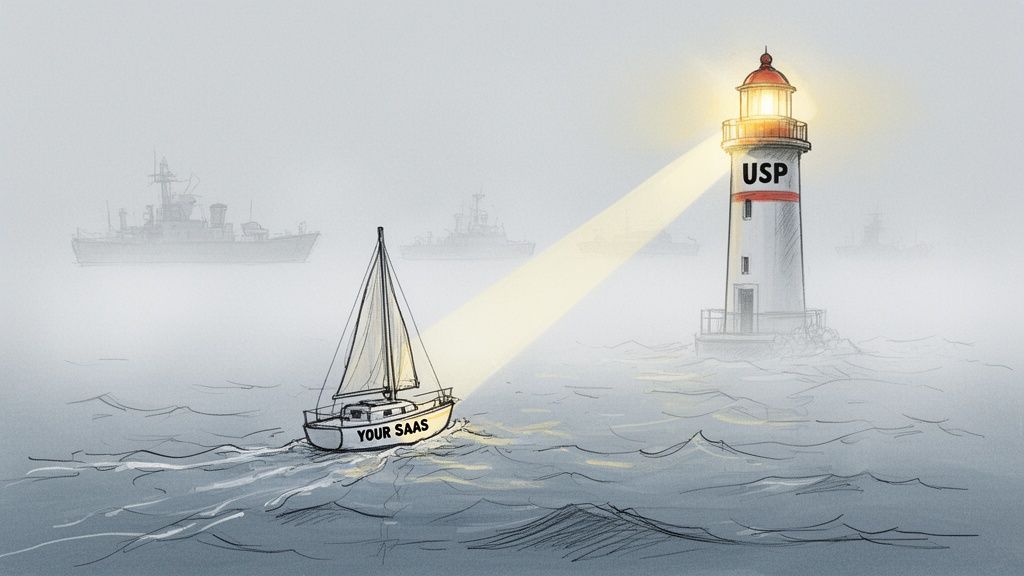
Think of your SaaS as a ship navigating a vast, foggy ocean teeming with competitors. A powerful USP is the lighthouse that cuts through all that noise, guiding your perfect customers straight to your shore. It answers the one question every potential user is asking: “With all these options, why should I choose you?”
For bootstrapped founders and indie hackers, a clear USP isn’t just fluffy marketing talk—it’s the bedrock of a sustainable business. Without one, you’re forced into a price war, a battle you’ll almost certainly lose against venture-backed giants with deep pockets. Your USP acts as a strategic filter, influencing everything from the features you build to the copy you write.
The Strategic Value of a Strong USP
A solid USP brings clarity and focus, two of the most precious resources a founder has. It stops you from building features nobody asked for and blowing your budget on marketing that doesn’t land. Instead of trying to be everything to everyone, a USP empowers you to be the absolute best solution for a specific group of people.
Here’s why it’s so critical:
- It sharpens your marketing: Your USP becomes the headline for your landing pages, ads, and emails, creating a consistent and memorable message.
- It guides product decisions: When a new feature idea pops up, you can ask, “Does this actually reinforce our unique selling point?”
- It builds real brand loyalty: Customers who connect with your USP become your biggest fans because you solve their problem in a way no one else can.
- It improves the entire user journey: This clarity shapes a seamless experience from the first ad they see to the moment they sign up, forming the backbone of effective customer experience management.
This distinction is even more vital in fast-growing markets. Take Southeast Asia’s booming SaaS scene, where spending per employee is expected to jump 2.5-fold between 2020 and 2025. This digital gold rush creates huge opportunities but also fierce competition, making a standout USP non-negotiable for survival. You can learn more about Southeast Asia’s new SaaS frontier on knowledge.antom.com.
The Three Pillars of a Powerful USP
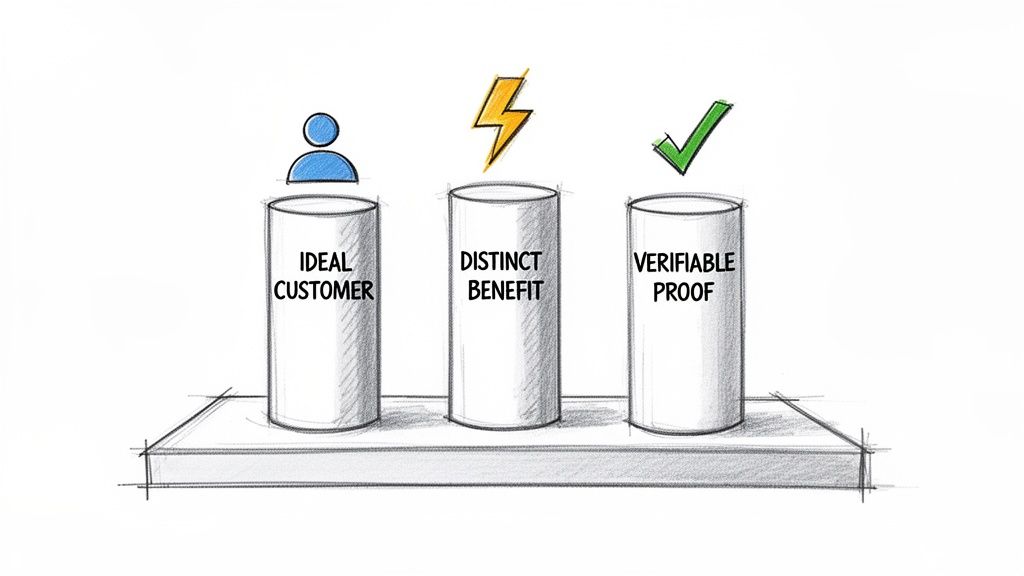
Crafting a USP that sticks isn’t some dark art reserved for marketing wizards. It’s less about a flash of genius and more about a repeatable, structured approach. A truly powerful USP is built on three core pillars that work together to send a clear, desirable, and believable message.
Think of it like building a sturdy stool. If one leg is wobbly or missing, the whole thing comes crashing down. By focusing on these three elements, you take the guesswork out of the equation and turn what feels like a creative gamble into a reliable process.
Pillar 1: Your Ideal Customer
The foundation of any great USP is an almost obsessive understanding of who you’re talking to. This goes way beyond flimsy personas like “small business owners.” A knockout USP targets a super-specific niche wrestling with a very specific problem.
You’re not aiming for everyone; you’re aiming for someone. For example, don’t just target “SaaS founders.” Get granular. Target “bootstrapped micro-SaaS founders who are juggling five different tools for customer comms and are sick of the subscription creep.” That level of focus lets you speak directly to their headaches, making them feel like you’ve read their diary. Your goal is to know their problem even better than they do.
A compelling USP isn’t just about being unique for the sake of it. It’s about being uniquely valuable to the right person by zeroing in on a need they desperately want solved.
Pillar 2: Your Distinct Benefit
Once you know exactly who you’re talking to, the next pillar is all about the tangible outcome you deliver. This isn’t the place for a laundry list of features. Nobody buys “an all-in-one platform.” They buy “launching all my customer messages in 10 minutes instead of spending 10 days wrestling with code.”
Your benefit is the clear, direct answer to the pain you identified in the first pillar. It should be a promise of transformation. Ask yourself: what incredible result does my product create that my competitors can’t easily copy?
To nail this down, ponder these questions:
- What massive frustration do we completely wipe out for our customers?
- How much time or money do we tangibly save them?
- What key goal can they finally achieve with us that was always just out of reach?
Pillar 3: Your Verifiable Proof
This is the final, crucial pillar that makes your bold promise believable. Verifiable proof is the “how” that backs up your what. It’s the specific feature, the hard data, or the social proof that builds instant trust and stops prospects from rolling their eyes.
This is where your product’s real strengths get to shine. If your benefit is lightning speed, your proof might be “our library of pre-built automation recipes.” If your benefit is saving cash, your proof could be “replaces five separate tools, saving you over £300/month.” This pillar connects your flashy marketing promise to your product’s reality, convincing even the most sceptical person that you can actually walk the walk.
To help you put this all together, here’s a quick breakdown of how these three pillars work in tandem.
USP Pillar Breakdown
| Pillar | Core Question | Example for SaaS |
|---|---|---|
| Ideal Customer | Who are we helping, and what’s their biggest headache? | Non-technical marketers at early-stage startups who waste hours trying to get customer data from different tools. |
| Distinct Benefit | What incredible outcome do we deliver for them? | Get a unified view of the entire customer journey in one click, without writing a single line of code. |
| Verifiable Proof | How do we actually make that happen? | Through our 50+ one-click integrations with tools like Stripe, Intercom, and Mailchimp. |
By thinking through each pillar, you build a USP that’s not just a catchy tagline but a rock-solid promise that resonates with the right people and sets you apart from the noise.
A Step-by-Step Framework for Finding Your Edge
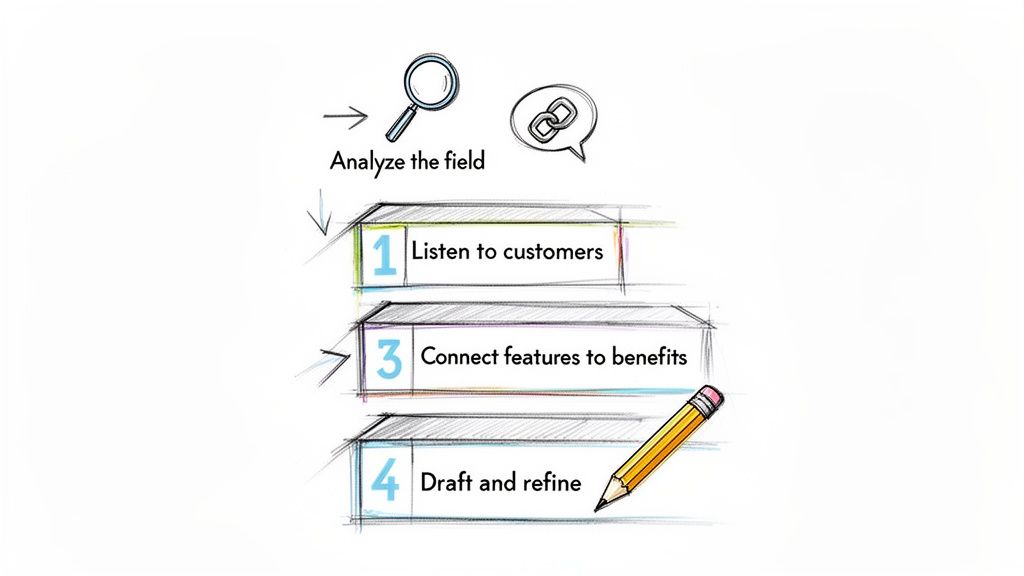
Defining your unique selling point isn’t about waiting for a lightning bolt of inspiration. It’s a structured, almost workshop-style process of digging, analysing, and refining. When you break it down into actionable steps, you can go from a fuzzy idea to a sharp, compelling message that genuinely sets you apart. This framework kills the guesswork and gives you a repeatable method to find your edge.
Think of it like being a detective. You need to gather clues from the market, listen carefully to your witnesses (your customers), connect the dots, and finally, present a clear, convincing case. Let’s walk through that investigation, one step at a time.
Step 1: Analyse the Playing Field
Before you can stand out, you need to know what you’re standing in the middle of. The first step is to map out your competitive landscape. Who are the big players? What are they all saying? Look for the common promises and the features everyone seems to have.
This isn’t just about making a list of competitors; it’s about finding the gaps. Where is the market underserved? What frustrations are being totally ignored? To really find your edge, you have to do a proper competitive analysis. Learn how to pinpoint your unique spot in the market with a solid competitive analysis framework. Nailing these gaps is your first move in carving out a space only you can own.
Step 2: Listen to Your Customers
Your customers hold all the secrets to your USP. They talk about their problems and what they want using specific, emotionally charged language. Your job is to capture it. Forget what you think their problem is and just listen to what they actually say.
Running even a few customer interviews can be a massive eye-opener. Ask open-ended questions and pay close attention to the exact words they use. This is more than just collecting feedback; it’s the bedrock of effective customer needs identification.
- “I’m drowning in subscriptions for tools that only do one thing.”
- “It took me two weeks just to get all the integrations working.”
- “I feel like I’m paying an enterprise price for a startup’s needs.”
This raw language is marketing gold. It gives you the exact phrasing that will resonate deeply with others just like them, forming the emotional core of your USP.
Step 3: Connect Features to Real-World Benefits
With a clear picture of the market and what’s bugging your customers, it’s time to look inward. List out your core features, but don’t stop there. For every single feature, you must answer the most important question: “So what?” This is how you turn product functions into tangible, real-world benefits.
A feature is what your product does. A benefit is the valuable outcome your customer gets. People don’t buy features; they buy better versions of themselves and their businesses.
This exercise forces you to get crystal clear on your value:
| Feature | So What? (Benefit) |
|---|---|
| Pre-built templates | Go live in minutes, not days, without needing a developer. |
| All-in-one platform | Replace five expensive tools and save over £300 every month. |
| AI-powered copy | Write compelling welcome emails without the guesswork. |
Step 4: Draft and Refine Your Message
Finally, it’s time to pull everything together into one concise statement. Use a simple, fill-in-the-blank template to quickly brainstorm a few different USP angles. This approach makes it easy to play around with different focal points without getting stuck.
Here’s a proven template to get you started:
For [your specific target audience], our [product name] is the only [product category] that [delivers a unique benefit] because [of your verifiable proof].
For instance, a USP for HappyPanda might look like this: “For bootstrapped SaaS founders, HappyPanda is the only customer communication platform that replaces five separate tools for one low price, because we combine email sequences, onboarding checklists, and feedback widgets into a single script.”
Draft a few different versions, slap them on your landing page, and see which one truly connects with people.
Learning From Successful Bootstrapped SaaS Companies
Frameworks and theories are great, but nothing makes a concept click quite like seeing it in the wild. By looking at how successful bootstrapped companies talk about themselves, we can reverse-engineer what makes their message land so perfectly. These founders aren’t just selling software; they’re selling a very specific solution to a very specific headache.
Let’s break down a few examples to see our three pillars—Ideal Customer, Distinct Benefit, and Verifiable Proof—working together. You’ll notice they almost never compete on features alone. Their real strength comes from a deep, almost obsessive focus on a niche audience and their unique pains.
A Masterclass in Niche Domination
Take a well-known example like ConvertKit. They didn’t bother trying to out-feature Mailchimp. Instead, they carved out a very specific space for themselves with a crystal-clear message.
- Ideal Customer: Professional creators (bloggers, authors, course creators).
- Distinct Benefit: Grow your audience and income with powerful, easy-to-use email marketing automation.
- Verifiable Proof: Through features built specifically for creators, like visual automations and tag-based segmentation.
Their USP wasn’t just “email marketing software.” It was “the email marketing hub for creators.” That message hit home with a community that felt overlooked by the bigger, more corporate-focused platforms. This sharp focus is the hallmark of a killer USP.
A great USP doesn’t try to be the best for everyone. It aims to be the only choice for a specific someone, making the buying decision feel obvious and easy for that target audience.
This is especially powerful in markets that are blowing up. For instance, the SaaS scene in Southeast Asia is on a tear, projected to hit $203B by 2025 with a whopping 25.3% CAGR. For an all-in-one platform like HappyPanda, this is a massive opportunity. Solo founders in this region often juggle a handful of tools, burning $300-500 a month on subscriptions. Suddenly, an all-in-one solution’s USP becomes incredibly compelling in this high-growth, high-cost environment. You can read more about the tale of two SaaS markets at vitex.asia.
Crafting Different USPs for HappyPanda
Alright, let’s bring this home and apply the same thinking to our own fictional SaaS, HappyPanda. Depending on which strength we want to lean into, we can shape different USPs for different kinds of bootstrapped founders. Each one tells a slightly different story.
Example 1: Focusing on Cost and Time Savings “The only all-in-one platform that saves bootstrapped founders over $300/month and weeks of setup time.”
- Pillar 1 (Customer): Budget-conscious founders drowning in subscription costs.
- Pillar 2 (Benefit): Hard, quantifiable savings in both money and time.
- Pillar 3 (Proof): By rolling five tools into one affordable platform.
Example 2: Focusing on Speed for a Niche Audience “For serial indie hackers, our platform lets you launch a complete communication stack—from onboarding to testimonials—in under 10 minutes.”
- Pillar 1 (Customer): Prolific indie hackers who value speed above everything else.
- Pillar 2 (Benefit): Unmatched launch speed for all their customer communication needs.
- Pillar 3 (Proof): Through our pre-built recipes and single-script installation.
Both of these USPs are perfectly valid, but they speak to completely different founder mindsets. The first one grabs the attention of the frugal operator, while the second one hooks the rapid experimenter. It just goes to show that your unique selling point is a strategic choice—it’s you deciding who you want your perfect customer to be.
How to Test and Validate Your Unique Selling Point
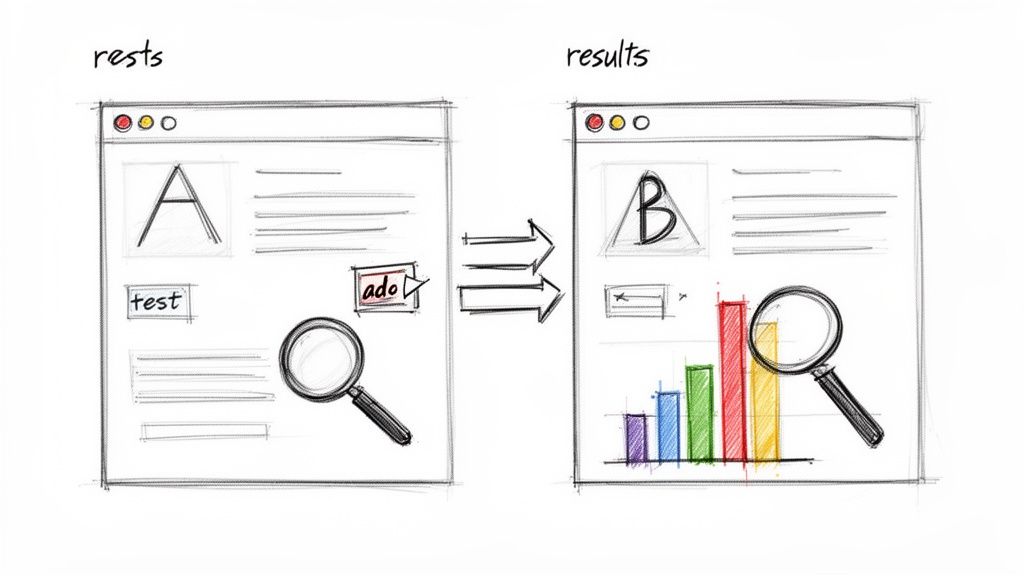
Let’s be honest, a freshly minted unique selling point is really just a well-educated guess. It’s a hypothesis—a bet on what you think your customers truly care about. But until the market weighs in, it’s all theory. The next step is getting your USP out of the lab and into the wild to see if it actually has legs.
As a bootstrapped founder, you don’t need a massive R&D budget for this. The game is all about running small, lean experiments to find the message that moves the needle—more sign-ups, lower bounce rates, and clearer sales calls. This is about letting cold, hard data, not just your gut, steer the ship until your messaging really starts to convert.
Running Low-Cost Validation Tests
Your landing page is the perfect place to start. It’s the digital front door to your product, and simple A/B tests can reveal which message truly connects with your ideal customers. You’re not looking for the headline that makes people nod thoughtfully; you’re looking for the one that makes them click.
Here are a few practical ways to get the ball rolling:
- Headline A/B Testing: Use a simple testing tool to pit two versions of your headline against each other, each built around a different USP. Let it run for a week and see which one drives a higher conversion rate.
- Small Ad Campaigns: Run two identical, small-budget ad campaigns on a platform like LinkedIn or Twitter. Keep everything the same except the ad copy, which should highlight your competing USPs. The click-through rates will tell you which message sparks the most curiosity.
- Customer Discovery Calls: On your next sales or onboarding call, drop your USP into the conversation and watch their reaction. A genuine “aha!” moment or a follow-up like, “Wait, how does it do that?” is a dead giveaway that you’re onto something powerful. To dig deeper into this, check out our guide on capturing the voice of the customer.
Interpreting the Results and Iterating
Once the results start trickling in, you need to know what you’re looking for. The right metrics will tell you if your USP is actually doing its job. Focus on user behaviours that signal genuine interest and a clear understanding of your value.
A validated USP isn’t the one you like the most; it’s the one that consistently makes your ideal customers take action. It clarifies your value so effectively that the next logical step for them is to sign up.
For example, a high-growth region like Southeast Asia presents a massive opportunity for a platform like HappyPanda. The Asia Pacific SaaS Management Platform market is projected to explode with a 30.5% CAGR. This growth is driven by founders in places like Indonesia and Thailand who are drowning in a sea of different tools. Validating a USP that promises to replace a messy tech stack and slash costs speaks directly to a huge, measurable pain point in that market.
Ultimately, testing your USP is about finding product-market fit for your messaging. This isn’t a one-and-done task; it’s a cycle of listening, testing, and tweaking until your message hits as hard as your product. To get this right, it’s worth diving into some real-world lessons on achieving product-market fit from founders who have been there and done that.
Common USP Questions I Hear from Founders
Even with a solid framework in hand, I see founders get stuck on the same few questions when trying to nail down their USP. These feel like massive roadblocks at the time, but trust me, the answers are usually much simpler than you think.
Let’s break down the three most common hurdles that pop up. Getting these sorted will help you move past the dreaded “analysis paralysis” and finally land on a message that actually connects with your ideal customers.
Can My Price Be My Unique Selling Point?
Ah, the classic question. While being the cheapest option is definitely a differentiator, it’s a treacherous path for a bootstrapped SaaS. Competing on price alone is a race to the bottom, and it attracts the kind of high-churn customers who will ditch you the second a slightly cheaper alternative pops up. It’s a tough game to win and nearly impossible to sustain without deep pockets.
Instead of just being cheap, think bigger. Frame your pricing as part of a much larger value proposition. Your USP isn’t “we’re more affordable.” It’s “we replace five expensive tools with one simple platform, saving you over $300/month.” See the difference? The real value is the consolidation, the efficiency, the headache you’re removing—the lower price is just the cherry on top.
Don’t sell “cheaper.” Sell “smarter value.” Shift the conversation from sticker price to the total cost and time saved. It turns a commodity purchase into a strategic investment for your customer.
What if My Product Isn’t Truly Unique?
Here’s a secret: very few products are 100% original, and yours doesn’t have to be. Your unique selling point often comes from a fresh combination of existing ideas, tailored specifically for your audience. Your true advantage might not be a single killer feature but your unique spin on things.
Think about what makes your approach different:
- A laser-focus on a niche: You’re the only platform built by indie hackers, for indie hackers.
- A superior user experience: Your competitors might have the same features, but yours are genuinely intuitive and a joy to use.
- An empathetic brand story: You get the bootstrapped journey because you’re living it, too.
Your features might exist elsewhere, but your USP could be that you’re the only one who bundles those specific tools into a workflow that perfectly fits a micro-SaaS founder’s reality. That’s unique enough.
How Often Should I Revisit My USP?
Your USP isn’t a tattoo; it’s a living statement that should evolve right alongside your business. It’s not meant to be set in stone. I recommend reviewing it at least once a year, or whenever something big changes. A static message in a dynamic market loses its punch pretty quickly.
Key triggers for a review include:
- Launching a major new feature that changes your core value.
- Seeing a new competitor start to gain serious traction in your niche.
- Getting customer feedback that your marketing message just isn’t landing anymore.
Your core mission might stay the same, but how you talk about your unique value has to adapt as you learn, grow, and respond to the market around you.
Stop juggling a dozen different tools and subscriptions. HappyPanda brings all your customer communications—from onboarding to testimonials—into one simple, affordable platform. Get started for free at https://happypanda.ai.