
Right, let’s talk about Customer Experience Management (CXM). Forget the stuffy corporate definitions for a moment. At its heart, CXM is about making sure every single interaction a customer has with your business feels intentional, valuable, and, well, human. For a bootstrapped SaaS, it’s not about sinking cash into fancy platforms; it’s a mindset that shapes everything from your onboarding flow to your support chats.
What Is Customer Experience Management Anyway?
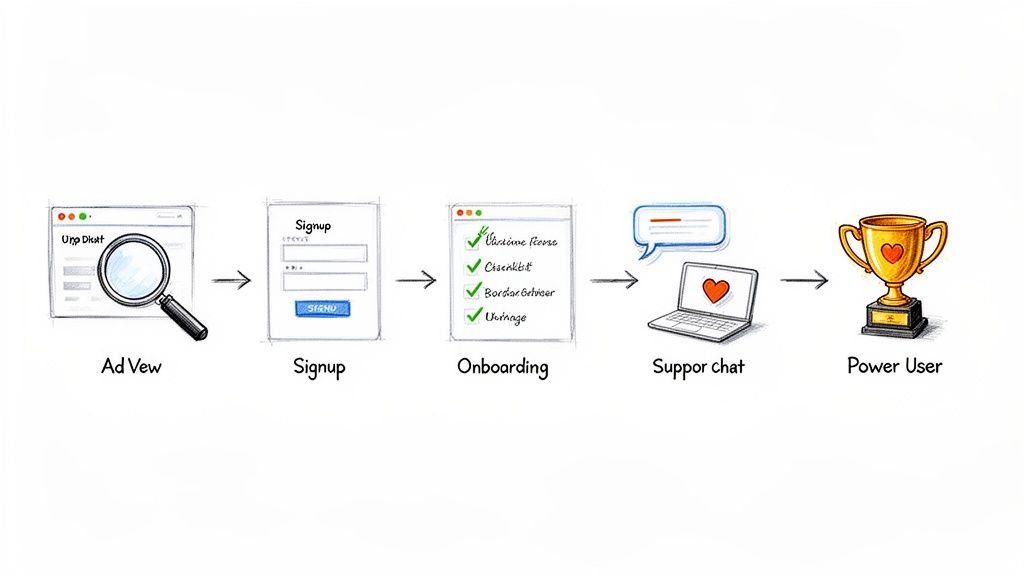
Think of CXM as directing a movie where your customer is the hero. Every touchpoint—from the first ad they see, to the sign-up form, to that late-night support query—is a scene in their story with your brand. Your job is to make sure the script is brilliant from start to finish.
This is a much bigger picture than just fixing problems. To really get it, you have to understand the difference between customer service and customer experience. Customer service is reactive; it’s one specific scene, like a support agent squashing a bug. CXM is the entire film—it’s about proactively shaping the plot so your hero wins in the end.
Why CXM Is a Superpower for Bootstrappers
When you’re a small team without a monster marketing budget, CXM becomes your secret weapon. A truly great experience is the most powerful, low-cost growth engine you can build. It’s simple, really. When users feel like you get them, they stick around longer, are more likely to upgrade, and—best of all—they tell their friends. That’s how you create a flywheel that drives real, sustainable growth.
The core idea is to make your product feel like it was built just for them. This boils down to a few key things:
- Anticipating Needs: Getting ahead of what a user wants to achieve and clearing the path for them before they even have to ask.
- Reducing Friction: Hunting down and eliminating unnecessary steps, confusing jargon, or clunky interfaces that cause frustration.
- Creating ‘Aha!’ Moments: Guiding new users to that magical moment where your product’s value just clicks. The faster, the better.
CXM is the simple practice of seeing your business through your customers’ eyes. It’s a commitment to making their journey smooth, valuable, and memorable, turning passive users into passionate advocates.
Moving Beyond Isolated Interactions
A classic mistake is getting obsessed with individual metrics in a vacuum, like how fast a single support ticket was closed. While that’s important, CXM is about connecting the dots to see the whole picture.
For instance, if you suddenly get a flood of support tickets about one specific feature, that isn’t just a support problem—it’s a CX problem. It’s a massive red flag pointing to a potential breakdown in your onboarding, UI design, or help docs.
Effective CXM means you’re always listening, learning, and adapting. You’re not just putting out fires; you’re building a system that stops them from starting in the first place. This customer-first mindset is the secret sauce that separates the SaaS companies that skyrocket from the ones that stagnate. And it proves you don’t need a huge budget to deliver an exceptional experience. You just need to be smart, empathetic, and intentional with every single interaction.
The Core Frameworks of Modern CXM
Great customer experience doesn’t just happen by accident. It’s not about guesswork or happy accidents; it’s a discipline built on solid frameworks that help you stop reacting to problems and start proactively designing a journey your customers will genuinely love. Think of these frameworks as your map and compass for navigating the entire user lifecycle.
The absolute foundation for any SaaS is Customer Journey Mapping. Imagine creating a storyboard for your user’s entire relationship with your product. Your goal is to visually map out every single interaction—every touchpoint—a customer has, from the moment they first hear about you to the day they can’t imagine working without you.
This whole process forces you to step out of your founder shoes and see your product through your customers’ eyes. By charting out key moments like signing up, getting through onboarding, or reaching out for help, you can pinpoint exactly where things get frustrating and where you have a golden opportunity to create a little bit of magic.
Mapping the Moments That Matter
A journey map isn’t just some technical flowchart; it’s an empathy-building exercise. It’s all about uncovering the emotional highs and lows a user feels at each stage. Finding these “make-or-break” moments is the very first step toward making them better.
- Discovery: How do people even find you? Is that first impression clear and compelling enough to make them stick around?
- Onboarding: Do new users hit that “aha!” moment quickly, where your product’s real value just clicks for them?
- Feature Adoption: How easily can users find and use the features that actually solve their problems?
- Support Interaction: When they hit a snag and need help, is the experience fast, painless, and human?
- Renewal/Upgrade: What makes a user decide to stick with you for the long haul?
When you visualise this path, you stop seeing your product as just a bundle of features and start seeing it for what it truly is: a complete experience.
Measuring What Truly Matters in SaaS
Once you understand the journey, you need a way to measure it. While there are a million metrics you could track, bootstrapped founders should laser-focus on three core indicators that deliver actionable insights without drowning a small team in data. Many modern CXM strategies lean heavily on data analysis, and getting a handle on data science in marketing can seriously level up your approach.
So, let’s cut through the noise. To get started, you need a quick way to compare the essential metrics at your disposal. This table breaks down the big three you’ll rely on time and time again.
Essential CXM Metrics for SaaS Founders
| Metric | What It Measures | When to Use It | Example Question |
|---|---|---|---|
| NPS | Long-term loyalty and brand advocacy. | As a periodic health check (e.g., quarterly) to gauge overall brand sentiment. | ”How likely are you to recommend us to a friend or colleague?” |
| CSAT | Short-term satisfaction with a specific interaction. | Immediately after a key event, like a support ticket being closed or a new feature being used. | ”How satisfied were you with your recent support experience?” |
| CES | The ease of an experience. How much effort did the customer have to put in? | After a customer tries to self-serve, like using your help docs or completing a task. | ”How easy was it to get the help you needed today?” |
These three metrics give you a powerful, well-rounded view without overcomplicating things. They form the backbone of a practical customer experience management system.
1. Net Promoter Score (NPS): This is your big-picture metric. It measures long-term loyalty by asking one simple question: “How likely are you to recommend our product to a friend or colleague?” on a 0-10 scale. Your score is the percentage of Promoters (9-10) minus the percentage of Detractors (0-6). Think of it as the ultimate health check for your overall customer relationship.
2. Customer Satisfaction (CSAT): This one is all about the here and now. It gives you immediate, transactional feedback right after a specific interaction, like closing a support ticket. It asks, “How satisfied were you with this interaction?” on a simple scale (like 1-5). CSAT is your real-time pulse on the quality of individual touchpoints.
3. Customer Effort Score (CES): This metric answers a crucial question: “How easy was it for your customer to get something done?” After they find an answer in your help docs, for instance, you ask, “How easy was it to resolve your issue?” A low-effort experience is a massive predictor of loyalty—in fact, 94% of customers who have a low-effort interaction will buy from that same company again.
By combining journey mapping with these key metrics, you create a powerful feedback loop. The map shows you where to look, and the scores tell you how you’re doing at each of those critical points.
Together, these frameworks give you a complete toolkit. Journey mapping provides the qualitative, story-driven context, while NPS, CSAT, and CES deliver the hard numbers you need to track progress and prove that your CXM efforts are actually paying off. For a deeper look at how these metrics play together, check out our guide on the relationship between CSAT and NPS.
The Bootstrapper’s Playbook for Implementing CXM
Knowing the frameworks is one thing. Putting them into practice is a whole different ball game, especially when you’re bootstrapping. For a founder running a lean operation, successful customer experience management isn’t about a massive budget; it’s about being relentlessly efficient.
This playbook is all about high-impact, low-effort tactics you can set up today. The goal? To build a self-running system that gathers insights and improves the user journey, pretty much on autopilot.
At the heart of it all is a simple, repeatable process: map the journey, measure what matters, and implement improvements. It’s an agile flow.
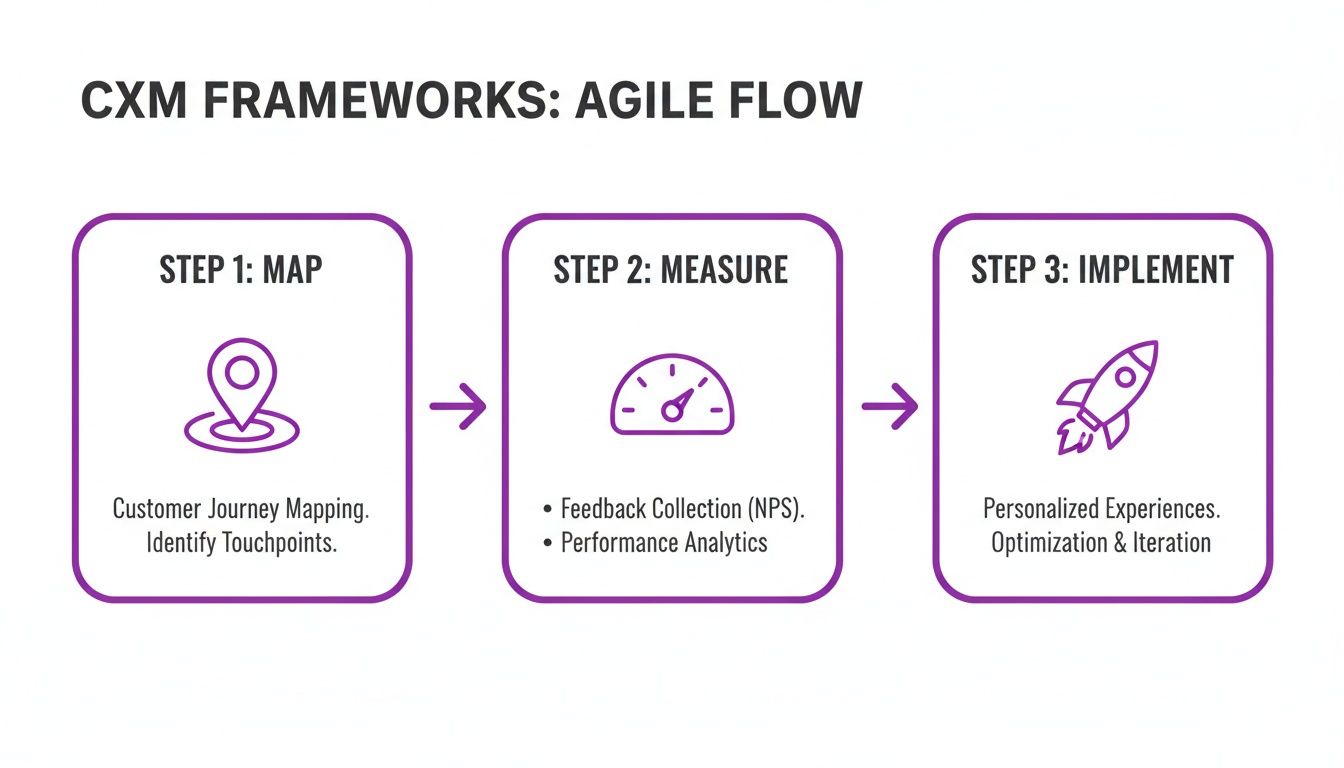
Think of this as a continuous cycle, not a one-off project. It’s how you consistently fine-tune the user experience based on what real people are telling you.
Prioritise High-Impact Automation Recipes
As a solo founder or small team, you simply can’t handle every interaction manually. And you shouldn’t have to. The idea is to automate the 80% of repetitive tasks that deliver consistent value, freeing you up for the complex 20% that needs a human touch.
The secret is to create simple “if this, then that” automation recipes that run quietly in the background. Think of them as your tireless CX assistants, working 24/7 to engage users at the perfect moment.
Here are three dead-simple recipes to get you started:
- The Onboarding Win: The moment a new user completes your onboarding checklist, send them a celebratory email. It’s a small touch that reinforces their progress and builds positive momentum right from the start.
- The Proactive Check-in: If a user hasn’t logged in for 7 days during their trial, fire off a friendly email asking if they’re stuck or need help. This can be the nudge that re-engages someone who’s drifted away.
- The Timely Feedback Request: Trigger an NPS survey exactly 14 days after a user signs up. This is often the sweet spot—they’ve had enough time to form an opinion, but the initial experience is still fresh.
These aren’t complicated workflows. They’re simple, event-based triggers that make your customer experience feel thoughtful and proactive without you lifting a finger.
Master the Art of the Feedback Loop
Collecting feedback is only half the battle. The real magic happens when you use that feedback to trigger immediate, relevant actions. This is called closing the feedback loop, and it’s a powerful way to turn raw insights into measurable results. You can find out more by learning how to close the feedback loop effectively in our detailed guide.
Your goal is to build a system that doesn’t just ask for feedback but reacts to it intelligently. This creates a powerful dynamic where customers feel heard and you gain valuable assets for your business.
Smart automation transforms customer feedback from a passive report card into an active growth engine. It’s about creating a system where positive experiences automatically generate social proof and negative experiences trigger immediate resolutions.
Let’s look at a practical example. You can set up an automation that triggers a specific action based on a user’s NPS score:
- If NPS score is 9 or 10 (Promoter): Automatically send an email asking if they’d be willing to leave a testimonial. You’re striking while the iron is hot, which dramatically increases your chances of collecting powerful social proof.
- If NPS score is 0-6 (Detractor): Automatically create a high-priority support ticket or notify a team member to reach out personally. This lets you jump on a problem quickly, resolve the user’s issue, and maybe even turn a bad experience into a great one.
This approach ensures no feedback ever falls through the cracks. It systematises your response, making your CXM strategy scalable even with a team of one.
Leverage Lightweight Personalisation
In Southeast Asia, hyper-personalisation using real-time data and AI has become a dominant trend, with leaders seeing nearly double the revenue growth of competitors. Now, bootstrappers can’t deploy thousands of machine-learning models like the big banks can. But you can mimic the principle at a fraction of the cost.
Lightweight, event-driven personalisation—like triggered surveys or context-aware onboarding—delivers a massive return by making users feel seen and understood, all without a complicated tech stack.
By focusing on these practical, automated tactics, you can build a robust CXM system that works for you. It’s not about doing more work; it’s about building a smarter system that delivers a better experience on autopilot, giving you the leverage you need to compete and win.
Real-World Examples of Effective SaaS CXM
Theory and frameworks are all well and good, but seeing customer experience management in action is what really drives the point home. For bootstrapped SaaS founders, even small, clever improvements can deliver a massive punch.
Let’s dive into a few real-world stories of how lean teams used simple CXM tactics to get some seriously impressive results. You don’t need a monster budget—just a sharp eye for a friction point and a thoughtful way to smooth it out.
SaaS A: Nailing Trial Conversions with an Onboarding Checklist
The Problem: A slick project management tool—we’ll call it ‘SaaS A’—was pulling its hair out over a dismal trial-to-paid conversion rate. A quick look at their analytics revealed the culprit: users would sign up, poke around for a minute, and then vanish without ever experiencing the product’s core value. They weren’t creating a project, assigning a task, or setting a deadline.
The Tactic: Instead of another boring, click-through product tour, the team built a simple, interactive in-app checklist. It did one job and did it well: guide every new user through those three critical “aha!” moments. Each time a user finished a step, they got the satisfying little checkmark, giving them a real sense of progress.
The Outcome: This one change completely gamified the first-run experience and gave users a clear path to value. The result? Within just two months, ‘SaaS A’ saw its trial-to-paid conversion rate jump by a remarkable 15%. It was proof that actively guiding users beats passively hoping they’ll figure things out on their own, every single time.
SaaS B: Putting Social Proof Collection on Autopilot
The Problem: An invoicing tool for freelancers, ‘SaaS B’, knew it had a legion of happy customers. The trouble was, they couldn’t get testimonials to prove it. Manually emailing everyone was a time-suck with a terrible response rate, leaving their marketing site looking a bit… lonely.
The Tactic: They cooked up a dead-simple automation. Thirty days after a user subscribed, an NPS survey would automatically fire off. If someone dropped a score of 9 or 10, a follow-up email would instantly land in their inbox asking if they’d be willing to share a few kind words.
This tactic transforms feedback from a static metric into a dynamic asset-generation engine. It intelligently identifies your happiest customers and asks for social proof at the precise moment they feel most positive about your product.
The Outcome: The impact was immediate. By automating the request and timing it perfectly, ‘SaaS B’ saw a 30% increase in the number of high-quality testimonials they collected every single month. This fresh social proof was sprinkled across their website and ad campaigns, giving their credibility and new sign-ups a serious boost.
SaaS C: Cutting Support Tickets with a Public Changelog
The Problem: ‘SaaS C’, a social media scheduling tool, was drowning in support tickets. Users were constantly asking about recent updates, bug fixes, and whether that one feature they asked for was ever going to be built. The support team felt like they were stuck in a loop, answering the same questions over and over.
The Tactic: The team rolled out a simple, public changelog using an in-app widget. A small notification icon would light up whenever an update was pushed. Users could click it and see a clean, organised list of everything that was new, improved, or fixed.
The Outcome: This move was a game-changer for transparency. Users finally felt in the loop with the product’s evolution and could find answers about recent changes themselves. This one addition led to a 20% reduction in support tickets tied to product updates, freeing up the team to tackle the gnarlier issues.
How to Consolidate Your CX Stack
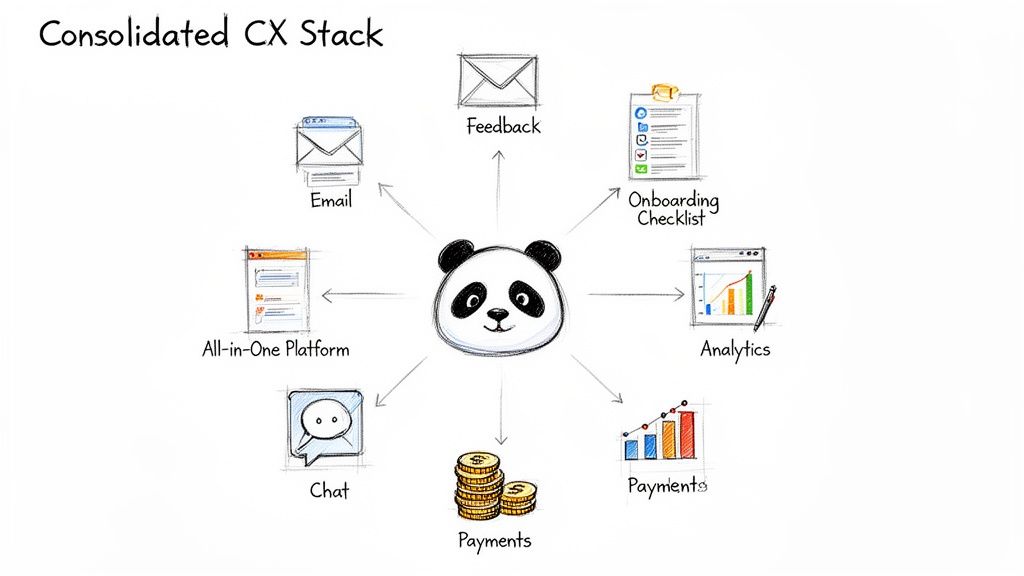
If you’re a bootstrapped founder, you’ve probably felt the sting of the “startup tax.” It’s that painful moment you look at your monthly subscriptions and realise you’re paying for a dozen different tools just to handle email, feedback, onboarding, and product updates.
This patchwork of tools isn’t just expensive; it’s a complexity nightmare. Each one has its own login, its own billing cycle, and its own learning curve. More importantly, they don’t talk to each other. You’re left with data silos that make it impossible to see the full picture of your customer’s journey.
When your stack is fractured like this, sophisticated customer experience management becomes a pipe dream. You can’t trigger an email sequence in one tool based on an NPS score from another without clumsy workarounds. It forces you to rely on unreliable integrations or, even worse, manual work you simply don’t have time for.
The Hidden Costs of a Fragmented Stack
The financial drain is obvious, but the real costs of a disjointed CX stack are often hiding in plain sight. They show up as operational drag, missed opportunities, and a diluted customer experience that actively works against your growth.
These hidden costs add up fast:
- Integration Headaches: Trying to duct-tape multiple single-purpose tools together is a technical minefield that eats up precious development time.
- Wasted Time: Your team is forced to juggle multiple tabs and dashboards just to get a basic overview of what a single customer is doing.
- Inconsistent Experiences: With different tools handling different touchpoints, it’s nearly impossible to maintain a consistent brand voice and a seamless user journey.
- Missed Automation Opportunities: The most powerful automations—like asking for a testimonial right after a glowing CSAT score—are impossible when your data lives in separate kingdoms.
A fragmented toolset doesn’t just cost you money; it costs you momentum. It creates friction for both your team and your customers, slowing down your ability to learn, adapt, and deliver a truly cohesive experience.
Unlocking Power with an All-in-One Platform
This is where consolidation becomes a founder’s superpower. Moving your core customer communication into a single, unified platform isn’t just about saving a few quid on subscriptions. It’s about unlocking a level of strategic insight and automation that was previously out of reach.
Imagine a world where your feedback tools, email sequences, onboarding checklists, and changelog all live under one roof. In this setup, data flows freely between functions, creating a single source of truth for every single customer interaction.
This consolidation is the key to enterprise-grade CXM at a bootstrapper-friendly price. It lets a small team build sophisticated, automated workflows that would otherwise require a dedicated team and an eye-watering budget.
The benefits are immediate and tangible:
- Seamless Automation: When a user gives you a high NPS score, you can instantly add them to a testimonial request sequence without any third-party connectors.
- Deeper Insights: You can see a user’s entire history—their feedback, their onboarding progress, the emails they’ve opened—all in one clean view.
- Faster Implementation: Instead of setting up and learning five different tools, you just master one. You can get a complete CXM system live in minutes, not weeks.
The Growing Demand for Unified CX
This shift away from fragmented point solutions is more than just a bootstrapper trend; it’s a global movement. In Southeast Asia, for instance, spending on CX and CRM systems is booming as companies race to keep up with rapid digital consumer growth.
The regional CRM market is projected to hit USD 2.27 billion in 2025, with cloud-based SaaS tools already capturing the majority of the market. This surge highlights a clear preference for integrated, cloud-native solutions that consolidate customer data and simplify workflows. For a closer look at this market shift, you can explore detailed reports on the rise of CRM in Southeast Asia.
This is precisely where a platform like HappyPanda comes in. It bundles all the essentials—feedback, email, onboarding, and updates—into one affordable package. By doing so, it provides the powerful, interconnected system you need for effective customer experience management without the startup tax. For founders looking to streamline their operations, exploring the best customer feedback tools that integrate these functions is a critical first step.
So, What’s the Big Idea for Your SaaS?
We’ve gone from the high-level theory of customer experience management down to the nitty-gritty, real-world tactics. Now, let’s tie it all together with a bow. For a bootstrapped SaaS, getting CXM right isn’t some fancy extra you bolt on later—it’s the very engine that drives sustainable, profitable growth, especially when you can’t just throw money at problems.
Success isn’t about luck; it follows a surprisingly simple recipe. It all kicks off with truly understanding your customer’s story. You have to map their entire journey, from their first “hello” to becoming a power user, so you can spot the bumps in the road and find those golden opportunities to make their day. Flying without that map? You’re just guessing.
Your Blueprint for Growth
Once you can see the journey, you need to measure what actually matters. By zeroing in on core metrics like NPS, CSAT, and CES, you get a clear, no-nonsense scorecard telling you how you’re doing at the moments that count. This isn’t about getting lost in spreadsheets; it’s about tuning into the signals that tell you whether a customer will stick around or churn.
With those insights in hand, you can start automating the smart way.
- Create Feedback Flywheels: Automatically ask your happiest customers for a review or testimonial. Let them do the marketing for you.
- Step in Before They Stumble: Proactively reach out to users who seem stuck or confused before their frustration boils over.
- Nudge Them Towards “Aha!”: Use event-based triggers to guide every single user toward your product’s core value.
Finally, you have to wrangle your tool stack. A dozen different subscriptions are a recipe for chaos. It bleeds your budget dry, siloes your data, and makes any meaningful automation a complete nightmare. Pulling it all into one unified platform is how you unlock big-company capabilities without the eye-watering price tag.
Great customer experience management isn’t a one-and-done project. It’s a constant loop of listening, learning, and tweaking that weaves the customer’s voice right into the fabric of your product.
This whole approach doesn’t just build a better product; it builds a tougher, more resilient business. When you take command of your customer experience, you ignite a powerful growth engine fuelled by genuine loyalty and word-of-mouth. You’re no longer just shipping features—you’re building a profitable, beloved, and durable SaaS.
The next move is to see what this consolidated power looks like in action. Ready to turn your customer communication from a cost centre into your biggest growth lever? You can start a free trial of HappyPanda today and get your first automated CXM recipe running in minutes.
Common Questions About CXM for SaaS Founders
As a bootstrapped founder, you’re already juggling a dozen different things. The idea of adding “customer experience management” to the pile can feel daunting, like another complex system you just don’t have time for.
Let’s cut through the noise. Here are some of the most common questions we hear, answered in a way that’s straightforward and, most importantly, practical.
How Much Time Does This Actually Take to Set Up?
The old-school approach to CXM was a nightmare. You’d spend weeks trying to duct-tape a dozen different tools together for surveys, emails, and onboarding. For a founder trying to move fast and stay lean, that’s a complete non-starter.
Thankfully, things have changed. A modern, unified platform flips the script entirely. With a solution built specifically for SaaS founders, you can get a powerful customer experience management system up and running in minutes. Seriously. Using pre-built recipes and templates means you can launch your first feedback survey or onboarding checklist with a single script tag. No painful integrations, no endless setup.
When Is the Right Time to Start Focusing on CXM?
Simple answer: yesterday. The most common mistake founders make is treating CXM as a “nice-to-have” they’ll get to after hitting a certain MRR. This is a critical misstep. From your very first user, you’re creating a customer experience—the only question is whether it’s by design or by accident.
Starting early gives you a massive leg up.
- Get Early Insights: You can learn what makes your first few users tick and bake that feedback directly into your product roadmap.
- Build Loyalty from Day One: A stellar initial experience turns your earliest adopters into your most passionate cheerleaders.
- Prevent Bad Habits: It’s far easier to build a customer-first culture from the ground up than to try and fix a broken one down the line.
Delaying your focus on customer experience is like building a house and deciding to check the foundation later. By the time you notice the cracks, the problem is much bigger and far more expensive to fix.
How Do You Actually Measure the ROI of CXM?
This is the big one. For any CXM initiative to be worth your time, you have to connect it directly to cold, hard business metrics. This isn’t about chasing fuzzy feelings; it’s about driving tangible financial results.
A proper customer experience management strategy lets you draw a straight line from your efforts to your key performance indicators. For example, you can measure how an improved onboarding checklist directly boosts your trial-to-paid conversion rate. You can see how proactive support and feedback loops lead to a measurable drop in customer churn.
Ultimately, great CXM directly increases your Customer Lifetime Value (LTV) by keeping users happy, engaged, and subscribed for longer. By proving this financial impact, CXM stops being a cost centre and becomes one of the most powerful growth levers in your entire business.
Ready to turn customer communication into your biggest growth driver? With HappyPanda, you can consolidate your stack and launch powerful automations in minutes. Start your free trial of HappyPanda today and see the difference for yourself.