
Ever found yourself staring at a dashboard, completely baffled as to why users aren’t converting? User-centered design (UCD) is the framework that stops the guesswork. It’s a refreshingly simple approach: build products based on what real people actually need, not just what you think they want.
Why User-Centred Design Is Your Secret Weapon
For a bootstrapped SaaS, adopting a user-centred design mindset isn’t some fluffy nice-to-have; it’s a survival strategy. It’s what stops you from sinking precious time and money into shiny features nobody ever touches.
Instead of building in a vacuum, UCD forces you to get out of your own head and step into your customer’s world.
This shift in perspective is everything. It means you prioritise empathy, taking the time to understand your user’s context, their goals, and their frustrations before writing a single line of code. Think of it as the difference between building a bridge from a blueprint versus building one after you’ve watched people struggle to cross a raging river. One is a guess; the other is a solution.
By weaving UCD into your workflow, you start seeing real, tangible results:
- Minimise Risk: Validate your ideas early and often. No more building something for six months only to find out you solved the wrong problem.
- Boost Engagement: When you create an intuitive experience that fixes a genuine headache, users stick around. It’s that simple.
- Increase Retention: Build a product that people genuinely love using, one they’re happy to pay for month after month.
This guide will walk you through the practical principles, scrappy research methods, and actionable workflows to make UCD a reality for your team. You’ll learn how to systematically listen to your customers—a practice we dig into in our guide on the voice of the customer—and turn those insights into a product that truly works.
The Core Principles of User Centered Design
At its heart, user-centered design is built on a simple, powerful idea: you are not your user. It’s a tough pill to swallow, but realising this is the first step away from building products based on your own assumptions and towards creating solutions people actually need.
Think of it less as a rigid set of rules and more as a mindset. It’s a pragmatic way to de-risk your product development and avoid wasting months building a feature nobody asked for.
It’s a bit like a chef perfecting a new soup. They don’t just throw ingredients into a pot based on a recipe they think will be good. They taste it constantly, adjust the seasoning, add a little something extra, and taste again until it’s just right. UCD is that same process of continuous tasting and adjusting, ensuring the final product actually delights the customer.
This iterative loop—understand, design, validate, repeat—is what makes it so powerful, especially for smaller teams.
Understand the User and Their Context
First things first: you have to develop a deep, genuine understanding of the people you’re building for. This goes way beyond simple demographics like age or location. It’s about getting inside their world.
What are their goals? What does their work environment look like? What are the nagging pain points that ruin their day? You need to dig into the “why” behind their actions. Why are they even looking for a solution like yours in the first place? Gaining this kind of empathy is non-negotiable; it’s the bedrock upon which every single design decision rests.
Focus on User Needs and Requirements
Once you’ve stepped into your user’s shoes, the next job is to translate that understanding into crystal-clear requirements. This principle acts as a powerful filter, helping you say “no” to feature creep and a confident “yes” to what truly matters.
It shifts the internal conversation from, “What cool thing can we build next?” to, “What should we build to help our users win?” For a bootstrapped team with finite time and money, that kind of clarity is gold. It directs all your energy toward creating maximum value where it counts.
“The central premise of user-centered design is that the best-designed products and services result from understanding the needs of the people who will use them.” - Don Norman, Author of The Design of Everyday Things
Involve Users Throughout the Design Process
Here’s the thing about UCD: it’s not a spectator sport for your users. This principle demands their active involvement from the very beginning right through to the end. This isn’t a one-off survey, either. It’s an ongoing conversation.
This involvement can take many forms:
- Initial Discovery: Conducting interviews and surveys to uncover those initial problems.
- Ideation: Getting gut-checks on early concepts and rough sketches.
- Prototyping: Letting users click around low-fidelity wireframes to see what feels natural.
- Usability Testing: Watching real users try to complete tasks with your product. (Always an eye-opener!)
This continuous feedback loop is what keeps a project on track. The standard UCD process diagram visualises it perfectly.
As the diagram shows, it’s not a straight line from A to B. It’s a continuous cycle of learning and refining, with the user smack-bang in the middle of every single stage.
Iterate Based on Feedback
Finally, the design has to be iterative. Let’s be honest, nobody gets it perfect on the first try. The UCD process fully embraces this reality by building in cycles of feedback and refinement.
You build a version of your solution, test it with real people, learn what works and what doesn’t, and then use those golden nuggets of insight to make the next version better. Each iteration gets you closer to a solution that feels intuitive and effortless.
This is where understanding things like Cognitive Load Theory in UX and design comes in handy—it helps you refine your interface to reduce the mental effort required from your users, making each iteration more effective. This cycle of build-test-learn repeats until the design truly nails what your users need.
To tie this all together, let’s look at how these principles directly impact business outcomes, especially for bootstrapped SaaS companies who need every decision to count.
How UCD Principles Drive Business Outcomes
| Principle | Description | Benefit |
|---|---|---|
| Understand User & Context | Gaining deep empathy for users’ goals, pains, and environments. | Higher Product-Market Fit: You build a solution for a real, validated problem, not just an assumption. |
| Focus on User Needs | Translating user understanding into clear requirements and prioritising features that solve real problems. | Reduced Waste: You avoid spending precious time and money on features nobody will use. |
| Involve Users Throughout | Treating users as active collaborators in the design process, from discovery to testing. | Lower Risk: Continuous feedback catches design flaws early, preventing costly mistakes down the line. |
| Iterate Based on Feedback | Committing to a cycle of building, testing, learning, and refining the product. | Increased Retention: The product evolves to meet user needs, creating a stickier, more valuable tool. |
Ultimately, adopting these UCD principles isn’t just about making things “look nice.” It’s a strategic framework for building a better, more successful business by putting the people you serve at the very centre of everything you do.
Doing User Research When You’re Strapped for Cash
Great design is built on great insights, but a lot of founders assume user research means hiring a team and spending a fortune. Good news: that’s a total myth. In reality, some of the most powerful user-centered design methods are scrappy, cheap, and deliver incredible results.
You can start figuring out what your users actually need with some simple, direct approaches. This isn’t about fancy tools; it’s about building a consistent habit of listening. The goal is to create tight feedback loops that constantly inform your product decisions.
Start with Simple Surveys
Surveys are one of the quickest ways to get both quantitative and qualitative data without emptying your pockets. The trick is not to overcomplicate them. Just focus on short, targeted questions that test a specific assumption you have about your users or your product.
Tools like HappyPanda let you pop a simple survey widget right into your app. This is brilliant because you catch people in the moment, right when they’re interacting with the feature you’re curious about. You can use these to quickly measure things like:
- NPS (Net Promoter Score): A fast pulse check on overall customer loyalty. Are people recommending you or warning their friends?
- CSAT (Customer Satisfaction): Instant feedback on a specific interaction, like right after a support ticket is resolved.
- Feature-Specific Feedback: Simple prompts like, “How could we make this dashboard better for you?”
By asking the right questions at the right time, you get a stream of valuable data without the big budget. For a deeper dive, check out our guide on how to collect customer feedback for more strategies.
Have Informal Chats with Your Users
Surveys tell you what is happening, but interviews tell you why. You don’t need a sterile, two-way-mirror usability lab for this. A casual 30-minute video call is often more than enough to uncover a goldmine of insights into a user’s real-world struggles and motivations.
Finding people to talk to is easier than you think. Shoot an email to recent sign-ups, users who have already left feedback, or even folks in your network who fit the bill. A small gift card for their time is usually all it takes.
During these chats, your main job is to listen. Shut up and let them talk. Ask open-ended questions like, “Can you walk me through how you currently solve [the problem your app tackles]?” or “Tell me about a time you got really frustrated trying to do [a specific task].” These conversations reveal the human context that raw numbers will always miss.
Pull It All Together and Create Personas
Once you’ve gathered all this feedback, the last step is to make sense of it all. Go through your notes and start looking for patterns—recurring themes, common frustrations, and shared goals. This is where you turn a messy pile of data into clear, actionable direction for your team.
From these patterns, you can build some lightweight user personas. These aren’t 20-page dossiers; they’re simple, one-page summaries of your key user types. A solid persona just needs:
- A fictional name and a stock photo.
- Their main goals.
- Their biggest frustrations or pain points.
- A killer quote that sums up their entire vibe.
These personas become your North Star. They’re a constant reminder of who you’re building for, keeping the whole team aligned and focused on solving problems that actually matter to real people.
A Lean Workflow for Prototyping and Testing
So, you’ve gathered some raw user insights. Now what? Turning that feedback into a better product isn’t some mystical art form; it’s a fast-paced, systematic workflow. The best way to avoid sinking months of engineering effort into a feature that ultimately flops is to embrace a lean cycle of prototyping, testing, and learning.
Think of it as creating incredibly tight feedback loops. You make small bets, see what happens, fix what’s broken, and double down on what works—all before your developers write a single meaningful line of code. It’s a cornerstone of modern user-centred design, and it’ll save you from some seriously expensive headaches down the road.
This whole scrappy process is about turning initial questions into validated insights through simple steps. You start with a survey, follow up with interviews, and then pull it all together.
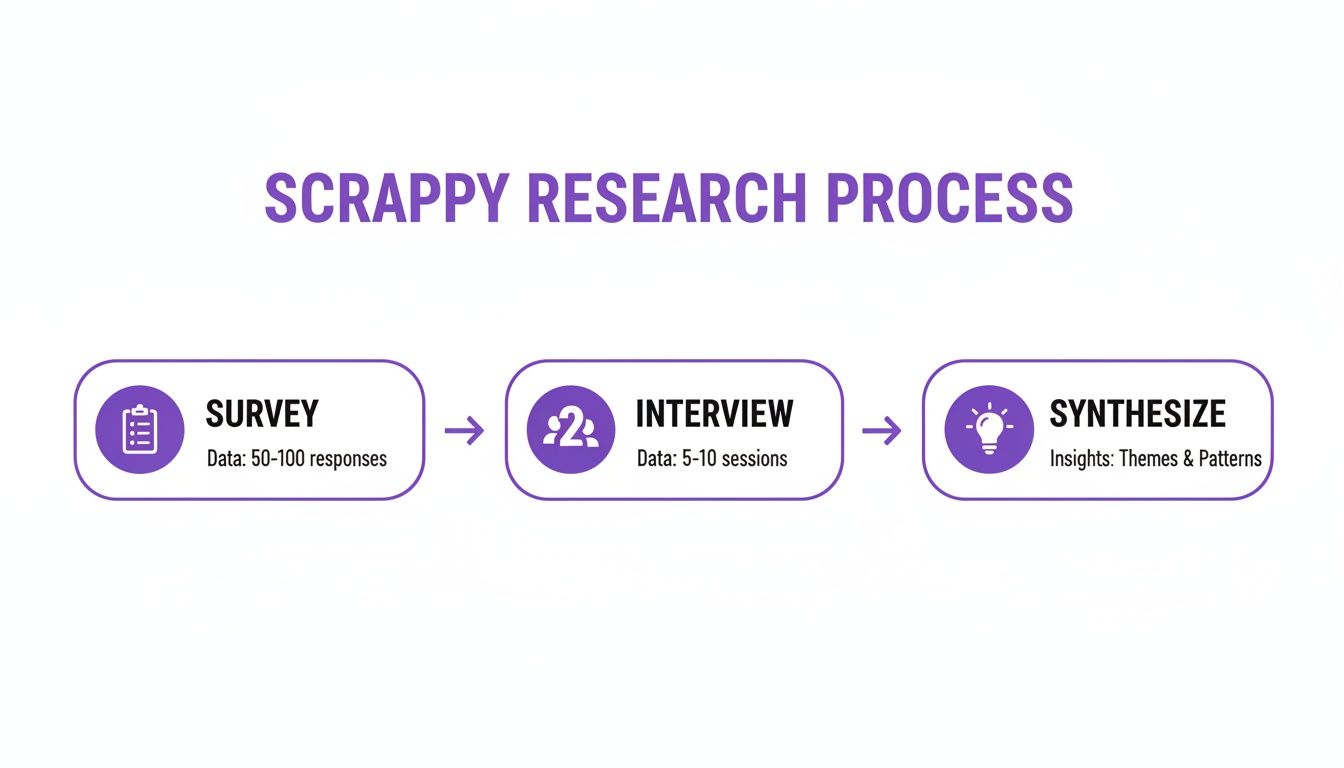
As you can see, research doesn’t have to be a massive, complicated affair. It’s about building your understanding step-by-step to inform your next move: creating something you can actually test.
Build Simple Prototypes First
Your first prototype should be nowhere near a polished piece of software. In fact, it should be the simplest, scrappiest representation of your idea possible. We’re talking low-fidelity wireframes or clickable mockups cobbled together in a tool like Figma. You could even just link some images together in a slideshow. Seriously.
The goal here isn’t to dazzle users with a beautiful design. It’s to test the core concept and the workflow. Can someone figure out how to get from A to B? Is the navigation even remotely logical? These are the fundamental questions you need to answer. By keeping it simple, you can build and scrap ideas in hours, not weeks.
Conduct Guerrilla Usability Tests
“Guerrilla testing” sounds way more intense than it is. It’s just a fancy term for doing quick, informal tests with real people wherever you can find them. Forget the sterile lab setting with two-way mirrors. This is about grabbing five or six people from your target audience for a quick 15-minute session to get their raw, unfiltered thoughts.
Give them a simple task to complete using your prototype and then… just watch. The golden rule is to listen far more than you talk. You will be absolutely floored by what you uncover when you see someone interact with your concept for the very first time. If you want a lean, user-centric workflow, mastering how to conduct usability testing is non-negotiable for validating your ideas effectively.
From Prototype to Product
The gold you dig up during these sessions feeds directly into your next prototype iteration. Did everyone get stuck on the same screen? Change it. Did they completely miss that critical button? Make it bigger, brighter, or move it somewhere else. You just keep repeating this cycle until the prototype feels intuitive and users can breeze through the main tasks without getting tripped up.
Only then—once you have that confidence—do you translate the validated design into a clear user story for the development team. By doing all this work upfront, you’re handing your engineers a blueprint that has already been de-risked. If you need a hand bridging that gap between design and development, our article on writing an agile story is a great place to start.
Of course. Here is the rewritten section, crafted to sound completely human-written and natural, following all your specified requirements.
Putting User-Centred Design into Practice with HappyPanda
Theory is one thing, but execution is everything. Knowing the principles of user-centred design is a great start, but the real magic happens when you build a practical, repeatable workflow around them.
If you’re a bootstrapped SaaS founder, this process needs to be lean, fast, and tied directly to tools that save you time—not add more complexity. This is where you can turn HappyPanda into your UCD command centre.
The goal isn’t to run a massive, months-long research project. It’s about creating a continuous rhythm of listening, learning, and shipping that puts user feedback right at the heart of your development cycle. Let’s break down how to make this happen with some simple recipes that connect what your users are feeling directly to your product roadmap.
Automate Feedback at Key Journey Moments
The best feedback comes when you ask for it at the perfect moment. Catching a user right after they’ve finished a core task or hit a big milestone gives you context-rich insights that are way more valuable than a generic annual survey. With HappyPanda, you can get this up and running immediately.
For example, instead of guessing if your onboarding is any good, you can trigger a simple, one-question CSAT survey the moment a user completes their onboarding checklist. Did they find it helpful? You’ll know within minutes. This creates a direct feedback loop that informs your user-centred design process from day one.
Here’s a look at how an onboarding checklist might appear in your app, guiding a new user through those critical first steps.
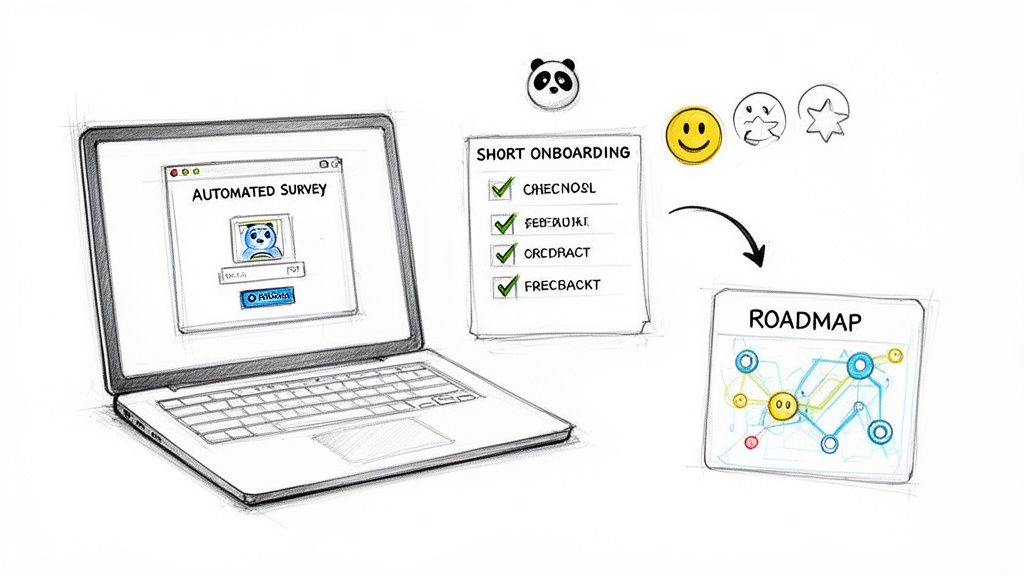
This kind of visual guide ensures users experience the core value of your product quickly, which is a fundamental goal of any user-centric approach.
You can set up several of these automated touchpoints:
- After First Value: Trigger a survey after a user successfully uses your main feature for the first time. Ask something simple like, “How easy was it to get started?”
- Post-Support Interaction: Automatically send a CSAT survey after a support ticket is closed to measure the quality of your help.
- 30 Days In: Send an NPS survey to gauge long-term loyalty and identify your biggest fans (and your detractors).
These small, automated actions build a powerful, continuous stream of user data without you having to lift a finger.
Guide New Users with Onboarding Checklists
A huge part of user-centred design is cutting down on friction and helping people achieve their goals as fast as possible. Those first few minutes a user spends in your product are absolutely critical. If they get confused or overwhelmed, they’re likely to churn and never come back.
HappyPanda’s onboarding checklists are designed to solve this exact problem. They provide a clear, step-by-step path for new users, guiding them through the key actions they need to take to experience your product’s “aha!” moment. This isn’t just about showing off features; it’s about leading them to a win.
A great onboarding experience is the first promise you deliver on. It shows users you respect their time and are committed to their success, setting a positive tone for the entire relationship.
By breaking the setup process into small, manageable tasks, you reduce cognitive load and build momentum. As users tick off each item, they gain confidence and a deeper understanding of how your tool can actually solve their problems. This guided journey is UCD in action—anticipating user needs and designing a path to meet them.
Close the Loop with Changelog Updates
Gathering feedback is only half the battle. True user-centred design means showing your users that you’re actually listening and acting on what they tell you. This is where a public changelog becomes an unexpectedly powerful tool for building trust and engagement.
When you ship a feature or fix a bug that users requested, announcing it in your changelog closes the feedback loop. It sends a clear message: “We heard you, and we built this for you.” HappyPanda’s changelog widget makes it easy to push these updates directly inside your app, so users see the progress you’re making.
This simple act transforms your users from passive consumers into active collaborators. They see tangible proof that their voice matters, which makes them far more likely to give you feedback in the future. It’s a brilliant, virtuous cycle of insight, action, and validation.
Connect Sentiment Directly to Your Roadmap
The ultimate goal here is to let user needs drive your product strategy. With HappyPanda, you can create automations that turn raw feedback into actionable signals for your roadmap. This is how you move from guesswork to data-informed prioritisation.
Imagine these simple but powerful workflows:
- If a user gives an NPS score of 9 or 10… automatically send them an email asking for a testimonial. This helps you collect social proof from your happiest customers.
- If a user gives a low CSAT score on a new feature… tag them in your CRM and add a note to follow up with a personal email to understand their frustration.
- If a user submits a feature request survey… categorise their feedback and add it to a running tally to identify the most-requested improvements.
This systematic approach ensures that every piece of feedback contributes to a clearer picture of what you should build next.
This is especially critical in diverse, high-growth markets. Take Southeast Asia’s booming SaaS landscape, for instance, where user-centred design has proven essential. Research on UI/UX design for SaaS localisation found that culturally adapted designs led to a remarkable 73% faster cultural adaptation rate and 45% higher local user engagement than generic interfaces. These numbers show exactly why bootstrapped founders in the region can’t afford to ignore UCD; it’s a direct path to a competitive edge in a mobile-first environment.
By mapping specific HappyPanda features to your UCD workflow, you create a practical system for turning user insights into genuine product improvements.
Mapping HappyPanda Features to Your UCD Workflow
This table breaks down exactly how you can use specific HappyPanda features to put key UCD methods into practice, making the whole process tangible and achievable, even for a small team.
| HappyPanda Feature | UCD Method | Benefit |
|---|---|---|
| Automated Surveys (NPS, CSAT) | Continuous User Research | Gathers quantitative feedback at key moments to measure satisfaction and loyalty without any manual work. |
| Onboarding Checklists | Usability & Task Guidance | Reduces new user friction, increases activation rates, and guides users to their “aha!” moment much faster. |
| Changelog Widget | Closing the Feedback Loop | Visibly shows you’re listening and acting on feedback, which builds trust and encourages more engagement. |
| Testimonial Collector | Validating Success | Systematically collects social proof from your most satisfied users, directly tying positive sentiment to marketing assets. |
| Automation Layer | Operationalising Insights | Connects feedback triggers to real actions, turning raw data into an organised system for roadmap prioritisation. |
Using a platform like HappyPanda lets you embed user-centred design principles right into your daily operations. It stops being a separate, occasional task and becomes a natural part of how you build your product.
Lessons From Real World UCD Success Stories
Principles and workflows can only take you so far. It really sinks in when you see user-centered design driving decisions at companies big and small. From global powerhouses to garage startups, these stories prove how research, empathy and iteration turn ideas into market winners.
They’re not just feel-good case studies; they’re blueprints you can adapt. By unpacking these playbooks, any bootstrapped founder can pick up tactics to accelerate growth and deepen customer loyalty.
How Lazada Conquered A Diverse Market
When Lazada set out to dominate Southeast Asia, they faced a brutal reality: one platform for countless cultures was a recipe for disaster. Instead of shoe-horning every market into the same design, they built a regional UX team from the ground up.
That crew didn’t stop at surveys. They spent weeks on the ground—visiting homes, corner shops and internet cafés—to see how people really shop online. The results were eye-opening:
- 67% Faster Time-To-Market for new features
- 156% Jump in User Engagement
For a deeper dive, see cross-cultural design excellence on Emerge Creatives.
Their systematic UCD process boiled down to three core steps:
- Deep Ethnographic Research: Observing shoppers in their own environment, not just behind a screen.
- Localised User Personas: Crafting profiles that capture each market’s unique goals and pain points.
- Region-Specific Usability Testing: Rolling out prototypes locally to gather authentic feedback.
The takeaway? You don’t need Lazada’s budget—just their curiosity. Chat with five local users in your next target market and you’ll sidestep costly assumptions.
The Indie Dev Who Listened And Won
You don’t need millions of dollars or an army of designers to make user-centered design work. Some of the savviest micro-SaaS tools come from solo founders glued to a small, passionate user base. Their secret weapon is a relentless feedback loop.
Imagine a one-person shop launching a project management tool for creative agencies. It packed in every feature imaginable—and still saw crickets.
The founder hit pause on all new features and booked weekly 15-minute “virtual coffee” chats with his first ten customers.
Those casual chats revealed a simple truth: agencies weren’t struggling with task lists. They were drowning in client approval emails, juggling PDF versions and chasing feedback. With that clarity, he sketched a lightweight mockup-sharing widget complete with in-app comments.
The result? Churn plummeted and referrals exploded. No fancy ad campaigns. No big sales force. Just genuine empathy and a laser focus on one clear pain point. That’s UCD at its purest—solving a real problem with surgical precision.
So, Where Do You Start?
Feeling that spark? The journey into user-centred design doesn’t begin with a massive budget or a dedicated team of researchers. It starts with a single, simple decision: to stop guessing and start listening.
You now have the principles and a practical workflow to build what your users actually want. Let’s turn that knowledge into action. The goal here is to give you the confidence and the tools to start building a more user-centric product, literally today. It all comes down to small, deliberate steps that eventually become second nature.
Your Action Checklist
Ready to jump in? Here’s a simple, no-fluff plan to kickstart your first UCD initiative and sidestep the common traps. Think of this not as a massive project, but as a manageable sprint.
-
Launch One Research Initiative: Don’t try to boil the ocean. Pick one nagging assumption you have about your users—like why they seem to ghost you during onboarding—and pour all your energy into understanding just that one thing.
-
Talk to Three Users: Seriously, just three. Find a few people who fit your ideal customer profile and schedule a quick, 15-minute chat. Ask them open-ended questions about how they get their work done. You’ll be floored by what you learn.
-
Sketch a Lightweight Prototype: Based on those conversations, mock up a simple wireframe. You can use a tool like Figma or even just grab a pen and paper. Focus on the core workflow, not the visual bells and whistles. The point is to test the concept, not the colour palette.
-
Set Up One Feedback System: Use a tool like HappyPanda to install a simple survey widget. Ask a single, targeted question at a key moment in your user’s journey—for instance, right after they complete their first major task.
Look, the aim isn’t perfection; it’s progress. Every little insight you gather is a step away from building in a vacuum and a step closer to creating a product that actually clicks with your customers.
By following this simple plan, you’ll have completed your first full cycle of user-centred design—from research and ideation to prototyping and feedback. This initial loop will build the confidence and momentum you need to weave UCD into the very fabric of how you build, ensuring every decision is grounded in real human needs.
A Few Common Questions About UCD
Even with a clear roadmap, jumping into user-centred design can feel a bit much, especially for bootstrapped founders. Here are a few answers to the questions that always seem to pop up when you’re just getting your feet wet.
How Can I Start UCD with Zero Budget?
Good news: you don’t need fancy, expensive tools. All you really need is a bit of time and genuine curiosity.
Start by scheduling three 15-minute video calls with some of your most recent sign-ups. Ask them open-ended questions about their workflow, what drives them mad, and what a “win” looks like for them. This simple habit costs you absolutely nothing but delivers priceless insights to steer your early design choices.
What Are the Most Important Metrics to Track?
In the beginning, focus on qualitative feedback over getting lost in complex dashboards. That said, there are two beautifully simple metrics that are crucial for knowing if you’re on the right track:
- Task Completion Rate: Can people actually finish the main job your product is supposed to do?
- Time on Task: How long does it take them to get it done?
These two numbers tell you a surprisingly complete story about whether your design is actually usable or just a pretty picture.
How Can I Convince My Co-Founder This Is Worthwhile?
Don’t frame it as a “nice-to-have.” Frame it as a risk-reduction strategy. Every single hour you spend understanding your users saves you at least ten hours of engineering work building features that nobody will ever touch.
Present it as the fastest path to finding product-market fit and building something that keeps customers around. It’s not about making things look good; it’s about directly impacting your bottom line.
What Are the Biggest Mistakes to Avoid?
The single biggest mistake you can make is asking users what they want. It’s a classic trap. People are brilliant at describing their problems, but they are absolutely terrible at designing the solutions.
Your job isn’t to be a glorified order-taker. It’s to observe their behaviour, truly understand the messy, underlying problems they face, and then go create the solution they couldn’t have imagined. Never, ever take a feature request at face value without digging into the “why” behind it.
Ready to put these principles into practice? HappyPanda gives you the tools to gather feedback, guide users, and build a product your customers will love, all in one place. Start your free trial today.