
Going to market is about more than just flipping the switch on your new SaaS. It’s the master plan—your strategic blueprint for how you’ll introduce your product to the world, connect with the right customers, and carve out a space for yourself in a crowded market.
Frankly, a solid go-to-market strategy is often what separates a launch that makes waves from one that quietly sinks without a trace.
Laying Your Go-To-Market Foundation
The fate of your SaaS launch is pretty much decided long before you write a single line of code or fuss over landing page designs. It’s all built on a bedrock of deep customer knowledge and a few sharp, strategic decisions.
For a bootstrapped founder, this isn’t just important—it’s everything. You don’t have a pile of venture capital to patch over bad guesses or sloppy execution.
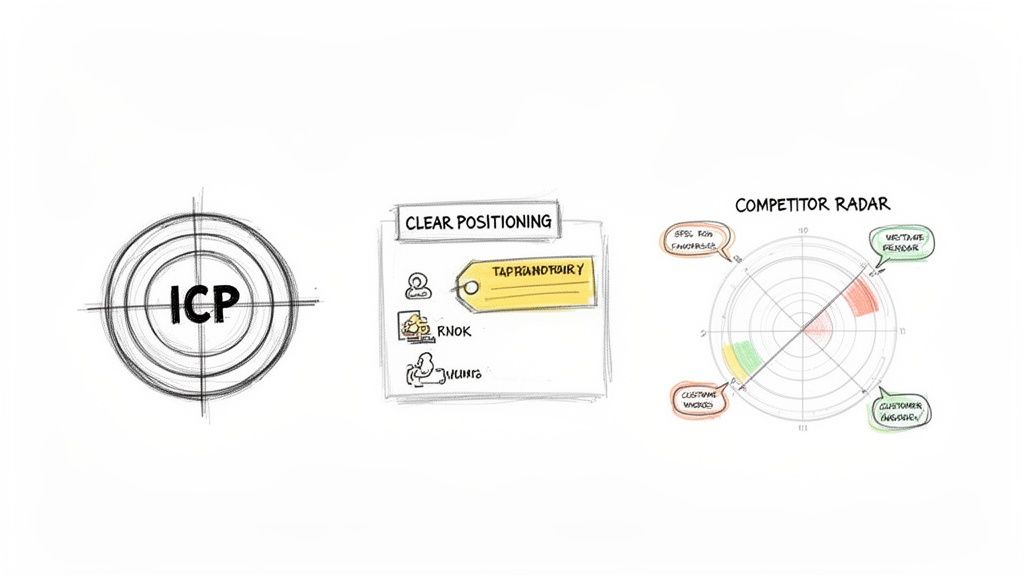
This whole foundational stage is about getting crystal clear. Forget the abstract theories you might hear in business school; this is about gathering practical, boots-on-the-ground intelligence yourself. The aim is to answer three crucial questions with surgical precision:
- Who are you really selling to? This means digging deeper than vague demographics and nailing down a hyper-specific Ideal Customer Profile (ICP).
- Why should they pick you over everyone else? This is all about your positioning—the unique spot you own in your customer’s mind.
- What can you learn from the competition? This isn’t just about listing features; it’s a smarter way of analysing what other players are doing right (and wrong).
Pinpoint Your Ideal Customer Profile
A fuzzy ICP like “small marketing agencies” is a one-way ticket to wasted time and money. You have to get granular. For a bootstrapper, a strong ICP is someone you can actually find and have a real conversation with. So, think smaller and more specific.
Instead of “small marketing agencies,” drill down to something like, “Solo social media managers in Southeast Asia who specialise in Instagram for D2C brands.”
See the difference? That level of specificity is a superpower. It tells you exactly where to find them (Instagram-focused communities, D2C forums), the slang they use, and the precise problems keeping them up at night. This clarity shapes every single decision you make, from your website copy to your feature roadmap. A great starting point is exploring our guide on how to perform proper customer needs identification to build this profile from the ground up.
Craft a Compelling Positioning Statement
Positioning is not just a catchy tagline you slap on your homepage. It’s the core promise of your product, and it has to instantly signal your unique value.
A simple but ridiculously powerful framework to use is:
For [Your Target Customer] who struggles with [The Core Problem], our product is a [Product Category] that provides [The Main Benefit] unlike [The Main Competitor/Alternative].
Here’s how that looks in the real world: “For freelance content writers who struggle with tracking project profitability, our product is a simple time-tracking app that provides a real-time profit dashboard, unlike complex accounting software.” This statement becomes the compass for all your marketing.
Your positioning must be a sharp spear, not a wide net. Trying to appeal to everyone means you will ultimately appeal to no one. Be bold enough to exclude people who aren’t your ideal fit.
Conduct Smarter Competitor Analysis
As a bootstrapper, you can’t outspend your competitors, so you have to outthink them. Forget just making a spreadsheet of their features. Instead, you need to become a secret shopper and dissect their entire strategy.
Here’s how:
- Sign up for their product. Go through their whole onboarding flow with a fine-tooth comb. Where do they guide new users? What are the first key actions they push you to take? Document everything.
- Analyse their communications. Get on their email list and follow them on social media. What kind of language do they use? What benefits do they hammer home, and which ones do they ignore?
- Read their customer reviews. Pay laser-focused attention to the specific words and phrases used by both happy and unhappy customers. This is an absolute goldmine for marketing copy.
This kind of intelligence work gives you a serious pre-launch advantage. It helps you spot the gaps in their approach that your product can swoop in and fill. As you get this foundational strategy dialled in, exploring innovative approaches to market strategy can give you an extra competitive edge.
Crafting Your Pricing and Packaging
Let’s be honest: for bootstrapped founders, pricing is the single most powerful growth lever you have, but it often brings on a cold sweat. Get it wrong, and you’re either leaving cash on the table or scaring off good-fit customers before they even start. But get it right? It becomes the engine that drives everything else.
The secret is to stop thinking about your costs or your feature list. Instead, you need to anchor your price directly to the value you create for your customers. This is the heart of value-based pricing, and it’s a perfect match for a nimble micro-SaaS.
Your pricing shouldn’t be a complex spreadsheet. It should tell a simple, compelling story about the results a customer can expect.
Building Tiers That Tell a Story
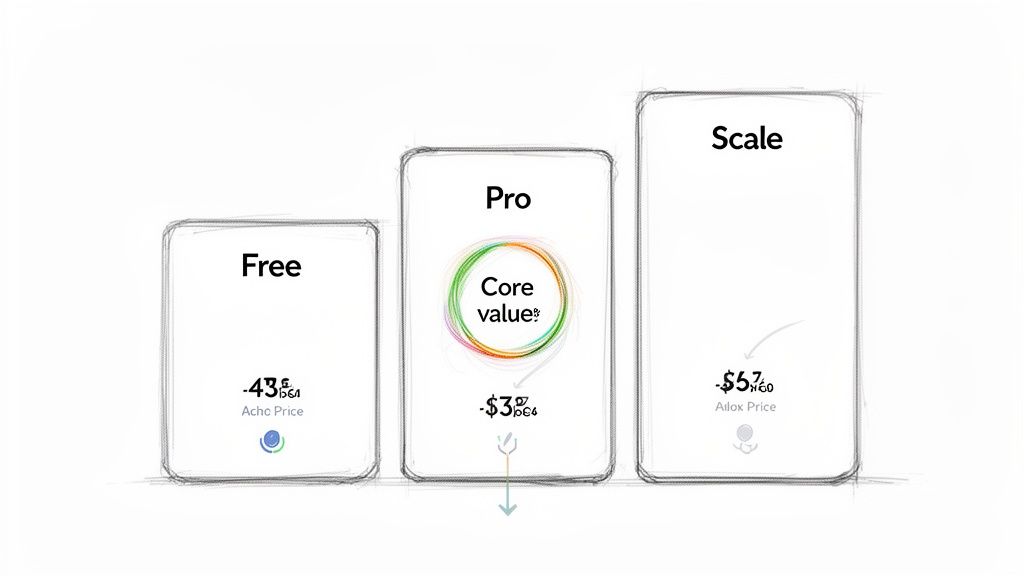
A good pricing structure is a journey. It should create a natural upgrade path that aligns with your customer’s own growth, making the decision to move up feel like the next logical step. The key is to avoid just slapping random feature limits on your plans. Instead, tie them to a core value metric.
So, what’s a value metric? It’s the specific unit of value your customer gets from your product that scales as their business succeeds.
- For an email marketing tool, it’s the number of subscribers.
- For a project management app, it could be active projects.
- For HappyPanda, it might be the number of survey responses you collect.
When you price this way, your revenue grows as your customers succeed. It’s a beautiful alignment—you only make more money when they’re getting more value from your tool. This is a non-negotiable part of a solid go-to-market plan.
One of the most common mistakes is creating a “middle plan” that’s just a slightly souped-up version of the basic one. Your middle tier should be the hero—the one you genuinely want most of your ideal customers to choose because it offers the perfect blend of value and features for their needs.
Freemium Versus Free Trial
Ah, the great debate: freemium or a time-limited free trial? There’s no single right answer here. The best choice depends entirely on your product and market.
A freemium model is brilliant for products with wide appeal and network effects, where having a massive user base is an asset in itself. It drops the barrier to entry to zero, but you run the risk of attracting a lot of users who will never, ever pay.
A free trial, on the other hand, is usually a better fit for B2B SaaS products that solve a specific, high-value problem. It filters for people with genuine buying intent and creates a natural sense of urgency. For a bootstrapper, a 14-day or 30-day trial often hits the sweet spot.
Designing a High-Converting Pricing Page
Your pricing page needs to be a masterclass in clarity. Confusion is the ultimate conversion killer. A visitor should land on your page and know which plan is for them in less than ten seconds.
Here’s a quick checklist for a pricing page that actually works:
- Clear Tier Names: Use intuitive names like “Starter,” “Growth,” or “Scale.” Ditch the confusing jargon.
- Highlight the Target Audience: Add a simple tagline under each tier, like “Best for freelancers” or “Perfect for growing teams.”
- Focus on Outcomes, Not Just Features: Frame your features as benefits. Instead of “API Access,” try “Integrate with your favourite tools.”
- An Obvious Call-to-Action (CTA): Every plan needs a big, bold button that screams “Start Your Free Trial.”
The global SaaS market is primed for this. Businesses everywhere are actively looking for tools that deliver a clear ROI, especially in emerging tech hubs. Take Southeast Asia, where SaaS spending per employee is set to jump from $3.79 in 2020 to $13.47 in 2025—that’s a 2.5-fold increase. This growing appetite for effective software makes clear, value-based pricing more critical than ever. Getting this right is also fundamental for forecasting revenue, which you can read more about in our guide to using a customer lifetime value calculator.
Picking Your High-Impact Launch Channels
As a bootstrapped founder, your time is the one resource you can’t afford to waste. It’s tempting to try and be everywhere at once, but that’s a surefire way to burn out. A great launch isn’t about blanketing the internet; it’s about making a few smart, focused bets on the one or two channels where your ideal customers already hang out.
The aim here is to create a concentrated burst of momentum, not a scattered effort that leaves you exhausted with nothing to show for it. It’s about finding your tribe and showing up with something they’ll genuinely value.
Choosing Your Battlefield Wisely
Think of launch channels as digital “watering holes.” Each one has its own culture, unspoken rules, and audience. A killer strategy on Product Hunt could fall completely flat on a niche subreddit. The trick is to match the channel to your product and, most importantly, to your ideal customer profile.
This flow shows how different channels can all funnel attention back to your main product site, which is exactly what you want.
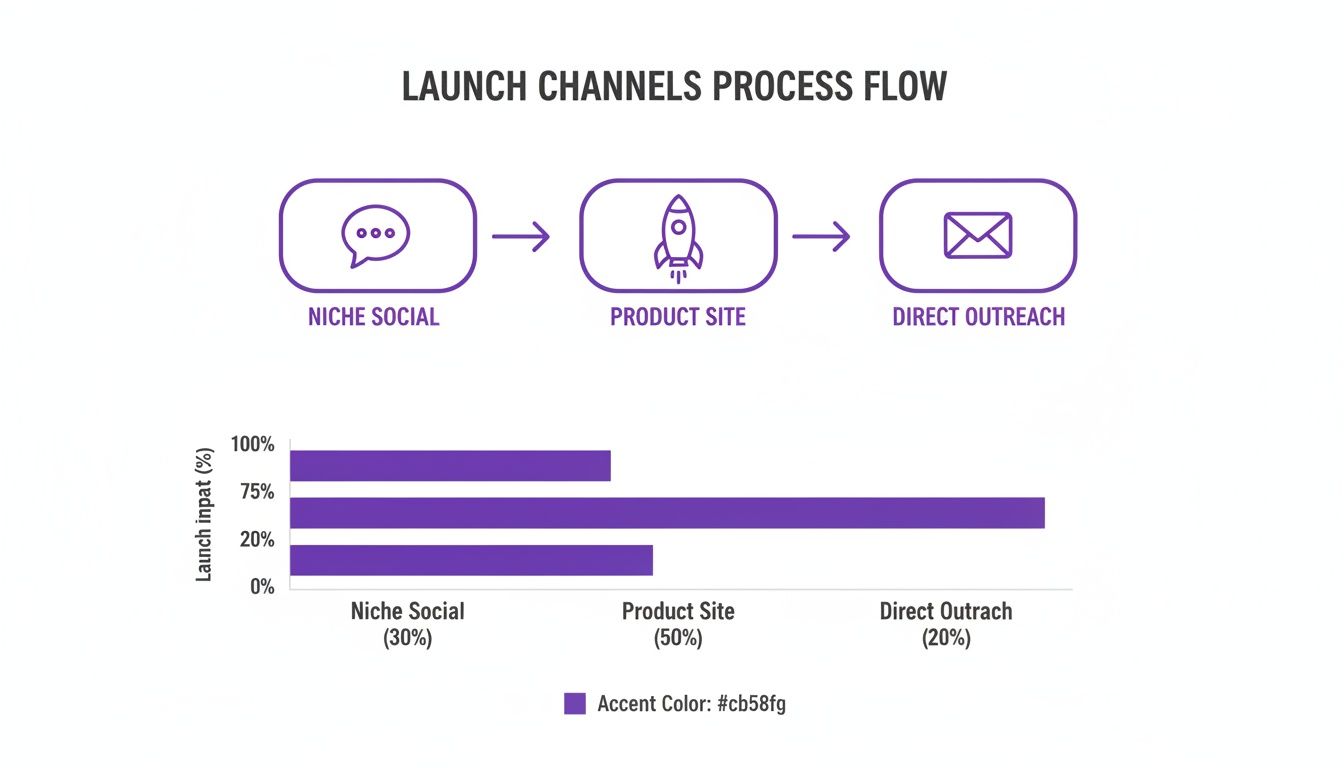
As you can see, everything from community posts to direct outreach serves one central purpose: driving the right kind of traffic to your product.
Let’s break down some of the most effective options I’ve seen work for indie SaaS founders.
Community-Led Launch Playbooks
These channels are gold if your product solves a problem for a specific community—developers, designers, fellow indie hackers, you name it. The secret sauce is authenticity. You have to be a member of the community, not just a marketer dropping in to make a sale.
- Niche Subreddits: Find subreddits like
r/saasorr/entrepreneurridealong. The key is to provide value for weeks, or even months, before you even think about launching. Share your journey, ask for feedback, and become a familiar face. When you finally share your product, it feels like a contribution from a peer, not a sales pitch. - Building in Public: Platforms like X (formerly Twitter) or LinkedIn are fantastic for this. You document everything—the wins, the bugs, the late-night coding sessions. This approach builds an audience that’s emotionally invested in your success long before they can even sign up.
Platform-Driven Launch Playbooks
These channels give you access to a built-in audience of early adopters who are actively looking for new and interesting products. A solid launch here can generate a huge wave of initial traffic and sign-ups.
- Product Hunt: A launch here is a rite of passage for many SaaS products. Success requires serious preparation: high-quality visuals, a clear and punchy description, and being ready to engage with every single comment on launch day. It’s a one-shot deal, so make it count.
- App Marketplaces: If your product integrates with platforms like Slack, Shopify, or Notion, launching in their marketplace is a no-brainer. This puts you directly in front of users who are already searching for solutions within that ecosystem.
Your initial launch isn’t about reaching millions. It’s about reaching the right first hundred users—the ones who will give you the feedback and early revenue you need to survive and improve. Go deep, not wide.
Speaking of high-impact channels, another one to consider is PPC for lead generation. While it does require a budget, even a small, highly targeted campaign can provide immediate feedback on your messaging and conversion rates. That’s invaluable data to have in your back pocket.
This kind of strategic focus is especially powerful in high-growth regions. The broader Asia-Pacific SaaS market, for instance, is exploding, creating massive opportunities. Projections show the market hitting around $230 billion by 2025 and growing at a CAGR of up to 20%. For indie hackers, this means a rapidly expanding pool of new SaaS founders who need effective tools—a perfect audience if you’re in that space.
Bootstrapper-Friendly Launch Channel Comparison
To help you decide where to focus your energy, I’ve put together a quick comparison of the most common launch channels for bootstrappers. There’s no single “best” channel; it all comes down to your product, your audience, and your personal strengths.
| Channel | Typical Effort | Monetary Cost | Target Audience | Best For |
|---|---|---|---|---|
| Product Hunt | High (Pre-launch prep, launch day engagement) | Low (Free) | Early adopters, tech enthusiasts | Products with strong visual appeal and a clear, immediate value prop. |
| Niche Subreddits | Medium-High (Requires long-term community building) | Low (Free) | Highly specific interest groups | Solving a deep, specific pain point for a well-defined community. |
| Building in Public | High (Consistent content creation and engagement) | Low (Free) | Fellow founders, indie hackers | Founders who enjoy sharing their journey and building a personal brand. |
| App Marketplaces | Medium (Integration work, marketplace submission) | Low (Platform fees may apply) | Users of a specific platform (e.g., Shopify) | Products that extend the functionality of an existing popular tool. |
| PPC Ads | Medium (Campaign setup, monitoring, and optimisation) | Medium-High | Highly targeted keyword searchers | Validating messaging and generating immediate, qualified leads with a budget. |
Ultimately, the best approach is to pick one primary channel and maybe one secondary one. Give them your full attention, learn the ropes, and build real momentum. You can always expand later once you’ve found your footing.
Automating Your Onboarding To Drive Activation
So, your launch channels are firing on all cylinders, and a wave of new users is signing up. Pop the champagne! But don’t celebrate for too long, because the real work is just beginning.
Those first few interactions a new user has with your product are everything. They’re the moments that decide whether someone becomes a loyal fan or ghosts you within a week.
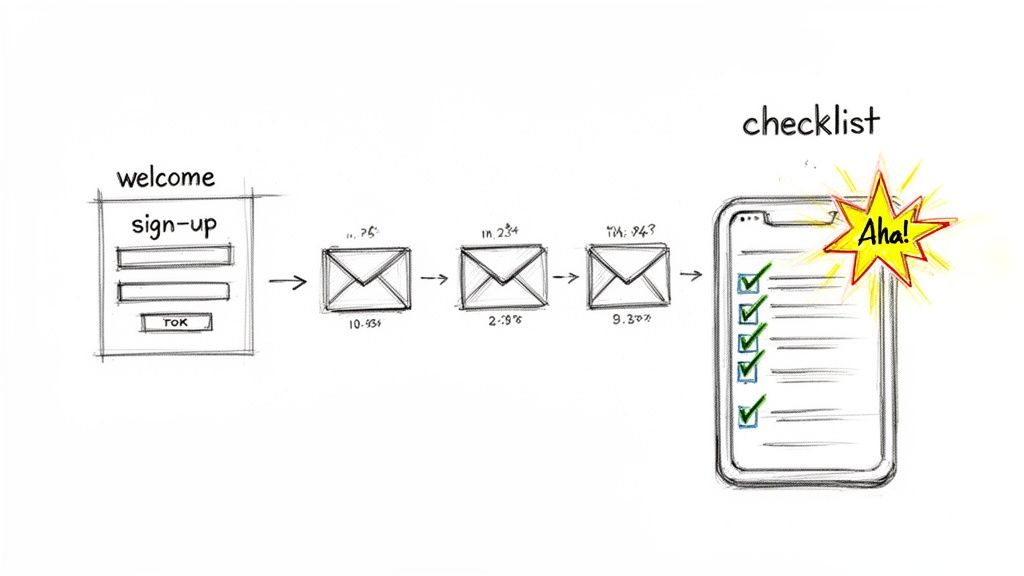
This is where a slick, automated onboarding system becomes your secret weapon. It’s your 24/7 welcome committee and personal guide, all rolled into one. The goal is simple: get every single user to their “aha!” moment as fast as possible—that magic point where they truly get the value of your product and see how it solves their problem.
For us bootstrappers, manually guiding every person just isn’t an option. Automation isn’t a nice-to-have; it’s a must-have for survival and scale.
Crafting a Welcome Email Sequence That Connects
That first email a new user gets is your digital handshake. A generic “Welcome to Our App” is a massive missed opportunity. Your welcome sequence needs to feel personal, be genuinely helpful, and set the right tone from the get-go.
Here’s a simple but effective three-email flow you can set up in a tool like HappyPanda:
- The Immediate Welcome (Sent instantly): The goal here is pure reassurance and one clear call-to-action. Confirm their sign-up, show some genuine excitement they’re here, and guide them to take the single most important first step in your app.
- The Value Nudge (Sent on Day 2): Shine a spotlight on a key feature they might have missed, but frame it around a benefit. Instead of saying “Check out our reporting feature,” try something like, “See how much time you’ve saved this week with your personal productivity report.”
- The Personal Check-in (Sent on Day 4): This one should feel like it’s coming directly from you, the founder. A simple message like, “Hey [First Name], just checking in. How are you finding things so far? Let me know if you hit any snags,” can work wonders. It opens a direct line for feedback and makes people feel seen.
Even though it’s fully automated, this sequence builds a human connection. It shows you’re invested in their success from day one.
Implementing an In-App Onboarding Checklist
Emails are great for staying top-of-mind, but the real magic happens inside your product. An in-app checklist is one of the best tools for getting people to take action. It gamifies the onboarding process, giving users a clear path to follow and a little hit of dopamine with every box they tick.
Your onboarding checklist shouldn’t be a boring tour of every single feature. Think of it as a guided mission to achieve a specific, valuable outcome. Focus on the 2-3 essential actions that lead straight to that “aha!” moment.
For example, a project management tool’s checklist might look like this:
- Create Your First Project: The foundational step.
- Invite a Team Member: Shows off the collaborative value.
- Assign Your First Task: This is the core action of the app.
Each completed item is a small win that builds momentum. Using a tool like HappyPanda, you can easily build an in-app checklist widget and set it to trigger based on user actions, so they always know what to do next.
Using Behavioural Triggers to Re-Engage Users
But what about the users who sign up and then vanish? A proactive, automated system can catch them before they’re gone for good. Behavioural triggers are your best friend here. These are automated actions that fire based on what a user does—or doesn’t do—in your app.
Here are a few practical examples of triggers you could set up:
- User hasn’t created their first project within 3 days? Ping them a targeted email with a link to a 60-second tutorial video.
- User completes the onboarding checklist? Automatically send a celebratory email, maybe with a little reward like a bonus template pack.
- User’s trial is ending in 3 days but their activation score is low? Send a personalised offer for an onboarding call or a trial extension.
This isn’t about spamming people. It’s about offering timely, relevant help exactly when they need it most. By connecting these pieces—the email sequence, the in-app checklist, and the behavioural triggers—you build a powerful system that guides every user toward activation. No one gets left behind.
Turning Early Feedback Into a Growth Engine
Your first users are gold. They’re more than just your initial revenue; they’re walking, talking treasure maps leading you straight to product-market fit. They hold the secrets to your next killer feature and even the exact words you should be using on your homepage.
If you want to survive the bootstrapped journey, you have to turn their raw, unfiltered feedback into a repeatable growth machine. This isn’t optional.
But for a founder spinning a dozen plates at once, this can’t mean getting lost in a messy spreadsheet or manually chasing people for their thoughts. Forget that. You need a simple, automated system that pulls in priceless insights without sucking up your precious time. It’s about moving beyond just reacting to support tickets and starting to proactively ask for feedback at just the right moments.
Systematising Your Feedback Collection
The real secret to getting great feedback? Asking the right person the right question at the right time. Blasting every new signup with a 20-question survey is a one-way ticket to the spam folder.
Instead, think about deploying targeted, automated surveys that trigger based on what a user actually does. This creates a steady drip of high-quality intel. Here are a few must-haves to get you started:
- Net Promoter Score (NPS) Survey: The classic “how likely are you to recommend us?” question is your go-to for measuring overall loyalty. Don’t send it on day one. Trigger it automatically after a user has been active for 14-30 days—long enough for them to have a real opinion.
- Post-Activation Survey: The second a user hits that “aha!” moment (like creating their first invoice or publishing their first post), you’ve got a golden opportunity. That’s the perfect time to ask, “How easy was that?” or “What did you expect to happen next?”
- Churn Survey: It stings when a user cancels, but their final interaction can be invaluable. Set up an automated exit survey that’s short and sweet, focused on the one primary reason they’re leaving. The answers are painful but priceless.
With a tool like HappyPanda, you can build these little automated workflows in minutes. A simple rule like, “When a user has been active for 14 days and logged in 5+ times, send them an NPS survey,” ensures you’re constantly learning, even while you sleep.
Your goal isn’t just to collect data points; it’s to start conversations. When someone leaves a thoughtful response—good or bad—follow up personally. A quick, “Thanks so much for this, it’s incredibly helpful” can turn a casual user into a die-hard advocate.
Closing the Loop With Your Community
Collecting feedback is only half the job. The part that really matters—the part that builds die-hard fans—is showing your users you’re actually listening. Nothing builds loyalty faster than seeing your suggestion pop up as a new feature.
This is what we call “closing the loop,” and for a nimble bootstrapper, it’s a massive competitive edge.
The best way to do this is with a public changelog. When you ship a new feature or squash a bug that users pointed out, don’t just quietly push the code. Announce it. Shout it from the rooftops and give credit where it’s due.
A simple update like, “We just added CSV exports—a huge thank you to Jane D. for the fantastic suggestion!” does two incredibly powerful things:
- It makes Jane feel like an absolute hero.
- It proves to your entire user base that you listen and you act.
This transparent process transforms your feedback system from a one-way suggestion box into a genuine partnership. You’re no longer just building a product for them; you’re building it with them. We’ve written a lot more about this in our guide on closing the feedback loop, which dives deeper into making this a core part of your culture.
This cycle—listen, act, announce, repeat—is what turns your first few users into a true growth engine. They stop being just customers and become your co-builders, your best source of testimonials, and your most passionate evangelists.
Your Burning Questions Answered
Launching a SaaS for the first time feels a bit like trying to solve a Rubik’s Cube in the dark. You’ve got more questions than answers, and everyone seems to have a different opinion. Let’s cut through the noise. Here are the most common questions I get from bootstrapped founders, along with some straight-up, practical advice.
”How Much Should I Actually Spend on Marketing for My Launch?”
For a bootstrapped founder, the best budget is as close to £0 as you can get. Seriously. Right now, your time and hustle are worth far more than any ad spend. The mission isn’t mass acquisition; it’s validation.
Pour that energy into organic channels where you can build real relationships. I’m talking about things like:
- Building in public on platforms like X or LinkedIn. Share the journey.
- Genuinely participating in relevant subreddits or niche online communities. Don’t just spam your link.
- Launching on sites like Product Hunt, which are built to attract curious early adopters.
Your one and only goal is to land your first 10-20 paying customers. Learn everything you can from them. Don’t even think about paid ads until you have a conversion funnel that actually works, a crystal-clear idea of who your customer is, and numbers that make sense.
”What’s the Single Most Important Metric to Watch After I Go Live?”
Forget vanity metrics like sign-ups for a moment. The number you need to be obsessed with right after you launch is your user activation rate.
This is the percentage of new users who complete that one critical action—the “aha!” moment—that delivers the core value of your product. For a project management tool, maybe it’s “creating their first project and adding a task.” It’s the moment they get it.
A flood of sign-ups with a trickle of activations is a massive red flag. It’s a blaring alarm telling you that your onboarding is confusing, your marketing promise doesn’t match reality, or the user experience is just plain broken. Fix this before you do anything else.
All your initial energy should be channelled into nudging this number up. A healthy activation rate is the foundation for everything that comes next.
”How Soon is Too Soon to Ask for Feedback and Testimonials?”
The answer is simple: immediately. Your feedback loop should be up and running from the second your first user signs in. Don’t wait for the product to be “perfect”—it’s a mythical creature you’ll never actually find.
Get some simple, automated systems in place to ask for feedback at just the right moments. For instance, you could:
- Send a dead-simple survey seven days after they sign up, just to check in.
- Automatically trigger a testimonial request right after a user gives you a high NPS score.
- Pop up a quick question right after they complete a key task for the very first time.
Early feedback is the fuel for your roadmap, and early testimonials are the social proof you desperately need to convince the next wave of users to take a chance on you. Make feedback collection a core, automated part of your process from day one.
Ready to build a customer communication system that just works? With HappyPanda, you can set up automated emails, feedback surveys, onboarding checklists, and more in minutes, not weeks. Start your free trial and see how easy it is to grow your SaaS.