
Forget just shipping features. Strategic product development is all about building the right product, for the right market, to hit your specific business goals. Think of it like this: you can either nail boards together randomly and hope it floats, or you can build a seaworthy ship with a map, a compass, and a clear destination in mind.
Moving from Guesswork to Deliberate Growth
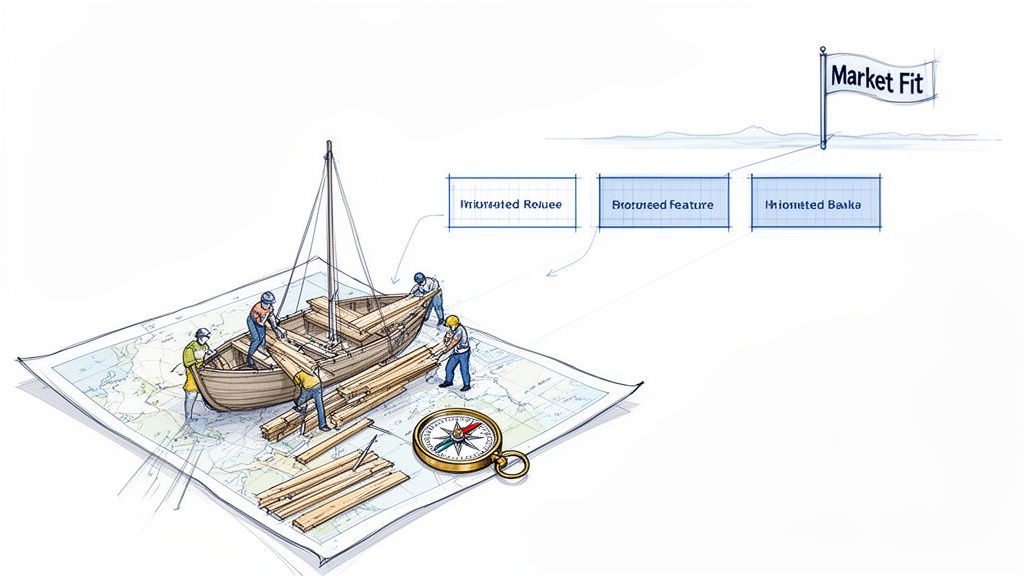
For bootstrapped founders, flying without a strategy feels a lot like running on a treadmill. You’re pouring in the effort—shipping features, squashing bugs, answering support tickets—but that Monthly Recurring Revenue (MRR) needle just isn’t moving. It’s a reactive cycle that burns through your two most valuable assets: time and focus.
Strategic product development is the cure. It’s a way of thinking that connects your day-to-day tasks back to the big picture, ensuring every ounce of effort is actually productive, not just busy.
The Core Idea of Strategy
At its heart, this is all about making intentional choices. Instead of asking, “What can we build next?”, the question becomes, “What should we build next to get us closer to our goal?”. That simple shift in perspective is a game-changer. It forces you to define what success looks like and then work backwards from there.
For a small SaaS team, the benefits are huge:
- De-risking Your Venture: You validate ideas before you write a single line of code, so you stop building features that nobody actually wants.
- Conserving Limited Resources: Every hour and every pound is channelled toward a specific, impactful outcome. No more wasted effort.
- Building a Sustainable Business: You end up with a product that people genuinely need and are happy to pay for, which is the only way to survive long-term.
“A product development strategy defines how to achieve the vision behind the product without getting too deep into details… The task of the product development strategy is not only to explain what to build but also to emphasize what not to build.”
This discipline is what stops “feature creep” dead in its tracks. It keeps your product lean, focused, and exceptional at solving one core problem really, really well.
From Reacting to Leading
Ultimately, strategic product development is what gets you out of the guessing game. You move from hoping you’re building the right thing to knowing what will make the biggest impact. It aligns your product roadmap directly with your business goals, making sure your development work actually generates measurable growth. A huge piece of this puzzle is achieving Product Market Fit, where your solution is the perfect answer to a real market need.
This isn’t about creating massive documents or getting bogged down in corporate bureaucracy. It’s a nimble, iterative mindset. By constantly figuring out what your users need and testing your assumptions, you create a tight feedback loop that fuels smart product decisions. That’s the secret to building a product that doesn’t just survive, but truly thrives.
To get this flywheel spinning, check out our guide on setting up a process for continuous product discovery.
Why You Can’t Just “Wing It” in Southeast Asia’s SaaS Market
Trying to break into the Southeast Asian SaaS market without a solid strategy is like trying to cross a street in Ho Chi Minh City during rush hour. Blindly. On a unicycle. You might make some frantic progress, but you’ll get overwhelmed before you get anywhere meaningful. This region isn’t one giant, uniform market; it’s a vibrant, chaotic, and incredibly diverse collection of different economies, cultures, and levels of digital readiness.
A reactive, feature-first approach is doomed from the start. What absolutely delights a customer in Singapore might completely confuse someone in Indonesia or be totally irrelevant in Vietnam. Strategic product development is your map through this complexity. It forces you to build something that truly resonates with one specific group before you even think about taking on the whole region.
The Indonesia-Singapore Paradox
A classic strategic playbook many founders use is what I call the “Indonesia-Singapore paradox.” It’s a brilliant way to de-risk and scale a new product by leveraging the unique strengths of both markets. It’s strategy in action, plain and simple.
-
Singapore for Validation: Think of Singapore as your high-tech testing lab. With its crazy-high digital penetration and mature business landscape, it’s the perfect place to validate your core idea. You can test your value proposition, pricing, and key features with a sophisticated user base that won’t hesitate to tell you what’s wrong.
-
Indonesia for Scale: Once you’ve ironed out the kinks, you turn to Indonesia. With its massive, mobile-first population of over 270 million, this is where you find explosive growth. Here, you adapt your proven product for a mass market, focusing on hitting huge numbers and making it accessible to everyone.
This two-step dance conserves your most precious resource: cash. Instead of building a generic product for a non-existent “pan-Asian” user, you prove it works in a controlled environment first, then tweak it for a hyper-growth market.
Tapping into a Digital Gold Rush
The opportunity in Southeast Asia is staggering, but you have to be smart about it. The region’s SaaS market is on track to hit $203 billion by 2025, growing at a mind-boggling 25.3% CAGR—a rate that leaves European markets in the dust. Strategic hubs like Singapore, which commands 31% of the market share, are the perfect launchpad for testing ideas before scaling into a true unicorn factory like Indonesia. For bootstrappers, the path is clear. And keep an eye on Vietnam—its digital economy is set to reach $49 billion by 2030, making it a prime spot for R&D. You can read more about this in this tale of two SaaS markets and their growth.
A smart strategy for a bootstrapper isn’t about competing with enterprise giants head-on. It’s about finding and completely dominating a profitable niche where you can provide exceptional value.
For a small team, this is the only way to play. You find a specific, painful problem that’s unique to a certain group—like inventory management for small retailers in Jakarta or class scheduling for freelance tutors in Manila—and you solve it better than anyone else. That sharp focus is what lets you build a loyal customer base and a profitable business without needing millions in VC funding.
Aligning with Regional Realities
A huge part of a winning strategy is making sure your product and business model fit local expectations. A “pay-as-you-go” culture is king here; businesses are often suspicious of complex, multi-year contracts. They want simple, low-friction tools that just work.
This is exactly why unified platforms like HappyPanda are such a natural fit for the region. Instead of asking a small business owner to juggle five different tools for emails, feedback, and onboarding, a single platform offers an all-in-one, affordable solution. Your product strategy needs to reflect this hunger for simplicity and value, delivering a seamless experience that solves a real problem without adding a bunch of complexity and cost.
The Five Pillars of Strategic Product Development
Strategic product development isn’t some high-and-mighty theory you read about in a textbook. It’s a hands-on, repeatable process. For bootstrapped founders, it’s best to think of it as a continuous loop made of five core pillars. This isn’t a straight line you walk once; it’s a cycle you spin over and over, sharpening your product with every turn.
Getting this cycle right is how you stop guessing what to build and start knowing what will drive real growth. Each pillar flows directly into the next, creating a powerful engine that connects your day-to-day grind with your big-picture goals.
Let’s break down these pillars into a simple playbook. The table below gives a quick overview of each stage, what you’re trying to achieve, and how a unified platform like HappyPanda can keep things running smoothly without needing a dozen different tools.
The Five Pillars of Strategic Product Development for Bootstrappers
| Pillar | Core Goal | Bootstrapper’s Playbook | How a Unified Platform Helps |
|---|---|---|---|
| 1. Discovery | Understand the real user problem. | Conduct monthly user interviews, analyse support tickets, and do competitor “tear-downs.” | Centralises user feedback, survey responses, and support chats in one inbox. |
| 2. Prioritisation | Decide what to build next (and why). | Use simple frameworks like RICE or MoSCoW to score and rank ideas objectively. | Tags and categorises feedback to reveal patterns, making it easier to spot high-impact ideas. |
| 3. Validation | Confirm there’s demand before writing code. | Run landing page tests, demo low-fidelity prototypes, or offer a “concierge” MVP. | Use lifecycle emails and in-app messages to recruit users for prototype testing. |
| 4. Delivery | Ship small, iterative improvements consistently. | Focus on small, frequent releases that test a specific hypothesis. Ship, learn, repeat. | Announce new features and fixes with an integrated changelog to keep users in the loop. |
| 5. Measurement | Measure the impact of what you’ve shipped. | Track feature adoption, user engagement, and retention—not just sign-ups. | Analyse how new features impact CSAT/NPS scores and user behaviour over time. |
This framework isn’t just about building features; it’s about building a sustainable business by making smarter bets with your limited time and resources. Now, let’s dive into each one.
Pillar 1: Discovery
The Discovery pillar is all about answering one simple question: “What problem are we really solving, and for whom?” As a bootstrapper, you don’t need expensive market research reports. You just need to get your hands dirty with some lightweight, high-impact methods.
The whole point here is to gather raw, unfiltered insights straight from your users and the market. And it’s not a one-off task you do at the beginning—it’s a continuous habit.
Practical Discovery tactics for a small team include:
- Customer Interviews: Actually talk to your users. Aim for real conversations with at least five of them every single month. Ask open-ended questions about their workflows and pains. Don’t pitch; just listen.
- Feedback Analysis: Systematically comb through your support tickets, survey responses, and in-app feedback. Hunt for recurring themes and pain points that scream “widespread need.”
- Competitor “Tear-downs”: Sign up for your competitors’ products. Go through their entire onboarding flow, poke around their core features, and read their customer reviews. You’ll learn their strengths and, more importantly, their weaknesses.
Pillar 2: Prioritisation
Okay, so your backlog is now overflowing with ideas from the Discovery phase. Great problem to have! But now you face a new challenge: what on earth do you build next? This is where the Prioritisation pillar comes in, forcing you to apply logic to make tough calls.
Without a system, you’ll naturally drift toward the easiest task, the loudest customer request, or whatever idea popped into your head this morning. A simple framework replaces that gut feeling with a structured, objective approach.
A classic mistake is treating every feature request as equal. A solid prioritisation framework makes sure you’re working on what delivers the highest strategic value, not just what seems urgent.
Two of the most popular frameworks for SaaS teams are:
- RICE Scoring: This method scores ideas based on Reach, Impact, Confidence, and Effort. It’s a fantastic way to get a quantifiable score to compare totally different ideas, like a small UI tweak versus a major new feature.
- MoSCoW Method: This framework helps you categorise features into Must-have, Should-have, Could-have, and Won’t-have. It’s perfect for defining scope and making sure you ship a functional core product first.
Pillar 3: Validation
The Validation pillar is your secret weapon against building something nobody wants. Before you sink weeks or months into writing production-ready code, you absolutely have to confirm that there’s real demand for your big idea. For a bootstrapper, this step is critical for not wasting precious resources.
Validation is all about testing your core assumptions with the least amount of effort possible. You’re trying to get a clear “yes” or “no” from the market before you go all in.
This infographic shows a simplified flow for how SaaS companies in Southeast Asia approach this, often validating in a mature market before scaling into a larger one.
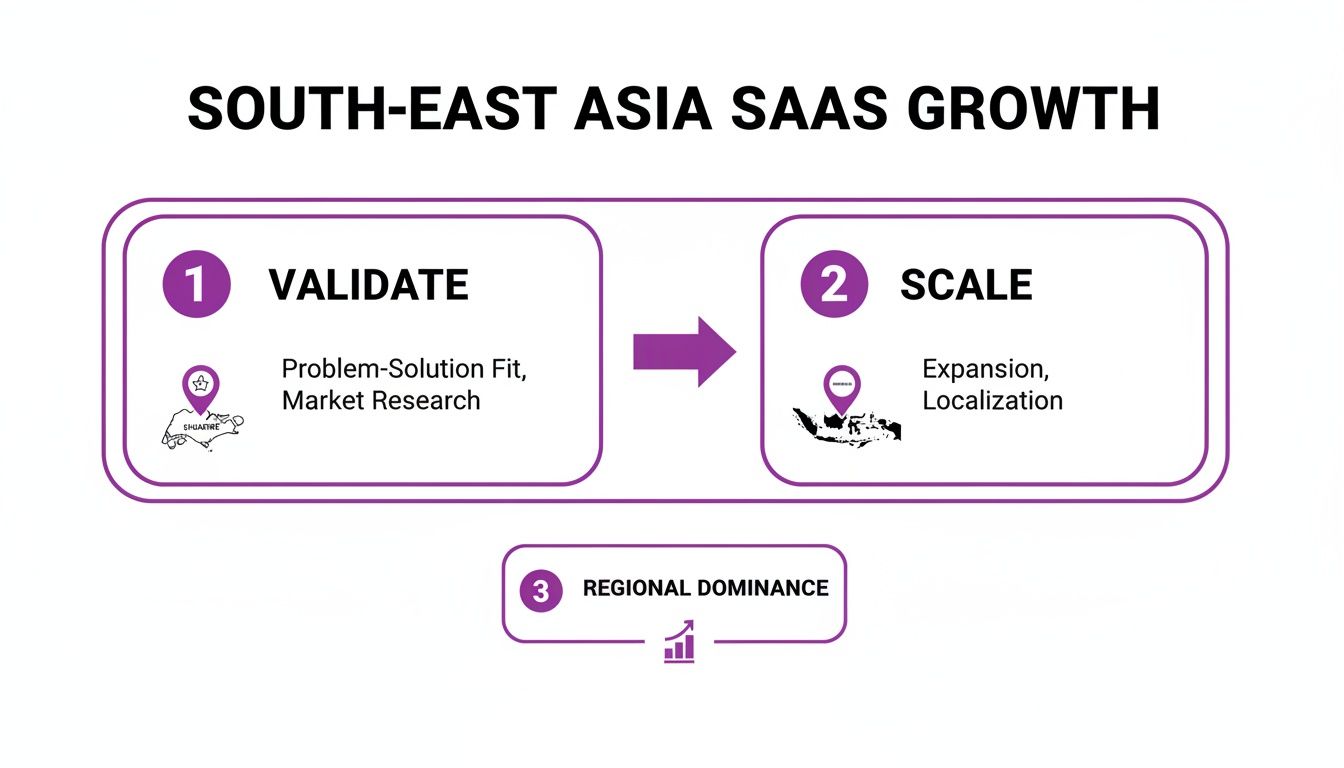
This illustrates the “validate then scale” approach—proving a concept in a market like Singapore before adapting it for hyper-growth in a market like Indonesia.
Lean validation techniques include:
- Landing Page Tests: Whip up a simple landing page describing the new feature with a sign-up form for early access. Drive a little bit of traffic to it and see what percentage of people are interested enough to sign up.
- Prototype Demos: Build a non-functional prototype using a tool like Figma. Get it in front of potential users and just watch them. Do they get the value instantly? Are they confused? Their reactions are gold.
- Concierge MVP: Manually deliver the “feature” for a handful of early users. This lets you prove the value and learn all the messy details of the process before you even think about automating it.
Pillar 4: Delivery
Delivery is where the rubber meets the road—code gets written and shipped. But in a strategic context, this isn’t about massive, big-bang releases that happen twice a year. It’s about shipping small, iterative improvements consistently. This approach slashes risk, shortens your feedback loops, and gets value to customers way faster.
Think of each release as a tiny experiment designed to test a hypothesis. Did that UI change improve activation rates? Did the new integration boost retention? The goal is to learn something with every single deployment.
Pillar 5: Measurement
Finally, the Measurement pillar closes the loop. After you’ve delivered a feature, you must measure its impact against the goals you set back in the prioritisation phase. This is the only way to know if your strategy is actually working.
Forget vanity metrics like page views or total sign-ups. You need to focus on the numbers that truly signal the health of your product and business.
Key metrics to obsess over include:
- Feature Adoption Rate: What percentage of users are actually using the new thing you built?
- User Engagement: Are people more active in the app after the release?
- Retention: Are users who adopt the feature more likely to stick around long-term?
- Customer Satisfaction (CSAT/NPS): How did the change affect overall user happiness?
The insights you gather here feed directly back into Discovery. A feature with terrible adoption might trigger a new round of customer interviews to figure out why, kicking off the entire five-pillar cycle all over again.
Building Your Customer-Powered Flywheel
Those five pillars are a solid framework, but the real magic happens when you connect them into a self-powering cycle. Forget linear, step-by-step processes. The goal here is to build a customer-powered flywheel—an engine where happy users naturally fuel your next wave of growth.
This isn’t just fluffy theory. It’s about turning your product into an active participant in its own development. Instead of treating customer chats and feedback as a separate chore, you bake it right into the product experience. You create a seamless loop that goes from user insight straight to feature delivery.
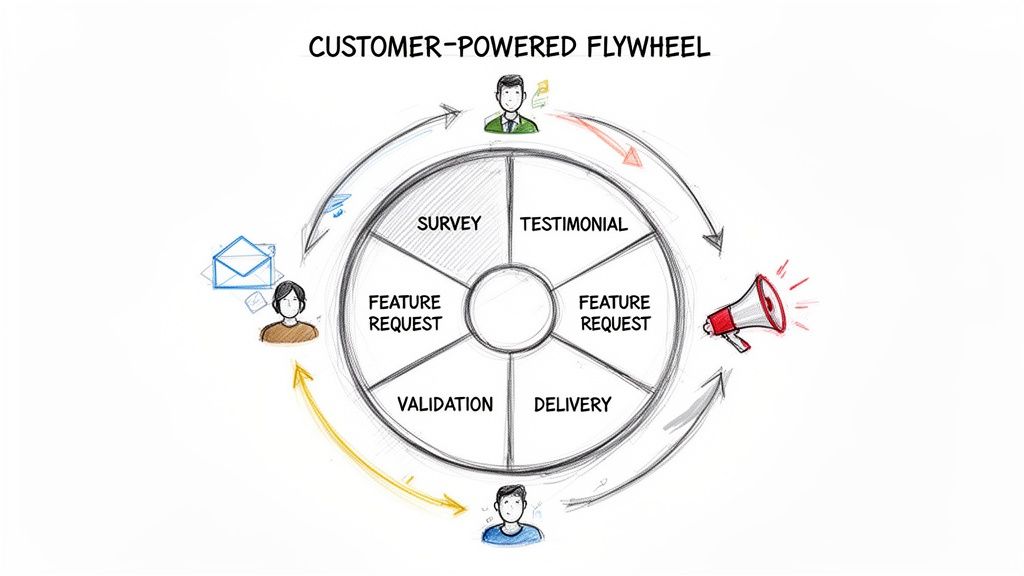
Suddenly, your product isn’t just a jumble of tools. It becomes a fully integrated system for executing your strategy. The diagram above shows exactly how it works: measurement sparks discovery, which informs validation and delivery, creating a system that learns and gets better on its own.
The Flywheel in Action: A Practical Example
Let’s make this tangible. Imagine you run a project management SaaS for small creative agencies. You want to build what your best customers actually need, not just what you think they need.
Here’s how you get the flywheel spinning:
-
Measurement: An automated in-app survey pops up for a user who just completed their 10th project. It asks for a Net Promoter Score (NPS), and they give you a 9 out of 10. Boom. That’s your trigger.
-
Discovery: Because the score was high, an automation rule instantly fires off a personalised email asking if they’d be willing to leave a testimonial. The user agrees and casually mentions they love the tool but wish it had a simple client approval workflow. Gold.
-
Validation: You’ve just captured a high-value feature idea. Instead of chucking it onto a messy backlog, you create a new user segment in HappyPanda called “Power Users at Creative Agencies.” You send this specific group a quick, targeted survey: “How valuable would a one-click client approval feature be?” The response is overwhelmingly positive.
-
Delivery: With solid validation, your team builds a lightweight version of the feature. The moment it goes live, you hit two channels. An in-app changelog notification appears for all active users, and a targeted email goes out only to the user segment that asked for it. They feel heard, and you look like a hero.
This entire sequence closes the loop, moving you from passive measurement to active, strategic development. You’ve used direct customer feedback to discover, validate, and ship a feature you know your best users want. If you’re looking to put a system like this in place, you can learn more about closing the feedback loop in our detailed guide.
From Manual Effort to Automated Strategy
The beauty of the flywheel is that it runs on automation. A small, bootstrapped team simply doesn’t have time for constant manual outreach. By setting up simple “if-this-then-that” rules, you can have this entire strategic process humming along in the background.
Building a flywheel means you stop hunting for insights and start designing a system that delivers them to you automatically. It’s the difference between fishing with a single rod and setting up a network of nets that work while you sleep.
This approach is becoming essential, especially in dynamic markets like Southeast Asia. The region’s CRM market, a great proxy for customer-centric SaaS, was valued at USD 2.27 billion in 2025 and is projected to hit USD 2.49 billion by 2031. Your target audience, SMEs, make up a massive 42.60% of this market. These small teams are ditching scattered tools for unified platforms—a trend supercharged by initiatives like Indonesia’s SNAP mandate, which slashes integration costs. To win here, your product has to be an all-in-one solution. You can dig into more data on Southeast Asia’s evolving CRM landscape.
With a tool like HappyPanda, you can visually build these automated workflows without touching a line of code.
For instance, the screenshot below shows a simple automation that connects a positive NPS score directly to a testimonial request.
This workflow is the flywheel in a nutshell. It identifies happy users (Measurement) and automatically asks for social proof (Discovery), turning positive sentiment into a real marketing asset without you lifting a finger.
A Strategic Playbook for Your Next SaaS Launch
Theory is nice, but a solid playbook is what gets the job done. Think of this as your step-by-step checklist for launching your next micro-SaaS. It’s all about speed and efficiency, showing you how to spin up a complete customer feedback and communication system in minutes, not weeks.
This isn’t about getting lost in complex project plans. It’s about moving fast, learning from real users, and iterating quickly. A huge part of that is knowing how to build MVP that validates your idea fast. It’s the key to using your resources wisely and getting those crucial early signals from the market.
Bookmark this guide. You’ll want to reuse it for every product you launch.
Phase 1: Pre-Launch Validation (Day 0–14)
Before you even think about writing a line of production code, your first job is to see if anyone actually wants what you’re selling. The goal here is simple: get a clear signal from your target market that your idea solves a problem they’ll happily pay to fix.
-
Craft a Simple Landing Page: Don’t overthink it. Clearly describe the problem you solve and how your solution is different. Your call-to-action should be just as clear—something like “Get Early Access” or “Notify Me on Launch.”
-
Run a Smoke Test: Push a small amount of targeted traffic to the page. The percentage of visitors who sign up is your first, and most critical, data point. Are you onto something?
-
Gauge Interest with a Survey: The moment someone signs up, hit them with a one-question survey: “How disappointed would you be if this product no longer existed?” It’s a classic product-market fit question that gives you a quick read on how intense the need really is.
This whole pre-launch phase is about gathering evidence. A high sign-up rate paired with strong survey responses gives you the green light to start building with confidence.
Phase 2: Trial Conversion and Onboarding (Day 15–Launch)
Once you have a working MVP, your focus pivots. Now, it’s all about converting those curious trial users into paying customers. That means guiding them straight to their “aha!” moment—the point where they truly get the value of your product.
An effective onboarding flow is non-negotiable here. Our comprehensive guide on creating a solid go-to-market strategy is a great place to start.
Next, you need an automated system that nudges new users towards activation.
- Create an Onboarding Checklist: Use an in-app widget to walk new users through the 3-5 key actions they need to take to be successful. It gives them a clear path to value.
- Set Up Automated Trial Conversion Emails: A simple email sequence can work wonders. Send a welcome email, a mid-trial check-in with a few helpful tips, and a trial-ending reminder.
- Configure Lifecycle Emails: Look beyond the trial. Set up basic emails to re-engage inactive users or celebrate milestones. This is how you nurture your user base for the long haul.
With a platform like HappyPanda, you can use a “SaaS Starter Kit” recipe to generate and deploy all of this—the landing page survey, onboarding checklist, and email sequences—in under ten minutes.
Phase 3: The Post-Launch Feedback Loop (Launch and Beyond)
Your work isn’t done at launch; it’s just getting started. Now you need to build a system that constantly collects feedback to fuel your roadmap and keep you moving in the right direction.
This is especially true in fast-growing markets. Take Southeast Asia’s SaaS scene, for instance. Average spending per employee on SaaS tools is predicted to jump from $3.79 in 2020 to $13.47 by 2025. This massive 2.5-fold increase shows a region in a frantic digital catch-up, where indie hackers are prioritising nimble, all-in-one platforms over clunky legacy software. For bootstrappers in this mobile-first world, bundling feedback, emails, and onboarding into one simple plan fits perfectly with the pay-as-you-go culture and the relentless need for speed.
Set up these automated feedback collectors from day one:
- Launch an In-App NPS Survey: Trigger an NPS survey about seven days after a user signs up. This gives you an early read on customer happiness.
- Automate Testimonial Collection: Create a simple rule: if a user gives you an NPS score of 9 or 10, automatically send them an email asking for a testimonial. Easy.
- Deploy a Changelog: Announce new features and fixes with an in-app changelog widget. It keeps your users in the loop and shows them you’re constantly improving the product.
Here’s the rewritten section, designed to match the human-written, expert tone of the examples provided:
Build Strategically, Not Just Faster
Let’s be honest. For a bootstrapped founder, your time and attention are finite resources. You can’t afford to burn them on guesswork. Adopting a strategic approach isn’t about bogging yourself down with corporate-style processes; it’s about making sure every hour you invest actually pushes the needle forward.
That’s what building strategically, not just faster, really means.
The whole point is to forge a direct, unbreakable link between your big-picture vision and the code you ship every day. Those five pillars we just walked through—Discovery, Prioritisation, Validation, Delivery, and Measurement—aren’t just theory. They’re a repeatable playbook for making smarter bets, and it becomes surprisingly manageable when you have a single platform connecting customer conversations to your product roadmap.
It’s time to stop the frantic juggling act between scattered tools and a disjointed workflow. You can build a cohesive, customer-centric engine with HappyPanda that turns real user insights into sustainable growth. Your next killer feature is probably already sitting in your feedback inbox; a strategic system just helps you find it, prove it’s a winner, and ship it with confidence.
Got Questions? We’ve Got Answers
Stepping into strategic product development can feel like a lot, especially when you’re a bootstrapper wearing multiple hats. Let’s tackle some of the common questions we hear from founders.
How Much Strategy Is Too Much?
Great question. The point of being strategic isn’t to get bogged down writing a hundred-page business plan or fall into the dreaded “analysis paralysis” trap. For a small team, strategy should be a lightweight, guiding force—not a concrete set of rules you can never break.
Think of it as your compass, not a turn-by-turn GPS. It points you in the right general direction but doesn’t dictate every single step of the journey. If you find you’re spending more time on the strategic process than actually building and learning, you’ve gone too far. It should bring clarity, not more complexity.
Can a Solo Founder Really Do All This?
Absolutely. In fact, solo founders are often perfectly positioned to be strategic because they have a bird’s-eye view of everything, from customer support tickets to the last line of code they wrote. The secret is to lean on simple frameworks and smart automation.
You don’t need a dedicated product manager to make this work. The five pillars—Discovery, Prioritisation, Validation, Delivery, and Measurement—can be managed with a surprisingly simple system. It’s all about making smart, evidence-based decisions, which is even more critical when you’re the only one making them.
The heart of strategy for a solo founder is simple: stop guessing what to build. Instead, create a repeatable system that uses real customer feedback to tell you what the highest-impact work is right now.
What If My Customers Don’t Know What They Want?
Ah, the classic dilemma. This is precisely why the Discovery and Validation pillars are so critical. Customers are fantastic at telling you about their problems, but they aren’t always great at designing the solutions. Your job isn’t to take feature requests at face value; it’s to dig deeper and uncover the real pain point underneath.
For example, if a user asks for a “PDF export,” don’t just add it to your backlog. Ask why they need it. You might find out their actual goal is to share a report with their boss. Suddenly, a simple, shareable link might be a much faster and better solution. Always focus on the “job to be done,” not just the feature they think they need.
Ready to stop juggling scattered tools and build a cohesive, customer-powered product engine? HappyPanda combines everything you need—feedback, emails, onboarding, changelogs, and testimonials—into one simple platform. Start building strategically today.