
Continuous product discovery is all about staying in a constant conversation with your users to figure out what to build next. It’s not a project with a start and end date; think of it more like a habit—a muscle you build for learning, testing, and adapting so your product never stops delivering real value.
Why Continuous Product Discovery Matters

Too many SaaS teams are stuck in a “launch-and-pray” cycle. They spend months building a feature based on what they think customers want, release it with a big bang, and then just hope for the best. This approach treats the product launch as the finish line when it should be the starting gun.
The painful truth is that this way of thinking often leads to building features nobody actually uses—a huge waste of time, money, and morale. Continuous product discovery completely flips the script. It turns product development from a monologue, where you’re just talking at your users, into a genuine, ongoing conversation with them. To really get it, it helps to understand what is product discovery in the first place before you make it a daily practice.
The Shift from Building to Learning
Instead of building in a silo, this approach weaves learning directly into your workflow. It’s a simple loop: identify user problems, test out potential solutions, and then tweak your approach based on what you learn from real people. For small SaaS teams, that kind of agility is a massive advantage.
This shift is especially critical in markets that move at lightning speed. Just look at the explosion of social commerce in Southeast Asia, where user behaviour changes in the blink of an eye. Platforms like TikTok Shop now make up around 20% of the region’s total e-commerce sales, all thanks to a young, mobile-first audience. Brands that aren’t constantly learning from trends like this get left behind, fast.
Continuous product discovery isn’t about shipping more features. It’s about increasing the odds that the features you do ship will solve a real problem and make a meaningful impact on your business.
Key Benefits for Small SaaS Teams
Getting into this mindset helps teams move faster and smarter. It’s less about dusty academic theories and more about building practical, repeatable habits.
- Reduces Product Failure Risk: By getting feedback on ideas early and often, you stop pouring development hours into features that are destined to flop.
- Improves User-Centric Design: When you’re constantly talking to users, you can’t help but build a product that feels intuitive and genuinely useful. A great first step is learning how to get quality feedback from users.
- Creates a Competitive Edge: While your bigger competitors are stuck in slow, bureaucratic development cycles, your team can pivot and respond to what the market needs right now.
- Boosts Team Alignment: When product, design, and engineering are all plugged into the same user insights, everyone is pulling in the same direction. That means less friction and fewer misunderstandings.
The Four Pillars of Discovery
Trying to make continuous product discovery a regular habit can feel like a massive task, especially for a small SaaS team already juggling a dozen other things. But here’s the secret: you don’t have to do everything at once. The trick is to break the process down into a simple, repeatable loop. Think of it as building a well-oiled engine—you just need four key parts working in harmony.
These parts are the four pillars of discovery: Continuous User Research, Ideation and Prioritisation, Prototyping and Testing, and Learning and Iteration. Each one feeds into the next, creating a powerful feedback cycle that turns guesswork into genuine momentum.
Pillar 1: Continuous User Research
This is your compass. It’s the foundation for everything else, making sure your team is always pointing towards real user problems. This isn’t about launching huge, one-off research projects. It’s about building small, consistent habits to stay plugged into your users’ world.
For a small team, this could look like:
- Weekly User Chats: Block out just one or two hours a week to talk to a customer. It’s a tiny time investment that pays off big in insights.
- Mining Support Tickets: Your support inbox is a goldmine of feedback. Regularly scan tickets to find recurring frustrations and pain points.
- In-Product Surveys: Drop a simple survey right inside your app to catch users for contextual feedback just after they’ve done something important.
The goal isn’t to find perfect, final answers. It’s about constantly collecting clues. Every conversation, ticket, and survey response helps paint a richer picture of your users’ challenges and unmet needs. This whole pillar is really just about one thing: listening.
Pillar 2: Ideation and Prioritisation
Okay, so you’ve got a steady stream of insights flowing in. Now you need a way to turn all that listening into actual ideas. This pillar is where you start drawing the map. Ideation is simply the creative part—brainstorming ways to solve the problems you’ve just uncovered.
The point of ideation isn’t to find the one “best” idea. It’s to generate a bunch of different possibilities you can test out. A healthy discovery process explores several paths before locking one in.
Once you have a list of ideas, prioritisation is crucial. Let’s be real, a small team can’t build everything. You have to focus on what’s going to deliver the most bang for your buck. Frameworks like a simple Value vs. Complexity matrix or RICE (Reach, Impact, Confidence, Effort) are brilliant for this. They take the guesswork out of decision-making, helping you focus on problems that are both painful for the user and smart for the business.
Pillar 3: Prototyping and Testing
Think of this pillar as your scouting party. Instead of sinking weeks of engineering time into building a full-blown feature, you create cheap, low-effort versions to test your assumptions first. This is where you find out if your brilliant idea is actually as brilliant as you think it is.
Prototyping doesn’t have to be a big technical affair. For a SaaS team, it can be as simple as:
- Quick Mock-ups: Firing up a tool like Figma (or even PowerPoint) to create a visual of a new feature flow.
- Clickable Prototypes: Stitching those mock-ups together to fake the user experience, all without writing a single line of code.
- Concierge Tests: Manually delivering a service for a few users to see if the solution is valuable before you even think about automating it.
The whole point is to get something tangible in front of real users, fast. This lets you gather feedback on whether a solution is usable and valuable before you commit serious development time, massively reducing the risk of building something nobody wants.
Pillar 4: Learning and Iteration
And finally, this is where you update your map based on what your scouts found. The feedback and data from your tests circle right back to the beginning, enriching your understanding of the user and kicking off the cycle all over again. Learning is the fuel that keeps the continuous product discovery engine running.
Did users click where you expected? Did the prototype actually solve their problem? What new questions popped up during testing? The answers inform your next move. You might decide to tweak the prototype, pivot to a totally different solution, or even realise the problem you started with wasn’t that important after all. That’s not failure; that’s learning. This loop ensures your product evolves based on evidence, not just assumptions.
To put it all together, here’s a quick summary of how these pillars work in practice.
Continuous Discovery Pillars and Key Activities
| Pillar | Primary Goal | Key Activities for Small SaaS Teams |
|---|---|---|
| User Research | Constantly understand user problems and needs. | Weekly user chats, analysing support tickets, in-product surveys. |
| Ideation & Prioritisation | Generate and select high-impact solutions. | Brainstorming sessions, using frameworks like RICE or Value vs. Complexity. |
| Prototyping & Testing | Validate ideas with minimal effort and risk. | Creating mock-ups, building clickable prototypes, running concierge tests. |
| Learning & Iteration | Turn test results into actionable product insights. | Analysing test feedback, deciding to iterate, pivot, or kill an idea. |
Each stage is designed to flow naturally into the next, creating a sustainable rhythm that keeps you perfectly in sync with your customers’ needs.
How to Build Your Discovery Engine
Theory is great, but let’s be honest—real progress happens when you turn those concepts into concrete habits. For a small SaaS team, that means building a lightweight but reliable “discovery engine” to pipe user insights directly into your workflow. The goal is to make learning a reflex, not a special project that needs its own kick-off meeting.
This isn’t about shelling out for complex, expensive software. It’s about connecting the tools you already use, like Slack and Linear, to create a seamless feedback loop. You’re building a system that grabs user feedback, helps you make sense of it, and then nudges actionable items right where your team lives and breathes.
Step 1: Capture Feedback From Everywhere
Your users are talking about your product all over the place. The first, most crucial step is to funnel all that chatter into one central hub. Without a single source of truth, brilliant insights get lost in random Slack DMs, buried in email threads, or completely forgotten after a sales call.
A feedback collection tool like HappyPanda is built for exactly this. It lets you capture input from multiple channels:
- An in-app widget: This is your direct line. It lets users submit feedback, report bugs, or share ideas without ever leaving your product.
- Public feedback boards: You can create a space where users see what others are suggesting and vote on ideas. It’s an instant signal for what’s most popular.
- Direct integrations: Hook it up to tools like Intercom or your support email to automatically pull customer conversations into your feedback hub.
By centralising everything, you create a rich, searchable database of user needs. You can explore all sorts of ways to gather this info by checking out different types of customer feedback forms.
Step 2: Turn Raw Feedback Into Actionable Insights
Let’s face it, raw feedback is messy. A single user comment might contain a bug report, a feature request, and a general grumble all rolled into one. Your next job is to process this raw data into structured, trackable “Insights.”
Think of an Insight as a single, clear idea distilled from one or more pieces of feedback. For example, if three different users mention struggling with your app’s date-picker, you can create one single Insight: “Improve date selection usability on the dashboard.”
This simple act of organising the chaos helps you spot patterns so much more easily. A tool like HappyPanda helps by letting you link multiple feedback submissions to a single Insight, giving you a clear count of how many users are hitting the same wall.
An “Insight” isn’t just a summary of feedback; it’s a hypothesis about a user problem. It’s the starting point for investigation, not a direct command to build a feature.
This is especially vital in competitive markets. Brands must quickly adapt to their users’ specific needs to stand out.
Step 3: Integrate Insights Into Your Workflow
This is where your discovery engine really comes to life. Once an Insight is created and feels solid, it needs to slide into your team’s existing workflow without adding friction. This is where integrations and webhooks become your best friends.
Here’s a practical example of a workflow using HappyPanda, Slack, and Linear:
- Feedback Arrives: A user submits feedback through the HappyPanda widget. A notification instantly pops up in a dedicated
#feedbackchannel in Slack, so the whole team sees it. - Insight is Created: The product manager reviews the feedback. Noticing a recurring theme, they create a new Insight called “Users need bulk-export functionality.”
- Push to Linear: With one click, they push this Insight to Linear. Boom—a new issue is automatically created in the “Triage” or “Backlog” section of their product board, complete with a link back to the original feedback in HappyPanda.
- Team Discussion: The new Linear issue triggers another notification, this time in the
#product-devSlack channel. Now engineers and designers can jump in to discuss feasibility and ask questions.
This simple, automated process connects a user’s original comment directly to the engineering backlog, making sure nothing ever falls through the cracks. Once you’ve got your engine humming, you’ll need a way to communicate the outcomes, which is where creating a clear product roadmap comes in. It ensures everyone gets the “why” behind what’s being built.
The four pillars of continuous discovery—research, ideation, testing, and iteration—provide the perfect framework for this engine.
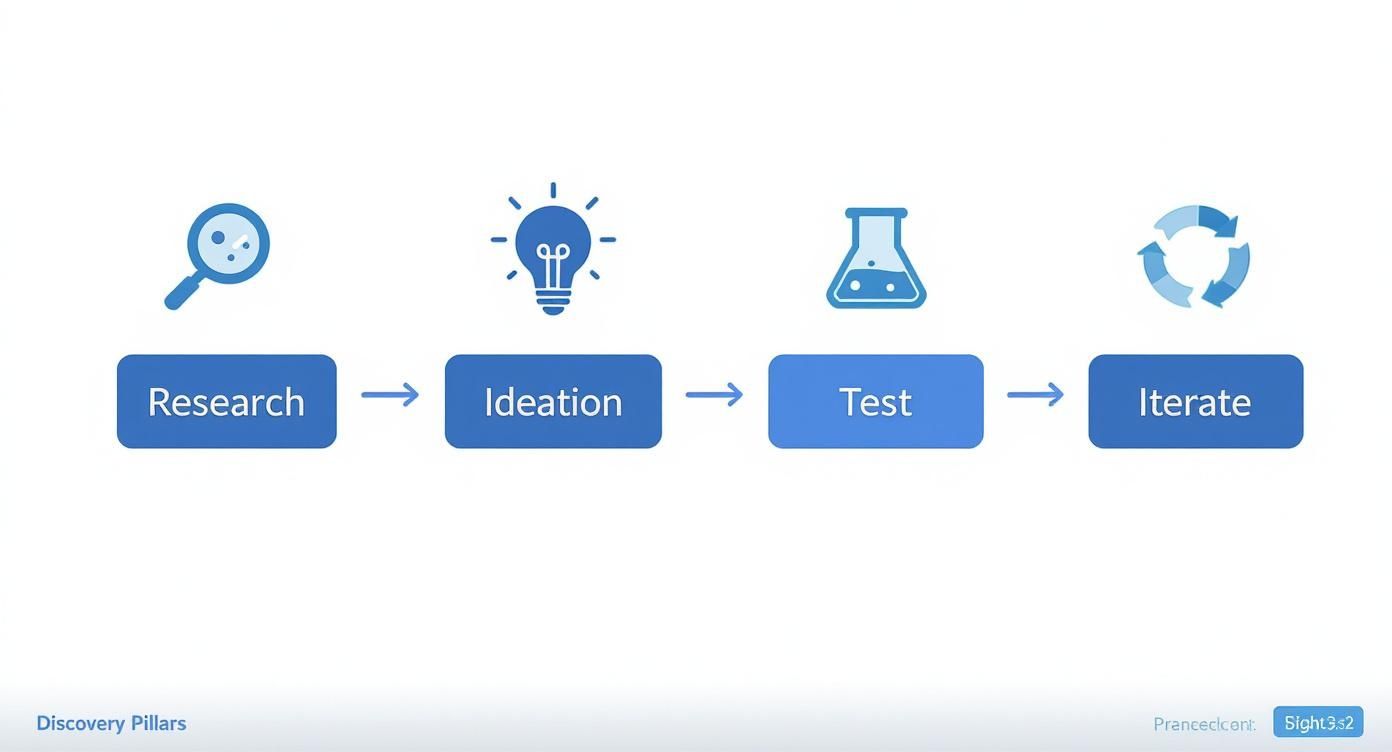
This cycle shows how each stage flows into the next, creating a self-sustaining loop of learning and improvement that’s powered by the engine you just built.
Measuring What Truly Matters for Discovery
In the old world of product development, we loved to measure output. How many features did we ship this quarter? How many lines of code did we push? These numbers feel good—they show we’re busy. But they tell you nothing about whether you’re actually solving real problems for real people. They measure motion, not progress.
A huge part of embracing continuous discovery is changing your scoreboard. Instead of tracking what you’ve built, you start measuring what you’ve learned. This means ditching the vanity metrics and focusing on KPIs that tell you how healthy and fast your learning cycle is.
The goal isn’t to ship more features; it’s to increase the rate at which you learn what your users truly need. Healthy discovery metrics are a direct reflection of this learning velocity.
For small SaaS teams, this is everything. Focusing on the right numbers helps you justify the time you spend on discovery and proves your efforts are leading to smarter, more impactful product decisions.
From Output Metrics to Discovery Outcomes
Let’s get this straight from the start. Traditional metrics are all about the efficiency of the “factory”—how fast can we build stuff? Discovery metrics, on the other hand, are about the effectiveness of your decisions. It’s a complete flip in perspective that puts customer value right at the centre of your universe.
Getting your head around this difference is the first step toward building a culture that values learning over just being busy. A quick side-by-side shows just how different these two mindsets are.
This table shows the shift in focus from traditional development metrics to those that measure the effectiveness of continuous product discovery.
Comparing Output Metrics vs Discovery Outcomes
| Metric Type | Traditional Metric (Output-Focused) | Discovery Metric (Outcome-Focused) |
|---|---|---|
| Speed | Velocity (story points completed) | Time to Insight |
| Volume | Number of Features Shipped | Experiment Velocity |
| Success | Meeting Project Deadlines | User Value Score |
This isn’t just semantics; it’s a move from celebrating shipping code to celebrating validated learning.
Key Metrics for Your Discovery Engine
So, what should you actually track? Here are three powerful, outcome-focused metrics perfect for a small team looking to measure the effectiveness of their discovery efforts.
1. Time to Insight
This is the heartbeat of your discovery process. Time to Insight measures how quickly a piece of raw user feedback gets processed, understood, and turned into a testable hypothesis.
Think of it as the latency in your learning loop. A long Time to Insight means feedback is getting stuck somewhere—maybe it’s rotting in an inbox, lost in a Slack channel, or waiting for someone to finally get around to it.
- How to Calculate It: Measure the time from when feedback is received (e.g., a HappyPanda submission) to when a corresponding Insight or idea is created in your backlog.
- What’s a Good Target: For a small, nimble team, aim for under 48 hours. The goal is to make processing feedback a daily habit, not a weekly chore.
2. Experiment Velocity
Once you have an insight, how fast can you test it? Experiment Velocity tracks the number of experiments your team runs per cycle, whether that’s a week or a two-week sprint. These could be anything from prototype tests and user interviews to small A/B tests.
This isn’t about running perfect, massive experiments. It’s about maintaining a high tempo of learning. Even showing a mock-up to two users counts. High velocity means you’re constantly poking your assumptions with a stick to see if they hold up.
- How to Calculate It: Simply count the number of distinct experiments completed per week or sprint.
- What’s a Good Target: A great starting goal for a small team is 1-2 experiments per week. This keeps momentum high without derailing your development schedule.
3. User Value Score
Finally, you need to know if your validated ideas actually delivered the goods post-launch. A User Value Score is a simple metric pulled directly from feedback on a new feature.
You can grab this with targeted in-app surveys that pop up after a user interacts with the new functionality. This could be a simple Customer Satisfaction (CSAT) score or a custom question like, “How valuable is this new feature to you?” For a deeper dive into these survey types, it helps to understand the nuances between CSAT and NPS and when to use each one.
- How to Calculate It: After a user tries a new feature, trigger a 1-5 star or emoji-based CSAT survey. Your score is the average rating.
- What’s a Good Target: Aim for an average score of 4 out of 5 or higher. Anything lower is a strong signal that your discovery process might have missed something important, giving you a clear reason to go back and iterate.
Common Discovery Pitfalls to Avoid
Deciding to embrace continuous product discovery is a fantastic first step. But be warned, the path is littered with subtle traps that can trip up even the sharpest teams. Knowing what these pitfalls look like ahead of time is your best defence, making sure your discovery engine keeps humming along.
For small SaaS teams, these hurdles can feel particularly high. With limited resources, every hour is precious, and stumbling into a common trap can kill your momentum. So, let’s break down the usual suspects and figure out how to sidestep them.
Analysis Paralysis
Ah, the classic “too much research, not enough action” dilemma. This is where your team gets so buried in gathering data—endless surveys, interviews, support tickets—that you never actually get around to testing a solution. You’re stuck waiting for that one perfect, mythical insight to appear.
The cure? Embrace small, rapid experiments. Instead of chasing absolute certainty, your goal is to get just enough information to form a testable hypothesis. Remember, continuous product discovery is all about learning by doing, not just by observing from the sidelines.
Confirmation Bias
We’re all human, and we love being right. Confirmation bias is our natural tendency to hunt for information that backs up what we already believe. As a product person with a brilliant idea, the danger is you start cherry-picking user feedback that supports it, while conveniently ignoring anything that doesn’t.
Fight this by actively seeking out dissenting opinions. Keep your interview questions neutral. Instead of asking, “Wouldn’t this new dashboard be amazing?” try something like, “Walk me through how you find the information you need right now.” This simple shift opens the door for honesty, not just a pat on the back.
Treating Discovery as a Phase
One of the biggest mistakes is treating discovery like a one-and-done project. Teams do a huge “discovery phase” at the start, then flip a switch into “delivery mode” and stop listening altogether. This completely misses the whole “continuous” part of the equation.
Discovery isn’t a gate you pass through; it’s a path you walk every single day. The moment you stop learning from users is the moment you start building on outdated assumptions.
The trick is to weave small discovery habits into every single sprint. Maybe it’s one user interview a week, or a team commitment to review five support tickets each day. The key is making it a consistent, low-effort rhythm, not a huge, infrequent event.
This ongoing connection is vital, especially in fast-moving markets. Take e-commerce in Southeast Asia, where platforms have to constantly adapt. A recent report found that nearly 70% of Gen Z consumers there start their research on e-commerce sites, but 73% also check social media and reviews before buying. That kind of complex behaviour shows exactly why a one-off discovery phase would fail. You can dig into more insights on Gen Z’s e-commerce habits on marketech-apac.com.
Failing to Get Stakeholder Buy-In
If your stakeholders—like the execs or the sales team—don’t get the value of continuous discovery, they’ll just see it as a roadblock to “real work.” They’ll push for faster delivery, wondering why you’re wasting time “just talking to users” instead of shipping code.
The solution is to bring them into the fold. Make them part of the process.
- Share recordings: Send them short, punchy clips from user interviews that highlight a key pain point.
- Invite them to listen in: Ask a stakeholder to silently observe a user testing session. The “aha!” moments are contagious.
- Connect insights to outcomes: Clearly draw a line from a discovery insight to a successful feature or, even better, a costly mistake you avoided.
When stakeholders see for themselves how discovery de-risks decisions and drives better business outcomes, they’ll quickly go from being sceptics to your biggest fans.
Making Discovery Your Competitive Advantage
We’ve spent this guide digging into the nuts and bolts of building a product culture that’s driven by learning. It should be pretty clear by now that continuous product discovery isn’t just another box-ticking exercise or a trendy process to follow. It’s a complete shift in how you think—a relentless focus on your customer that gets baked right into your company’s DNA.
This approach stops you from making a series of expensive, risky bets and instead turns product development into a cycle of validated learning. For small, nimble SaaS teams, this isn’t just a “nice-to-have.” It’s your secret weapon. It’s how you consistently punch way above your weight class.
Your Roadmap to a Discovery Culture
To pull it all together, the whole journey really comes down to three core commitments. Think of these as the practical steps that turn all that theory into a sustainable, results-driven habit.
-
Establish the Four Pillars: Get into a rhythm with the full cycle of User Research, Ideation, Prototyping, and Iteration. These pillars are what keep your team grounded in what users actually need, making sure you’re always solving problems that genuinely matter.
-
Build Your Integrated Engine: Don’t let valuable insights gather dust in siloed tools. You need to create an automated feedback loop that pipes customer input directly into your development workflow using tools like HappyPanda, Linear, and Slack. This turns learning into a reflex, not a special project.
-
Focus on Outcome-Based Metrics: Ditch the vanity metrics like how many features you’ve shipped. Start measuring what actually signals progress—your Time to Insight, Experiment Velocity, and the real value new features are delivering to users. These metrics keep you focused on learning, not just building.
Continuous product discovery is your licence to out-learn and outmanoeuvre larger, slower-moving competitors. It’s about creating a product that doesn’t just meet user needs today but evolves right alongside them tomorrow.
By weaving these habits into your daily work, you stop guessing what to build next. You start building a product that feels like it was tailor-made for your users, creating a powerful, defensible moat that no competitor can easily cross. This is how you win.
A Few Common Questions
Alright, even with a solid plan, theory and reality can be two different things. For small SaaS teams juggling a million tasks, the idea of adding one more process can feel… well, a bit much.
Let’s tackle some of the common questions that pop up when you’re trying to make this work in the real world.
How Much Time Do We Actually Need for This?
I get it. The thought of adding another meeting or task to an already packed schedule is daunting. But here’s the good news: when it comes to discovery, consistency beats volume every single time. You don’t need to block out entire days. It’s about building small, repeatable habits that just become part of your team’s weekly rhythm.
A great place to start? Aim for 2-3 hours of dedicated discovery work per person, per week. That’s it. It’s a small enough commitment to be realistic but big enough to build some serious momentum.
That time could look like:
- Jumping on one 45-minute call with a customer.
- Spending an hour sifting through support tickets and feedback from the week.
- Grabbing a couple of users to test a rough-and-ready prototype.
Can This Really Work Without a Dedicated Product Manager?
Absolutely. In fact, for most early-stage startups and small SaaS teams, the founder or a lead engineer is already wearing the product hat anyway. Continuous product discovery isn’t about a job title; it’s a mindset and a set of habits.
In a founder-led team, the trick is to spread the responsibility around. The founder can steer the ship with the high-level vision, while engineers and designers can own smaller discovery loops, like running user tests on the features they’re building. This keeps everyone grounded in what the customer actually needs.
The real goal is to build a culture of curiosity across the entire team, not to create a knowledge silo with one person. When everyone feels a sense of ownership over understanding the user, the product always wins.
What’s the Single Most Important Thing to Do First?
If you’re staring at this guide wondering where on earth to begin, the answer is refreshingly simple: start a weekly habit of talking to one customer. Just one.
This is, without a doubt, the highest-leverage thing you can do. It cuts through all the noise, crushes assumptions, and grounds your entire team in the reality of your users’ problems. Everything else flows from here.
How Do We Balance All This with Actually Shipping Features?
Ah, the classic tug-of-war. But what if it’s not a competition? The trick is to stop thinking of discovery and delivery as two separate things fighting for your time. They should be two sides of the same coin.
Think of it this way: your delivery work should be the output of your discovery efforts.
Instead of a backlog bloated with unvalidated feature ideas, it should be filled with customer problems you need to solve and hypotheses you want to test. Every feature you build becomes an experiment designed to achieve a specific outcome you learned about during discovery. It completely reframes the conversation from, “Are we building or are we learning?” to, “What’s the smallest thing we can build to learn more?”
Ready to build your own discovery engine? HappyPanda gives you the tools to capture feedback, identify insights, and integrate them directly into your workflow. Start your free trial and turn user feedback into your biggest advantage.