
A public relations strategy is your long-term game plan for how the world sees your SaaS company. It’s not about blasting out press releases and hoping for the best. Instead, it’s the art of building a rock-solid reputation through earned trust and credibility—something fundamentally different from just buying attention with ads.
Why a Public Relations Strategy Matters for Bootstrapped Founders
When you’re bootstrapping, every pound and every hour counts. Marketing budgets are notoriously tight, so every activity has to pull its weight and show a clear return. It’s tempting to dump what little cash you have into paid ads because the results feel quick and easy to track. But that’s a rookie mistake. It completely overlooks a far more powerful and cost-effective tool for long-term growth: a proper PR strategy.
Think of it like building a reputation in a new town. You can’t just show up and buy trust. You earn it, slowly but surely, through genuine conversations and consistent actions over time. That earned reputation becomes your most valuable asset—a moat that competitors with bottomless ad budgets can’t easily cross. That, right there, is the heart of good PR.
Building Your Defensible Moat
Paid advertising is like renting an audience; the moment you stop paying, it vanishes. Public relations, on the other hand, builds brand equity that sticks around for the long haul. A single feature in a respected tech blog or a mention on a popular industry podcast provides social proof that can last for years, driving organic traffic and bringing down your customer acquisition costs over time.
This foundation of credibility is a game-changer for a few reasons:
- It creates trust at scale. When an independent third party vouches for your product, it carries a hell of a lot more weight than any ad you could ever create yourself.
- It fuels your go-to-market strategy. Earned media can generate that initial buzz you need to find product-market fit and build an early user base. We’ve got a detailed guide on how to build a go-to-market strategy if you want to dive deeper.
- It attracts top talent and partners. A strong public reputation makes your company a magnet for great employees and strategic partners who want to align themselves with a credible brand.
A Growing Field of Opportunity
The old myth that PR is only for venture-backed giants is completely outdated. The tools and channels available today have levelled the playing field, allowing founders to tell their own stories without breaking the bank. This is especially true in fast-growing markets. For example, the Southeast Asian public relations market is projected to hit $214.419 million by 2033, which shows just how much businesses are investing in strategic communications.
This growth signals that PR’s value is being recognised more widely, creating massive opportunities for savvy SaaS founders to build their brands. You can dig into these regional trends in the full SEA global relations report.
Ultimately, a smart PR strategy isn’t some fluffy luxury; it’s a core business function that turns your authentic story into a powerful engine for growth.
Laying the Foundation: Your PR Goals and Core Message
Let’s get one thing straight before you even think about writing a pitch or hunting down a journalist’s email: random acts of PR are a waste of time. An effective strategy isn’t built on wishful thinking; it’s built on a solid foundation of clear goals and a message that actually sticks.
Think of it like building a house. You wouldn’t just start throwing up walls without a blueprint. Your PR goals are that blueprint—they define what success even looks like. Your core message? That’s the structural frame holding the whole thing together, ensuring everything you say is strong, consistent, and supports your brand.
Doing this groundwork is what turns PR from a fluffy “nice-to-have” into a measurable engine for growth.
Defining Your PR Goals
As a bootstrapped founder, vague goals like “get more press” are totally useless. You need specific, measurable targets that tie directly back to business outcomes. Every single piece of media coverage should have a job to do, whether it’s driving sign-ups, getting you on an investor’s radar, or making you the go-to expert in your niche.
Forget the generic stuff. Focus on goals that actually move the needle for your SaaS:
- Increase trial sign-ups from earned media referrals by 20% this quarter.
- Secure 3 guest appearances on industry podcasts with audiences over 10,000 listeners.
- Become a recognised voice in the AI productivity niche by getting quoted in 5 major tech publications.
A clear PR strategy is built on the twin pillars of trust and credibility. Get those right, and you’ll fuel sustainable growth. It’s a simple, powerful hierarchy.
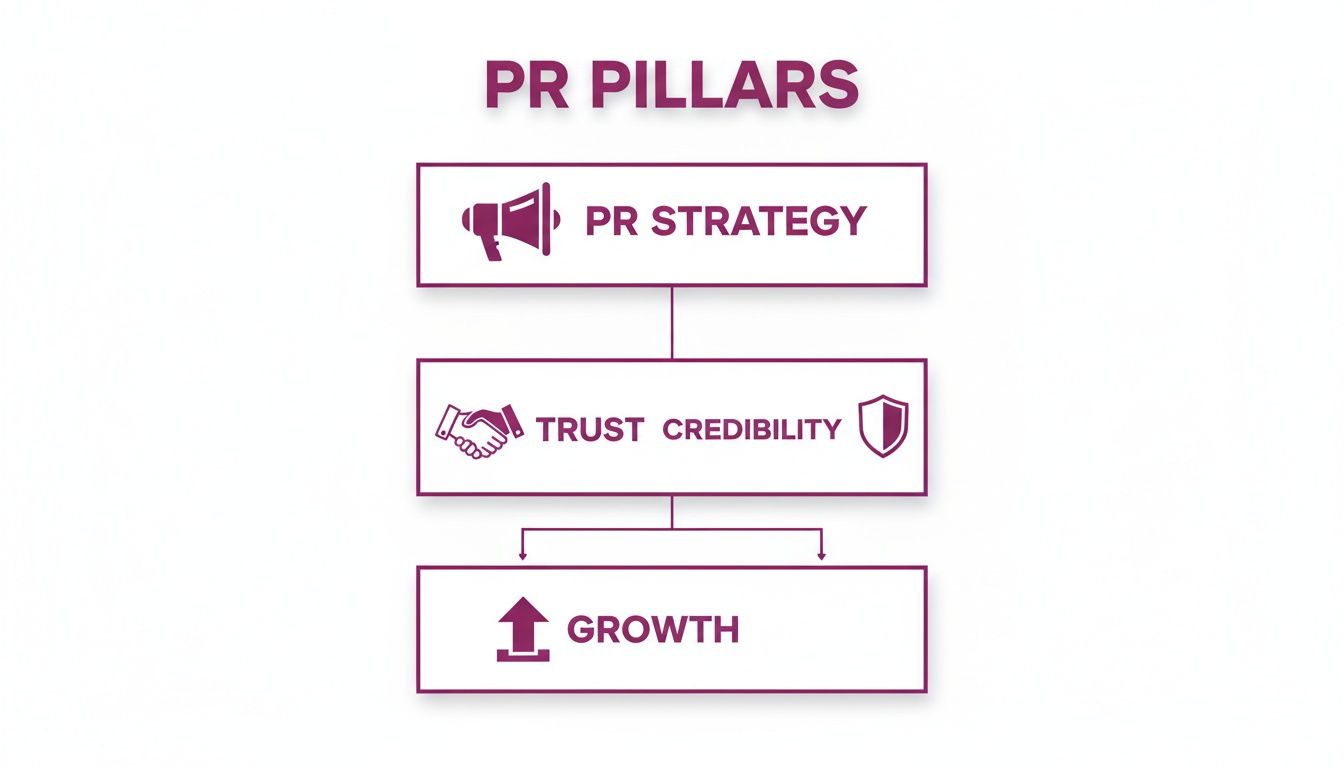
This shows how a well-defined strategy is the starting point. Everything else flows from there, building the trust and credibility you need to actually grow the business.
To help connect the dots between your business objectives and your PR efforts, here’s a simple framework.
PR Goal Framework for SaaS Founders
| Business Objective | PR Goal Example | Key Performance Indicator (KPI) |
|---|---|---|
| Increase new user acquisition | Generate 200 new trial sign-ups from earned media. | Track referral traffic from media mentions; measure conversion rate to sign-up. |
| Build brand credibility | Secure 3 feature stories in top-tier industry publications. | Number of high-domain-authority placements; track share of voice against competitors. |
| Establish thought leadership | Land 5 quotes or expert contributions in relevant tech articles. | Number of secured quotes; track mentions of the founder/company as an expert. |
| Support fundraising efforts | Get featured in 2 prominent VC or startup-focused newsletters. | Inbound investor interest; website traffic from target investor communities. |
Use this table as a starting point. The key is to ensure every PR goal has a clear “why” behind it that aligns directly with what you’re trying to achieve as a business.
Crafting Your Core Message
Alright, you know what you want to achieve. Now, what are you actually going to say? Your core message is the single, consistent story you tell about your company everywhere. It’s your unique value proposition, but told as a narrative that clicks with both journalists and your ideal customers.
A strong core message isn’t just what your product does; it’s the problem it solves, why it matters, and why your team is the one to solve it. It’s the “why” behind your “what.”
To keep this organised, I’m a big fan of a simple “Messaging House.” It’s a one-page document that holds all your essential talking points in one place. This ensures you’re singing from the same hymn sheet whether you’re writing a press release, an email pitch, or a social media post.
Building Your Messaging House
Think of your Messaging House as your go-to cheat sheet for all things communication. It’s built on three key parts that form the foundation of your story.
-
Key Talking Points (The Roof): These are the 3-4 primary messages you want to land. Make them concise, memorable, and laser-focused on your audience’s pain points. For a SaaS like HappyPanda, a talking point could be: “Stop paying the startup tax—get an all-in-one customer communication stack for one fair price.”
-
Customer Proof Points (The Pillars): This is the evidence that backs up your claims. Use stats, glowing testimonials, and mini case study examples to add some serious credibility. For instance: “90% of our users launch their entire communication stack in under 10 minutes.”
-
Company Boilerplate (The Foundation): This is a short, one-paragraph blurb about your company. It explains who you are, what you do, and who you do it for. This is the standard description you’ll stick at the end of press releases and in your company profiles.
By setting up clear goals and a well-defined message first, you create a PR strategy that’s both purposeful and repeatable. This groundwork makes sure every single action you take is directly contributing to building your brand’s reputation and hitting your business objectives.
Choosing Your Channels for Maximum Impact
So, your message is polished and your goals are set. But a brilliant story is useless if no one’s around to hear it. The next step is figuring out where to tell that story. For a bootstrapped founder, this isn’t about being everywhere at once; it’s about being in the right places to get the most bang for your buck (and your time).
Think of your PR channels like a sound system. You’ve got different speakers—some you own, some you borrow, and some you can rent for a bit. Used in harmony, they create a powerful, immersive experience. But rely on just one, and you’re left with flat, one-dimensional sound. The real magic happens when you get Owned, Earned, and a dash of Paid media working together.
Owned Media: The Foundation of Your Story
Owned media is every channel you control completely. This is your home turf. It’s your blog, your case studies, your original data reports, your newsletter—basically, your corner of the internet. This content is the bedrock of your authority and the central hub for your entire PR strategy.
Before you can earn attention from others, you have to prove you’ve got something valuable to say. Owned media is where you do just that. It’s where you publish the insightful, data-backed content that journalists and influencers will eventually want to reference.
A high-value owned asset could be:
- An original data report: Survey your users or analyse anonymised product data to uncover a unique industry trend.
- A deep-dive case study: Go beyond a simple testimonial. Show, with real numbers, how a customer achieved a specific, impressive outcome.
- A definitive guide: Create a massive blog post that becomes the go-to resource for solving a common problem in your niche.
These assets become the fuel for your earned media engine.
Earned Media: The Goal of Traditional PR
Earned media is the holy grail. It’s the coverage you earn through merit, not the attention you buy. This includes feature articles in tech blogs, guest spots on podcasts, mentions in industry newsletters, and quotes in news stories.
Why is it so powerful? Because it provides third-party validation. When a respected journalist or publication talks about you, it builds a level of credibility that no advertisement can ever replicate. For a SaaS founder, that kind of trust is pure gold.
Finding the right earned media targets is crucial. Don’t waste your time pitching huge, mainstream outlets right out of the gate. Instead, focus on a hyper-targeted list of publications and creators whose audience perfectly matches your ideal customer. And don’t forget to look for PR opportunities on Twitter by monitoring relevant hashtags and journalist requests.
Your goal isn’t just to get your name in any publication; it’s to get your story in front of the right audience, in a context that builds trust and drives action. One placement in a niche, respected blog can be worth more than ten mentions in a generic outlet.
Paid Media: The Strategic Amplifier
For a bootstrapped founder, “paid media” can sound like a dirty word. But we’re not talking about splashing cash on expensive banner ads. Instead, think of small, strategic paid placements as a way to amplify your hard-won successes from owned and earned media. It’s the final piece of the puzzle.
Strategic paid placements can include:
- Sponsoring a niche newsletter: Pay a small fee to get your content featured in a newsletter read by your ideal customers.
- Promoting a key article: Put a small budget behind a social media post linking to your feature story to ensure more of your target audience actually sees it.
- Content syndication: Pay to have your best blog posts republished on larger industry sites to reach a new audience.
This is how you create a powerful flywheel effect. You publish a compelling data report on your blog (Owned), pitch that story to a relevant tech journalist who writes about it (Earned), and then put £50 behind promoting that article to a targeted audience on LinkedIn (Paid).
Each channel feeds and strengthens the others, creating a momentum that a single-channel approach could never achieve. For more on this, our guide on social media marketing can provide deeper insights.
The Art of the Pitch: Crafting Emails Journalists Actually Read
Right, you’ve done the groundwork. You’ve got your goals nailed down, your messaging is sharp, and you know which channels to target. Now for the moment of truth: reaching out and convincing a busy journalist that your story is worth their time.
This isn’t a numbers game; it’s about relevance and respect.
A generic, mass-blasted pitch is the fastest way to get your email deleted and maybe even get your domain flagged as spam. Journalists get literally hundreds of these a day. To cut through that noise, your pitch needs to feel less like a press release and more like a helpful, personal tip from a peer who’s done their homework.
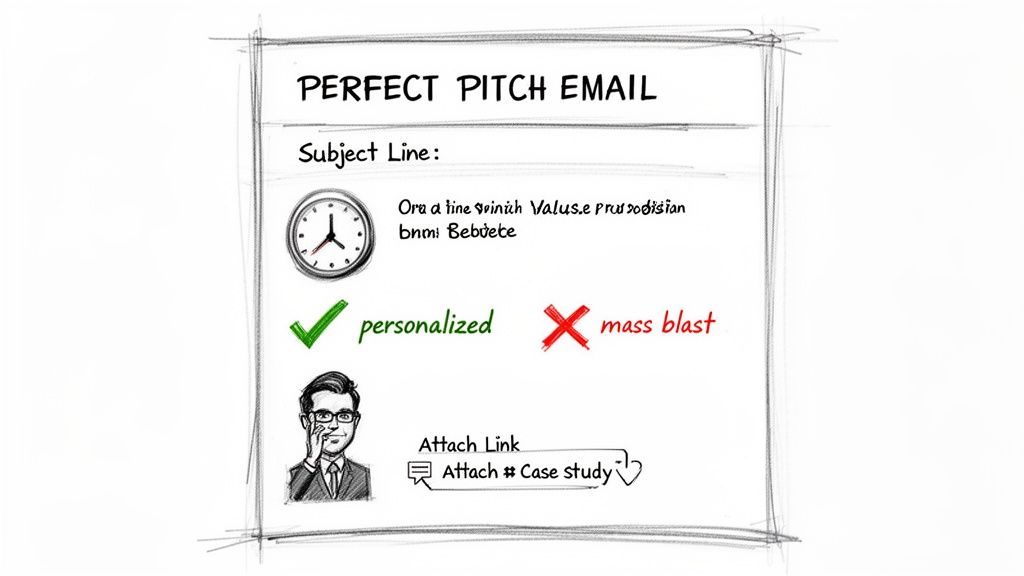
Let’s break down the anatomy of a killer pitch, from the subject line to the sign-off, so you can craft emails that people actually want to open.
Building Your Hyper-Targeted Media List
Before you write a single word, you need to know exactly who you’re writing to. Forget those expensive media databases—they’re total overkill for a bootstrapped founder. Your secret weapons are much simpler and completely free: LinkedIn and Twitter (now X).
Your goal isn’t to blast hundreds of generic contacts. It’s to build a tight, curated list of 20-30 highly relevant journalists, podcasters, and newsletter writers who live and breathe your specific niche.
Here’s how you find them:
- LinkedIn Sleuthing: Use the advanced search to find people with titles like “journalist,” “reporter,” or “editor” at your target publications. Filter with keywords related to your world (e.g., “SaaS,” “AI productivity,” “bootstrapping”).
- Twitter/X Lists: Find one journalist who covers your space and check out the public “Lists” they’ve been added to. You’ll often find goldmines like “Fintech Reporters” or “SaaS Journalists” that have done the hard work for you.
- Reverse Engineer: Who covered your competitors? Who’s always commenting on industry news? Get them on your list.
For each person, jot down their name, publication, email (often found in their social bio or on the publication’s website), and a link to a recent article they wrote. This research is non-negotiable. It’s the difference between a pitch that lands and one that gets ignored.
The Anatomy of a Perfect Pitch Email
Your email needs to be brutally concise and packed with value. Journalists are short on time and have a finely tuned nonsense detector. Every single sentence has to earn its place. To get a handle on the nuances of email intros, you can find helpful tips on how to start an email that grabs attention.
Let’s break down the structure.
1. The Subject Line Is Your First Test
Your subject line has one job: get the email opened. That’s it. Ditch the clickbait, all caps, and vague phrases. Be specific and intriguing.
- Don’t: “Story Idea for You”
- Do: “Story Idea: New Data on Bootstrapped SaaS Burnout”
- Don’t: “URGENT PRESS RELEASE”
- Do: “Following up on your article about AI tools…“
2. The Personalised Opening
This is where your research shines. Prove this isn’t a copy-paste job. Reference a specific, recent article they wrote.
- Don’t: “I’m a long-time reader of your work.”
- Do: “Loved your recent piece on the rise of asynchronous work tools. Your point about digital presenteeism really resonated.”
3. The Core Value Proposition
Get straight to it. In one or two sentences, explain what your story is and why their specific audience would care. Tie your story directly to their beat.
This is the most critical part of your pitch. You are not selling your product; you are offering a compelling story that will interest their readers. Frame it as data, a trend, or a unique human-interest angle.
4. Provide the Proof
Briefly introduce yourself and your company, then offer up the evidence. This could be a link to a data report, a case study, or an offer to connect them with a customer for an interview. Keep it short and make it dead simple for them to see the value.
5. The Clear, Simple Call to Action
Don’t be demanding. Make it incredibly easy for them to say yes.
- Don’t: “When are you free for a 30-minute call to discuss?”
- Do: “Happy to send over the full data report or answer any questions if this sounds like a fit.”
Relationship Building Before You Pitch
The best PR is built on relationships, not transactions. Before you even think about hitting “send” on a pitch, try to get on a journalist’s radar in a genuine, non-creepy way.
- Follow them on social media.
- Share their articles (and tag them).
- Leave thoughtful comments on their posts or articles.
- Answer their #journorequest posts on Twitter/X if you have relevant expertise.
This “warm-up” period shows you respect their work and are a helpful member of the community, not just another founder with their hand out. A pitch from a familiar name is always more likely to be opened than one from a total stranger. This long-term approach is what separates a one-hit wonder from a sustainable PR engine.
Measuring What Matters: Proving PR ROI on a Budget
Let’s be honest. For most data-driven founders, PR can feel a bit… fluffy. Metrics like “impressions” are so vague they don’t tell you a thing about what’s actually moving the needle. It’s time to cut through that noise.
Your PR efforts shouldn’t be a mysterious black box of activity. Think of it as a measurable growth engine. By tracking the right key performance indicators (KPIs), you can draw a straight line from your media wins to what really matters: sign-ups, demo requests, and cold, hard revenue.
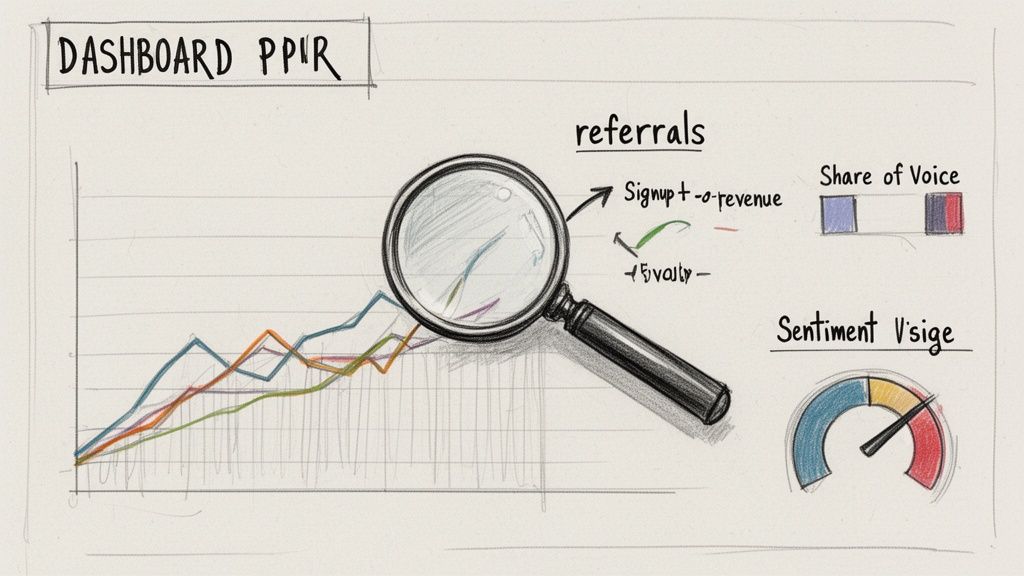
This data-first approach turns PR from a hopeful expense into a strategic, predictable investment.
Connecting PR Hits to Business Goals
The cleanest way to measure impact is to see how media coverage actually changes user behaviour. This means we’re moving past simply counting articles and looking at what those articles make people do.
The trick is to set up your analytics to watch a few key metrics right after a story about your company drops. This gives you a clear line of sight from a press hit to a customer action.
You should zero in on these:
- Referral Traffic: This is your bread and butter. In Google Analytics, create a segment for traffic coming directly from the publications that featured you. Are these visitors hitting your sign-up page or booking demos? This is the most direct link you’ll find between PR and conversions.
- Direct Traffic Spikes: Did your direct traffic get a nice bump in the 48 hours after a big mention? This is a classic sign that people read about you, remembered your name, and typed your URL straight into their browser. It’s a great signal.
- Branded Search Volume: Pop open Google Search Console and see how many people are specifically searching for your company name. A healthy increase after some media coverage is solid proof that your brand awareness is growing.
Moving Beyond Simple Mentions
While direct traffic and conversions are fantastic, a smart PR strategy also builds long-term brand equity. To measure this, you need to zoom out and look at your position in the wider market conversation.
This is where concepts like Share of Voice (SOV) and sentiment analysis come into play. And don’t worry, you don’t need a six-figure enterprise software budget to get started.
Share of Voice (SOV) is simply the percentage of conversation about your market that is specifically about your brand, compared to your competitors. It answers the question: “How much of the conversation are we actually owning?”
You can run a basic SOV analysis yourself with some simple tools. Just set up alerts to track mentions of your brand name alongside your top three competitors across key blogs, forums, and social media. Tallying these up each week gives you a rough but surprisingly effective benchmark.
Tracking Sentiment and Share of Voice
Knowing how people are talking about you is just as important as knowing how often. This is where sentiment analysis comes in, which basically sorts mentions into positive, negative, or neutral buckets.
Here’s a simple, bootstrapped way to track these metrics:
- Set Up Alerts: Use free tools to keep an eye on mentions of your brand, your CEO, and your top competitors online.
- Categorise Mentions: In a basic spreadsheet, log each mention and tag its sentiment (Positive, Neutral, Negative). Easy.
- Calculate SOV: Tally the total mentions for each brand over a set period, like a month. Divide your mentions by the total market mentions to get your SOV percentage.
- Analyse Trends: Now, look for patterns. Did that new feature launch boost your positive sentiment? Did a competitor’s bad press open a door for you to grab a larger share of voice?
This focus on measurement is becoming the standard. Data-driven evaluation is now central to PR strategy, with pros tracking metrics far beyond headline counts to show how earned media truly supports business goals. For SaaS founders wanting to dig deeper, tools like AI brand tracking for SaaS companies can also offer great insights into brand visibility and sentiment.
By making these measurement habits part of your routine, you can confidently prove the value of your PR and make smarter, data-backed decisions to keep your company growing.
Taking Your PR Message Global (Without Losing the Plot)
Your SaaS product might be borderless, but your PR strategy can’t afford to be. It’s a fundamentally local game. A story that lights up Silicon Valley could easily fizzle out in Southeast Asia or Europe, leaving your launch dead in the water before it even starts.
Why? Because great PR is all about cultural context. Business etiquette, how people consume media, and even what counts as “newsworthy” can be wildly different from one country to the next. A pitch packed with hard data might kill it in Germany, while in Japan, it’s the personal relationship you build with a journalist that opens doors.
Localisation Is More Than Just Translation
Just running your press release through Google Translate is a rookie move, and a costly one. Real localisation means rethinking your entire message for the local palate. It’s about showing you genuinely understand the headaches and ambitions of customers in that specific region.
For bootstrapped founders, this is where you can outmanoeuvre the big guys. While your well-funded competitors are busy carpet-bombing the globe with a generic, one-size-fits-all message, you can be the one who did their homework. That’s how you build the kind of trust that gets you early traction in a new market.
Think globally, but execute locally. Your product may solve a universal problem, but the story you tell about it has to feel like it was born and raised in every market you enter.
This is especially true in regions that are anything but monolithic. For example, anyone attempting PR in Southeast Asia quickly learns that a single approach is doomed to fail. A fintech story that lands perfectly in Singapore needs a total rewrite to address Malaysian regulations and a different consumer-protection angle for Indonesia. Without these tweaks, your campaign won’t connect. You can read more about how this is playing out on Ellerton.co.
Your Pre-Launch Global Checklist
Before you push the button on a launch in a new country, run through this quick sanity check. It’ll make sure your message is ready to land.
- Map the Local Media: Who are the go-to tech journalists and bloggers? What kinds of stories do they actually write? Get a feel for their beat.
- Decode Cultural Nuances: Are there unwritten rules of business communication? What are the big local holidays or industry events you should know about?
- Find Your Local “In”: How does your product solve a problem that’s a particularly sore point in this market? Can you hook your launch into a local trend or a recent news story?
- Adapt Your Proof: Use testimonials and case studies from local customers if you have them. Social proof is 10x more powerful when it comes from someone people can relate to.
Founder PR: Your Questions Answered
Even with the best strategy in hand, you’re bound to have questions once you start putting it into practice. Here are the answers to the most common ones we hear from bootstrapped founders hitting the PR trail for the first time.
How Much Time Should a Solo Founder Really Dedicate to PR Each Week?
A good starting point is 3-5 hours per week. But don’t think of it as one big block of time. It’s better to split your efforts into two modes.
First, there’s “maintenance mode.” This is your ongoing, low-level effort, maybe 1-2 hours a week. You’ll use this time to keep an eye on industry news and chat with key journalists on social media. It’s about staying present and building connections slowly.
Then you have “campaign mode.” This is when you’re gearing up for a product launch or a big announcement. You’ll need to ramp up to a more focused 3-5 hours for personalised pitching and follow-ups. Remember, consistency beats intensity every time. A steady, long-term effort will always deliver better results than random, frantic bursts of activity.
Should I Hire a Freelancer or Do PR Myself?
In the early days, doing PR yourself is your secret weapon. No one can tell your story with the same fire, authenticity, and deep-down knowledge of your product as you. Getting your hands dirty builds priceless relationships with the media and gives you raw, unfiltered feedback from the very people covering your industry.
Once you’ve got steady revenue coming in and you know your core message is landing, then think about bringing in a specialised freelancer for a specific campaign. That way, they’re amplifying a strategy that already works instead of figuring out your business from scratch on your dime.
The best path is almost always founder-led PR first. You establish the narrative, then bring in strategic freelance support to scale up your outreach for major announcements.
What’s the Single Biggest PR Mistake Founders Make?
Easy. Sending generic, mass email blasts to huge, untargeted lists. Journalists can spot a copy-paste pitch from a mile away and will hit delete without a second thought. It’s the fastest way to burn your reputation before you even get a chance to build it.
Public relations isn’t a numbers game; it’s a relevance game. A single, thoughtful, personalised pitch sent to the perfect journalist is worth more than a generic email blasted to 500. Do your homework. Research each person, understand what they write about, and tell them exactly why your story is a perfect fit for their audience. Respect their time, and you’ll earn their attention.
Ready to manage your entire customer lifecycle without the enterprise price tag? HappyPanda combines feedback, email, onboarding, and more into one simple platform. Start your free 14-day trial and launch your customer communication stack in minutes.