
You only get one shot at a first impression, and in the world of email, that shot is fired the second your message lands in someone’s inbox. Before they even see your brilliant offer or witty prose, they’re making a snap judgment based on a powerful trio: the subject line, the greeting, and the very first sentence.
Get these right, and you earn a click. Get them wrong, and you’re headed straight for the trash folder.
The Anatomy of an Email That Gets Opened
Think of the start of your email as its packaging. It doesn’t matter how valuable the contents are if the box looks sketchy. Mastering how to start an email isn’t about following a rigid formula; it’s about understanding how these three key pieces work together to convince someone your message is worth their time.
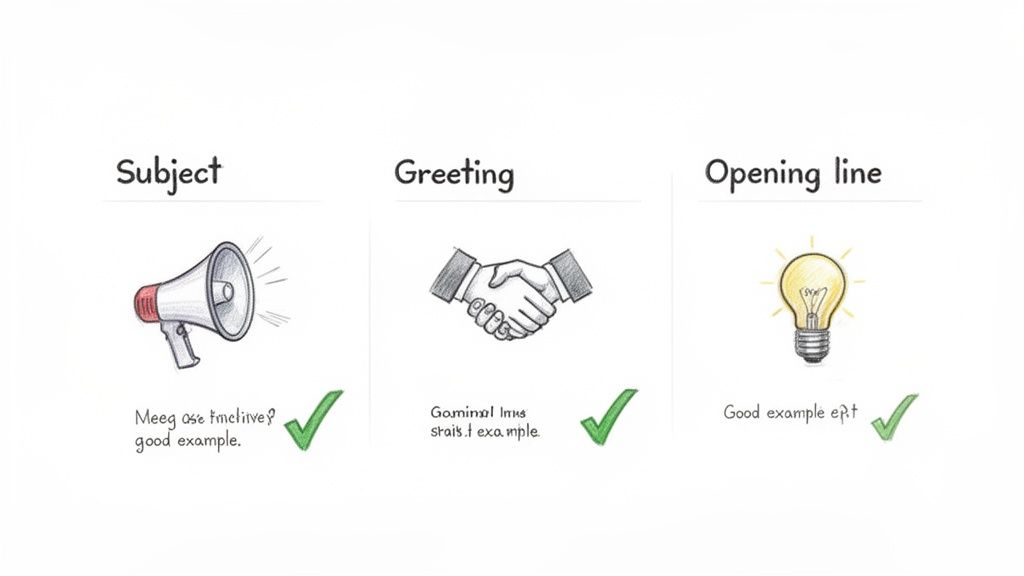
A weak opening undermines everything that follows. But a strong start? It builds instant rapport and signals that this isn’t just another email to be deleted. It’s something they need to read.
The Three Pillars of a Strong Email Start
Every email that actually gets a response is built on these three strategic elements. Nail them, and you’re already halfway there.
- The Subject Line: This is your headline. Its only job is to be intriguing or useful enough to get a click. It needs to be clear and relevant, sparking just enough curiosity to stand out in a crowded inbox without feeling like cheap clickbait.
- The Greeting: This is your digital handshake. The salutation you choose—from a casual “Hey” to a more formal “Dear Mr. Smith”—instantly sets the tone and defines the relationship. The right greeting makes the recipient feel seen and respected.
- The Opening Sentence: This is your hook. Once they’ve opened the email, you have about three seconds to prove it was worth their time. A great opening line dives straight in, providing immediate context and value that confirms their decision to click was the right one.
Of course, these components don’t exist in a vacuum. Truly mastering email etiquette at work is the glue that holds it all together, ensuring your messages come across as professional, clear, and effective. An email that respects established norms is simply one that gets taken more seriously.
The first few words of your email are the most important. They don’t just introduce your message; they build a bridge of relevance between you and your reader, making or breaking the entire communication.
For bootstrapped SaaS founders, this isn’t just theory—it’s your lifeline. A well-crafted onboarding email can dramatically improve user activation. A thoughtful follow-up can win back a churning customer. As you scale, figuring out how to automate and personalise your emails gives you a massive advantage.
We’ll dive deep into each of these pillars, but first, let’s look at a quick cheat sheet for matching your strategy to the situation.
Email Opening Strategies for Different Scenarios
To get the best results, you need to adapt your approach. This table breaks down how to tailor your subject, greeting, and opening line for common email scenarios you’ll encounter every day.
| Email Scenario | Subject Line Strategy | Greeting Style | Opening Sentence Goal |
|---|---|---|---|
| Cold Outreach | Personalised and intriguing | Formal but approachable | State a specific, relevant reason for contact immediately. |
| Onboarding | Welcoming and action-oriented | Warm and friendly | Make them feel welcome and guide them to the first step. |
| Customer Support | Clear and reference-focused | Professional and empathetic | Acknowledge their issue and show you’re there to help. |
| Follow-Up | Contextual and direct | Familiar (based on last interaction) | Gently remind them of the previous conversation or action. |
| Networking | Mention a mutual connection or event | Respectful and professional | Establish context and state your purpose clearly. |
Think of this table as your go-to guide. By aligning these three core elements with your specific goal, you drastically increase the odds of your email not only getting opened but getting the response you want.
Crafting Subject Lines That Demand a Click
Let’s be honest: your subject line is the gatekeeper. It’s the one thing standing between your beautifully crafted email and the abyss of the trash folder. In an inbox overflowing with generic updates and spammy offers, a killer subject line isn’t just nice to have—it’s everything.
Think of it less as a title and more as a direct promise. A great subject line tells the recipient, “Hey, this is for you, and it’s actually worth your time.” The goal isn’t to be clever for the sake of it; it’s to be clear, intriguing, and hyper-relevant to the person on the other end.
Personalisation Beyond the First Name
Anyone can drop a {{first_name}} token into an email. Real personalisation goes deeper. It’s about showing you’ve done your homework and understand your recipient’s world—their challenges, their recent activities, their context.
Try these angles to show you’re not just blasting a template:
- Reference a recent action: “Your thoughts on the new checkout flow?”
- Mention a shared connection: “Loved your recent post on scaling SaaS”
- Tap into a relevant pain point: “Is customer onboarding eating up your time?”
These aren’t just subject lines; they’re conversation starters. They immediately signal that this isn’t a one-to-many broadcast but a message from one human to another.
The Power of Clarity and Intrigue
Your subject line has to walk a fine line. It needs to be clear enough that the reader gets the gist, but just intriguing enough to make them need to know more. Vague, lazy subject lines like “Following up” or “Quick question” get ignored because they put all the work on the reader.
Let’s sharpen that up.
- Vague: “Checking in”
- Better: “A quick idea for your next product launch”
See the difference? The second option is specific and promises immediate value. It creates a tiny information gap that the reader feels an itch to scratch by opening the email.
A subject line’s only job is to sell the open. It doesn’t need to tell the whole story, just enough to make the reader want to hear the rest.
Don’t forget that regional quirks can give you a serious edge. For instance, our data on Southeast Asian email marketing shows that a one-size-fits-all approach is a recipe for failure. Founders with customers in Singapore and Malaysia often see higher open rates with longer, more descriptive subject lines. Meanwhile, shorter, punchier ones tend to crush it in Indonesia.
This is just scratching the surface. To really level up your open rates, you need to dive into comprehensive Email Subject Line Best Practices. By constantly testing and tweaking your approach, you can turn your subject lines from a simple chore into one of your most powerful growth levers.
Choosing a Greeting That Sets the Right Tone
If the subject line is the movie trailer that gets them in the door, your greeting is the opening scene. It’s the digital handshake, the first real word your reader sees, and it sets the tone for everything that follows. Mess this up, and your email can feel impersonal, clueless, or just plain weird before they’ve even read your first sentence.
Think about it. A casual “Hey” to a C-suite executive you’ve never met screams unprofessional. On the flip side, a stuffy “Dear Sir/Madam” to a friendly, long-term customer feels robotic and cold. The goal is to match the greeting to the context, your relationship with the person, and your brand’s voice.
This decision tree gives you a quick visual guide for navigating those choices, from who you’re talking to and what you’re trying to achieve.
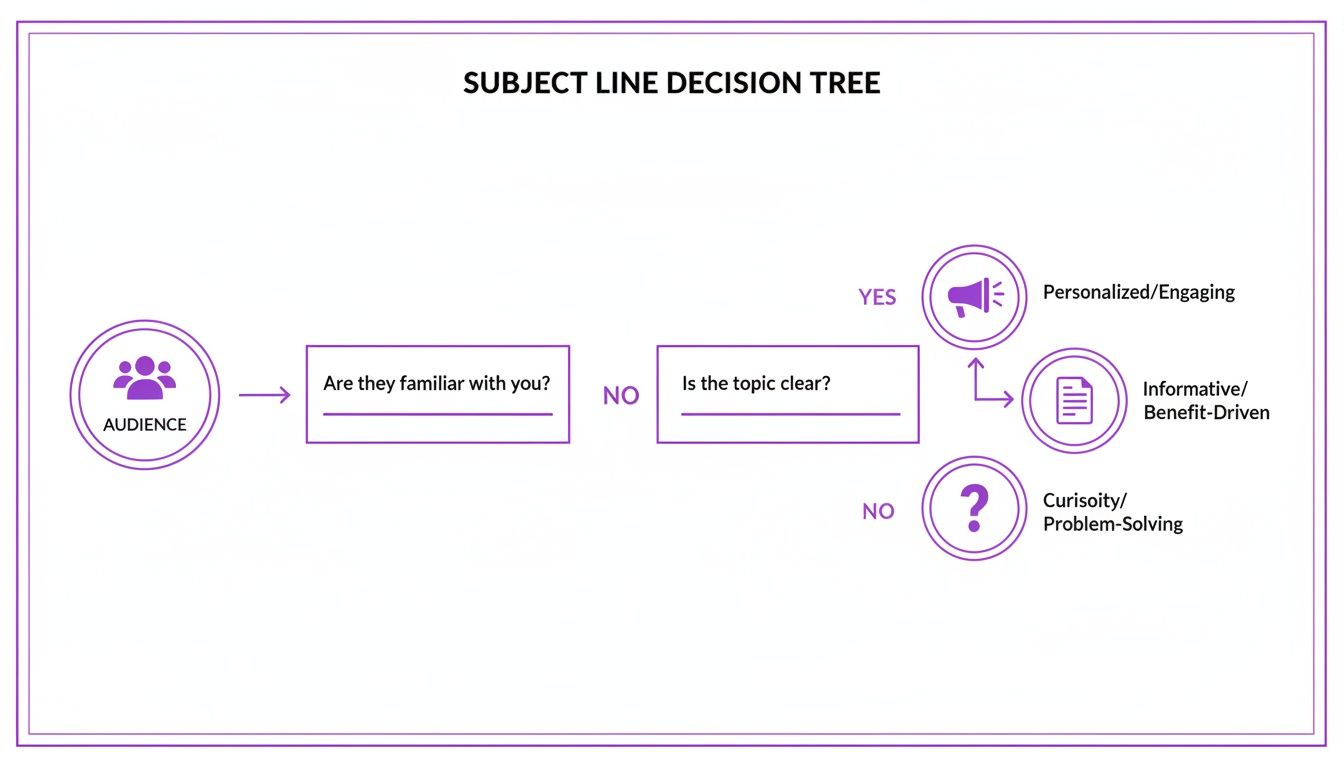
As you can see, the right choice always circles back to knowing your audience and your goal.
Decoding Formality Levels
Figuring out whether to go formal or casual is easier than it looks. A solid rule of thumb? Start a little more formally than you think you need to, then mirror their tone if they reply. Simple.
- Formal Greetings: These are your go-to for first contact with senior-level people, official company announcements, or when you’re dealing with a very traditional industry.
- Examples: “Dear Mr. Smith,” “Dear Dr. Evans,” “Dear [Full Name],”
- Semi-Formal Greetings: This is pretty much the gold standard for most professional emails today. It’s respectful without being stiff, making it a safe bet for almost any business chat.
- Examples: “Hi [First Name],” “Hello [First Name],”
- Informal Greetings: Keep these for colleagues you know well, internal team comms, or online communities where being casual is part of the culture.
- Examples: “Hey [First Name],” “Hi everyone,”
Pro Tip: When in doubt, “Hi [First Name],” is almost always the right move. Research has shown time and again that emails starting with “Hi” or “Hello” followed by a name get great engagement. It hits that sweet spot between professional and personal.
Real-World Scenarios and Solutions
Let’s put this into practice with situations you probably face every week. Context is everything.
Scenario 1: You’re sending a cold email to a potential partner.
- Bad Greeting: “Hey there” (Way too casual and shows you’ve done zero research.)
- Good Greeting: “Dear Ms. Chen,” or “Hello Alice,” (Respectful and proves you know who you’re talking to.)
Scenario 2: You’re responding to a customer support ticket.
- Bad Greeting: “Dear Valued Customer,” (Impersonal, dated, and just plain lazy.)
- Good Greeting: “Hi David,” (Friendly, personal, and gets straight to the point.)
Ultimately, the best greeting is one that shows you took a split second to think about the human on the other end. It’s a tiny detail, but it makes a massive difference in how your message lands, building a connection from the very first word.
Writing an Opening Line That Hooks Your Reader
Alright, you’ve nailed the subject line and picked the perfect greeting. They’ve clicked open. Now you have a split second to convince them it was worth their time. This is where your opening line comes in—it’s the hook that has to justify that click and pull them into the rest of your message.
Let’s be honest, the days of lazy, generic openers like “I hope this email finds you well” are long gone. These phrases are conversational clutter. They waste the most valuable real estate in your email and signal that what follows might be just as uninspired. A powerful opening line delivers context and value right away.
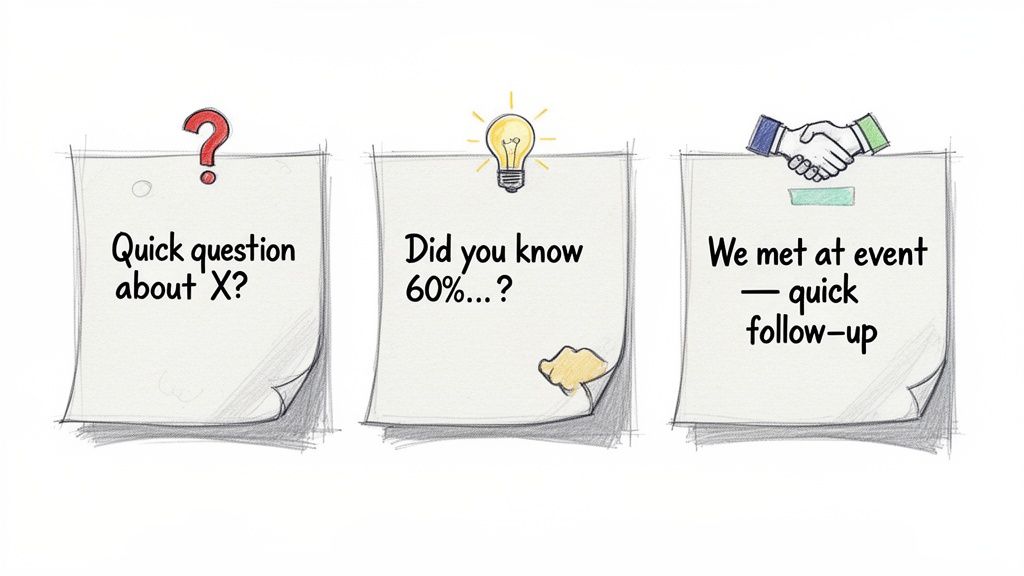
Ditch the Fluff, Get Straight to the Point
Your reader’s first thought is always, “What is this about, and why should I care?” Your opening needs to answer that question instantly. The best way to do this? Make it about them, not you.
Start by connecting the dots between your message and their world. This could be a shared connection, a recent accomplishment of theirs you noticed, or a direct nod to a problem you know they’re facing. That personal touch shows you’ve done your homework and aren’t just blasting out another mass email.
Consider these powerful opening moves:
- Reference a Shared Connection: “Sarah from your marketing team suggested I reach out…”
- Mention a Recent Action: “I just finished reading your latest blog post on product-led growth and loved your take on user onboarding.”
- State Your Purpose Directly: “I’m writing to follow up on our chat about integrating a new customer feedback tool.”
- Ask a Relevant Question: “Have you considered how a dedicated changelog could improve your user engagement?”
Each of these examples gets straight to business, respects the reader’s time, and establishes immediate relevance. This directness is a huge driver of email effectiveness. Even today, email marketing delivers stellar results, with B2C brands seeing a 2.8% conversion rate and B2B organisations hitting 2.4%. Those numbers are built on messages that provide value from the very first line.
The goal of your first sentence is to make the second sentence irresistible. It should confirm the promise of your subject line and build immediate momentum.
Opening Line Formulas for Any Situation
Knowing how to kick off an email in different contexts is a game-changer. Here are a few adaptable formulas you can put to use right away, whether you’re sending a cold outreach email or a simple follow-up.
For Cold Outreach
- The Praise Opener: “I was really impressed with [specific achievement or piece of content]. Your work on [topic] inspired me to reach out.”
- The Common Ground Opener: “I noticed we both [attended the same conference/are part of the same online community]. I wanted to connect because…”
For Onboarding New Users
- The Welcome and Guide: “Welcome to HappyPanda! The first step to collecting feedback is to install our widget—it only takes about two minutes.”
- The Value Prop Reminder: “Excited to have you on board. Most new users get their first valuable insight within 24 hours of setting up their first survey.”
For Re-engaging Inactive Subscribers
- The Gentle Nudge: “It’s been a while since you last logged in, and we’ve added some features we think you’ll love, including…”
By customising your opening line, you turn a generic message into a personal conversation. This small shift dramatically increases the odds that your reader will not only keep reading but also take the action you want them to. Remember, a strong opening sets the stage for a compelling call to action later in the email.
The Blunders That Send Your Emails Straight to the Bin
Knowing how to kick off an email is one thing, but knowing what not to do? That’s where the real wins are. So many emails are dead on arrival, torpedoed by simple mistakes that either send the reader to sleep or get flagged by spam filters.
Dodging these common pitfalls is one of the fastest ways to see your open and reply rates climb. Let’s break down the big ones.
The Kiss of Death: Vague Subject Lines & Robotic Greetings
The fastest way to get ignored is with a subject line that makes the reader do all the work. Subjects like “Quick question” or “Checking in” are just lazy. They force someone to open the email just to figure out what you’re on about, creating friction before they’ve even read a word.
Then there’s the greeting. A stiff “Dear Sir/Madam” feels like it’s been teleported from the 1950s, while a super-casual “Hey” might completely miss the mark with a potential investor you’ve never met. The goal is to be respectful and relevant, not out of touch.
A little specificity goes a long, long way.
Before: Subject: Following up
Dear Valued User,
I hope this email finds you well. I am writing to…
After: Subject: A quick idea for your onboarding flow
Hi Jane,
I was really impressed with your latest product update and had a thought…
See the difference? The “after” version is specific, personalised, and gets straight to the point. It respects Jane’s time by giving her context immediately, making her far more likely to actually read on.
Forgetting They’re a Person, Not a Data Point
Nothing screams “spam” louder than a generic, one-size-fits-all email. We’ve all received them, and we all delete them. Failing to personalise your message is a guaranteed trip to the trash folder, especially in markets where people are getting smarter about what they open.
For instance, consumers in the Southeast Asia region are increasingly tuning out generic blasts in favour of personalised emails. This isn’t just a quirky trend; it’s a huge shift toward marketing that actually connects with individual needs. If you’re targeting that audience, it’s a critical insight. You can dive deeper into email marketing trends in Southeast Asia over at Statista.
Making It All About You
And for the final nail in the coffin: starting the email by talking about yourself. Opening with “My name is John and I work for…” immediately puts the focus on your needs, not theirs. It’s the conversational equivalent of walking into a party and shouting your résumé.
Instead, flip the script. Start by referencing their work, a shared connection, or a problem you’ve noticed that you can help solve. Make the email about them, and you’ll earn their attention every single time.
Your Most Pressing Email Questions, Answered
Even with a solid game plan, you’re bound to hit a few tricky spots right before you click ‘send’. Let’s clear up some of the most common questions that pop up when you’re crafting that all-important email opening.
Think of this as your quick-reference guide for navigating those little moments of doubt. It’s designed to give you the confidence that every email you send starts off on the right foot.
How Formal Should My Email Greeting Be?
The honest answer? It completely depends on who you’re talking to. The vibe you’re going for hinges entirely on your audience and the situation at hand.
A casual “Hey [First Name]” is perfect when you’re chatting with colleagues or someone you already have a rapport with. But if you’re reaching out to a potential enterprise client for the first time, something more traditional like “Dear Mr./Ms. [Last Name]” is a much safer bet.
A great rule of thumb is to mirror your recipient’s communication style. Take a peek at their website or LinkedIn. If it’s buttoned-up and corporate, start formally. If they write a laid-back blog, you can probably relax a bit.
For most day-to-day customer communication, a friendly yet professional “Hi [First Name]” has become the modern gold standard. It strikes just the right balance.
Is It Ever Okay to Use a Long Subject Line?
Absolutely. In fact, sometimes it’s the smarter move, especially when clarity trumps brevity. While everyone preaches the gospel of short, snappy subject lines, a longer, more descriptive one can work wonders if it delivers immediate value.
Think about it. A subject line like, “Question about your recent blog post on scaling Node.js” is miles better than a vague “Quick question.” It tells the recipient exactly what’s inside and gives them a compelling reason to open it.
The trick is to front-load the most important info. Mobile email apps are notorious for cutting off long subject lines, so make sure the first few words get straight to the point. Ultimately, you should always be testing to see what your audience responds to. What works for one group might fall flat with another.
What Is the Best Way to Start a Cold Outreach Email?
The best cold emails don’t feel cold at all. The secret ingredient is making it about them, not you, right from the first word. Steer clear of openers like “My name is…” or “I work for…”—they’re instant signals that a sales pitch is coming.
Instead, lead with something that shows you’ve actually done your homework.
- Kick off with a specific and genuine compliment about their work.
- Ask an insightful question that shows you understand their world.
- Reference a shared connection or interest to build instant rapport.
An opening like, “I was so impressed with the UI of your new app, especially the seamless onboarding flow,” proves you’ve paid attention. It builds a bridge of respect from the get-go. And of course, having a professional email address is step zero; our guide on getting a Gmail for your custom domain can get you sorted.
When you shift the focus from yourself to the recipient, they’re far more likely to stick around and see what you have to say.
Ready to turn these insights into action? HappyPanda combines email sequences, onboarding checklists, and feedback tools into one simple platform. Stop juggling multiple tools and start building better customer relationships today. Get started for free at https://happypanda.ai.