
For a bootstrapped SaaS founder, social media marketing isn’t just another box to tick on a massive to-do list. Forget the textbook definition. It’s your direct line to your first handful of users, a live product feedback channel, and your best shot at building social proof when you don’t have a marketing budget.
What Social Media Marketing Means for SaaS Founders
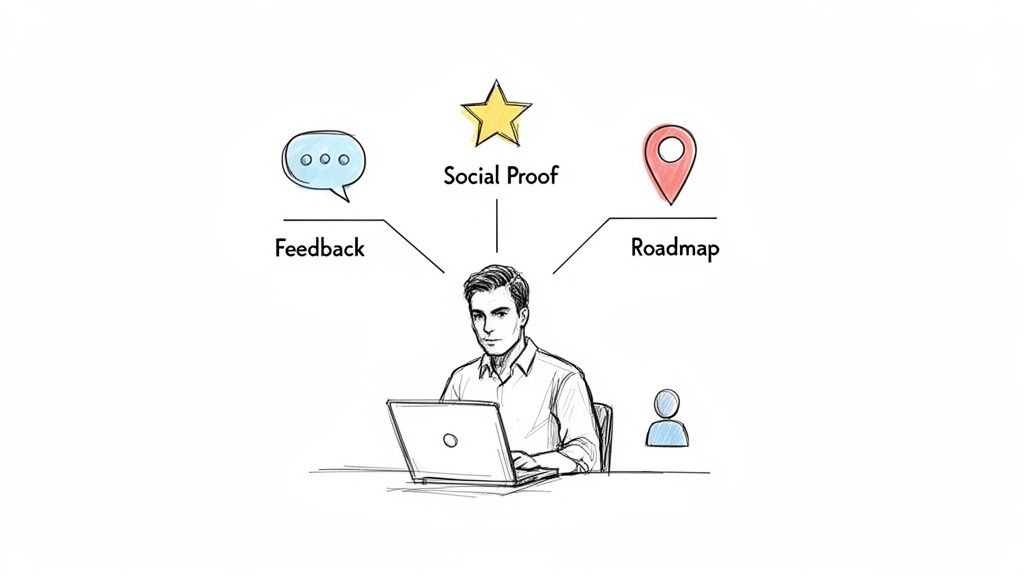
If you’re deep in the code, it’s easy to see social media as a chore. It’s that thing you know you should be doing, but it always gets bumped for bug fixes, new features, and that one critical support ticket. That’s a mistake, because it misses the point completely for a lean startup.
Think of social media less like a megaphone for shouting announcements and more like a two-way radio. It’s the public front door to all your customer communications. With over 5 billion people scrolling through their feeds, your early adopters are out there, right now, just waiting to find a tool like yours.
It’s More Than Just Marketing
A bootstrapped founder playing the social media game right isn’t chasing follower counts or viral fame. It’s about weaving social interactions directly into how you run your business. Every single comment, question, and DM is a chance to learn something, validate an idea, and build your product with direct input from the people who actually use it.
This mindset transforms a platform like X (formerly Twitter) or LinkedIn from a simple marketing channel into a powerful business tool. A question about a missing feature isn’t just a support request; it’s free, invaluable input for your product roadmap. A glowing comment in a Facebook group isn’t just a nice thing to see; it’s the beginning of a powerful testimonial you can capture and put on your homepage.
Social media marketing for a SaaS founder is the art of turning public conversations into product improvements and customer loyalty. It bridges the gap between building your product in private and building your community in public.
The Founder’s Unfair Advantage
Unlike the big corporations with endless layers of marketing managers and social media coordinators, you have something they don’t: authenticity. You’re the one building the product, writing the code, and talking to users. That gives you an incredible advantage.
This direct, unfiltered connection is what turns users into a real community. People aren’t just buying your software; they’re buying into your journey and your vision. An effective social media marketing plan for a founder is really about:
- Validating Ideas: Firing off a quick poll to see if a feature idea is a hit or a miss before you spend a week coding it.
- Building Social Proof: Actively spotting positive feedback and turning it into marketing gold. Tools like HappyPanda can even automate this by converting great survey responses into testimonial requests.
- Creating a Feedback Loop: Funnelling conversations from social platforms straight into your development workflow.
- Establishing Authority: Sharing what you know—the wins, the failures, the story behind it all—to build trust and attract people who get what you’re doing.
At the end of the day, social media is your unfair advantage. It lets you build a loyal user base, get priceless feedback, and generate the social proof you need to grow—all while you’re busy building something great. It’s not just marketing; it’s how you build a customer-centric product from the ground up.
Choosing the Right Social Media Channels to Dominate
As a founder, your time is your most valuable currency. Trying to be on every social media platform is a surefire way to burn out and get nowhere fast. The real goal isn’t to be everywhere; it’s to be exactly where your future customers already are. Your social media will only work when you pick one or two channels and go all-in.
Think of it like fishing. You wouldn’t cast a giant net across the entire ocean hoping to catch something. You’d find the specific spots where the fish you want are schooling. The same idea applies here. You need to find the digital watering holes where your ideal SaaS users hang out, listen, and share ideas.
This laser-focused approach lets you learn the unique language and culture of a platform, build real connections, and create content that actually lands. It’s the difference between shouting into a packed stadium and having a great conversation in a quiet café.
Understand Your Ideal Customer Profile
Before you can even think about picking a channel, you need to know who you’re talking to. And I mean really know them, beyond basic demographics. What does their average day look like? Where do they go for industry news or to ask for advice when they’re stuck?
- For B2B SaaS: Your people are probably lurking in specific LinkedIn groups, following industry thinkers on X (formerly Twitter), or getting into the weeds in niche subreddits.
- For B2C SaaS: Your users might be finding new apps through TikTok trends, watching quick tutorials on Instagram Reels, or joining Facebook Groups based on their hobbies.
Once you have a crystal-clear picture of this person, you can connect their online habits to the platforms they use most. Don’t just guess—go look. Search for keywords related to the problem your SaaS solves and see where the most active conversations are happening.
Focus on Southeast Asian Market Dynamics
If you’re targeting Southeast Asia, you need to throw out the standard playbook. This region isn’t just mobile-first; it’s social-first. People discover brands, research products, and even make buying decisions entirely within social media apps.
Platforms that might be an afterthought in other markets are the main event here. In countries like Thailand, Vietnam, and Indonesia, user behaviour is all about visual content and community-driven commerce. If you ignore this cultural context, you’re leaving a massive opportunity on the table.
Your social media strategy has to fit the local digital culture. In Southeast Asia, that means understanding that platforms like TikTok aren’t just for fun—they are powerful engines for commerce and discovery.
For example, Southeast Asia is a powerhouse for TikTok marketing, with the region accounting for nearly a quarter of its global ad audience. In Thailand, over 80% of monthly users are on the platform, a number that completely eclipses the global average. This makes TikTok a goldmine for anyone looking to grab attention with short-form video. You can learn more about TikTok’s advertising audience reach here.
To help you get started, here’s a quick rundown of where each major platform shines for SaaS founders targeting the SE Asia market.
Social Media Platform Strengths For SaaS in SE Asia
| Platform | Primary Audience | Key Strength for SaaS | HappyPanda Use Case |
|---|---|---|---|
| B2B professionals, decision-makers, corporate users. | Building professional authority, lead generation, networking with industry peers. | Collect feedback from professional users to refine B2B features. | |
| X (Twitter) | Tech enthusiasts, journalists, early adopters, professionals. | Real-time conversations, community building, quick updates and support. | Run quick polls on feature ideas and engage directly with user feedback. |
| Broad consumer base, community groups, local businesses. | Building niche communities, targeted advertising, customer support. | Create a user group and use feedback to foster a loyal community. | |
| Visual-centric audience, creators, lifestyle & B2C brands. | Showcasing product UI/UX, brand storytelling through visuals (Reels/Stories). | Share visually appealing testimonials and user-generated screenshots. | |
| TikTok | Gen Z and Millennials, trend-driven consumers. | Short-form video explainers, viral marketing, showing the “human side” of your SaaS. | Create short, engaging videos showcasing customer success stories. |
| Niche communities, hobbyists, tech-savvy users. | Gaining authentic user feedback, participating in relevant subreddits. | Monitor niche subreddits for product mentions and gather candid feedback. |
This table should give you a starting point, but remember to validate it by finding where your specific audience spends their time.
Picking Your Primary and Secondary Channels
Your mission is to choose one primary channel to absolutely own and one secondary channel for experiments.
Your primary channel is where you’ll invest 80% of your time and creative energy. This has to be the platform where your ideal customer is most active and ready to engage.
Your secondary channel is your playground. You’ll spend the other 20% of your effort here, repurposing content from your main channel and trying out new formats. It lets you expand your reach without losing focus. For example, if LinkedIn is your primary, X could be a great secondary channel.
By sticking to this focused strategy, you create a workflow you can actually maintain. You’ll build deeper community relationships, create better content, and drive real results for your SaaS without stretching yourself too thin. For any lean startup, this is the foundation of smart social media marketing.
Building Your SaaS Content Strategy From Scratch
Let’s be honest. Content is the fuel for your entire social media marketing engine. But when you’re a solo founder juggling code, support tickets, and sales calls, the idea of becoming a full-time “content creator” sounds exhausting.
The good news? You don’t need a design team or a convoluted strategy to make a real impact. Your biggest asset is the journey you’re on right now. By focusing on authenticity and the value you’re building every day, you can turn your work into a story that pulls in the right people. Forget chasing viral trends; the goal is to build a library of content that teaches, builds trust, and shows your product in its natural habitat.
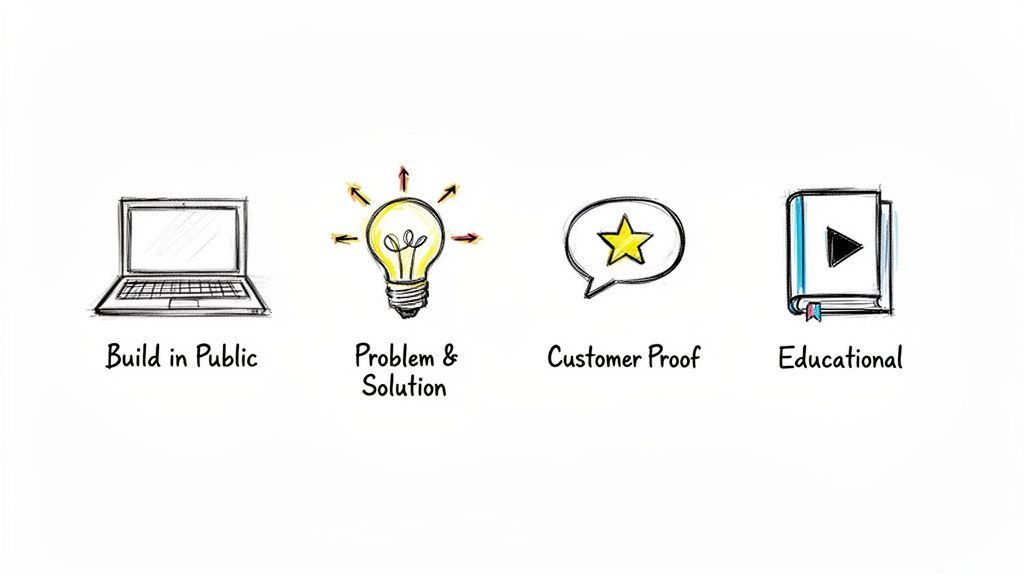
To keep things simple and sustainable, we’re going to build your entire strategy around four powerful, low-effort content pillars. These pillars don’t require fancy production—just a willingness to share your process and celebrate your customers.
Pillar 1: The Build in Public Journey
The “Build in Public” movement is a gift to bootstrapped founders. It’s all about transparency—sharing the behind-the-scenes story of your SaaS, from the wins and the struggles to the lessons learned the hard way. This approach creates a community that feels genuinely invested in your success.
People connect with people, not faceless brands. Sharing your progress, your revenue milestones (even small ones like your first $100 MRR), or that pesky bug you finally squashed makes your brand relatable and human.
- Example Post Template: “This week’s challenge: [describe a specific problem you faced]. Here’s how I tackled it: [share your thought process or a code snippet]. Huge learning moment! #buildinpublic #saas”
- Why It Works: It positions you as an expert, builds trust through vulnerability, and attracts other founders and early adopters who respect the grind.
Pillar 2: Problem and Solution Stories
Your SaaS exists to solve a very specific problem. Your content should be a constant reminder of that simple fact. Frame your posts around the pain points your ideal customers are wrestling with, and then introduce your product as the clear, straightforward solution.
This isn’t about a hard sell. It’s about empathy. Show you deeply understand the user’s struggle before you even whisper a feature’s name. It makes your eventual pitch feel like helpful advice instead of just another ad.
The most effective social media marketing doesn’t feel like marketing at all. It feels like a helpful conversation where you demonstrate a deep understanding of the customer’s world and offer a clear path forward.
For instance, instead of posting “Our tool automates reports,” tell a story. Start with the relatable frustration of manually compiling data every Friday afternoon, and then show how your tool gives that time back. That narrative framing makes the value stick.
Pillar 3: Customer-Generated Social Proof
Your happiest customers are your best marketers. Period. Their words carry more weight than any ad copy you could ever write, so your job is to get their success stories out into the world. This is easily the most powerful content you can share.
Actively look for positive feedback everywhere—in support tickets, survey responses, and social media mentions. When you find a glowing comment, reach out and ask for permission to share it. Better yet, use a tool like HappyPanda to automatically trigger a testimonial request after a user leaves a high NPS score. This creates a steady, authentic stream of social proof.
Simple ways to showcase social proof include:
- Screenshot Testimonials: Post a clean screenshot of a positive tweet or email (always with permission).
- Mini Case Studies: Share a quick story: “Big shoutout to [Customer Name] who just cut their onboarding time in half using our new checklist feature!”
- User-Generated Content: Repost a photo or video of a customer using your product in their workflow.
Pillar 4: Educational Snippets
Finally, share your expertise in small, digestible bites. You’ve learned a ton while building your product, so share that knowledge freely. This positions you as a helpful authority in your niche and builds incredible goodwill.
These educational snippets don’t need to be long-form blog posts. Think in terms of quick tips, a useful statistic, or a simple “how-to” thread on Twitter. The goal is to provide immediate value that helps your audience, whether they become a customer today or not. Adding a clear call to action can also guide them to learn more. Our complete guide on writing a compelling call to action can provide excellent pointers for this.
This four-pillar framework gives you a repeatable system for creating high-value content without the burnout. It turns your daily work into marketing assets, transforming your social media feed from a broadcast channel into a genuine, community-building tool.
Creating a Sustainable Social Media Calendar
When it comes to social media marketing, consistency will always beat intensity. A couple of solid, high-quality posts each week will do far more for you than a frantic burst of activity followed by radio silence. The secret isn’t some complex spreadsheet or a pricey tool; it’s a simple, sustainable content calendar that stops you from burning out.
Think of your social calendar like a workout plan. You wouldn’t hit the gym and try to do every single exercise in one day, right? You’d focus on different muscle groups on different days. This approach builds strength over time without causing injury. Your content calendar works the same way, creating a steady presence that grows your community without draining your will to live.
Establishing a Simple Weekly Rhythm
First off, forget trying to fill seven days a week with mind-blowing content. As a founder, your time is gold, and it’s better spent on your product and your customers. The goal is to set up a simple, repeatable weekly workflow based on the content pillars we’ve already talked about.
This structure takes the daily “what on earth do I post today?” stress off your plate. It turns content creation from a reactive chore into a predictable, proactive part of your week.
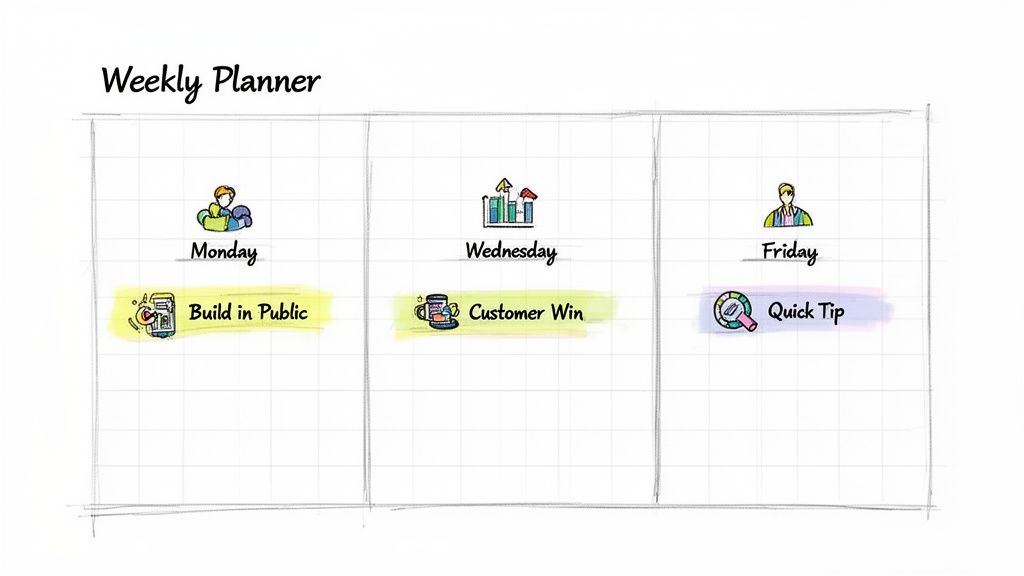
Here’s a sample weekly rhythm that any SaaS founder can steal:
- Monday: Build in Public Update. Share a quick win, a bug you’re wrestling with, or a sneak peek of a feature in the works. This keeps your audience invested in your journey.
- Wednesday: Customer Win Wednesday. Post a glowing piece of feedback, a customer testimonial, or a mini case study. This is powerful social proof, and it makes your customers the heroes of the story.
- Friday: Educational Quick Tip. Drop a useful piece of advice related to your industry or the problem your SaaS solves. This builds your authority and gives your followers genuine value.
This simple three-post-a-week schedule is totally manageable, effective, and hits all your key strategic notes. To keep things organised, you can learn more about what a content calendar entails.
The Power of Content Batching
Now for the real secret to making this feel effortless: content batching. Instead of scrambling to create posts daily, you carve out a few hours once a month and create everything in one go.
Content batching is a productivity superpower for founders. It lets you get into a creative flow state and knock out a month’s worth of quality social media content in the time it might take to create just a few posts on the fly.
Think of it like meal prepping. You spend one Sunday afternoon cooking and end up with grab-and-go lunches for the whole week. You can do the exact same thing here—spend one morning writing captions and designing simple graphics, then schedule it all. Suddenly, your social media is running on autopilot, freeing up precious mental energy for the million other things on your plate. To keep this whole process tidy, a dedicated content management software system is a lifesaver.
Weaving Social Media into Your Customer Journey
If you think social media marketing is just about scheduling posts and counting likes, you’re missing the real magic. For a modern SaaS, true social media mastery is about weaving your channels deep into the fabric of your business. It’s about turning your social presence from a simple broadcast megaphone into a core part of your entire customer journey.
Think of it this way: what if you could create a seamless, automated loop between what people say about you online and how your product actually evolves?
Imagine a user drops a glowing comment about your app on X. Instead of just a quick “like,” an automated workflow kicks in, sending them a polite DM asking if they’d be willing to share that as a formal testimonial. Or, a feature request pops up in your private Facebook group. That comment doesn’t just sit there; it’s automatically logged in your product backlog, and the user even gets a little ping the moment that feature ships. This isn’t some far-off dream; it’s just smart integration.
This approach stops you from having to manually hunt down every crumb of feedback or social proof. It transforms passive followers into active partners in building your product, all without piling hours of manual work onto your plate.
Automating Feedback and Social Proof Collection
The first step is connecting social listening with real action. Your users are already out there talking about your product; your job is to capture what they’re saying and turn it into something tangible and useful for your business. This means setting up systems that listen for keywords, mentions, and sentiment, and then trigger workflows that actually do something.
Here are a few practical ways this could work:
- Positive Mention to Testimonial: A user mentions your brand with a positive vibe on LinkedIn or X. A system can automatically follow up. Using a tool like HappyPanda, this could be a direct request to submit a formal testimonial, effortlessly piping powerful social proof right onto your marketing site.
- Feature Request to Roadmap: Someone in your community forum suggests a new feature. That request is automatically parsed and sent straight to your product management tool. No great idea gets lost, and you build incredible goodwill with your user base.
- Negative Feedback to Support Ticket: If a user expresses frustration or spots a bug, an automation can instantly create a support ticket. This lets you jump in with a swift, proactive response, often turning a bad experience into a seriously positive one.
This level of integration shows your users you’re not just on social media—you’re actively listening and genuinely responsive.
By treating social media as the public-facing part of your customer communication stack, you can automate the collection of feedback and social proof. You’re creating a scalable system that enriches both your marketing and your product development.
Connecting Social Media to Direct Sales
Beyond just feedback, social media is quickly becoming a direct sales channel, especially in fast-moving markets. The line between a friendly chat and a transaction is getting blurrier by the day, making your social efforts a direct contributor to your bottom line.
This trend is absolutely exploding in Southeast Asia, where social commerce is on track to influence or directly drive over 60% of e-commerce transactions by 2026. Live shopping events in countries like Indonesia, Thailand, and Vietnam are already pulling in conversion rates 3-5x higher than traditional e-commerce. With creator content being 3.5x more engaging than paid ads and 79% of consumers preferring story-driven posts, the message is crystal clear—social platforms are powerful sales engines. You can learn more about the Southeast Asian digital marketing landscape here.
For a SaaS founder, this means you need to start thinking about how social interactions can trigger sales-focused actions.
Sales-Oriented Social Workflows:
- Monitor High-Intent Keywords: Set up alerts for phrases that scream “I’m ready to buy,” like “alternative to [competitor]” or “need a tool for [your solution].” This lets you jump into conversations with helpful advice, not a cringey hard sell.
- Turn DMs into Webinar Sign-ups: If a user slides into your DMs with a detailed question, a chatbot or a team member can respond with a personal invitation to an upcoming product demo. Just like that, you’ve captured a high-quality lead.
- Trigger Onboarding Sequences: When a new user follows you right after signing up for a trial, you can trigger a special welcome email sequence. This could include social-specific goodies, like links to your user community or helpful video tutorials.
By integrating social media this deeply, you create a cohesive experience where marketing, sales, and product development are all singing from the same hymn sheet. It’s a powerful strategy that turns your social presence from a simple checkbox into a genuine growth engine for your SaaS.
Measuring the SaaS Metrics That Actually Matter
Let’s be honest: vanity metrics like follower counts feel great, but they don’t keep the lights on. For a product-led SaaS, smart social media marketing comes down to tracking the key performance indicators (KPIs) that actually map to business growth. It’s time to tune out the noise and focus on what truly moves the needle.
Think of it like being the captain of a ship. You wouldn’t obsess over the number of waves you’re making, would you? Of course not. You’d be glued to the dashboard, checking your speed, direction, and fuel levels. Your social media dashboard should be just as focused, giving you the critical data to guide your strategy and prove you’re getting a return on your effort.
To really get a grip on this, a crucial first step is learning How to Measure Social Media ROI for Real Growth. This is what takes you from guessing to knowing.
The Three Core SaaS Metrics
Instead of drowning in dozens of data points, zero in on three core metrics. Together, they create a clear funnel from initial interest all the way to product usage, giving you a complete picture of your performance.
-
Engagement Rate: This is the pulse of your content. It tracks likes, comments, and shares relative to your audience size, telling you if your message is actually landing. A high engagement rate means you’re providing real value, not just shouting into the void.
-
Website Clicks: This is the bridge connecting your social presence to your product. By tracking clicks from your bio link, posts, and stories, you can see how effectively you’re turning curious followers into potential users who land on your website.
-
Sign-ups From Social: This is the big one—the ultimate conversion metric. Using simple UTM parameters, you can see exactly how many free trials or sign-ups came directly from your social channels. It’s the clearest line you can draw from a tweet to your bottom line. Tracking this also helps you get a better handle on your customer lifetime value, a topic we dive into in our customer lifetime value calculator guide.
This focused approach lets you double down on what’s working, all without needing a complicated and expensive analytics suite.
The diagram below illustrates how you can turn simple social listening into a powerful feedback loop that fuels your testimonials and even your product roadmap.
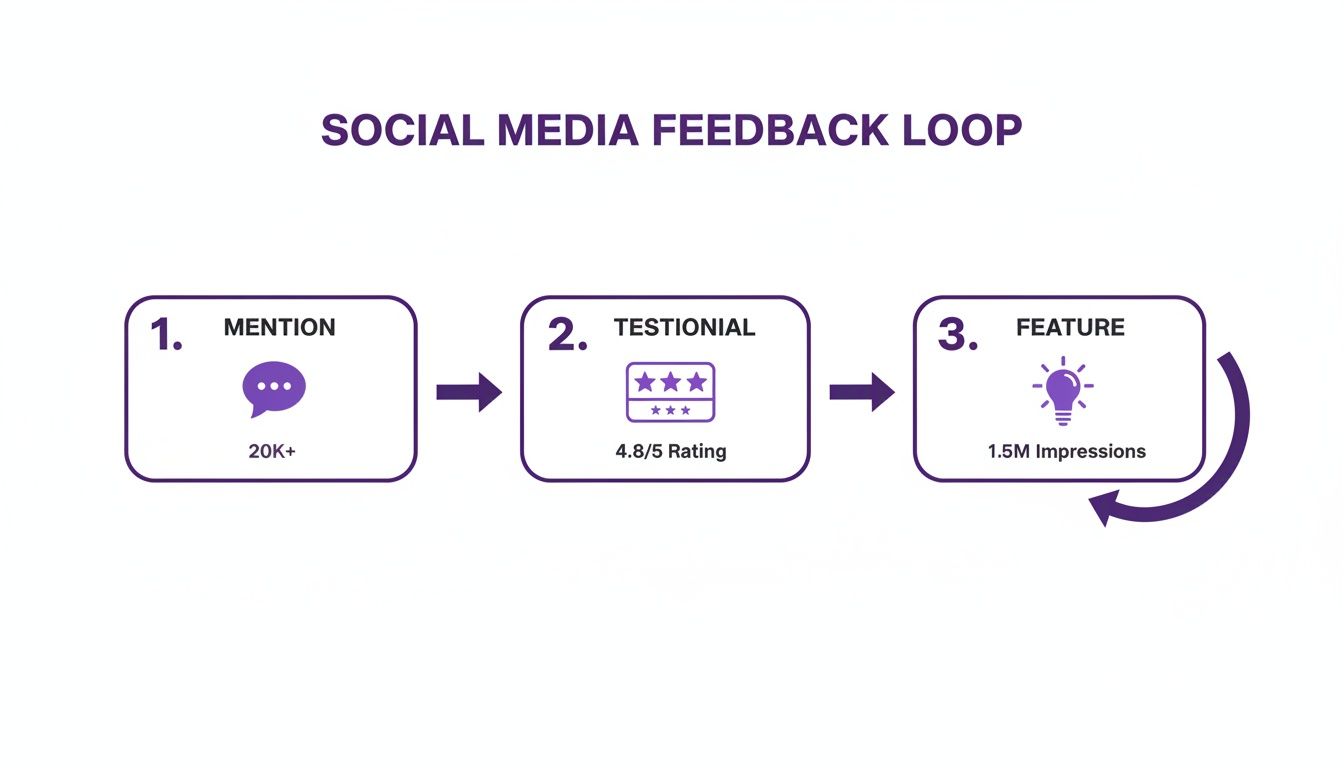
This process transforms everyday online mentions into valuable assets that drive both your marketing and your product development forward.
Having a solid, data-driven approach is non-negotiable, especially in crowded markets. For instance, social media ad spending in Southeast Asia is on track to hit US$4.75 billion in 2025. This surge is driven by a huge demand for authentic engagement through creators and short-form video.
With creator-led commerce already a $46 billion industry delivering 3.5x higher engagement, knowing your numbers isn’t just important—it’s essential to compete.
A Few Common Questions
Jumping into social media marketing can feel like a lot, especially when you’re busy building an amazing product. Let’s clear up a few of the most common questions bootstrapped founders run into.
How Much Time Should a Solo Founder Actually Spend on Social Media Each Week?
As a solo founder, your time is your most valuable asset. The sweet spot is around 3-5 hours per week. This is enough to build and maintain a consistent presence without hitting burnout.
Here’s a practical way to break that down:
- Content Creation (1-2 hours): Set aside one block of time to create all your posts for the week. Batching your content is a game-changer—it gets you in a creative rhythm and is way more efficient than trying to come up with something new every single day.
- Daily Engagement (20-30 minutes): Hop on for a bit each day to reply to comments, answer messages, and engage with mentions. It shows you’re listening and helps build a real community around your work.
If you stick to just one or two platforms and lean on some simple content templates, you’ll find this schedule is surprisingly manageable.
Should I Use a Personal or a Brand Account for My SaaS?
In the early days, especially if you’re building in public, your personal account is your superpower. People connect with people, not logos. Your own brand is the most authentic thing you’ve got.
Use your personal profile to share the unfiltered journey—the wins, the struggles, the late-night coding sessions. This creates a genuine bond with your first users. Once you start getting traction and have a steady stream of customers, you can launch a dedicated brand account for the more official stuff like announcements and support.
At the start, you are the brand. That direct connection is how you’ll build a loyal following of people who are invested not just in your product, but in your story.
What’s the Best Way to Get My First Followers From Zero?
Whatever you do, don’t buy followers. It’s a vanity metric that will only come back to haunt you. The real secret is genuine engagement in the communities where your ideal customers already hang out.
Start by being genuinely helpful. Find the right subreddits, niche Facebook groups, or hashtags like #buildinpublic on X. Jump into conversations, answer questions, and share what you’ve learned without a heavy sales pitch.
This approach naturally draws the right people to your profile. Just make sure your bio clearly states what your SaaS does and has a link to your site. Your first 100 followers should be people who are actually excited about what you’re building.
Ready to turn customer feedback into your most powerful marketing asset? HappyPanda combines surveys, testimonials, changelogs, and email automation into one simple platform for bootstrapped founders. Start your free 14-day trial and see how it works.