
Think of your SaaS product not just as code and features, but as a living thing with its own story. Every product has a beginning, a middle, and an end—a narrative arc that follows a predictable pattern. This journey is what we call the product life cycle.
It’s not some dry theory from a business textbook. It’s a practical roadmap that tells you where you are, where you’re going, and what you should be doing right now. Are you a fragile seedling just breaking ground, or a sturdy oak tree dominating the forest? Knowing the answer helps you make smarter decisions.
This framework gives you much-needed context. It tells you when to pour fuel on the growth fire, when to focus obsessively on keeping the customers you already have, and when it’s time to head back to the drawing board for your next big idea.
The Four Chapters of Your Product’s Journey
The product life cycle breaks down your product’s story into four distinct chapters. Each one comes with its own set of goals, challenges, and signals that let you know it’s time to shift your strategy.
Here’s a quick rundown of the four stages we’ll dive into:
- Introduction: The grand opening. Your idea finally meets the real world. The main goal here is to find your first true fans and nail product-market fit.
- Growth: Things are taking off. You’ve found your footing, and new users are signing up faster than you can send welcome emails. The focus shifts to scaling everything—your tech, your team, and your marketing.
- Maturity: The explosive growth starts to level off as the market gets crowded. Now, it’s all about defending your turf from competitors and squeezing as much profit as possible from your position.
- Decline: The party starts to wind down. The market might be shrinking, a new technology makes your solution obsolete, or customer needs have simply changed. It’s decision time: reinvent or retire gracefully.
This timeline gives you a great visual of how a typical SaaS product moves through these chapters.
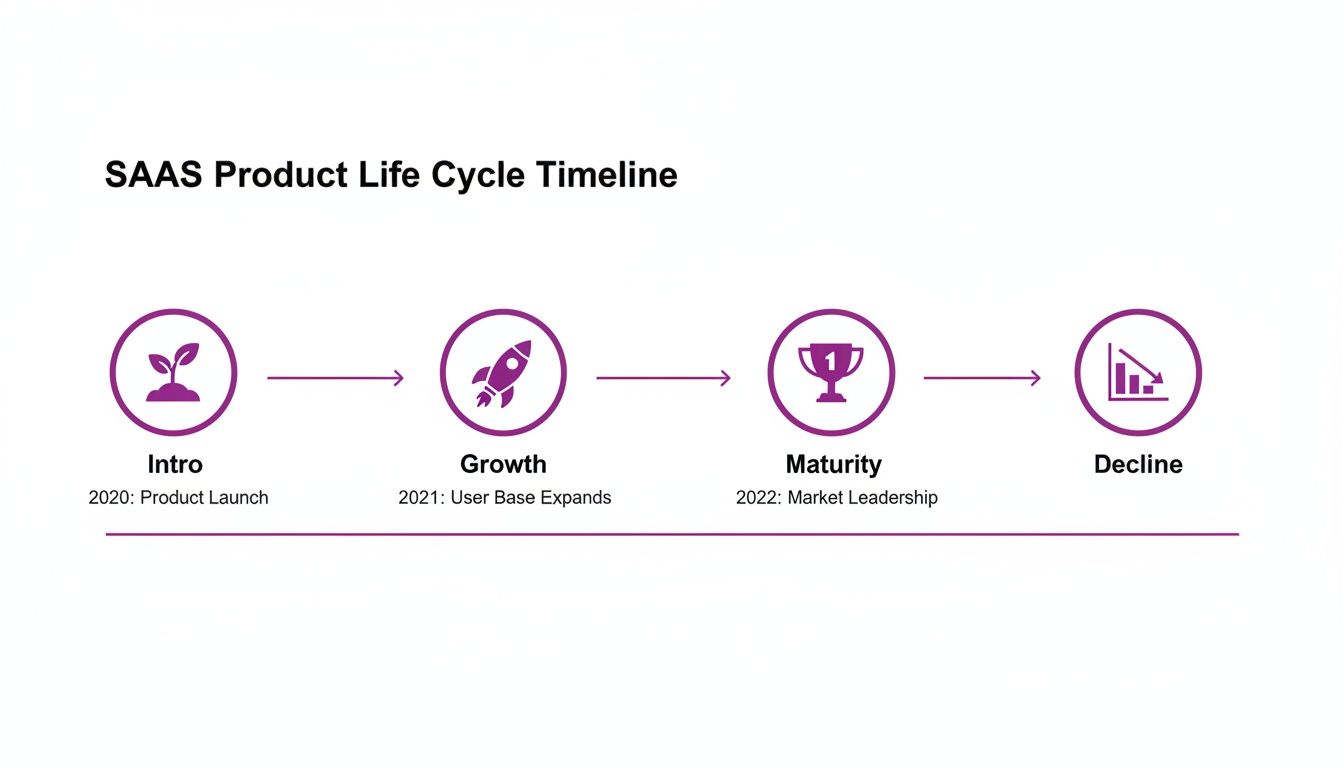
As you can see, revenue and user growth climb steeply through the first two stages before hitting a plateau in maturity and eventually trailing off.
To help you keep these stages straight, here’s a handy table that summarises the key details for each one.
The Four Stages of the SaaS Product Life Cycle at a Glance
| Stage | Primary Goal | Key SaaS Metric |
|---|---|---|
| Introduction | Find product-market fit and validate the core idea. | Activation Rate |
| Growth | Acquire new users and scale operations rapidly. | Monthly Recurring Revenue (MRR) Growth Rate |
| Maturity | Retain existing customers and maximise profitability. | Customer Lifetime Value (CLV) |
| Decline | Decide whether to pivot, reinvest, or sunset the product. | Churn Rate |
This table gives you a cheat sheet for the entire life cycle, connecting each chapter to a clear goal and a metric that tells you how you’re doing.
A Modern Roadmap for a Faster World
While this model has been around for ages, the speed at which products move through it has accelerated dramatically. Take Southeast Asia’s booming smart manufacturing sector. Companies there are using new tech to shorten their product life cycles, moving from idea to full-scale growth faster than ever before. That market was valued at USD 13.4 billion and is expected to more than double by 2033. You can read more about the trends in the South East Asia smart manufacturing market on imarcgroup.com.
What does this mean for you as a SaaS founder? It means you have to be even more tuned in to the signals of each stage. Throughout this guide, we’ll show you how a tool like HappyPanda can give you the insights you need to manage customer communication across every chapter, turning this framework into a real, actionable playbook for your business.
The Introduction Stage: Finding Your First True Fans
This is it—the beginning. Your carefully crafted idea is finally stepping out into the real world. Think of it like a new restaurant’s soft opening. You’re not trying to pack the house just yet; you’re focused on delighting a handful of early patrons and making sure your kitchen—your product—can actually deliver on its promises.
During the introduction stage of the product life cycle, your one and only mission is to find product-market fit (PMF). This isn’t about chasing thousands of sign-ups or getting a splashy feature in TechCrunch. It’s about proving that you’ve built something a specific group of people genuinely needs and, more importantly, loves to use.
The biggest mistake I see founders make here is getting distracted by vanity metrics like total user count. Forget that. Your attention should be laser-focused on the engagement of a small, core group of users. Are they logging in every day? Are they using your key features? This early, intense usage is a far stronger signal of future success than a big number of accounts gathering digital dust.
Key Signals and Metrics to Watch
Early on, qualitative data is often worth more than quantitative data. A single, detailed email from a passionate user can tell you more than a dashboard full of shallow metrics. Your goal is to gather deep insights that tell you you’re on the right path.
Here are the vital signs of a healthy introduction stage:
- High Activation Rate: What percentage of new users successfully complete the one core action in your app? A high rate here means your onboarding works and your value is crystal clear from the get-go.
- Strong Early Retention: Are your first users still around after day one, week one, and month one? Even with a tiny group, seeing people come back is a powerful sign you’re solving a real problem.
- Positive Qualitative Feedback: Are users telling you they “couldn’t live without” your product? That’s the kind of feedback, gathered from real conversations and surveys, that’s pure gold.
- Willingness to Pay: The ultimate gut-check. When users are willing to pull out their credit cards for your solution, even in its early, imperfect state, you know you’re delivering real value.
Practical Tactics Using HappyPanda
This stage is all about direct, personal communication. You need to talk to your first users, understand their problems, and walk them to their “aha!” moment. With a tool like HappyPanda, you can automate this crucial outreach without sounding like a robot.
A great place to start is with a simple welcome email sequence. Forget those generic “Welcome to the app” messages. Your goal is to start a conversation.
Pro Tip: Your welcome email should feel like it came straight from you, the founder. Ask a simple, open-ended question like, “What’s the main thing you’re hoping to achieve with our product?” This simple prompt can open the door to some of the most valuable customer conversations you’ll ever have.
Next, you can set up a Product-Market Fit (PMF) survey right inside your app. Using HappyPanda, you can trigger this survey to pop up after a user has been active for a week or has used a key feature three times. The heart of this survey is the critical question made famous by Sean Ellis: “How would you feel if you could no longer use this product?” If over 40% of your users answer “very disappointed,” that’s a strong signal you’re on the road to product-market fit.
Another killer tactic is creating an in-app onboarding checklist. This guides new users step-by-step through the actions that lead them to experience your product’s core value. By breaking down the setup into small, manageable tasks, you drastically increase the odds of users sticking around long enough to see what makes your solution special.
Ultimately, the introduction stage is a delicate dance of building, listening, and tweaking. For a deeper dive into making this a core part of your operations, check out our guide on creating a system for continuous product discovery. By focusing on deep engagement with a small group of true fans, you build a rock-solid foundation for the explosive growth to come.
The Growth Stage: Scaling Without Chaos
You’ve made it through the choppy waters of the introduction stage and found that sweet spot: product-market fit. Now, the tide is turning. New users are signing up, revenue is climbing, and your little SaaS is starting to feel like a real business. Welcome to the growth stage. It’s exhilarating, but with rapid growth comes the very real risk of chaos.
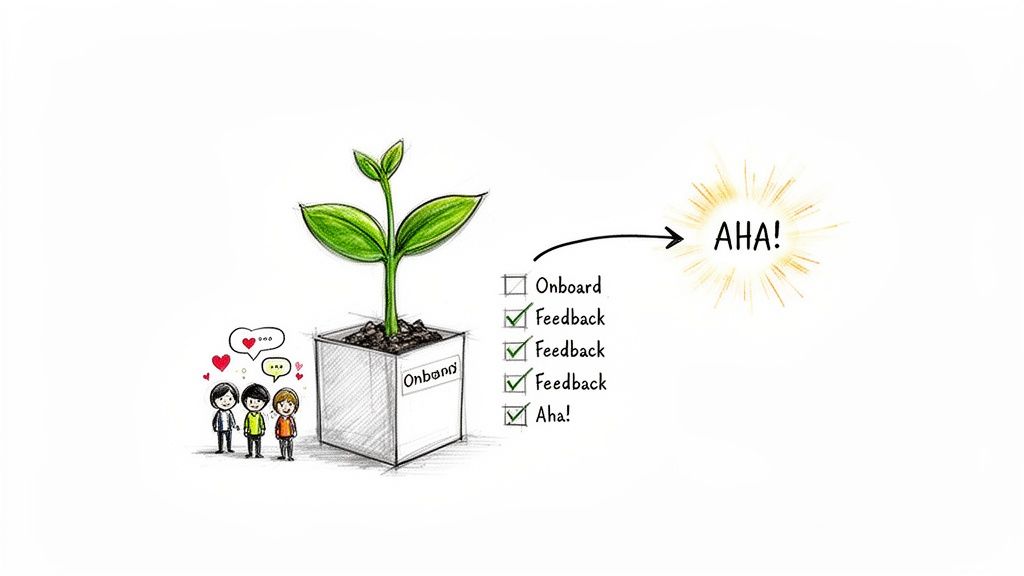
The name of the game here is scaling your user acquisition and operations without letting the customer experience fall apart. Your challenge is no longer just finding users; it’s about managing them, keeping them happy, and building a repeatable engine for growth. This means shifting your focus from purely qualitative feedback to more scalable, quantitative metrics.
Key Signals and Metrics to Watch
During the growth stage, your dashboard becomes your best friend. You need to keep a close eye on the numbers that signal healthy, sustainable expansion. If these metrics are trending in the right direction, you’re successfully navigating this critical phase.
Here are the key indicators of healthy growth:
- Rising Net Promoter Score (NPS): This is your loyalty gauge. As you bring on more users, a stable or rising NPS means your product is still delivering value to a broader audience.
- Consistent Month-over-Month (MoM) Revenue Growth: This is the ultimate sign you’re scaling effectively. Healthy SaaS companies in the growth stage often see 10-20% MoM growth.
- Stable Customer Acquisition Cost (CAC): As you crank up the marketing spend, your CAC will naturally increase. The goal is to keep it stable and predictable, making sure your growth stays profitable.
The speed of this transition can vary wildly depending on the market. Just look at the manufacturing evolution in Southeast Asia, where a surge in investment has drastically shortened the early phases of the product life cycle. A boom in foreign direct investment has accelerated new product launches—from Vietnam’s smartphone sector to Indonesia’s EV battery production—pushing companies into the growth stage faster than ever. This highlights just how crucial it is to have robust systems ready to handle rapid scaling.
Automating Your Growth Engine with HappyPanda
The manual processes that worked for your first 50 users will absolutely break under the weight of 5,000. This is where automation becomes your secret weapon. HappyPanda is designed to help you build a scalable communication strategy that keeps customers engaged as you grow.
First up: automate the collection of social proof. You can’t manually ask every happy customer for a review anymore. Instead, you can build a simple but powerful automation.
HappyPanda Automation Example: Trigger: A user gives you an NPS score of 9 or 10. Action: Wait 24 hours, then automatically send a follow-up email asking for a testimonial.
This simple workflow turns your happiest users into your best marketers, creating a continuous stream of social proof you can use on your website and in marketing materials.
Keeping Your Growing User Base Engaged
As you scale, you’ll be shipping new features and improvements more frequently. It’s crucial that your expanding user base knows about these updates. A static blog post just won’t cut it anymore.
This is where an in-app changelog widget becomes essential. With HappyPanda, you can add a “What’s New” feed directly inside your application.
- Announce new features to drive adoption of your latest work.
- Highlight improvements to show users you’re listening to their feedback.
- Share bug fixes to build trust and show you’re on top of things.
Finally, you need to keep a pulse on customer satisfaction at scale. Manually checking in after every support ticket is impossible. Instead, you can automate feedback collection to monitor service quality.
Here’s another simple automation you can set up:
- Integrate with your support tool: Connect HappyPanda to your help desk software.
- Set the trigger: When a support ticket is marked as ‘resolved’.
- Deploy the survey: Automatically send a simple Customer Satisfaction (CSAT) survey asking, “How satisfied were you with our support?”
This gives you a real-time health check on your customer support, letting you spot problems before they lead to churn. Effectively gathering and acting on this information is vital; you can learn more about how to systematically collect feedback from users in our detailed guide.
By putting these automations in place, you can scale your SaaS without sacrificing the personal touch that got you here, setting a strong foundation for the next stage of the product life cycle.
The Maturity Stage: How to Defend Your Market
After the exhilarating rush of the growth stage, things start to feel… different. This is the maturity stage. That explosive, hockey-stick growth begins to flatten out, your market suddenly feels a bit crowded, and you start seeing competitors borrowing—ahem, stealing—your best features.
The game is no longer just about landing new users. It’s about smart retention, optimisation, and defending the turf you’ve worked so hard to claim.
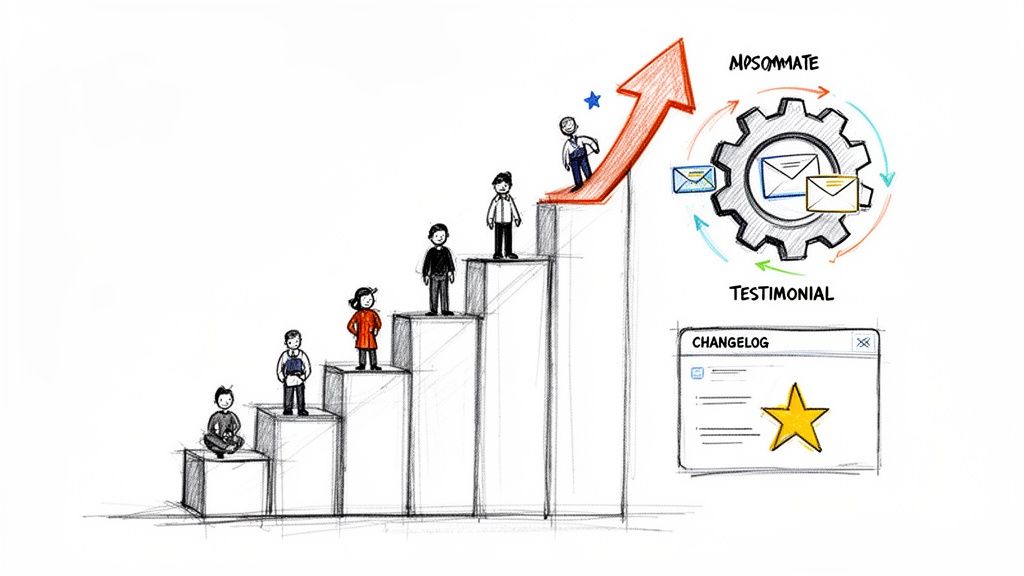
Think of it like being a reigning champion. During the growth phase, you were the scrappy underdog climbing the ranks. Now, you’re the one with the title, and everyone is studying your moves, looking for a weak spot. Your strategy has to shift from pure offence to a calculated, clever defence.
Key Signals Your Product Has Matured
Knowing you’re in the maturity stage is half the battle. The signs can be subtle at first, but they become impossible to ignore. A slowing user growth curve is the most obvious tell, but there are a few other things to keep an eye on.
You’ll need to start watching a different set of metrics—ones that tell a story of efficiency and loyalty.
- Stabilising User Count: Your month-over-month growth slows down from those exciting double-digit leaps to a more modest 2-5%. The conversation shifts from how many new sign-ups you got to how long your existing customers are sticking around.
- Increased Price Sensitivity: You might notice customers questioning your pricing more often, especially as cheaper alternatives pop up. This is a clear signal that you need to double down on communicating your unique value.
- Customer Churn Rate: This metric becomes your north star. Keeping churn low is the single most important factor in staying profitable during this stage. For a deeper look, check out our guide on how to tackle churn in SaaS.
- High Customer Lifetime Value (CLV): A healthy CLV is the ultimate proof that you’re succeeding. It shows you’re not just keeping customers, but you’re keeping them happy and engaged enough to stick with you long-term.
This isn’t just a SaaS thing, either. Across all industries, the goal is to extend this profitable phase for as long as possible. For instance, the move towards regenerative manufacturing in Southeast Asia is completely changing product life cycles by using AI from the get-go. This is all about optimising the entire lifecycle to grab a piece of the sector’s projected US$1.2 trillion output by 2030. In Singapore, smart factories have already managed to slash lifecycle costs by 25%. You can read more about how AI is unlocking growth in Southeast Asia on edb.gov.sg.
Advanced Tactics to Protect Your Market Share
In a packed market, your best defence is knowing your customers better than anyone else. You need to find and smooth out those little points of friction before a competitor can use them against you. This is where targeted feedback and proactive communication become your secret weapons.
HappyPanda helps you move beyond bland, generic surveys and set up smart, automated strategies to keep your users happy.
Key Insight: During the maturity stage, acquiring a new customer can cost 5x more than keeping an existing one. Every feature you build and every email you send should be focused on strengthening the relationships you already have.
One incredibly powerful tactic is using Customer Effort Score (CES) surveys. Instead of just asking if customers are happy, CES cuts right to the chase: “How easy was it to get your problem solved?”
HappyPanda Automation Example:
- Trigger: A user tries a complex feature for the first time, or maybe a support ticket is just closed.
- Action: Send them a quick CES survey asking, “How easy was it to accomplish your goal today?”
- Follow-up: If you get a low score (meaning high effort), automatically create a task for your team to reach out to that user personally.
This does two things brilliantly: it pinpoints friction in your product and shows users you’re genuinely invested in their experience. It builds a moat of loyalty that competitors will find tough to cross.
To make it even clearer, here’s a quick breakdown of how you can adapt your communication strategy using HappyPanda for each stage.
| Lifecycle Stage vs Customer Communication Tactic | | :--- | :--- | :--- | | Stage | Primary Tactic with HappyPanda | Goal | | Introduction | In-app welcome surveys & NPS | Understand initial impressions, find early adopters | | Growth | Feature feedback widgets & CSAT surveys | Prioritise roadmap, measure satisfaction with new releases | | Maturity | Customer Effort Score (CES) & churn surveys | Reduce friction, identify at-risk users, improve retention | | Decline | Exit surveys & win-back email campaigns | Understand reasons for leaving, salvage relationships |
As you can see, the focus in the maturity stage shifts from broad satisfaction to the specifics of user effort and retention—precisely where you need to be to defend your market share.
Building Automated Win-Back Campaigns
Let’s be real—even with the best retention strategy, some customers will leave. The maturity stage is the perfect time to build an automated win-back campaign to bring some of them back into the fold.
Using HappyPanda’s email sequences, you can set up a workflow that kicks in the moment a user cancels.
- Immediate Exit Survey: First things first, ask them why they’re leaving. This feedback is pure gold for preventing others from following them out the door.
- Acknowledge and Offer Help: A few days later, send a personal-feeling email (maybe from the founder?) that acknowledges their reason for leaving and offers direct help.
- The “Come Back” Offer: After 30 days, send one last email with a special offer to return—a discount, maybe, or early access to a new feature they asked for.
By shifting your focus from chasing new leads to deeply understanding and retaining your current customers, you can successfully defend your position and keep your business thriving through the maturity stage.
The Decline Stage: Making Your Next Smart Move
Every product eventually reaches its final chapter. The decline stage is an inevitable destination, but it’s not a sign you’ve failed. Think of it as a strategic crossroad where clear-headed, data-driven decisions are more important than ever.
This is the point where sales start to consistently drop, the market might be shrinking, or some new tech just made your solution feel a bit… dated. It’s easy to get sentimental about a product you’ve poured your heart into, but emotion is the enemy of good strategy here. Your job is to read the signals and choose your next move wisely.
Reading the Signals of Decline
The signs of the decline stage are usually pretty stark and hard to ignore. The trick is to act on them proactively, not wait until your bank account is screaming for help. The metrics will tell the story long before then.
Here are the key indicators that your product has entered this final phase:
- Persistently High Churn: Your churn rate isn’t just spiking; it’s consistently beating your acquisition efforts. You’re losing more users than you’re gaining, month after month.
- Dropping Engagement: Core feature usage is falling, daily active users are dwindling, and your product is becoming less essential to your remaining customers.
- Shrinking Market: The whole playground is getting smaller. The total market for your solution is contracting because of tech shifts or changing user needs.
Once you’ve confirmed you’re in this stage, you’re faced with two distinct paths: revival or retirement. The choice you make will define your product’s legacy and your freedom to move on to the next big thing.
The Two Paths: Revival or Retirement
Your first instinct might be to save the product at all costs, but a graceful exit can often be the smarter business decision. The key is to let customer data guide you, not wishful thinking.
Key Insight: The decline stage is the ultimate test of your ability to listen to the market. The feedback you gather here—especially from churned users—is priceless intelligence for your next product idea.
This is where you can lean on HappyPanda one last time to uncover the ‘why’ behind the decline. By setting up an automated exit survey the moment a user cancels, you can collect a steady stream of candid feedback. Are they leaving for a competitor with a killer new feature? Has their underlying problem just vanished? The answers will tell you if a pivot could spark a revival or if the market has truly moved on.
Executing a Graceful Retirement
If the data points towards retirement, your goal is to sunset the product in a way that preserves the goodwill you’ve built. A botched shutdown can burn bridges and tarnish your reputation, making it much harder to launch your next product successfully.
Here’s a simple, professional plan for sunsetting your SaaS using a HappyPanda email sequence:
- Announce the Plan Clearly: Send an email to all active users giving them a generous timeline (e.g., 90 days) before the service is discontinued. Be transparent about why you’re making this call.
- Provide Data Export Tools: Make sure users can easily export their data. This is non-negotiable. It shows respect for the information they’ve entrusted to you.
- Offer a Final Goodbye: Send a reminder one week before the final shutdown date. Thank them for their loyalty and, if you can, suggest an alternative solution that might work for them.
Navigating the decline stage with professionalism turns a potential failure into a valuable learning experience. It leaves you free—and respected—to go and build your next great idea.
Putting Your Product Life Cycle Strategy on Autopilot
Alright, so you understand the product life cycle. That’s the easy part. The real challenge? Actually doing something about it. Manually sending out surveys and emails at just the right moment for each stage is a recipe for headaches and missed opportunities. This is where you can tie everything together into a smart, automated system that does the heavy lifting for you.
With the right setup, you can roll out a polished communication strategy without needing a huge team or spending hours glued to your screen. It’s all about turning that textbook theory into an effortless, repeatable practice.
Instantly Deploy Your Strategy with Recipes
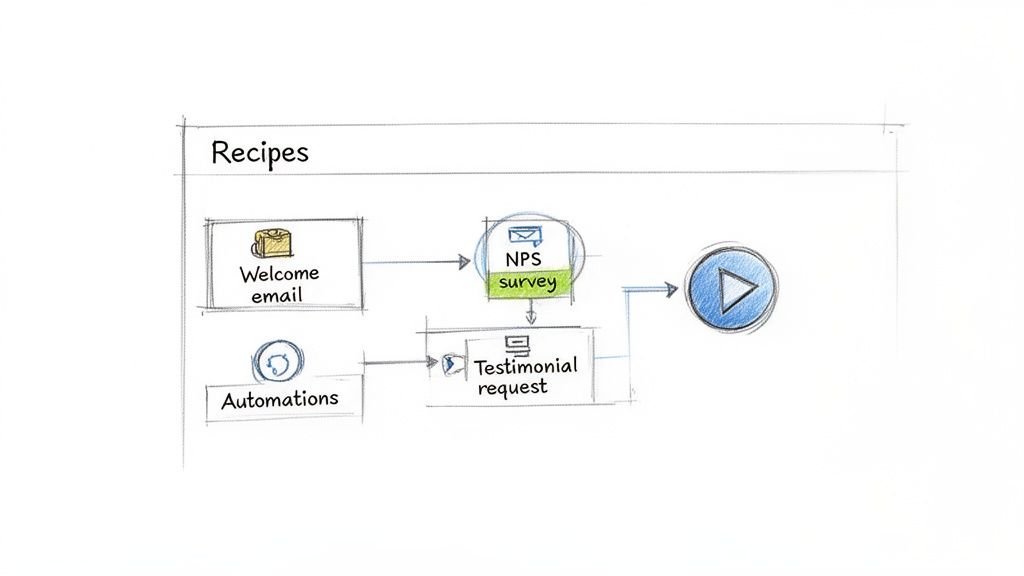
Think of HappyPanda’s pre-built ‘Recipes’ as complete playbooks that put your entire life cycle communication plan into action in minutes. No guesswork, no building from scratch—just a proven strategy ready to go.
Take the ‘SaaS Starter Kit’ recipe, for example. It instantly configures workflows perfectly timed for the early stages of the product life cycle:
- Introduction Stage: A personalised welcome email sequence automatically kicks off to engage new users and start valuable conversations from day one.
- Growth Stage: An NPS survey is set to go out after a user has been active for 14 days, helping you measure loyalty just as you’re starting to scale.
- Maturity Stage: A testimonial request is automatically sent to your happiest users (those with high NPS scores), building social proof to help you defend your spot in the market.
Using a pre-built recipe isn’t just about saving time on setup. You’re deploying a proven strategy that aligns perfectly with each phase of your product’s journey. It ensures you’re always sending the right message at the right time, without even thinking about it.
This whole approach reinforces a core message for solo founders and small teams: you don’t need a massive budget to manage your product life cycle like a pro. With a bit of smart automation, you can run a slick customer engagement programme that rivals those of much larger companies.
And to really put your marketing on autopilot, exploring the best Facebook Ads automation tools can be a massive help in streamlining your acquisition efforts.
By automating these key touchpoints, you free yourself up to focus on what really matters: building a fantastic product that customers can’t get enough of.
Your Questions, Answered
How Can I Tell Which Stage My SaaS Is In?
You need to look at a few key signals together. If you’re seeing explosive user and revenue growth—think over 10% month-over-month—you’re almost certainly in the Growth stage. When that momentum cools down to single digits and you start noticing new competitors popping up, you’ve likely hit Maturity.
Early on, in the Introduction stage, you’ll have a small but fiercely engaged user base. On the flip side, consistently high churn rates and a drop-off in user engagement are tell-tale signs of the Decline stage. Keep a close eye on your user growth, churn, and the overall market saturation to get a clear picture of where you stand.
Can a Product Move Backward Through the Life Cycle?
Absolutely. This is often called an “extension strategy” or a revival. A product deep in Maturity or even Decline can jump back into the Growth stage with a major pivot, a game-changing feature release, or by launching into a totally new market.
This isn’t a shot in the dark, though. It almost always starts with listening intently to your customers to find new problems worth solving. Using targeted surveys to understand what your users need now is the secret sauce for pulling off a successful comeback.
The key is realising that a product’s journey isn’t always linear. A strategic pivot, informed by real user data, can breathe new life into a mature product and kickstart a second wave of growth.
Is the Product Life Cycle the Same as the Customer Life Cycle?
They’re related, but they’re two different maps. The product life cycle (Introduction, Growth, Maturity, Decline) tracks your product’s journey across the entire market. It’s the big-picture view.
The customer life cycle (Awareness, Acquisition, Activation, Retention, Referral), on the other hand, zooms in on a single user’s journey with your product. A brilliant strategy aligns your customer messaging with your product’s current life cycle stage, making sure what you say is always perfectly timed and relevant.
Ready to automate your communication across every stage of the product life cycle? HappyPanda combines email sequences, feedback surveys, onboarding checklists, and more into one simple platform. Start your free 14-day trial today at https://happypanda.ai.