
For bootstrapped founders, key account management isn’t some stuffy corporate term. It’s a simple mindset: give your most valuable customers a genuine VIP experience. Forget managing a massive portfolio; this is about being a personal tech concierge for the clients who are the lifeblood of your early growth—the ones giving you crucial feedback and that beautifully consistent monthly recurring revenue.
Get this right, and you can slash churn and unlock a goldmine of expansion revenue.
What Key Account Management Really Means for SaaS Founders
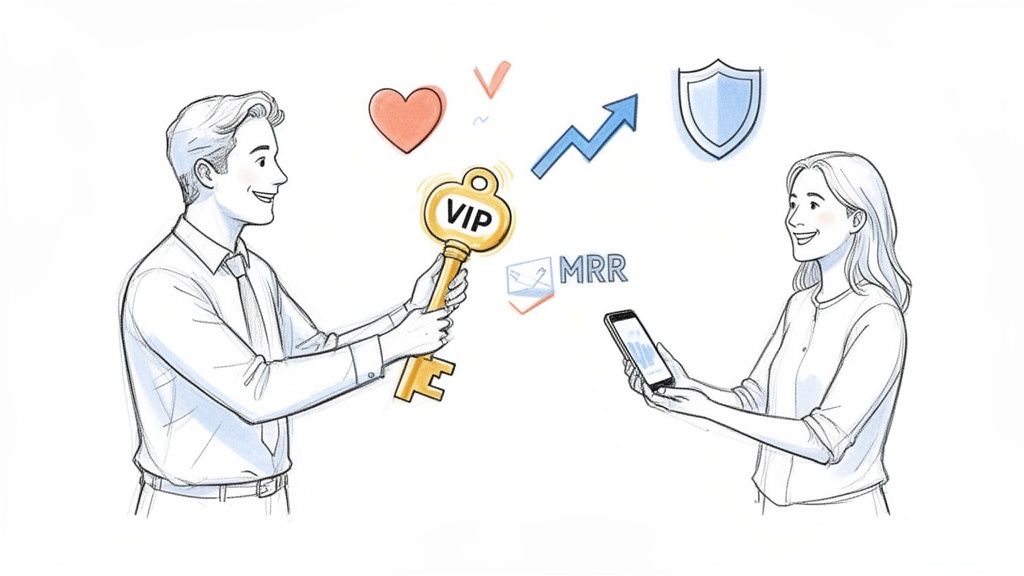
Think of traditional sales as a sprint to the finish line—the moment a customer clicks “subscribe.” The goal is pure acquisition. Key Account Management, on the other hand, is the marathon that starts after the sale. It’s a long-term strategy built on real relationships, designed to nurture and grow your most important customer accounts.
For a bootstrapped SaaS, these aren’t just any accounts; they’re your strategic partners. They’re the early adopters who took a chance on your vision, provide the most insightful feedback, and have the highest potential to grow right alongside you. Good KAM makes sure these critical relationships don’t just survive, they thrive.
The Hunter vs. The Gardener Analogy
To really get the difference, let’s imagine a hunter and a gardener.
-
The Hunter (Traditional Sales): This person is all about finding and capturing new prey (customers). Once a target is acquired, the hunter is already moving on to the next one. It’s a game of volume, and the relationship is purely transactional.
-
The Gardener (Key Account Manager): This person cultivates a select few high-yield plants (your key accounts). They provide the right conditions—water, sunlight, and nutrients—to help them flourish, bear more fruit, and even re-seed for future growth. The whole process is about relationships and creating long-term value.
This distinction is everything for a bootstrapped founder. With limited time and money, you can’t afford to constantly hunt for new customers while your best ones wither from neglect. The data doesn’t lie: a mere 5% increase in customer retention can boost profits by as much as 95%. The gardener’s approach isn’t just nice—it’s far more sustainable and profitable.
Key Account Management is the art of turning your top customers from simple users into true strategic partners. It’s a proactive investment in relationships that pays dividends in loyalty, expansion revenue, and priceless product insights.
A Quick Comparison
To put it in black and white, here’s a look at how these two approaches stack up.
| Aspect | Traditional Sales | Key Account Management |
|---|---|---|
| Primary Goal | Acquire new customers | Grow and retain existing high-value customers |
| Time Horizon | Short-term, focused on the close | Long-term, focused on the entire customer lifecycle |
| Relationship | Transactional | Relational and consultative |
| Key Metrics | New logos, conversion rates, deal size | Net Revenue Retention (NRR), churn rate, expansion MRR |
| Focus | Product features and price | Customer’s business goals and outcomes |
Seeing them side-by-side makes it clear: while sales gets customers in the door, KAM makes sure the best ones want to stay and grow with you for years to come.
Core Pillars of KAM for Bootstrappers
At its heart, KAM for a small SaaS team rests on a few key pillars that set it apart from just doing good customer support. Before diving in, it helps to understand the foundational customer relationship management basics. With that foundation, you can see how KAM builds on it.
The focus shifts from just closing tickets to actively creating shared success. This deeper level of engagement is a huge part of a strong customer experience management strategy, making sure your best clients feel genuinely seen and valued.
Ultimately, KAM is about protecting your most important revenue streams while systematically finding opportunities for growth within those very accounts. It turns your top customers into a powerful, predictable engine for your business.
How to Pinpoint Your Key Accounts (Without a Data Science Team)
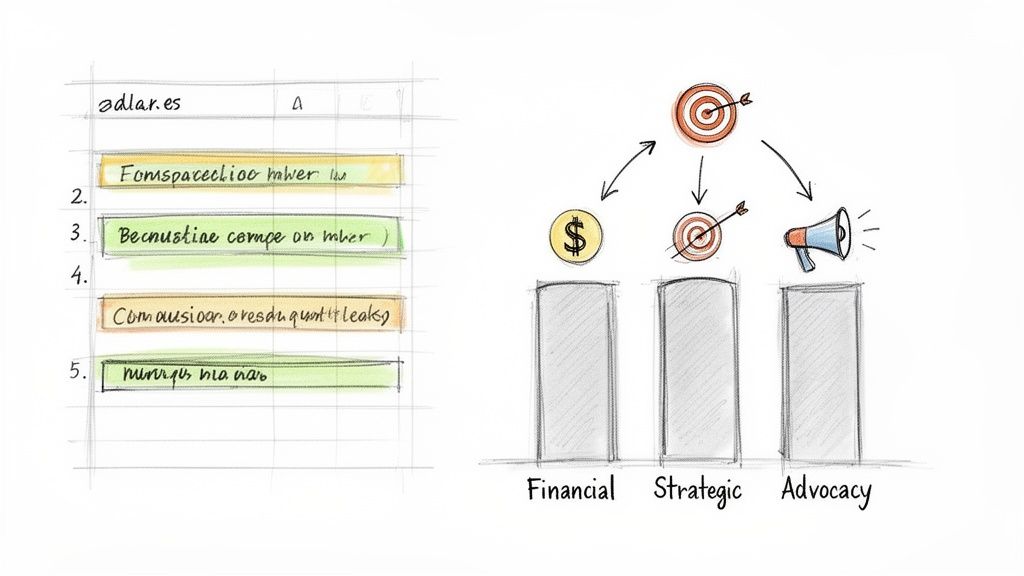
You don’t need a complex analytics platform or a team of data scientists to figure out who your most important customers are. For a bootstrapped founder, smart key account management starts with a simple spreadsheet and a bit of common sense.
The goal here is to get past gut feelings and build a repeatable system for identifying the clients who will actually shape your SaaS’s future. It’s all about focusing your limited time and energy where you’ll get the biggest bang for your buck.
This whole process boils down to three core pillars: financial value, strategic value, and advocacy potential. By scoring your customers against these criteria, you can build a clear, data-informed ranking of your entire user base.
The Three Pillars of Account Value
Looking at revenue alone is like trying to understand a movie by only watching the trailer—you miss the whole story. A balanced approach gives you a much richer picture of an account’s true worth.
After all, a high-paying customer who’s a nightmare to work with might be less valuable in the long run than a smaller, collaborative one who perfectly fits your ideal user profile.
Here’s how to break it down:
- Financial Value: This one’s the most straightforward. It’s all about the hard numbers. Who’s paying the bills right now, and who looks poised to spend more down the line?
- Strategic Value: This goes way beyond the monthly invoice. It’s about how well a customer aligns with your long-term vision. These are the partners who give you the feedback that helps you build a better product and a stronger business.
- Advocacy Potential: Your happiest customers are your best marketing team. This pillar helps you spot the users most likely to become vocal champions for your brand, providing the kind of social proof you just can’t buy.
By tallying up scores from these three areas, you can systematically rank every customer and confidently pick out your top 5-10 key accounts to pour your energy into.
Identifying key accounts isn’t just about finding your biggest spenders. It’s about pinpointing your strategic partners—the customers whose success is fundamentally intertwined with your own.
Creating Your Simple Scoring System
Right, let’s turn these ideas into something you can actually use. Open up a spreadsheet, list your customers down one column, and then add columns for the criteria below. Score each one from 1 (low) to 5 (high).
Pillar 1: Financial Value
- Current MRR: How much are they bringing in right now?
- Lifetime Value (LTV) Potential: How likely are they to stick with you for the long haul and upgrade?
- Expansion Opportunity: Is their company growing? Is there an obvious path to an upsell?
Pillar 2: Strategic Value
- Ideal Customer Profile (ICP) Fit: How closely do they match the dream customer you built your product for?
- Feedback Quality: Do they give you sharp, actionable feedback that helps you improve, or just complain?
- Prestige: Is their logo one you’d proudly slap on your homepage? A well-known name can lend you serious credibility.
Pillar 3: Advocacy Potential
- Net Promoter Score (NPS): Have they given you a high score (9 or 10)?
- Testimonial Willingness: Have they ever said they’d be happy to provide a quote or do a case study?
- Referral History: Have they ever sent a new customer your way?
Once you’ve scored everyone, just add up the points. The customers with the highest totals are your key accounts. Simple. This method takes the guesswork out of the process and lets you focus on the relationships that truly move the needle.
This kind of focus is absolutely crucial, especially in booming markets like Southeast Asia. SaaS spending per employee in the region is set to jump 2.5-fold, from $3.79 in 2020 to $13.47 by 2025, according to the e-Conomy SEA 2023 report. Mastering this targeted approach is how you’ll capture those high-value clients and build sustainable MRR.
Going through this exercise also gives you a much deeper understanding of your customer base. To learn more about gathering and using these kinds of insights, check out our guide on the voice of the customer.
Building Your Budget-Friendly KAM Playbook
You don’t need a massive budget or a dedicated department to nail key account management. For a bootstrapped founder, it’s all about creating a series of smart, repeatable processes—or ‘plays’—that give your top clients a high-touch experience without completely derailing your schedule.
Think of it this way: a playbook turns good intentions into a reliable system. It ensures your most important customers consistently feel valued, heard, and supported. Each play we’ll cover is designed to be simple, actionable, and easy to automate, letting you build deep relationships that can actually scale.
Let’s break down four essential plays any solo founder can run right now.
Play 1: The Welcome Concierge
The first few days after a customer signs up are make-or-break. This play is all about ditching the generic, automated welcome email and rolling out the red carpet with a personalised, concierge-style onboarding for your key accounts.
Objective: To make new key accounts feel like VIPs from day one, helping them see immediate value and feel personally welcomed.
Action Steps:
- Spot Your New Key Accounts: Use your scoring system to immediately flag new sign-ups that fit your ideal key account profile.
- Send a Personal Video: Grab a tool like Loom and record a quick, unscripted welcome video. Just mention their company by name and highlight one specific reason you’re excited to have them on board. It takes 60 seconds and makes a huge impact.
- Offer a 1-on-1 Onboarding Call: Don’t call it a “product tour.” Frame it as a “strategy session” to help them hit their main goal with your software.
- Share a Direct Line: Give them a direct way to reach you. This could be a dedicated email alias or even a private Slack channel.
This proactive, personal touch immediately sets the relationship off on the right foot. It shows you’re invested in their success, not just their subscription payment.
Play 2: The Proactive Check-in
Don’t wait around for your key accounts to run into problems. The Proactive Check-in is about starting conversations at regular intervals to see how they’re doing, uncover challenges, and offer help before they even have to ask.
This isn’t just customer support; it’s relationship management. The goal is to shift from a reactive “break-fix” model to a proactive “partner-in-success” one.
Objective: To keep a constant pulse on account health, spot potential churn risks early, and solidify your role as a trusted advisor.
Action Steps:
- Set a Cadence: Schedule automated email check-ins at key milestones—think 30, 60, and 90 days after they’ve onboarded.
- Ask Open-Ended Questions: Instead of the bland “Is everything okay?”, try something more engaging like, “What’s one thing you’re hoping to achieve with our tool this quarter?” or “Have you had a chance to try out [specific feature] yet?”
- Monitor Usage Data: Before your check-in, take a quick peek at their usage patterns. If you notice a feature they aren’t using, you can tailor your message to highlight how it could help their specific situation.
- Automate but Personalise: You can use an email sequence tool for this, but make sure the templates feel human. A simple tool like HappyPanda can automate these sends while still letting you add a quick personal touch before they go out.
Play 3: The Feedback Loop
Your key accounts are an absolute goldmine of product insights. This play creates a system for how you gather, acknowledge, and act on their feedback, making them feel like they’re co-creating your product roadmap with you.
Objective: To consistently collect high-quality feedback and prove that their voice directly shapes your product’s future.
This approach mirrors what’s happening in much larger industries. For instance, PwC’s Digital Banking Survey 2023 found that 68% of Southeast Asian banks are going all-in on digitalisation to improve customer experiences—a strategy that leans heavily on structured feedback. For a SaaS founder, a systematic feedback loop hits the exact same target: creating efficient, high-touch experiences for top clients. You can learn more about these strategic priorities in the SEA banking sector.
Action Steps:
- Targeted NPS Surveys: Don’t just blast your entire user base. Send Net Promoter Score (NPS) surveys specifically to your key accounts to get a clean signal on their satisfaction.
- Follow-Up Immediately: When feedback lands in your inbox—good or bad—respond within 24 hours. A simple “Thanks so much for this, we’re looking into it” makes a world of difference.
- Close the Loop: This is the most powerful step, and the one most companies skip. When you ship a feature or fix a bug they requested, send them a personal note to let them know. It shows you listened and took action.
Play 4: The Advocacy Engine
Let’s be honest: happy customers are your best marketing team. The Advocacy Engine play gives you a clear path for turning satisfied key accounts into powerful testimonials, case studies, and referrals.
Objective: To systematically identify your happiest customers and activate them to generate the kind of social proof that actually drives new business.
Action Steps:
- Trigger the Ask: The perfect time to ask for a testimonial is right after a positive interaction, like when they give you a high NPS score or send a glowing email. Automate this request.
- Make It Effortless: Use a tool that lets them submit a testimonial in just a few clicks. It helps to provide prompts or a few guiding questions.
- Showcase Their Success: Feature their story on your website or in a case study. This gives you fantastic social proof and gives their company some valuable exposure.
To really get the most out of your best client relationships, you might eventually look into more advanced Account Based Marketing (ABM) strategies. But for now, these playbooks are the foundation. They transform relationship management from a purely reactive chore into a scalable, proactive system that drives both retention and growth.
Tracking the KPIs That Actually Matter for KAM
Let’s be honest, you can’t run your key account strategy on good vibes alone. To really know if your most important relationships are thriving, you need to look past the vanity metrics and focus on the numbers that tell the real story of growth and loyalty.
These aren’t just figures on a spreadsheet; they’re the narrative of your business. They show you whether your strategic accounts are becoming more valuable, how deeply they’re woven into your product, and if your efforts are building a stronger, more predictable revenue stream. Forget the noise—these are the essential metrics every bootstrapper needs to watch.
Key Account Management KPIs for Bootstrappers
Before we dive deep, here’s a quick overview of the metrics that will give you the most bang for your buck. Think of this table as your go-to cheat sheet for measuring the health and growth of your most valuable customers.
| KPI | How to Calculate It | Why It Matters for Key Accounts |
|---|---|---|
| Net Revenue Retention (NRR) | (Starting MRR + Expansion - Contraction - Churn) / Starting MRR | The ultimate health score. An NRR over 100% proves your key accounts are growing on their own. |
| Customer Lifetime Value (LTV) | Average Revenue Per Account (ARPA) x Customer Lifetime | Justifies the extra effort. It shows the massive long-term financial upside of keeping these clients happy. |
| Customer Health Score | Weighted score of product usage, support tickets, NPS, last contact, etc. | Your early-warning system. It flags at-risk accounts before they show up in your churn numbers. |
These three KPIs form a powerful trio, giving you a complete picture of both current performance and future potential. Now, let’s unpack them one by one.
Measuring Growth with Net Revenue Retention
If you track only one metric, make it Net Revenue Retention (NRR). Seriously. It’s the single most powerful indicator for a SaaS business that cares about its existing customers. NRR tells you what percentage of revenue you kept from a group of customers over time, but it cleverly includes both upsells (expansion) and downgrades or churn (contraction).
A healthy NRR floating above 100% is the magic number. It means your business is actually growing from your current customers alone, without even needing to sign a single new one. For your key accounts, this is the gold standard—proof that the relationship is getting stronger and delivering more value for everyone.
The formula is simpler than it looks:
NRR = (Starting MRR + Expansion MRR - Contraction MRR - Churn MRR) / Starting MRR x 100
So, if you kicked off the month with £10,000 in revenue from your key accounts, added £2,000 in upgrades, but lost £500 from a downgrade, your NRR would be a stellar 115%. That’s a powerful signal that your KAM strategy isn’t just maintaining relationships; it’s actively growing them from the inside.
Understanding Long-Term Value
While NRR is your momentum gauge, Customer Lifetime Value (LTV) is your crystal ball. LTV estimates the total revenue you can expect from a single account over the entire course of your relationship. It’s the big-picture view.
This metric is absolutely critical for key account management because it’s your justification for going the extra mile. When you realise a key account’s potential LTV is 10x that of an average customer, suddenly investing in a personalised onboarding session or proactive check-ins doesn’t feel like a cost—it feels like a brilliant strategic move.
You can get a solid estimate with a straightforward calculation:
- Average Revenue Per Account (ARPA): What’s the average monthly recurring revenue you get from that account?
- Customer Lifetime: How long do they typically stick around?
Multiply the two, and you have a clear picture of that account’s total worth.
The diagram below shows how different KAM plays—like solid onboarding and regular check-ins—are the very things that boost these vital metrics.
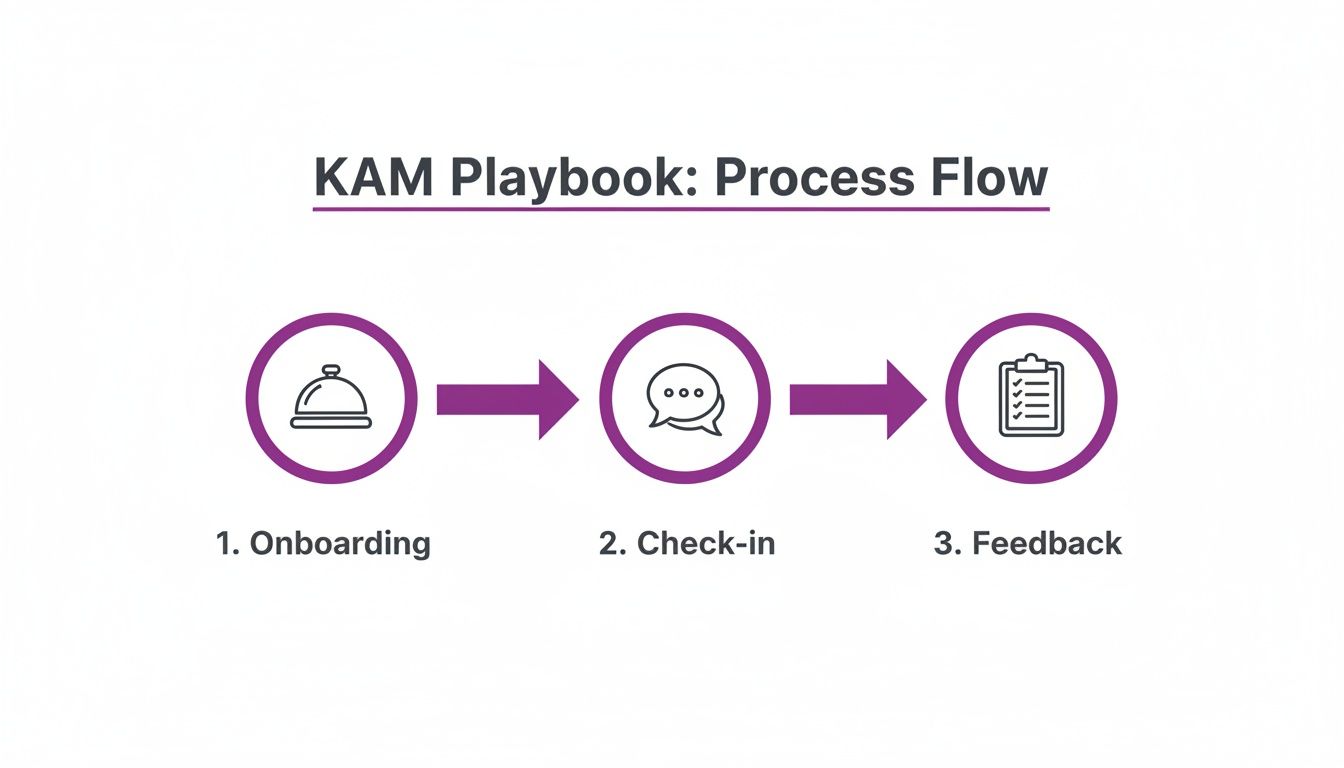
This isn’t just a theoretical flowchart. It’s a practical map showing how structured engagement builds the loyalty that directly drives up your LTV and NRR.
Gauging Relationship Strength with a Customer Health Score
Not everything that counts can be counted in pounds and pence. A Customer Health Score is a metric you create yourself to get a proactive, gut-check view of an account’s satisfaction and engagement levels. Think of it as your relationship’s pulse.
This score is a blend of different data points that, together, signal how “healthy” the partnership is. It’s your early-warning system, helping you spot an account that’s quietly drifting away long before they hit the cancel button.
You don’t need fancy software to start. A simple spreadsheet will do. Just score accounts based on a few key factors:
- Product Usage: Are they logging in often? Are they using the sticky features?
- Support Tickets: A sudden spike in tickets is a red flag. So is complete silence.
- NPS Score: Are they a cheerleader (Promoter) or a quiet critic (Detractor)?
- Last Contact: How long has it been since you had a real conversation?
By assigning points to each factor, you can create a simple colour-coded system (Green, Yellow, Red) to instantly see where you need to focus your energy. It’s a brilliant way to turn a vague “I think this account is at risk” feeling into a data-backed signal you can actually act on.
Automating Your KAM Strategy with the Right Tools
Having a solid playbook is one thing, but actually running it as a solo founder is a whole other beast. This is where so many of us get stuck, trying to juggle our most important customer relationships with a messy patchwork of spreadsheets, email clients, and survey tools. It’s not just a time drain; it creates data silos and makes it impossible to deliver a truly cohesive, high-touch experience.
Let’s be clear: the goal isn’t to replace human connection with bots. It’s about using smart automation to handle the repetitive, administrative grunt work. This frees you up to focus on the high-impact, strategic conversations that genuinely strengthen those key relationships.
Instead of wrestling with five different subscriptions and flaky integrations, a single, unified platform can become the central nervous system for your entire key account management strategy. It brings your feedback, email, and onboarding workflows together into one automated engine.
Centralising Your KAM Workflows
Think about this classic scenario: you send out an NPS survey, and one of your key accounts gives you a glowing 10. In a disconnected system, that awesome feedback just sits in a spreadsheet, waiting for you to notice it. To do anything with it, you’d have to manually draft a follow-up email, create a calendar reminder to schedule a call, and maybe update another document to tag them as a potential advocate.
With a platform like HappyPanda, that entire sequence can be triggered automatically the moment that positive score comes in.
The real power of automation in key account management isn’t just about saving time. It’s about creating instant, personalised, and scalable responses to customer signals, ensuring no opportunity to strengthen a relationship is ever missed.
This move towards integrated tools is a massive trend. The Asia-Pacific campaign management software market, for instance, shot up by 22.7% to hit $2.2 billion in 2023. With the global account-based market expected to reach $11.5B by 2034, efficient, all-in-one tooling is no longer a luxury—it’s a critical advantage, especially for indie hackers. You can find more insights into this high-growth SaaS frontier.
An Automation Workflow in Action
Let’s walk through how a single trigger can set off a powerful, multi-step KAM play, all without you lifting a finger. This is where your strategy gets real.
- The Trigger: A customer on your “Key Accounts” list submits an NPS survey with a score of 9 or 10.
- Automated Action 1 (Testimonial Request): The system instantly fires off a pre-written, personalised email asking if they’d be willing to share a testimonial, linking them directly to a simple collection form.
- Automated Action 2 (Internal Segmentation): The customer’s profile is automatically tagged as a ‘Brand Advocate’, making it dead simple to find your biggest champions for future case studies or beta tests.
- Automated Action 3 (Task Creation): A task is automatically added to your to-do list to “Schedule a thank-you call” with the customer, making sure you follow up with that crucial personal touch.
The screenshot below from HappyPanda shows just how simple it is to connect these triggers and actions with a visual builder. No code, just a clear, repeatable workflow.
What you’re seeing is a system that works for you, not the other way around. It ensures your best practices are followed every single time, turning your key accounts into a predictable engine for social proof and deeper engagement.
Beyond Workflows to Self-Service
Once you’ve got these core automations humming along, the next logical step is to empower your key accounts even further. Giving them dedicated spaces where they can manage their own experience can seriously deepen the relationship. Think of creating areas where they can track their own support tickets, grab exclusive resources, or manage their subscription details without needing to ping you directly.
This approach not only buys you back valuable time but also gives your top customers a greater sense of control and partnership. Giving them the right tools to help themselves is a powerful way to show you respect their time. To get a better handle on this, check out our guide on creating effective self-service portals. When you combine smart automation with self-service options, you build a key account management framework that’s truly built to scale.
Got Questions About Key Account Management?
Even with the best playbook in hand, diving into key account management can feel a bit like assembling flat-pack furniture—the instructions are there, but a few practical questions always pop up. When you’re running a lean SaaS, every minute is precious, and you need to know your efforts are going to pay off.
So, let’s tackle a few of the most common questions we hear from founders who are bootstrapping their way to success. Think of this as the friendly advice you’d get over a coffee—straightforward, no fluff, and ready to put into action.
How Many Key Accounts Should a Solo Founder Juggle?
For a solo founder or a tiny team, the mantra is simple: quality over quantity. Seriously. It’s far better to give a handful of clients an unforgettable, high-touch experience than to spread yourself thin and deliver a lukewarm one to dozens.
A good starting point is somewhere between 5 to 10 key accounts. That number is small enough to let you really get in the trenches with each customer, learn their business inside and out, and build genuine relationships without burning out.
The goal isn’t to rack up as many “key accounts” as possible. It’s to perfect your process with a small, strategic group first. Once you’ve nailed the plays and can prove the value, then you can think about scaling up.
Treat these first few accounts as your KAM training ground. You’ll figure out what works, what doesn’t, and which parts of your process are ripe for automation. As you get your workflow humming, you can gradually take on more without ever letting that personal, high-value touch slip.
What Happens When a Key Account Asks for a Custom Feature?
Ah, the classic balancing act. One of your top clients—someone you’ve worked hard to build a great relationship with—asks for a specific feature that’s nowhere on your roadmap. Your gut reaction might be to say “yes” immediately to keep them happy, but that’s a slippery slope that can completely derail your product strategy.
The trick is to handle these requests with a mix of transparency and genuine curiosity. Don’t just hear the feature request; dig deeper to understand the problem they’re trying to solve.
Here’s a simple way to navigate that conversation:
- Acknowledge and Appreciate: First things first, thank them for the feedback. Let them know you value their ideas and that their insights are exactly what helps you make the product better for everyone.
- Get to the “Why”: Ask open-ended questions. “Could you walk me through the workflow where this would fit in?” or “What’s the main goal you’re trying to achieve with this?” Often, you’ll discover their proposed feature is just one solution to a much broader problem.
- Be Honest About Your Roadmap: Don’t make promises you can’t keep. Nothing kills trust faster than a commitment that gets pushed back again and again. Be upfront about your current priorities and the direction the product is heading.
- Look for Workarounds: Is there a way they can get a similar result using existing features? Sometimes a quick tutorial or a clever workflow suggestion is all they need to solve the immediate issue, no new code required.
- Connect it to the Big Picture: Frame their feedback as a contribution to the product’s future. Let them know you’re taking their problem seriously and will factor it into future planning. This makes them feel like a partner, not just a customer making a demand.
Remember, building a long-term relationship on a foundation of honest communication is far more valuable than scrambling to build a one-off feature ever will be.
When Is the Right Time to Actually Start Key Account Management?
The short answer? Sooner than you think. While you can start applying the principles of KAM from day one (i.e., just being great to your customers), a more formal, structured process really starts to shine once you have about 10 to 20 paying customers.
At that point, you have enough data to spot real patterns. You can start to see which customers are just users and which ones are true strategic partners. If you wait until you have 100 customers, you’ve probably missed countless opportunities to nurture those critical early adopters who could have become your biggest champions.
It’s much smarter to start early with a simple, proactive system than to wait until churn becomes a fire you have to put out. Think of KAM not as a reactive defence mechanism, but as a core part of your growth engine. It’s what will help you build a loyal, profitable, and sustainable SaaS from the ground up.
Ready to stop juggling spreadsheets and disconnected tools? HappyPanda brings all your key account management workflows—from feedback and onboarding to testimonials and email sequences—into a single, powerful platform. Start your free 14-day trial and see how easy it is to build stronger customer relationships.