
Picture this: you’re a bootstrapped SaaS founder, and your to-do list is a mile long. The last thing you need is another email asking how to reset a password. What if you had an automated co-founder who handled all those common customer questions, 24/7, without ever asking for a coffee break?
That’s a self-service portal. It’s a dedicated digital space where your customers can find answers, manage their accounts, and sort out problems all on their own. For you, it’s less about adding a feature and more about reclaiming your time to focus on what actually matters—building a better product.
What Are Self-Service Portals and Why Should Founders Care?
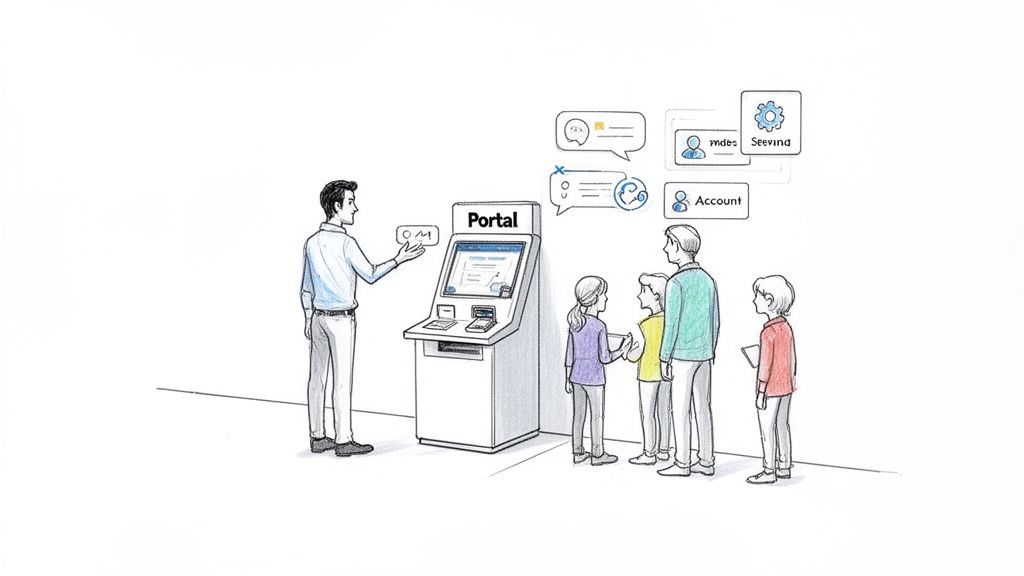
Think of it like the self-checkout lane at the supermarket. Instead of waiting for a cashier (your support team), customers can quickly scan their items (find answers), pay (manage their subscription), and be on their way. It’s a win-win: they get what they need instantly, and your team is freed up for the trickier stuff. For a solo founder or a small crew, this isn’t just helpful; it’s a game-changer.
Instead of hitting reply on that password reset email for the tenth time, you could be shipping a new feature. This is the heart of it for micro-SaaS builders: efficiency and scale. You can support a growing user base without your support costs—or your personal time—spiralling out of control. And here’s the kicker: your customers actually want this. Studies show a whopping 88% of customers now expect companies to offer an online self-service option.
Your First Line of Defence
For a bootstrapped business, every customer interaction is a moment of truth. A portal is your first line of defence against two of the biggest threats: customer churn and an inbox that never sleeps. When users can fix simple issues on the spot, their satisfaction and trust in your product shoot up. They feel empowered, not stuck waiting for a reply.
This isn’t about dodging your customers. It’s about meeting them where they are with the tools they need to succeed.
A great self-service portal transforms customer support from a cost centre into a scalable growth engine. It empowers users, deflects common tickets, and gives you invaluable insights into what your customers truly need.
More Than Just FAQs
Look, a solid FAQ page is a decent start, but a true self-service portal is so much more. It weaves multiple functions into one seamless experience, becoming the go-to hub for the entire customer journey, from day one to year five. A modern portal should bring together:
- A Searchable Knowledge Base: We’re talking detailed articles, how-to guides, and maybe even some video tutorials that tackle common questions and show off different use cases.
- Account and Billing Management: Let users upgrade, downgrade, swap payment methods, or even cancel their subscription without needing to send you an email. It’s their account; give them the keys.
- Automated Onboarding: Think interactive checklists and guides that help new users discover your product’s “aha!” moments on their own terms.
- Direct Feedback Channels: Give them a place to submit feature requests, report bugs, or just tell you how they feel with a satisfaction score.
By pulling these pieces together, you create a robust, automated system that lets you get back to high-impact work. Instead of being buried in repetitive support tasks, you can pour that energy into product development, marketing, and genuine growth.
The Undeniable Benefits for Product-Led SaaS Businesses
If you’re running a product-led SaaS, you know the product is the growth engine. This entire model hinges on users jumping in, figuring things out for themselves, and seeing the value fast. That’s precisely why a self-service portal isn’t just some nice-to-have support feature—it’s a core part of your strategy. For bootstrapped founders, it becomes a powerful tool that delivers real, tangible returns.
The first and most obvious win? A massive drop in customer support costs. As a solo founder or a tiny team, every minute you spend answering the same questions over and over is a minute you’re not building your product. A solid portal deflects all those common tickets—password resets, billing questions, “how do I do this?”—and hands you back precious hours every single week.
But this isn’t about giving users the cold shoulder; it’s about empowering them. When someone can find their own answer in seconds, their satisfaction shoots through the roof. That feeling of control and accomplishment leads directly to higher product adoption and a sense of ownership, which is gold for long-term loyalty.
Driving Retention and Scalability
It’s a simple truth: happy, self-sufficient users stick around. One of the clearest benefits of a self-service portal is how it helps with enhancing customer retention strategies. By having resources available on demand, you’re smoothing out the little bumps in the user journey—those small frustrations that can easily snowball into a cancellation.
This whole approach builds a support structure that can actually scale. A solo founder can genuinely support hundreds, even thousands, of customers without needing to hire a dedicated team. Your portal is on the job 24/7, helping users no matter their time zone or when you happen to be working. It lets your business grow without your costs growing right alongside it.
By automating answers to the top 20% of common questions, you can often deflect over 80% of your support ticket volume. This allows a bootstrapped team to operate with the efficiency of a much larger company.
This move towards user autonomy is happening everywhere. Take retail in Southeast Asia, for example. Retailers there are diving headfirst into self-service tech. With so many people on smartphones, 70% of consumers find these options easy to use, and a full six out of ten actually prefer stores that offer them for a faster checkout. That mobile-first, “let me do it myself” attitude is exactly what modern SaaS users expect.
Fostering a Proactive Customer Experience
A modern self-service portal does more than just sit there and wait for questions. It becomes a proactive tool for guiding your users toward success. For indie hackers, this unlocks a few strategic advantages:
- Improved Onboarding: You can build interactive checklists and guides right into the portal. These can steer new users straight to your product’s “aha!” moments and give your activation rates a serious boost.
- Centralised Knowledge: Your portal becomes the single source of truth for everything about your product. All your documentation, updates, and best practices live in one easy-to-find place, which keeps everyone on the same page.
- Actionable User Insights: Pay attention to what people are searching for. It gives you a direct line into their pain points and shows you where your documentation is weak. That’s a roadmap for both your content and your product.
At the end of the day, a self-service portal fits the bootstrapped ethos of efficiency and leverage perfectly. It’s a system that strengthens your relationship with users while protecting your most important resource: your time. That’s the kind of foundation you need to build a sustainable business and achieve real customer success for SaaS products.
Core Features Every SaaS Self Service Portal Needs
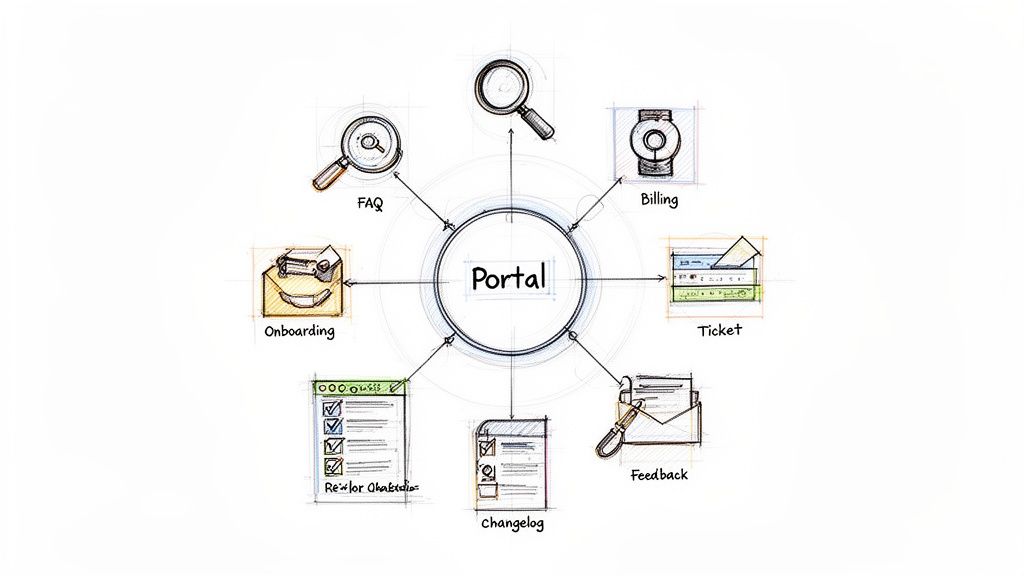
Alright, let’s move past the theory and get down to brass tacks. A great self-service portal isn’t just a vague idea; it’s a collection of specific, well-built features that work together. For a bootstrapped founder, every single feature needs to pull double duty: make the user’s life easier and take work off your plate.
Think of these as the essential building blocks for a system that grows with you, not against you. These components create a central hub where your customers feel capable and in control, which is exactly what you want.
The Foundational Support Trio
Let’s start with the non-negotiables. These three features are your first line of defence against a swamped support inbox, handling the most common and repetitive questions that come your way.
-
A Searchable Knowledge Base: This is your product’s bible. It needs to be packed with detailed how-to guides, troubleshooting steps, and practical examples. The key here is searchability—users should be able to type in a question and get a precise answer in seconds.
-
A Dynamic FAQ Section: If the knowledge base is the “how-to,” the FAQ is the “what” and “why.” Zero in on the top 10-20 questions you get on repeat. Keep the answers short, sweet, and to the point, with links back to the knowledge base for anyone who wants to go deeper.
-
Ticket Submission and Management: Look, self-service won’t solve everything. When a user truly gets stuck, they need a dead-simple way to reach you. An integrated ticket form that lets them track their request’s status shows you respect their time, even when they need a bit of hands-on help.
Empowering User Autonomy
Beyond just answering questions, a modern portal gives users the keys to the car. This is where you hand over direct control of their relationship with your product, cutting down on administrative busywork for you both.
The absolute must-have here is account and billing management. Customers should be able to upgrade, downgrade, pop in a new credit card, or download an invoice without ever having to write an email. Every billing question you automate is a huge win, freeing you up for more important work.
A self service portal that lets users manage their own subscription isn’t just a convenience—it’s a critical trust signal. It tells customers you’re confident in your product’s value and you respect their autonomy.
Proactive and Modern Portal Features
The best portals don’t just sit around waiting for problems to happen. They proactively guide users toward success and turn your help centre from a simple utility into a genuine growth engine.
Here’s a quick look at the features that make that happen, broken down so you can see why each one is a game-changer for a small, lean team.
Essential Features of a Modern Self Service Portal
| Feature Component | Primary Function | Key Benefit for Founders |
|---|---|---|
| In-App Onboarding Checklists | Guides new users through key “aha!” moments and setup tasks. | Drastically improves activation rates and reduces early-stage churn. |
| Feedback Collection Widgets | Captures NPS, CSAT, and feature requests directly within the portal. | Creates a constant stream of product intelligence without manual effort. |
| A Public Changelog | Announces new features, improvements, and bug fixes to users. | Fosters community, shows momentum, and reduces “when will you build X?” support tickets. |
Getting these proactive features right is what separates a basic help doc from a strategic asset.
For instance, guiding new users with in-app onboarding checklists turns the intimidating learning curve into an engaging, self-guided tour. If you want to nail this, it’s worth learning more about crafting effective user onboarding experiences that actually work.
By combining these foundational, autonomous, and proactive elements, you’re not just building a support tool. You’re building a scalable foundation that makes your customers happier, your workload lighter, and gives your growing SaaS the room it needs to thrive.
How Self-Service Became Southeast Asia’s Secret Weapon
The whole idea behind a great self-service portal isn’t just some niche SaaS trend. It’s part of a massive shift in how people get things done, and nowhere is this more obvious than in Southeast Asia’s absolutely booming digital economy. For any bootstrapped founder, what’s happening there is a masterclass in how giving users a bit of autonomy can spark explosive, scalable growth.
Think about the services that define modern life in the region—e-commerce, ride-hailing, food delivery. They’re all built on a self-service foundation. Users browse, order, pay, and track everything themselves through an app. This is the model that lets giants serve millions of customers with shockingly small operational teams. That’s a lesson every indie hacker should be writing down.
These platforms aren’t just successful; they’re dominant. Why? Because they empower people to get what they want, right when they want it, without ever needing to talk to another human being. That’s the exact same magic a well-built self-service portal brings to your SaaS customers.
The Perfect Storm for User Autonomy
So, what makes Southeast Asia such a perfect breeding ground for self-service? It’s a mix of rapidly improving digital infrastructure and a population that is young, glued to their phones, and incredibly comfortable with tech. With sky-high smartphone penetration, millions of people are already used to managing their entire lives through a screen.
This has created a world where self-service isn’t just a nice-to-have feature; it’s the baseline expectation. From hailing a Grab to managing a Shopee store, user autonomy is the engine driving the whole platform economy. The success of this model proves a simple truth: if you give users the right tools, they will happily solve their own problems.
This isn’t just about consumer convenience. It’s a fundamental change in how businesses are built, proving you can achieve incredible scale by empowering your users instead of just serving them. For a bootstrapped founder, that mindset is your single greatest advantage.
The numbers are pretty staggering. The platform economy has completely supercharged online-to-offline services, with seven in ten people across the six largest SEA countries using at least one of these services back in 2021. E-commerce, the ultimate self-service machine, made up 8% of total retail in 2020, which shows just how much room there is to grow compared to more mature markets. If you want to dive deeper, check out the full findings on Southeast Asia’s platform economy.
Universal Truths for SaaS Founders
The leap from a food delivery app in Jakarta to your micro-SaaS is shorter than you think. The very same principles that let Gojek coordinate thousands of orders at once can help you manage a growing customer base without pulling your hair out.
Here are a few universal takeaways from the SEA model:
- Automation Is Scale: The biggest platforms automate everything from placing an order to processing a payment. Your self-service portal should do the exact same thing for account changes, billing questions, and the usual support queries.
- Empowerment Creates Loyalty: When users can fix their own issues in seconds, their trust in your platform deepens. This builds a more resilient, happy user base that won’t churn over a minor hiccup.
- Lower the Barrier to Entry: Self-service digital tools are enabling one in five small and medium-sized businesses in the region to even participate in the digital economy. In the same way, a portal smooths the path for new users to get started with your SaaS.
At the end of the day, the self-service boom in Southeast Asia isn’t just a regional story. It’s a blueprint for building lean, scalable, and user-focused businesses. For bootstrapped founders, the message couldn’t be clearer: building a solid self-service portal isn’t just about cutting down on support tickets. It’s about aligning your business with a global economic shift toward empowering your users.
Building Your Portal the Bootstrapped Way with HappyPanda
If you’re a bootstrapped founder, the road to a self service portal often looks like a messy, expensive patchwork quilt. You start by stitching together a bunch of different tools—one for welcome emails, another for an onboarding checklist, a third for collecting feedback, and maybe a fourth for your changelog.
Before you know it, you’re drowning in subscription fees and integration headaches. This Frankenstein’s monster of an approach costs more than just money; it costs you time and creates a clunky, disjointed experience for your users. Trying to make five different tools talk to each other is a recipe for frustration and a massive distraction from what you should be doing: building a better product. The traditional way just wasn’t built for the speed and agility of an indie hacker.
The All-in-One Alternative
This is exactly where a purpose-built platform like HappyPanda changes the game. Instead of juggling a dozen subscriptions and wrestling with complex setups, you get a single, unified system that handles every part of your self service strategy. It’s not just about bundling features; it’s about creating a cohesive ecosystem where every piece works together seamlessly from day one.
HappyPanda maps its core features directly to the essentials of a modern self service portal we’ve been talking about, but in a way that’s affordable and ready to go in minutes.
- Feedback Collection: Ditch the separate survey tool. You get built-in NPS, CSAT, and feature request widgets.
- Email Sequences: Automated welcome, trial reminder, and win-back campaigns are all managed in one simple visual builder.
- Onboarding Checklists: Guide new users with in-app progress widgets—a feature usually locked away in expensive enterprise tools.
- Changelog Widget: Keep everyone in the loop with a “What’s New” feed right inside your app and on a public page.
- Testimonial Collector: Automatically ask for social proof right after a user leaves glowing feedback.
This integrated approach means you can launch a complete, professional portal in minutes, not weeks.
The diagram below shows how self-service models are already powering major sectors in the Southeast Asian economy. It’s not just theory; it’s a real-world engine for growth.
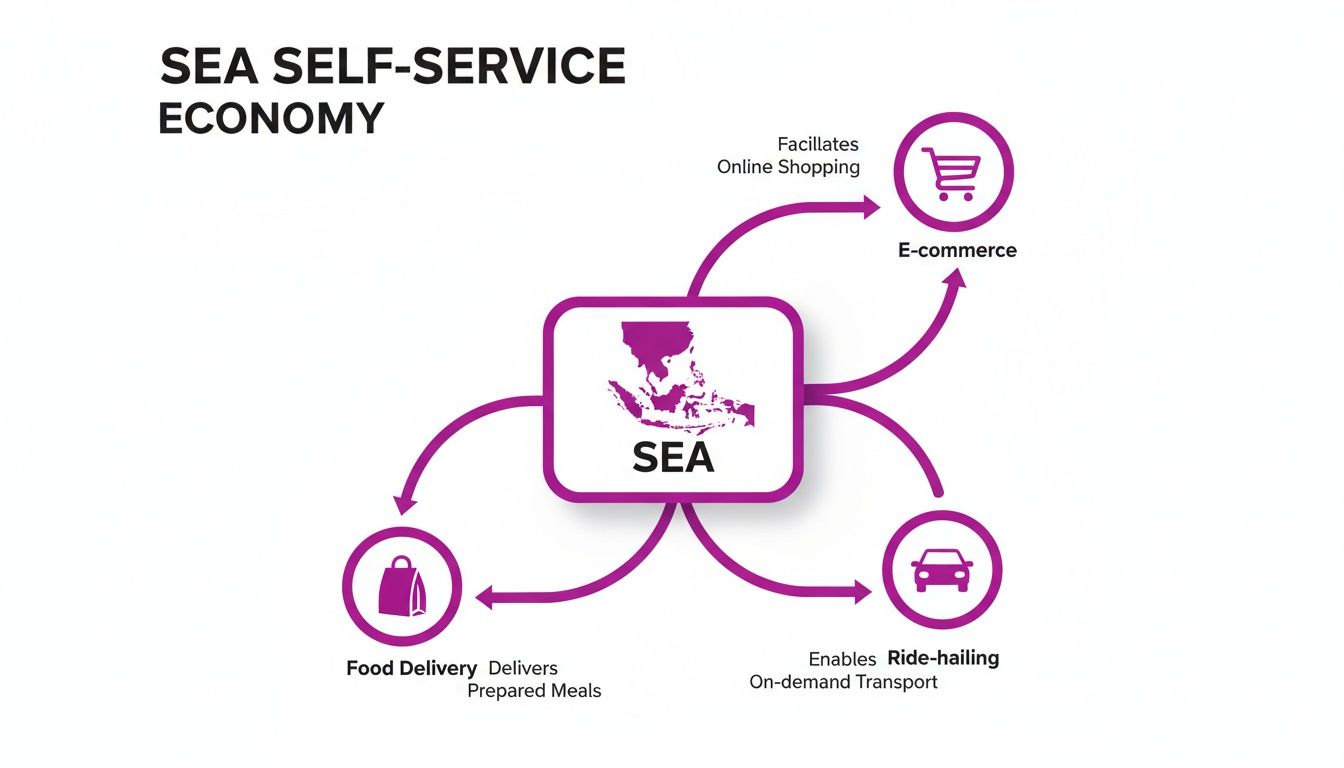
This visual underscores how the principles of user autonomy drive massive industries—a strategy HappyPanda makes accessible for any SaaS founder.
More Than Just Features—an Automation Engine
The real magic of a unified platform isn’t just having all the tools in one box. It’s the automation layer that connects them. This is what turns your portal from a passive resource into a proactive growth engine. You can create simple but powerful rules that automate the entire customer journey, almost like having a tiny, dedicated assistant working 24/7.
With a smart automation layer, you can create powerful workflows like: “If a user’s NPS score is 9 or 10, automatically send them a request to leave a testimonial.” This turns happy customers into your best marketing asset, with zero manual effort.
Imagine being able to set up these kinds of workflows in just a few clicks:
-
Trigger: A user ticks off the final item on your onboarding checklist.
-
Action: Instantly send them a CSAT survey to gauge their initial experience.
-
Trigger: A user’s trial is 3 days from ending.
-
Action: Ping them a personalised email highlighting a key feature they haven’t tried yet.
-
Trigger: A user submits a feature request.
-
Action: Pop them onto an email list so they get notified via the changelog when that feature ships.
This level of intelligent automation is usually a nightmare to build with separate tools, often requiring complex integrations and a hefty budget. HappyPanda makes it a core part of its platform, designed specifically for founders who need to make a huge impact without a huge team. It’s a smarter, leaner way to build a fantastic customer experience from day one.
Measuring the Success of Your Self-Service Strategy
Building a self-service portal feels great, but how do you actually know if it’s working? For a bootstrapped founder, every investment—whether it’s your time or your cash—needs to pull its weight. Forget drowning in complex analytics and vanity metrics; what you need is a simple way to see a real return.
The goal is to track a handful of key indicators that have a direct impact on your time and your bottom line. By focusing on the right numbers, you can make smart decisions to improve your portal, prove its value, and get back to what you do best: building your product. This isn’t about fancy business intelligence dashboards; it’s about getting practical, actionable insights.
Key Metrics That Actually Matter
To get a clear picture of how your portal is performing, just focus on these four core metrics. They give you a balanced view, covering efficiency, customer happiness, and user engagement without making things overly complicated.
-
Ticket Deflection Rate: This is the big one. It’s the most direct measure of your portal’s success, telling you how many support tickets you avoided because a user found an answer on their own. A rising deflection rate is proof that you’re successfully automating support and clawing back your time.
-
Customer Satisfaction (CSAT) Score: At the end of the day, happy customers are the whole point. Tracking your CSAT score shows you how your self-service efforts are landing with your users. A great portal should absolutely lead to a jump in satisfaction, as people get instant answers instead of waiting around.
-
Time to Resolution: How quickly can a user go from having a problem to solving it? A good self-service portal should slash this time. When users can find a fix in a few minutes instead of waiting hours for an email reply, their entire experience gets a boost.
-
Product Adoption Rates: A modern portal does more than just solve problems; it helps people discover the real value in your product. By tracking the adoption of key features you’ve highlighted in your knowledge base or onboarding checklists, you can see if your portal is helping users get to that “aha!” moment faster.
How to Track Your Portal’s Performance
You don’t need to hire a data analyst for this. Modern tools like HappyPanda are designed for bootstrappers and have these analytics built right in, making it dead simple to see what’s working.
For instance, HappyPanda’s built-in feedback tools let you deploy CSAT surveys with just a few clicks. You can automatically ask for feedback right after a user reads a knowledge base article or finishes an onboarding step. To go a bit deeper, our guide offers more on how to effectively measure CSAT and what those scores actually mean for your business.
By focusing on ticket deflection and CSAT, you connect your self-service efforts directly to two of the most important things for any founder: saving time and keeping customers happy. This is the core ROI of any successful portal strategy.
By checking in on these key metrics regularly, you can spot trends, identify gaps in your knowledge base, and keep refining your portal to better serve your customers. This data-driven approach ensures your self-service portal isn’t just a static page but a dynamic tool that grows with your users and helps drive sustainable growth.
A Few Common Questions About Self-Service Portals
Even with a killer strategy, a few practical questions always pop up before you dive in with a new tool. Let’s tackle the common ones we hear from bootstrapped founders so you can move forward without any lingering doubts.
How Much Time Does This Actually Take to Set Up?
Honestly, this can range from “a quick coffee break” to “cancel my plans for the next month.” A fully custom-coded solution? You’re easily looking at weeks, if not months, of development. That’s a luxury most bootstrapped founders just don’t have.
You could also try stitching together a few different tools for your knowledge base, feedback forms, and onboarding guides. That might take several days just to wrestle with all the integrations. But here’s the good news: modern, all-in-one platforms built for folks like us can be up and running in under 10 minutes. They use templates and often just need you to drop a single script tag into your app. Fast and painless.
Will a Portal Make My Support Feel… Robotic?
This is a big one, and I get it. The fear is that you’ll lose that personal touch. But if you do it right, the opposite is true. A good self-service portal handles all the repetitive, straightforward questions, which frees you up to provide amazing, high-touch support for the complex issues where it really counts.
Think about it: by automating the simple stuff, you get more time and mental energy back for the meaningful conversations that build real loyalty. Plus, features like integrated feedback widgets and targeted satisfaction surveys show your customers you’re actively listening, which makes the whole experience feel more personal, not less.
When Is the Right Time to Add a Self-Service Portal?
Almost always sooner than you think. So many founders wait until they’re drowning in support tickets, but setting up a portal from day one builds a scalable foundation for growth. It stops the problem before it starts.
Early on, it can be as simple as a basic FAQ page and a feedback button. As you grow, you can layer in more advanced features like in-app checklists or a public changelog.
When you build with a self-service mindset from the beginning, you create a culture of empowerment for your users. It also prevents a mountain of support and tech debt from piling up as you scale.
With affordable, easy-to-use tools on the market today, there’s really no reason to wait until you’re overwhelmed.
Can a Portal Actually Help with Onboarding and Activation?
Absolutely. In fact, this is one of its superpowers. Modern self-service portals have evolved way beyond just being a place for FAQs. Proactive features like in-app onboarding checklists are a core part of a smart portal strategy.
They guide new users through those critical “aha!” moments in your product, tracking their progress and nudging them to complete the actions that unlock long-term value. This hands-on, self-guided tour is proven to boost activation rates and slash early-stage churn. It makes your portal a growth engine, not just a support-cost-cutter.
Ready to build a powerful self-service experience without the headache and high cost? HappyPanda combines onboarding, feedback, email, and changelogs into one simple platform designed for bootstrappers. Get started in 10 minutes at https://happypanda.ai.