
Ever felt like your marketing efforts are a bit… disjointed? Like your emails are singing one tune, your social media is playing another, and your ads are off doing a drum solo in the corner? If so, you’re not alone. This is what happens when marketing operates in silos, and it’s a common trap for busy founders.
The solution is something called Integrated Marketing Communications (IMC). Stripped of the jargon, it just means getting all your marketing channels to tell the same story, consistently. It’s about creating a single, cohesive brand experience for your customers, no matter where they interact with you.
Orchestrating Your Brand Story
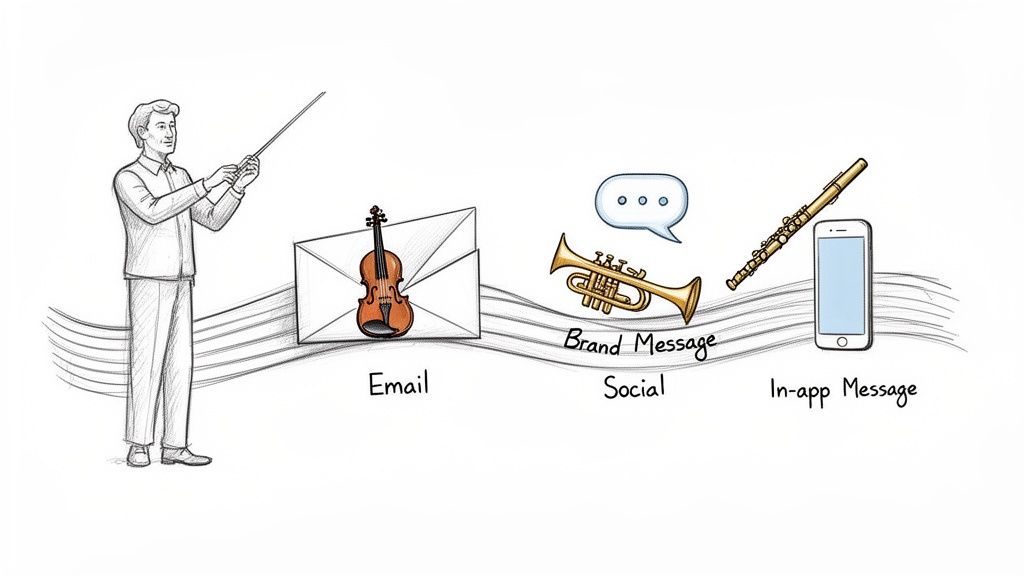
Think of your SaaS marketing as an orchestra. Your email campaigns are the strings, social media is the brass section, and your in-app messages are the woodwinds. When they all play from different sheet music, the result is just noise. It’s confusing for your audience and a waste of your time and money.
Integrated Marketing Communications (IMC) is the conductor that gets every instrument playing in perfect harmony. It’s the strategic approach that aligns every single piece of communication to reinforce your core message. For a bootstrapped founder, this isn’t some fluffy corporate theory—it’s a survival strategy. You can’t afford the wasted budget and mixed signals that come from a fragmented approach.
The Problem With Marketing Silos
When your marketing operates in silos, you create jarring experiences without even realising it. A potential customer might see a slick Facebook ad promoting your product’s simplicity, only to receive a complex, jargon-filled welcome email a few minutes later. That disconnect immediately erodes trust.
This siloed approach leads to some very real problems for indie founders:
- Wasted Resources: You end up paying for a handful of tools that don’t talk to each other, forcing you to duplicate efforts and overcomplicate your workflow.
- Customer Confusion: Inconsistent messaging across your website, ads, and product onboarding leaves users scratching their heads about your real value.
- Lost Opportunities: When your data is siloed, you can’t connect user behaviour to your communications. You miss golden opportunities to send the right message at exactly the right time.
An integrated approach isn’t just about sounding consistent; it’s about being more effective. It ensures that every touchpoint, from the first ad a user sees to the final onboarding step, builds upon the last.
The Power of A Unified Message
The data speaks for itself. Research shows that integrated marketing communications campaigns significantly outperform siloed marketing efforts, pulling in 31% higher profit and achieving 57% greater brand penetration. That kind of performance lift is massive when you’re bootstrapped and every customer counts. For a deeper dive, you can explore detailed findings on the impact of integrated communications.
Ultimately, IMC is about building a single, coherent narrative for your brand. This starts with establishing one central source of truth for all your customer data and messaging. You can learn more about creating a single source of truth in our guide. This principle is the bedrock of a successful, lean, and powerful marketing operation for any bootstrapped SaaS.
The Core Components Of A Lean IMC Strategy
Alright, let’s move from the high-level idea of an orchestra to the nuts and bolts of a practical, lean framework. A solid integrated marketing communications strategy really boils down to four essential pillars. For a bootstrapped founder, these aren’t just buzzwords on a slide deck; they’re the load-bearing walls holding up your entire marketing operation. Get them right, and you turn a bunch of scattered efforts into a focused, powerful growth engine.
These pieces all work together to create a unified brand experience that feels deliberate and trustworthy. Let’s break each one down and see how they apply to a lean SaaS business in the real world.
Consistent And Authentic Brand Voice
Before you type a single email or social media post, you need to decide on your brand’s personality. Are you the helpful, professional expert? The witty, informal friend? Or somewhere in between? A consistent brand voice is the common thread that ties all your communications together, making your brand instantly recognisable.
This isn’t about creating some rigid, corporate style guide that sucks the life out of your writing. It’s about setting a clear identity so that a welcome email, an in-app tooltip, and a product update all sound like they come from the same team. This consistency is what builds familiarity and, most importantly, trust with your users.
Key Takeaway: Your brand voice is your company’s personality. A consistent personality builds trust; an inconsistent one creates confusion and kills credibility—a luxury no indie founder can afford.
Audience Centric Messaging
Let’s be honest: generic, one-size-fits-all messages almost never land. A powerful IMC strategy is all about delivering the right message to the right person at the right time. That means you have to segment your audience based on their behaviour and where they are in their journey with your product.
Instead of shouting the same update at every user, you can create hyper-relevant communications that actually resonate.
- For Trial Users: Your messaging should be all about education and helping them find value. Think emails that highlight key features they haven’t tried yet or in-app messages that guide them to that “aha!” moment.
- For Paid Customers: Here, the focus shifts to retention and expansion. Share advanced tips, announce new features that will improve their workflow, and ask for feedback to show you see them as a partner.
- For Churned Users: The message changes again. Now it’s about understanding why they left and maybe even winning them back. A targeted email asking for feedback or offering a special incentive is miles more effective than a generic “please come back” plea.
This kind of segmentation turns your generic broadcasts into helpful, personal conversations.
Strategic Channel Integration
A classic mistake for bootstrapped founders is trying to be everywhere at once. A lean IMC plan is about mastering a few key channels that work together, not spreading yourself thin across a dozen different platforms. For most SaaS businesses, the most potent combo is email and in-app messaging.
Why? Because these are channels you own and control. By integrating them, you can create seamless user journeys that just make sense.
Here’s how it looks in action:
- A user ticks off a task in your onboarding checklist inside the app.
- That action immediately triggers an automated email celebrating their progress.
- The email includes a short video tutorial for the next logical step in their journey.
See how that works? The in-app experience (the checklist) and the external communication (the email) are perfectly in sync. They work as a team to guide the user forward, reinforcing your product’s value every step of the way. That synergy is the heart of effective channel integration.
Unified Measurement and Analytics
Finally, you can’t improve what you don’t measure. A disconnected strategy gives you siloed metrics—sure, you might know your email open rates and your in-app engagement, but you have no idea how one influences the other. An integrated approach demands unified measurement.
This means tracking the entire customer journey, not just how one channel is performing in a vacuum. The goal is to answer critical questions like, “Does receiving our onboarding email sequence make a user more likely to adopt this key feature?” or “Which in-app actions correlate with higher Net Promoter Scores?”
By connecting your data, you get a complete picture of your customer’s experience. This is what allows you to spot friction points, double down on what’s working, and make data-driven decisions that actually move the needle on your bottom line.
Why A Disconnected Strategy Hurts Indie Hackers
For a bootstrapped founder, every pound and every minute counts. Yet, so many of us unknowingly burn through both with a disconnected marketing strategy. It’s a silent business killer that often starts with what feels like a sensible approach: picking the “best” tool for each individual job.
You grab one service for your email sequences, another for those in-app onboarding checklists, and a third for collecting user feedback. On their own, they’re fantastic. But cobbled together, they create a Frankenstein’s monster of a system that actively works against you. This is the exact opposite of an effective integrated marketing communications plan.
This scattered approach creates pure chaos behind the scenes. You find yourself constantly exporting and importing CSV files, trying to make data from one platform make a lick of sense in another. The result? A massive time sink and a recurring monthly bill that easily creeps up to £300-£500 for just the basic functionality.
The Real Cost of Fragmentation
The financial drain is only half the story. A disconnected strategy inflicts deeper wounds on your business—the kind that are much harder to heal. The biggest cost is the jarring, confusing, and frankly unprofessional experience you create for your customers.
Imagine this all-too-common scenario:
- A user signs up for your SaaS, greeted by a polished welcome email that promises a simple, intuitive experience.
- But once they’re inside the app, they’re hit with a clunky, third-party onboarding widget that looks and feels completely alien.
- A week later, they get a generic NPS survey that has zero context of how they’ve actually been using your product.
This disjointed journey erodes trust from the very first interaction. When your messaging and branding change from one touchpoint to the next, it makes your business feel amateurish and unreliable. It creates friction and doubt at the precise moment you need to be building confidence. For a deeper dive, you might find our guide on improving the overall customer experience useful.
This is the hidden tax of a messy tech stack. To spell it out, let’s look at what you’re really paying for.
The True Cost Of A Disconnected Marketing Stack
Here’s a breakdown of the typical monthly costs and hidden time sinks for a bootstrapped SaaS founder managing separate communication tools.
| Tool Category | Typical Monthly Cost | Hidden Cost (Time/Effort) |
|---|---|---|
| Email Marketing | £50 - £150+ | Manually syncing contacts, creating segmented lists, and importing/exporting CSVs. |
| In-App Messaging | £80 - £200+ | Designing flows in a separate UI, no native access to user feedback or support tickets. |
| User Feedback Tool | £40 - £100+ | Manually transferring insights to other tools, trying to match feedback to user profiles. |
| Analytics & Data Sync | £30 - £150+ | Constantly fighting with Zapier or Make integrations that break or need updating. |
| Total | £200 - £600+ | 5-10 hours per week spent on manual data admin and “duct tape” fixes. |
When you add it all up, the numbers speak for themselves. The money is one thing, but losing a full day every week to busywork is what really stalls growth for an indie hacker.
Missed Opportunities and Stalled Growth
Beyond the poor user experience, a fragmented system blinds you to critical growth opportunities. When your customer feedback tool doesn’t talk to your email platform, you can’t act on valuable insights automatically.
A glowing piece of feedback from a happy user just sits in a dashboard, forgotten. A frustrated user’s cry for help gets lost in a separate system, leading to churn. This is where a lack of integrated marketing communications directly costs you revenue.
You miss the chance to automatically ask that happy user for a testimonial. You fail to trigger a helpful message to the struggling user before they cancel their subscription. Each of these missed connections is a lost opportunity to build social proof, reduce churn, and actually grow your business. This is the steep price indie hackers pay for a tech stack that operates in silos—and it sets the stage perfectly for a much smarter, unified solution.
A Practical Framework For Your First IMC Strategy
Alright, let’s move from theory to action. For a bootstrapped founder, the idea of building an integrated marketing communications strategy from the ground up can feel like a mountain of work. But it doesn’t have to be. Forget those stuffy corporate playbooks; this is a lean, four-phase framework built for founders who need to see results without burning cash.
To make this real, we’ll follow a fictional micro-SaaS called “CodeSnippet,” a simple tool that helps developers save and share code snippets. This will keep each step grounded and easy to apply to your own venture.
First, let’s look at why a disconnected approach is so painful for indie hackers. It’s a chain reaction of bad outcomes.
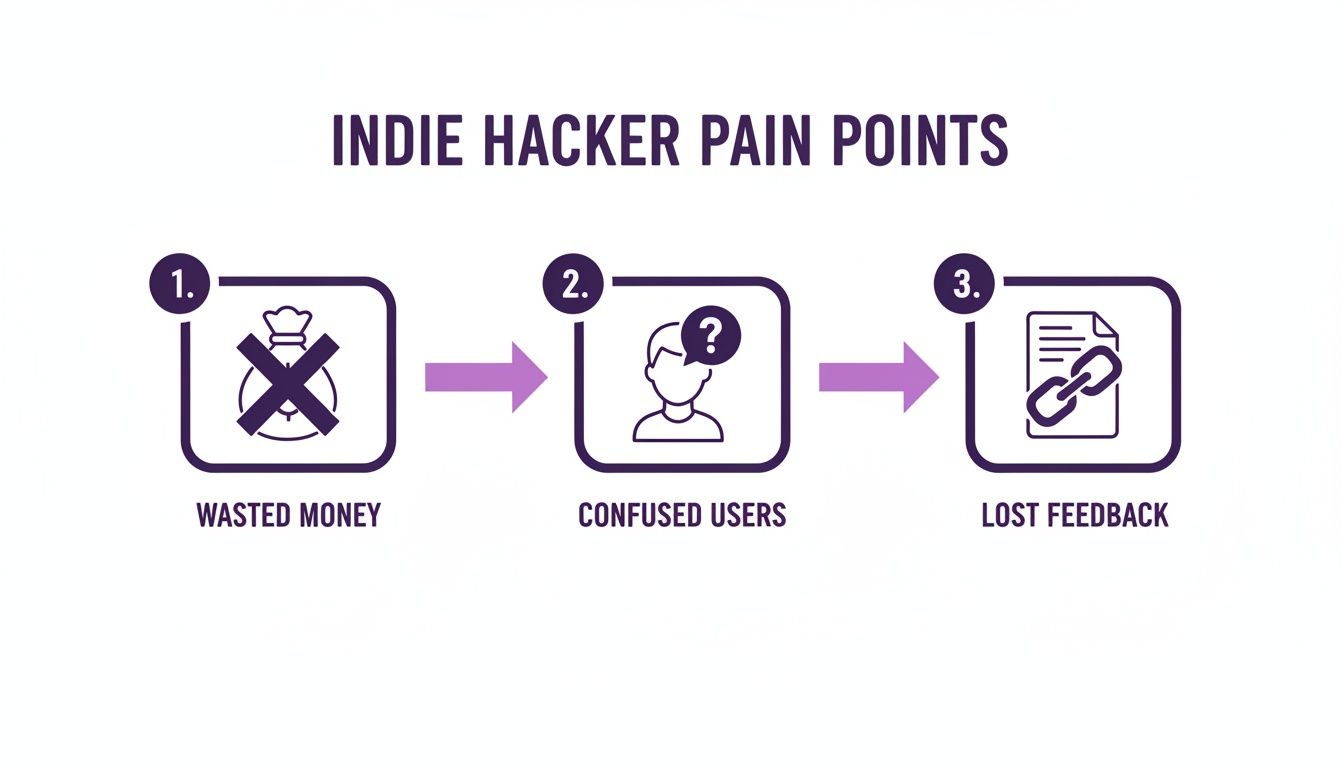
As you can see, it starts with money wasted on separate tools, which leads to a confusing experience for your users, and ends with you losing priceless feedback. This framework is designed to stop that cycle cold.
Phase 1: Map The Entire Customer Journey
Before you can integrate anything, you need a map of the road your customers travel. Don’t overthink it. Grab a whiteboard or open a blank doc and sketch out the key stages a person goes through, from total stranger to your biggest fan.
For our example, the journey for CodeSnippet might look something like this:
- Awareness: A developer spots a tweet from a respected peer sharing a useful code snippet with a public CodeSnippet link.
- Consideration: Intrigued, they click the link, land on the snippet page, and browse a few others. They see the “Create Your Free Library” call-to-action.
- Conversion (Trial): They sign up for a free 14-day trial to get their own snippets organised.
- Onboarding: A welcome email lands in their inbox, and an in-app checklist guides them to create their first three private snippets.
- Adoption: They’re now using CodeSnippet daily, saving time and making it a core part of their workflow.
- Conversion (Paid): The trial ends. They happily upgrade to a paid plan for more private snippets and team features.
- Advocacy: They love the tool so much they start sharing their own snippets on Twitter, turning into a genuine brand advocate.
This simple map is now your foundation. Every single email, tweet, or pop-up you create should be designed to help users get from one stage to the next, smoothly.
Phase 2: Define Your Core Message For Each Stage
With your journey map in hand, it’s time to figure out what you want to say at each stop. The goal is to define one primary message for each stage. What’s the single most important thing you want the user to feel, know, or do right now?
The goal isn’t to say everything at once. It’s to say the right thing at the right time. A successful IMC strategy delivers a focused message that aligns with the user’s current context and needs.
Let’s apply this to CodeSnippet:
- Awareness: “CodeSnippet makes sharing code effortless and beautiful.”
- Consideration: “Organise your code chaos into a clean, searchable library.”
- Onboarding: “Let’s get your first snippet saved in under 60 seconds.”
- Adoption: “Become a more efficient developer with instant access to your code.”
- Conversion (Paid): “Unlock your full potential with unlimited snippets and team collaboration.”
- Advocacy: “Share your knowledge and help other developers.”
These simple, punchy messages become your North Star. They guide the copy for every email, social post, and in-app tooltip, ensuring your communication is always relevant.
Phase 3: Consolidate Your Toolset
Here’s where the “integrated” part really clicks. Instead of juggling one tool for emails, another for in-app messages, and a third for collecting feedback, bring it all under one roof. For a lean operation, this step is non-negotiable. It kills the data silos and manual duct-taping that drain your time and energy.
For CodeSnippet, this means ditching the scattered stack of Mailchimp, Appcues, and Canny for an all-in-one solution. A platform like HappyPanda lets you manage the entire customer communication lifecycle from a single dashboard. This consolidation is the technical backbone of your integrated marketing communications plan.
Phase 4: Create Simple Automation Rules
This is where your strategy truly comes to life. With one tool and a clear messaging plan, you can set up simple “if this, then that” automation rules that connect all your touchpoints. These rules are what transform your separate messages into a cohesive, intelligent system that works for you.
Here are a few practical examples for CodeSnippet:
- If a user completes the “Create 3 Snippets” onboarding task, then send them an email with an advanced tip for tagging snippets.
- If a trial user hasn’t logged in for three days, then show them an in-app message highlighting a popular feature they might have missed.
- If a paid customer gives an NPS score of 9 or 10, then automatically send an email asking if they’d be open to leaving a testimonial.
These simple automations make sure your messaging is always timely, relevant, and genuinely helpful. Your marketing stops being a series of disconnected blasts and becomes a seamless conversation that guides users toward success—and builds a much stronger relationship with your brand.
How HappyPanda Pulls Your IMC Efforts Together
Knowing the theory behind integrated marketing communications is one thing. Actually having the right tools to pull it off is another beast entirely. For most bootstrapped founders, the problem isn’t a lack of vision—it’s the reality of juggling a dozen different, expensive tools that refuse to talk to each other.
This is exactly where HappyPanda comes in. Think of it as your command centre, replacing that messy collection of apps with a single, powerful platform. It’s built to turn that IMC framework we just talked about from a nice idea on a whiteboard into an automated, everyday reality.
Unifying Feedback and Communication
A core rule of IMC is getting all your channels to sing from the same hymn sheet. HappyPanda makes this happen by connecting user feedback directly to your communication workflows, creating a closed-loop system that used to require duct tape and a prayer.
Let’s paint a picture. Without HappyPanda, a user gives you a high NPS score in one tool. To do anything with that, you’d have to export their data, import it into your email tool, and then manually send a testimonial request. It’s slow, clunky, and nine times out of ten, it just doesn’t get done.
With HappyPanda, that whole process becomes a simple, one-click automation:
- Trigger: A user drops an NPS survey with a score of 9 or 10.
- Action: HappyPanda automatically waits a day, then fires off a pre-written email from your “Testimonial Collector” sequence.
Just like that, you’re turning passive feedback into active social proof, all without lifting a finger.
Keeping the In-App Experience Consistent
Your product is one of your most powerful marketing channels. Nothing breaks the spell faster than a disjointed in-app experience full of third-party widgets and clashing branding. HappyPanda solves this by bringing key communication moments natively inside your app.
Here’s how HappyPanda helps you tell a cohesive story right inside your product:
- Onboarding Checklists: Guide new users with a native-feeling checklist that actually matches your UI. It reinforces your brand from the moment they sign in.
- Changelog Widgets: Announce new features with a clean, integrated “What’s New” pop-up. Users see your progress without being booted to an external page.
This screenshot shows how you can build a flow where positive feedback automatically kicks off a follow-up action, like asking for a testimonial.
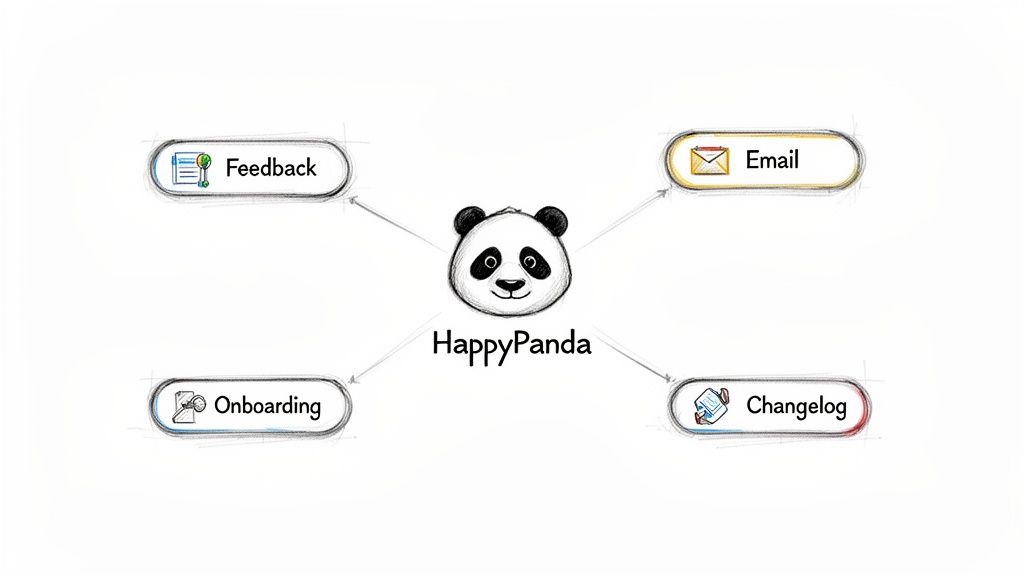
This visual builder is really the heart of a true IMC strategy, letting you connect user sentiment directly to marketing actions.
This kind of consistency ensures the promises you make on your marketing site are perfectly matched by the experience inside your product. It builds trust at every step. This alignment is especially crucial in crowded markets. For instance, the Southeast Asia advertising market has ballooned to a value of around USD 28 billion. That growth just highlights how important a clear, consistent message is to cut through the noise. You can learn more about Southeast Asia’s marketing dynamics on amraandelma.com.
From Siloed Data To a Single Source of Truth
At the end of the day, the biggest win of a consolidated platform is having a single source of truth for every customer interaction. When a user’s entire journey—from their first onboarding step to their latest feedback ticket—lives in one spot, you gain incredible clarity.
With a unified view, you stop guessing and start making data-driven decisions. You can finally see how your onboarding sequence impacts long-term retention or which feature announcements drive the most engagement.
This unified approach doesn’t just save you money on multiple subscriptions; it saves you your most valuable asset: time. By killing the manual work of syncing data between platforms, HappyPanda frees you up to focus on what actually matters—talking to your customers and building a better product. It’s the practical engine for your entire integrated marketing communications strategy.
Launching Your First Integrated Campaign
All the theory in the world is just noise until you put it into practice. So, let’s roll up our sleeves and walk through a real-world recipe for your first integrated marketing communications campaign. We’ll use HappyPanda to tackle a goal that keeps every SaaS founder up at night: boosting trial-to-paid conversion rates.
This isn’t just a hypothetical exercise. I’ll show you exactly how to set up a simple, automated flow that turns user feedback into a powerful conversion engine. It’s the perfect example of how different channels can work in harmony, creating a smart, responsive system that nudges users toward becoming paying customers.
Step 1: Trigger a Survey at the Perfect Moment
First things first, we need to gather feedback when it matters most. For a trial user, there’s a sweet spot right around the halfway mark. By day seven, they’ve had enough time to poke around and get a feel for the basics, but they might still be on the fence about your product’s real value.
Inside HappyPanda, you can whip up a simple automation rule to nail this timing.
- Set the Trigger: The automation kicks in the moment a user’s trial is exactly seven days old. This timing is crucial—not too soon, not too late.
- Define the Action: Automatically send them a Net Promoter Score (NPS) survey. This one-question survey is a breeze for users to answer and gives you a crystal-clear signal of how they’re feeling.
This initial touchpoint shows you’re proactively listening at a critical point in their decision-making process.
Step 2: Automatically Segment Users by Score
Once the feedback starts trickling in, the real integration magic begins. Instead of just staring at numbers on a dashboard, you’ll use those scores to automatically sort users into different buckets. This is what allows you to tailor your follow-up with surgical precision.
HappyPanda’s automation builder makes this a walk in the park. After the NPS survey is completed, you create a simple fork in the road:
- Promoters (Score 9-10): These are your fans. They get it, they love it, and they see the value.
- Passives (Score 7-8): These folks are on the fence. They aren’t unhappy, but they haven’t been wowed yet either.
- Detractors (Score 0-6): These users are having a rough time and are at a high risk of walking away.
This isn’t just data collection; it’s real-time audience segmentation. You’re creating dynamic groups based on actual user sentiment, which sets the stage for a follow-up message that actually resonates.
Step 3: Deliver a Targeted Follow-Up
With your users neatly segmented, the final step is to send the right message to the right group. This is where you connect the dots between channels—like email and in-app messages—to create one seamless conversation.
Here’s how the flow plays out for each group:
- Promoters (The Fans): Send a targeted email that shines a spotlight on a killer premium feature. The message could be something like, “Since you’re enjoying the basics, check out this powerful pro feature our paid customers can’t live without.” This gentle nudge might be all they need to see the full value of upgrading.
- Passives (The Undecided): Trigger an in-app message asking for specific feedback. A simple prompt like, “What’s one thing we could do to make your experience a 10/10?” shows you’re listening and gives you priceless insights to win them over.
- Detractors (The Unhappy): Immediately create a task for yourself to reach out personally. A quick, direct email from the founder can often turn a sour experience around and stop a customer from churning before it’s too late.
This simple, three-step campaign perfectly illustrates the power of an integrated approach. It moves beyond generic email blasts and creates a living, breathing system that listens to users and guides them with a relevant call-to-action. You can learn more about crafting the perfect prompt in our guide to effective calls-to-action on happypanda.ai. This is integrated marketing communications in action—tangible, immediate, and incredibly effective.
Got Questions? We’ve Got Answers
Here are a few common questions that pop up when indie hackers and solo founders start thinking about integrated marketing.
Is Integrated Marketing Just for the Big Guys?
Not a chance. In fact, you could argue it’s even more important for a bootstrapped business. When you’re running lean, you can’t afford to have your marketing efforts pulling in different directions. Every pound, dollar, and hour has to count.
An integrated approach makes sure everything works together, turning a small budget into a much bigger impact. It’s how you build a professional brand that can stand shoulder-to-shoulder with the larger players without breaking the bank.
How Long Does This Take to Set Up?
Honestly? You can map out a solid first draft of your strategy in a single afternoon. The trick is to focus on your core customer journey and keep it simple at the start. Don’t try to boil the ocean on day one.
With a platform that brings everything together, you can get your first simple integrated campaigns—like a feedback-to-testimonial flow—up and running in less than an hour. Your strategy will grow and change as you learn, but getting started is quick.
What’s the Most Important Channel for a SaaS IMC Plan?
For most early-stage SaaS companies, it boils down to two channels: email and in-app messaging. Why? Because you own them. They’re your direct line to your users, no gatekeepers or algorithms involved.
These channels let you talk to users at just the right moment—during onboarding, right after they try a new feature, or when they might be about to churn. Getting these two to work in harmony is the foundation of a powerful integrated marketing communications strategy that drives real engagement and keeps users coming back.
Ready to stop juggling a dozen different tools and start building a customer experience that just works? HappyPanda brings all your communication channels under one roof, so you can launch your first integrated campaign in minutes, not weeks. Get started today at HappyPanda.ai.