
Ever feel like you’re trying to solve a puzzle with pieces from ten different boxes? That’s the reality for a lot of SaaS founders. You’re trying to piece together a customer’s story from data scattered across a dozen different apps. It’s not just messy; it’s a hidden tax on your growth.
The True Cost of a Disconnected SaaS Business
When you’re bootstrapping, the default tech stack is usually a collection of specialised tools, each one brilliant at solving a single problem. You’ve got one app for your emails, another for onboarding checklists, and a third for collecting user feedback. It seems logical at first, but it creates invisible walls between your most valuable data.

This fragmentation turns you into a detective, constantly jumping between tabs to understand a single customer’s journey. Did the user who just submitted negative feedback also finish the onboarding sequence? Is the person asking for a new feature the same one who stopped opening your weekly emails? Answering these basic questions becomes a time-sucking chore.
The Hidden Startup Tax
This disjointed system has a very real financial cost. Subscribing to separate tools for every core customer communication function adds up fast. This “startup tax” often hits US$300-500 per month—a serious expense for any lean business.
But the financial drain is only half the story. The real penalty is strategic. When your data lives in separate silos, you lose the ability to see the complete picture. You end up making decisions based on incomplete evidence and missing out on golden opportunities.
The biggest cost of a fragmented system isn’t the monthly subscription fee; it’s the inability to connect the dots between customer behaviour, feedback, and engagement. You’re flying blind when you should have a clear view.
Why a Unified View Matters
Operating without a central hub for all customer interactions is like running with a massive handicap. The key insights that could drive growth and slash churn are buried in separate databases that refuse to talk to each other. For example:
- Onboarding drop-offs: You can see users aren’t completing their checklists, but you have no easy way to check if they also ignored your entire welcome email series.
- Feature requests: You get a brilliant idea submitted, but can’t quickly verify if it came from a power user or a customer who’s one foot out the door.
- Positive feedback: A user gives you a glowing 10/10 NPS score, but that information is completely disconnected from a system that could automatically ask them for a testimonial.
This constant data chaos creates friction, wastes your time, and stops you from building a truly customer-centric product. It’s a widespread problem, and it perfectly sets the stage for a powerful solution: a single source of truth.
What Is a Single Source of Truth in SaaS?
Forget the dry, technical jargon for a minute. Think of a single source of truth (SSOT) as the master storyteller for your entire business. It’s the one central, trusted place where every email opened, feature clicked, and survey filled out comes together to tell a single, coherent story about your customers.
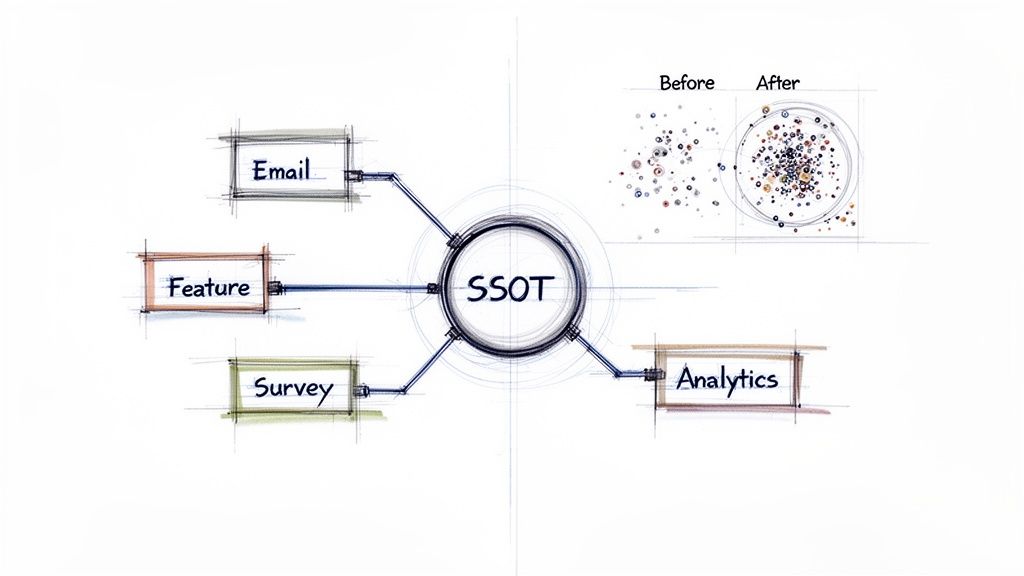
Without it, you’re left with pure data chaos. Your email marketing tool might scream that a user is super engaged, but your analytics platform shows they haven’t touched a key feature in weeks. Which one is right? This mess of conflicting reports leads to guesswork, shaky strategies, and missed opportunities.
An SSOT cuts through all that noise. By pulling and organising every scrap of customer data into one accessible hub, it guarantees that every team—from marketing to product—is working from the same playbook.
From Data Silos to Strategic Clarity
The difference between a fragmented system and an SSOT is night and day. Data silos force you to manually piece together clues like a detective, wasting time and risking costly mistakes. A single source of truth does the heavy lifting for you, turning scattered data points into genuine intelligence you can actually use.
This isn’t just a minor inconvenience; it’s a massive operational headache. A 2023 survey in Singapore revealed that only 43% of businesses felt their systems were connected enough to give them a clear view of their customers. Meanwhile, the average company was juggling more than 50 different applications just to manage customer interactions. Talk about organised chaos.
One of the biggest wins from building an SSOT is fostering effective knowledge sharing practices across your company. When everyone trusts the data because it all comes from the same place, collaboration just clicks.
A single source of truth isn’t just a database; it’s a business principle that ensures consistency and reliability in every decision you make. It’s the foundation for building a truly data-informed culture.
The transformation really comes into focus when you stack the two approaches side-by-side.
Fragmented Stack vs Single Source of Truth
Here’s a quick breakdown of how teams operate with scattered tools versus how they thrive with a unified hub for their data. One path leads to confusion, the other to clarity and growth.
| Operational Area | With a Fragmented Stack (The Old Way) | With a Single Source of Truth (The Smart Way) |
|---|---|---|
| Customer Insights | Incomplete view; requires manual data stitching | 360-degree customer profile available instantly |
| Team Alignment | Departments work with conflicting data sets | All teams share one unified, reliable data source |
| Decision Making | Based on guesswork and partial information | Driven by accurate, comprehensive data |
| Operational Speed | Slow and inefficient; time wasted on data hunting | Fast and agile; insights lead to quick action |
Ultimately, choosing to build an SSOT is about deciding whether you want your teams to spend their time hunting for answers or acting on them. The choice is pretty clear.
Why First-Party Data Suddenly Makes an SSOT a Must-Have
The digital ground is shifting right under our feet. For years, SaaS businesses leaned heavily on third-party cookies to get a sense of customer behaviour, but that whole era is winding down. This isn’t a small tweak; it’s a fundamental change that puts the spotlight squarely on first-party data—the information you collect directly from your own users.
Suddenly, every trial signup, every NPS score, and every single feature interaction has become a priceless piece of intel.
This is exactly where a single source of truth (SSOT) goes from being a “nice-to-have” to a non-negotiable part of your toolkit. Without one, all that valuable first-party data ends up siloed, trapped in different tools that don’t talk to each other. Your feedback widget knows who your biggest fans are, sure, but it can’t tell your email system to ping them for a testimonial. This kind of fragmentation makes it impossible to build a complete, 360-degree view of your customer.
The New Gold Rush for User Data
For bootstrapped SaaS founders, every scrap of user data is a signal. It’s a breadcrumb that can guide product development, help you slash churn, and ultimately boost your revenue. Think about the regional giants like Lazada or Shopee; their ridiculously powerful personalisation engines are fuelled by a central, unified understanding of user behaviour. They know what you browse, what you buy, and what you scroll right past, all because their data lives in one massive, connected pool.
You can apply the very same logic, just on a more manageable scale. An SSOT lets you connect the dots in a way that feels like magic to your users:
- A user finishes your onboarding checklist.
- A moment later, they click on a specific advanced feature.
- This instantly triggers an automated email with a helpful tutorial just for that feature.
This kind of smart, responsive engagement is only possible when all your data lives and works together in a single, reliable system.
And make no mistake, this isn’t just a fleeting trend; it’s a strategic necessity. Marketers all over Southeast Asia are scrambling to invest in platforms that can unify data from all their different sources, even with the final cookie apocalypse being delayed. The real challenge is breaking down those data silos to make advanced personalisation actually work. You can get more insights on how brands in Southeast Asia are adapting to this shift over on martechvibe.com.
Without a single source of truth, your first-party data is like gold dust scattered across a dozen different boxes. You own it, but you can’t spend it. An SSOT is the vault that collects it all, making it valuable and ready to use.
At the end of the day, building a single source of truth is the foundational step for any SaaS business that’s serious about not just surviving, but thriving in a post-cookie world. It’s the essential infrastructure that turns raw user clicks into the strategic insights that drive real, sustainable growth.
The Real-World ROI of a Unified Data System
Let’s be honest, setting up a single source of truth isn’t just a neat data-organising exercise; it’s a direct investment in your bottom line. When you stop chasing data across a dozen different apps and finally unify it, you unlock some serious efficiency gains. Suddenly, you have a clear path to growth that was impossible to see before.
For a SaaS founder, this is gold. You can make decisions faster, put your resources where they’ll actually make a difference, and get laser-focused on what moves the needle. When your data is reliable and all in one place, you can confidently tweak everything from your marketing spend to your product roadmap.
From Big Factories to Your SaaS
This isn’t just theory; the financial upside of unified data is proven at scale. Take a look at the manufacturing world in the Asia Pacific region. One company implemented a smart factory system to bring all its production data together. The result? They cranked up production capacity by 10% and slashed labour costs by a whopping 30%. All because they finally had one consolidated dataset they could trust. You can dig into the specifics in this Lumen report on automation in SEA.
Now, this isn’t just a win for the big players. Let’s apply that same logic to a micro-SaaS. Imagine your US$10,000 MRR business finds a similar 10% efficiency boost in onboarding and support. By centralising user feedback, email engagement, and in-app behaviour, you’ve just added US$1,000 per month to your business. That’s cash you can either pocket or reinvest.
A single source of truth turns abstract data points into hard cash. It connects the dots between how you operate and how much you earn, proving its worth in numbers you can take to the bank.
This newfound efficiency has a brilliant ripple effect. With manual grunt work out of the way, your team can finally focus on the high-impact stuff that actually grows the business. Think about what you could do:
- Stop Churn Before It Happens: Spot at-risk users by looking at their complete behavioural profile and step in with a solution before they hit “cancel.”
- Run Smarter Upsell Campaigns: Identify customers who are practically begging for a higher-tier plan based on how they’re using your features.
- Nail User Onboarding: Guide new users with personalised tips based on what they’re actually doing in your app, driving up activation rates.
Each of these isn’t just a time-saver; it directly pumps up your key growth metrics. And when you can accurately track and improve these numbers, you’re building a healthier business for the long haul. To get a better handle on this, check out our guide on how to build a customer lifetime value calculator. An SSOT gives you the clean, reliable data you need to make those calculations truly meaningful.
How to Build Your Customer Communication SSOT
For a bootstrapped founder, the term “single source of truth” (SSOT) can sound a bit intimidating—like something reserved for enterprise teams with massive budgets. But it doesn’t have to be complicated. In fact, it can be surprisingly straightforward when you have a system designed to connect the dots for you.
The goal is to bring the five pillars of customer communication—feedback, email, onboarding, changelogs, and testimonials—into one intelligent hub. Think of it less like building a complex database from scratch and more like creating a central nervous system for your customer interactions.
Platforms like HappyPanda are built for this exact job. Instead of wrestling with five different tools that refuse to talk to each other, you get one cohesive system where every piece of data informs the others. This creates a powerful, self-optimising loop that just works.
Turning Data into Automated Action
The real magic isn’t just in having all your data in one place; it’s what you do with it. An automation layer that acts as the “brain” of your SSOT is what turns a passive collection of information into an active system that drives growth. A great way to enable this kind of precision is with a system that uses Customer Data Platforms (CDP) for segmentation, allowing you to group users based on exactly what they do.
Here’s how data from one part of the system can intelligently trigger an action in another:
- Positive Feedback to Testimonial: A customer gives you a high Net Promoter Score (NPS) of 9 or 10. The system instantly recognises this as a happy user and automatically sends a friendly email asking for a testimonial.
- Onboarding Struggles to Support: A new user gets stuck on a specific step in your onboarding checklist. This signals they might be confused, prompting an automated, targeted email with a helpful guide or video for that exact feature.
- Feature Request to Changelog: A handful of users upvote the same feature request. The moment you ship it, you can notify only those specific users with an in-app changelog announcement and a direct email.
Your SSOT shouldn’t just store information; it should act on it. An intelligent automation layer connects user behaviour to timely communication, creating a personalised experience that feels proactive, not reactive.
The Real Return on Unified Data
When you connect these dots, you’re not just making things neater—you’re directly boosting efficiency and, ultimately, your bottom line. It’s a pretty simple equation.
This concept map shows how unifying your data creates a clear path to better profitability.
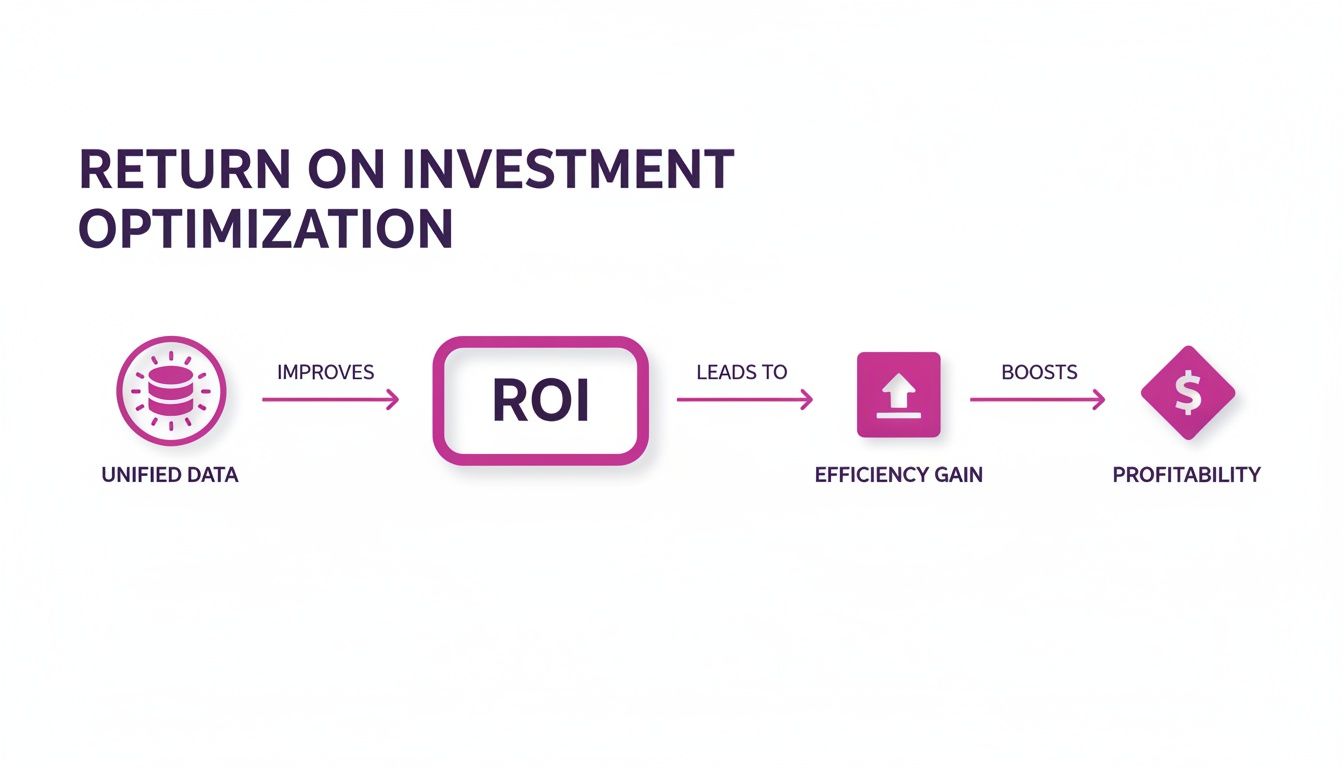
The takeaway here is simple but powerful: a single source of truth directly fuels operational gains, which in turn leads to more revenue and sustainable growth.
By automating these connections, you cut out countless hours of manual work and make sure no opportunity falls through the cracks. This unified approach is the key to understanding your users on a much deeper level. To learn more, check out our guide on choosing the right voice of the customer software, a critical piece of any effective SSOT.
Your Roadmap to a Unified System in 10 Minutes
Building a single source of truth sounds like a massive, time-consuming project, right? For most founders, it feels like one of those daunting tasks you’d reserve for a team with a big budget and months to spare.
But it doesn’t have to be that way. With a modern, all-in-one tool like HappyPanda, you can ditch your fragmented tech stack in less time than it takes to finish your morning coffee.
No, that’s not an exaggeration. The whole process is designed to be ridiculously fast, letting you unify your customer communications and start gathering insights almost immediately. Forget about complex setups and endless configuration screens.
A Simple Four-Step Plan
We’ve boiled the implementation down to four simple steps that get you from zero to a fully functional SSOT. Here’s the entire roadmap:
-
Choose a Pre-Built Recipe: Kick things off with a template like the “SaaS Starter Kit” or “Trial Conversion Kit.” These pre-configured setups give you a massive head start with proven email sequences, surveys, and onboarding checklists right out of the box.
-
Describe Your Product: Briefly tell the system about your SaaS. This simple prompt allows AI to help tailor the pre-written content, making sure it perfectly matches your brand’s voice and your product’s value proposition.
-
Make Quick Customisations (Optional): Want to tweak the wording on a welcome email or adjust the timing of an NPS survey? You can make small adjustments in seconds, but the templates are good to go as-is.
-
Add a Single Script Tag: Finally, copy one tiny snippet of code and add it to your website or app. That’s it. You’re live, and your new single source of truth is actively collecting data.
The goal is to move from idea to execution instantly. A unified system shouldn’t be a distant goal on your roadmap; it should be a quick win that starts paying dividends today.
By focusing on this rapid setup, you can immediately start seeing the benefits of a connected system. And as your needs grow, you can explore the full range of HappyPanda integrations to connect even more tools to your central hub. The real power of an SSOT lies in its simplicity and speed.
Still Have Questions?
Got a few more questions rattling around? Perfect. Let’s tackle them head-on.
What Does Single Source of Truth Really Mean for a Small Team?
Think of it this way: for a bootstrapped SaaS, a single source of truth (SSOT) is your command centre for every customer conversation. Forget juggling five different apps for feedback, emails, and onboarding. An SSOT centralises everything.
It means anyone on your team—whether it’s you, your co-founder, or your first hire—can see the complete, unvarnished story of any customer without logging into a dozen different platforms. No more “Wait, did you reply to that email?” or “Where did that feature request go?”. It’s all in one place.
Isn’t Migrating to an SSOT a Massive Headache?
It definitely can be, but it doesn’t have to be. If you’re thinking of a traditional, custom-built SSOT, then yes, you’re looking at a huge project. But a unified platform like HappyPanda is built for speed.
You can get the whole thing up and running in about 10 minutes. Seriously. Just choose a template, give a quick description of your product, and pop a single script tag onto your site. The whole point is to get you moving immediately, not to add another item to your long-term engineering backlog.
Adopting a single source of truth isn’t about overhauling your entire business overnight. It’s about choosing one reliable system for customer communication and building from there, saving time and money from day one.
How Does a Unified Platform Stack Up Against a Custom Solution?
Building your own SSOT gives you ultimate control, but it’s a bit like deciding to build your own car from scratch. It comes with massive costs in both development hours and the never-ending task of maintenance. A unified platform is the practical alternative for founders who’d rather be growing their business.
Let’s break it down:
- Speed to Implement: A custom solution could take months of planning and coding. A platform like HappyPanda? You’re live in minutes.
- Upfront Cost: Building your own requires a serious investment in engineering resources. A platform is just a predictable monthly subscription.
- Maintenance: With a custom build, you’re on the hook for every update, bug fix, and security patch. A platform handles all of that for you, so you can sleep at night.
For most founders, the speed and sanity saved by a unified platform make it the clear winner for creating a reliable customer communication SSOT.
Ready to build your single source of truth without the headache? HappyPanda unifies feedback, email, onboarding, and more into one simple platform. Start your free 14-day trial today.