
A Service Level Agreement (SLA) isn’t just another piece of corporate jargon. Think of it as a formal handshake between you and your customer—a contract that clearly defines the level of service they can expect from you. It takes vague promises like “we’re reliable” and turns them into solid, measurable commitments.
Why Your SaaS Actually Needs a Service Level Agreement
Picture this: It’s Monday morning. Your phone buzzes with a notification from your most important customer, and they are not happy. Your app was down for three hours over the weekend, right when their team needed it most.
Without an SLA, that conversation is a mess of apologies, guesswork, and a very real risk of churn. But with an SLA in place? The conversation is structured, professional, and clear for everyone involved.
This isn’t about appeasing angry customers; it’s about building a foundation of trust. An SLA cuts through the ambiguity. It’s not some scary, complex legal document reserved for massive enterprises. It’s your playbook for defining responsibilities, protecting your business, and setting a standard of quality that makes customers want to stick around.
Defining the Rules of the Game
An SLA is basically the official rulebook for your customer relationship. It answers all the critical “what if” questions before they turn into real problems:
- Uptime Guarantee: How much of the time will your service actually be available? A common and respectable target is 99.9% uptime.
- Support Response Time: If a customer submits a critical ticket, how fast will you get back to them? Are we talking one hour or twenty-four?
- Performance Metrics: How quickly should key features in your app load or respond?
- Penalties and Credits: What happens if you don’t hit your targets? Will you offer a service credit as a gesture of goodwill?
By spelling these things out upfront, you’re managing expectations from day one. Customers know exactly what they’re paying for, and your team has clear benchmarks to hit. This proactive approach stops the kind of misunderstandings that can kill a good business relationship.
More Than a Document—It’s a Commitment
For a bootstrapped SaaS, having an SLA sends a powerful signal: you’re mature, reliable, and you take your service seriously. It shows a commitment to transparency that’s essential for winning over and keeping high-value customers who rely on your tool for their own operations.
A well-crafted Service Level Agreement does more than just set expectations—it strengthens relationships between providers and customers by creating confidence and accountability.
Of course, making these promises means you need to be able to keep them. This is where clear communication comes in. You need tools to manage customer feedback, a changelog to announce maintenance, and a way to analyse performance. And when something inevitably goes wrong, you need a solid process to find out why. You can learn more about how to conduct a proper root cause analysis to ensure you meet your SLA promises and keep that hard-earned customer trust.
Ultimately, an SLA is a strategic asset. It shields you from unreasonable demands, gives you a framework for sorting out disputes, and shows a level of professionalism that can set you apart from the competition. It’s your promise in writing, and in the world of SaaS, your promises are everything.
The Building Blocks of a Strong SLA
A solid Service Level Agreement isn’t built on vague promises. It’s built on clear, measurable commitments. Think of it like assembling a piece of furniture—you start with the smallest screws and brackets and build up from there to create something you can actually rely on.
This hierarchy is all about turning ambiguity into clarity, making sure you and your customer are always on the same page.
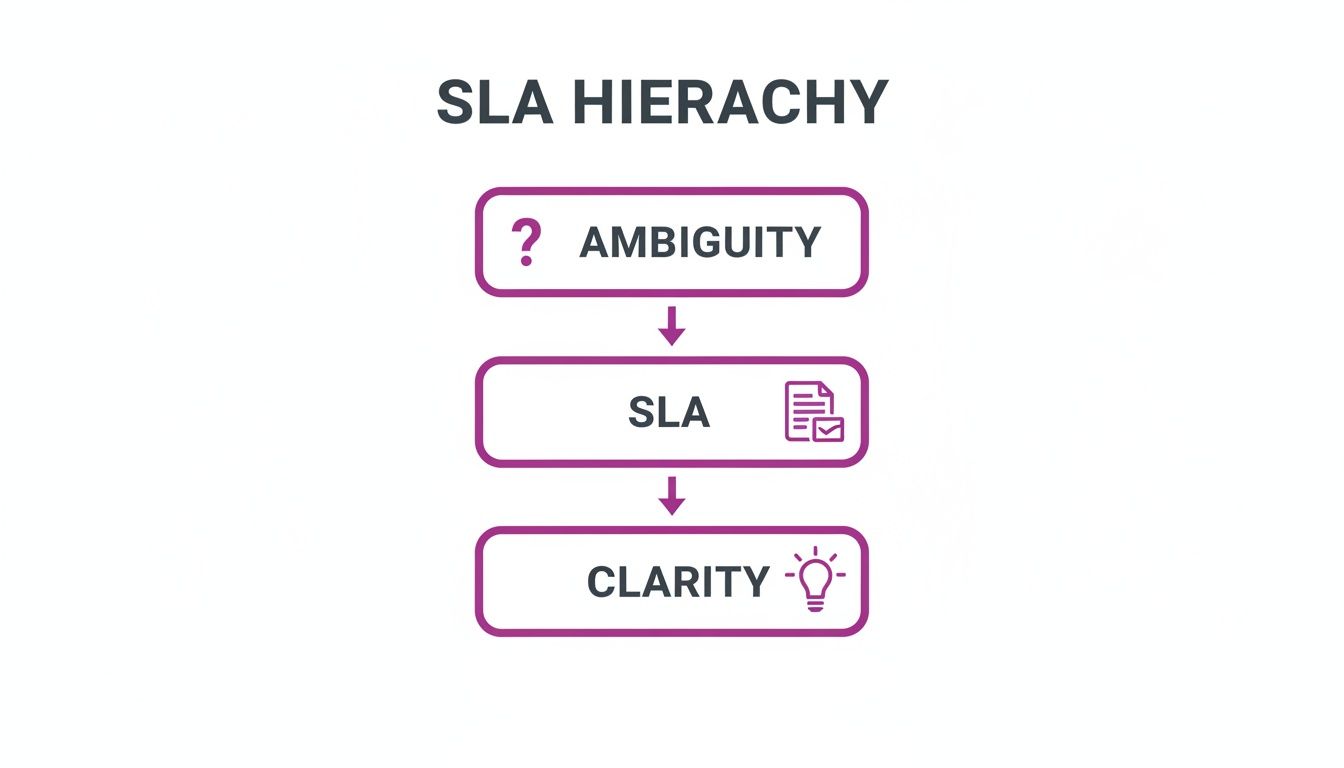
This flowchart nails it: a well-structured SLA is the bridge from uncertainty to a clear, actionable agreement. Let’s break down the components that get you there.
SLIs: The Foundational Metrics
At the very bottom of the structure, you have Service Level Indicators (SLIs). An SLI is a direct, quantifiable measurement of one specific part of your service. It’s the raw data, the hard numbers you collect to see how you’re performing.
You simply can’t promise what you can’t measure, and SLIs are how you measure. They’re the concrete proof of your service’s health. For a SaaS business, common SLIs might include things like:
- API Response Time: The number of milliseconds it takes for your API to return a call.
- Request Success Rate: The percentage of user requests that go through without an error.
- System Uptime: The percentage of time your application is online and working as expected.
These are just a few examples. The trick is to pick indicators that genuinely reflect what your customer is experiencing. To get a better handle on which metrics matter most, it helps to understand what makes a good performance indicator in the first place. You can learn more about how to define a key performance indicator that lines up with your business goals.
SLOs: Turning Metrics into Goals
Once you’re tracking your SLIs, the next step is to set a target for them. That target is your Service Level Objective (SLO). An SLO takes a raw metric (the SLI) and turns it into a specific, achievable goal over a given period.
If an SLI is the speedometer in your car, the SLO is the speed limit you’ve promised yourself you won’t break. It’s an internal goal your team works towards to keep customers happy.
An SLO is the promise you make to your own team about service quality. It’s the internal benchmark that, if you hit it consistently, means you’re delivering on your end of the deal.
Let’s look at how these pieces fit together. Below is a simple table that breaks down how SLIs and SLOs form the core of your SLA.
Understanding Your SLA Components
| Component | What It Is | Example for a SaaS |
|---|---|---|
| SLI | A raw, quantifiable measurement of a service aspect. | The response time in milliseconds for each API call. |
| SLO | A specific target or goal for an SLI over a period. | 99.5% of API calls will be faster than 200ms over a 30-day period. |
| SLA | The formal contract that includes SLOs and penalties. | A contract guaranteeing the SLO with service credits if it is not met. |
This structure is what gives your agreement teeth. You define the metric (SLI), set a realistic target (SLO), and then wrap it all in a formal, customer-facing promise (SLA).
Key Metrics Every SaaS SLA Should Include
While every SaaS is unique, a few metrics are universally important for building customer trust. A strong SLA should always cover these core areas to give your customers peace of mind.
Uptime and Availability
This is the big one. Uptime is the percentage of time your service is accessible and usable. A common target is 99.9% uptime (often called “three nines”), which works out to about 43 minutes of downtime per month. Be honest about what your infrastructure can handle—don’t promise something you can’t deliver.
Support Response and Resolution Times
Your customers need to know you’ve got their back. Your SLA should define different response times based on how severe an issue is.
- Initial Response Time: How quickly will you acknowledge a support ticket? For instance, “1-hour response time for critical issues during business hours.”
- Resolution Time: What’s the target for actually fixing the problem? This is tougher to promise with a hard deadline, but you can frame it as a goal.
When you’re figuring this out, it’s crucial to understand what your team can realistically support. It’s worth learning about the different service desk and help desk support models to see which structure fits your capabilities.
Performance Benchmarks
Beyond just being “on,” your app has to be fast enough to be useful. Performance metrics define how snappy your service should feel. This could be the SLO we mentioned earlier (“99.5% of API calls faster than 200ms”) or a benchmark for how quickly a key page in your application should load.
By breaking down your promises into these building blocks, you create a Service Level Agreement that isn’t just professional—it’s practical, transparent, and sustainable for your business.
Choosing the Right SLA Model for Your Business
A one-size-fits-all SLA almost never works. Just like your SaaS has different features for different customers, your service promises need to be just as tailored. Picking the right model isn’t some legal formality; it’s a strategic move that aligns your promises with your pricing and who you’re selling to.
Think about it: not every customer has the same needs or pays the same price. Promising the same aggressive uptime and support response to a free-tier user as you do for an enterprise client is a recipe for stretching your team dangerously thin. The trick is to match the promise to the value of the relationship.
Let’s break down the three main SLA models. Nailing these will help you build a structure that actually supports your growth instead of holding it back.
The Customer-Based SLA
Imagine you’ve just landed a massive enterprise client. They’re about to make up 30% of your monthly recurring revenue, but their needs are unique and they want guarantees that your other customers don’t need. This is the perfect time to roll out a customer-based SLA.
This model is a completely bespoke agreement, crafted for a single customer. It lets you offer premium terms—like lightning-fast support or higher uptime guarantees—to your high-value clients without being forced to offer that same level to everyone else. It’s a seriously powerful tool for closing big deals and cementing those key enterprise partnerships.
The Service-Based SLA
This is the bread and butter for most SaaS companies. A service-based SLA applies one uniform set of promises to all customers on a specific plan or using a particular service. For example, everyone on your “Pro Plan” gets the same 99.9% uptime guarantee and a four-hour response time for support tickets.
This approach is beautifully efficient and scalable. You’re not trying to juggle dozens of unique, fiddly agreements. All customers on a given plan know exactly what to expect, which builds a sense of fairness and transparency. For most product-led growth companies where standardisation is king, this is the way to go.
The Multi-Level SLA
So, what happens when your business has multiple services and different customer tiers? That’s where a multi-level SLA comes in. It combines different agreements into a layered structure. Think of it like a tiered cake, where each layer addresses a different part of the service relationship.
This model often breaks down into:
- Corporate-Level: A foundational agreement covering the general service stuff that applies to every single customer, no matter their plan.
- Customer-Level: Specific terms that apply to a particular group, like all users in your “Enterprise Tier.”
- Service-Level: Promises tied to a specific product or feature, like an add-on API service that has its own performance metrics.
A multi-level SLA gives you the ultimate flexibility. It allows a business to create a comprehensive service framework that addresses broad company standards while also catering to the specific needs of different customer segments and services.
Sure, this model is more complex, but it’s incredibly useful for mature SaaS businesses with a diverse lineup of products. By organising your SLA this way, you make sure every promise you make is clear, relevant, and perfectly aligned with what the customer is actually paying for and using.
How to Draft Your First Service Level Agreement
Alright, let’s move from theory to actually getting this done. Drafting your first Service Level Agreement can feel a bit like stepping into a legal minefield, especially when you’re a bootstrapper without a lawyer on speed dial. But here’s the good news: you don’t need to write like a solicitor to create a solid, fair, and effective document. The real goal here is clarity, not complexity.
Think of your SLA as part of your product’s user experience. It should be easy to read, simple to understand, and totally transparent. A clear, fair agreement isn’t just a legal shield; it’s a powerful feature that screams professionalism and builds the kind of trust that keeps customers around for the long haul.
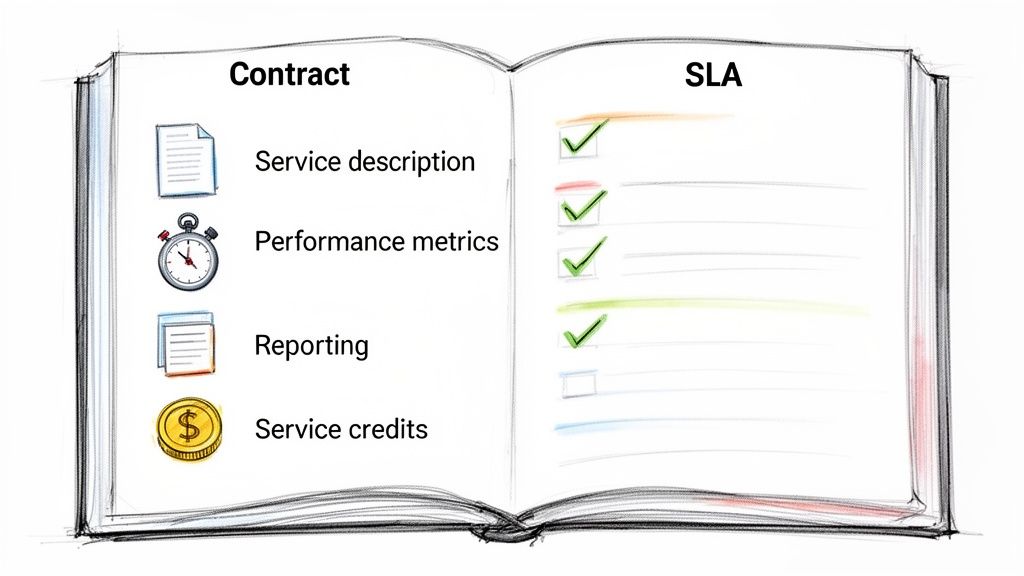
Breaking Down the Essential Clauses
Your first SLA doesn’t need to be a fifty-page monster. Far from it. Instead, just focus on a handful of essential clauses that cover the most critical parts of your service. These are the nuts and bolts of the promise you’re making to your customer.
Start with these core components:
- Parties Involved: Clearly state who the agreement is between—your company and the customer. Simple.
- Agreement Period: Define the start date and how long it lasts. Is it a monthly thing, an annual contract, or does it just keep rolling until someone cancels?
- Scope of Services: Be brutally explicit about what your service does and what this agreement covers. If certain features or fancy add-ons are out of scope, say so here. It’ll save you a world of headaches later.
Getting this foundation right ensures everyone is on the same page from the get-go. No ambiguity, no confusion.
Defining Your Performance Metrics and Remedies
This is the heart and soul of your SLA. It’s where you stop talking in marketing-speak and start using real, measurable numbers. Take those Service Level Objectives (SLOs) you worked out earlier and put them front and centre. Don’t bury them in fine print; make them a highlight.
Your metrics section should spell out:
- Uptime Guarantee: State your commitment as a clear percentage, like 99.9% monthly uptime. Be sure to define what counts as “downtime” and how you measure it.
- Support Response Times: Lay out your promise for getting back to people. For example, “a 1-hour response for critical issues, and 8 business hours for non-critical stuff.”
- Reporting Procedures: Explain how and when you’ll report on your performance. Monthly emails or a public status page are fantastic ways to keep things transparent.
- Service Credits (Remedies): Clearly outline what happens if you drop the ball. Service credits are the industry standard here. For example, “If monthly uptime falls below 99.9% but stays above 99.0%, the customer gets a 10% credit on their next bill.”
These clauses create a clear accountability framework. Customers love it, and it shows you stand behind your service.
Negotiation Tips for Indie Founders
When a potential customer—especially a bigger one—wants to negotiate your SLA, don’t break into a cold sweat. It’s actually a good sign; it means they’re serious about your service. The trick is to know your limits—where you can bend and where you have to hold firm.
Remember, negotiation is a dialogue, not a battle. The goal is to find a middle ground that makes the customer feel valued while protecting your business from unsustainable promises.
Come prepared by knowing your operational limits inside and out. If a customer is pushing for 99.999% uptime but you know your setup can only reliably deliver 99.9%, you have to be firm. Politely explain what you can guarantee and why. Frame your SLA not as a list of rules but as a transparent commitment to quality.
Creating a Cohesive Legal Foundation
Your SLA doesn’t live on an island. It needs to work hand-in-hand with your other legal documents to create a professional and seamless foundation for your SaaS. Any inconsistencies can lead to confusion and legal risk.
- Terms of Service (ToS): Your ToS governs the overall use of your product. It should point to the SLA as the go-to document for anything related to performance promises.
- Privacy Policy: This document explains how you handle customer data and should align perfectly with any data-related clauses in your SLA.
Making sure these three documents are in sync shows a high level of foresight and professionalism. It reassures customers that you’ve thought through the entire service relationship. This structured approach is becoming a global standard for operational excellence. For instance, consolidated service-level agreements have become critical for improving trade facilitation across Southeast Asia, with countries like Indonesia seeing a 33.33% boost in formalities efficiency by implementing such structured frameworks. You can read more about how SLAs are driving operational gains in the ASEAN region in this integrative report. By drafting a clear and fair SLA, you’re adopting a best practice that builds a robust and trustworthy SaaS business.
Monitoring SLA Performance and Communicating Effectively
An SLA you don’t track is just an empty promise gathering dust. Signing the agreement is the starting pistol, not the finish line. It’s the consistent monitoring and clear communication that follow which actually bring it to life. And for a bootstrapped founder, this doesn’t mean you need some eye-wateringly expensive, enterprise-level monitoring suite.
Effective monitoring is all about turning your promises into cold, hard data. It creates a transparent feedback loop that proves your reliability and builds genuine customer trust. Without it, you’re flying blind, unable to see if you’re hitting your targets or spot trouble before it snowballs into a full-blown breach.
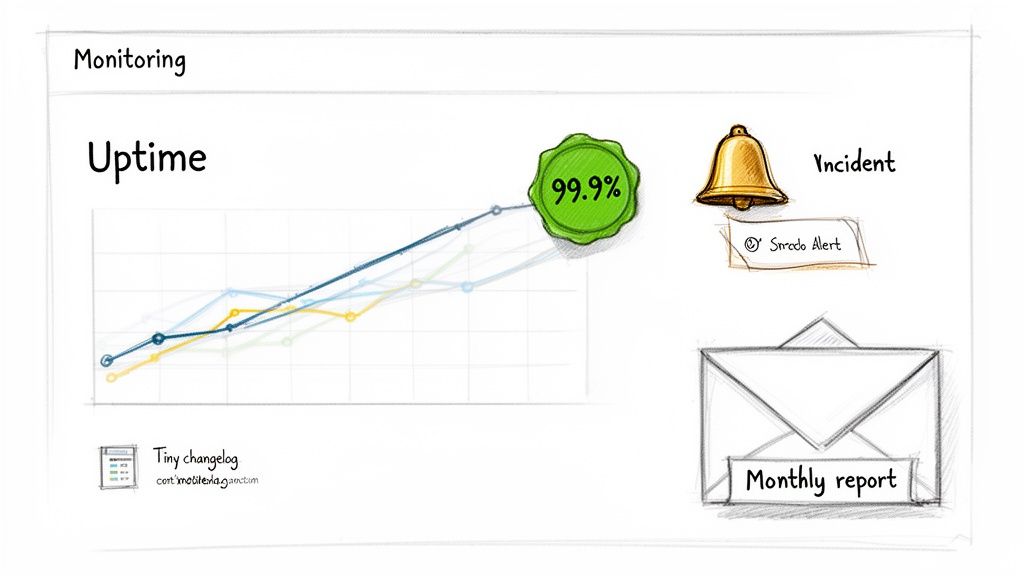
Tools and Practices for Effective Monitoring
Staying on top of your SLA commitments is easier than ever with plenty of affordable, modern tools out there. The real trick is to automate the tracking for your most critical metrics. That way, you always have a real-time pulse on your performance.
Your monitoring toolkit should really cover three main areas:
- Uptime and Performance: These are the tools that ping your application from different places around the world to make sure it’s online and responsive. This data is the lifeblood of your availability SLOs.
- Help Desk Analytics: Your support software should be tracking first response times and how long it takes to resolve issues. This isn’t just for your own team’s improvement; it’s hard evidence that you’re meeting your support promises.
- Application Performance: More advanced tools can keep an eye on specific SLIs, like how fast your API responds or how quickly a database query runs, ensuring the user experience stays snappy.
For monitoring to be truly effective, it helps to adopt robust Contract Lifecycle Management best practices. This gives you a bird’s-eye view, ensuring no commitment is accidentally overlooked from drafting all the way through to renewal.
The Power of Proactive Communication
Monitoring gives you the data. Communication is what gives that data meaning and context for your customers. Transparency is your greatest asset, especially when things aren’t going perfectly. This is where platforms like HappyPanda can make that conversation seamless.
Proactive communication turns an SLA from a static contract into a dynamic, trust-building relationship. It shows customers you respect their business and are accountable for your performance.
Try working these communication habits into your routine:
- Use a Changelog: Give people a heads-up about scheduled maintenance or new feature updates. This avoids nasty surprises and shows you respect their workflow.
- Automate Performance Reports: Set up a simple, automated monthly email that summarises your uptime and key metrics. It’s an effortless way to reinforce your reliability.
- Leverage Feedback Widgets: Use satisfaction surveys after a support ticket is closed to see how well your team is actually meeting expectations.
Handling an SLA Breach with Grace
Look, no matter how well you prepare, a breach can happen. It’s how you respond that defines the relationship from that point on. A breach isn’t just a failure; it’s a chance to prove you’re committed to being accountable.
When things go sideways, follow these steps:
- Acknowledge Immediately: Get the word out proactively through your status page or by email. Don’t wait for customers to start knocking on your door.
- Be Transparent: Explain what happened in simple terms, what you’re doing to fix it, and when you think you’ll have it sorted.
- Apply Service Credits Automatically: Don’t make customers chase you for the compensation they’re owed. Apply any service credits to their next invoice without them having to ask.
This approach can turn a negative event into a moment that actually strengthens customer loyalty. It shows you stand by your word, even when it’s tough. This is the same principle that makes SLAs such fundamental tools in critical sectors. The healthcare industry across Southeast Asia, for instance, leans heavily on this kind of performance monitoring to ensure provider accountability.
And, of course, the best way to handle a breach is to prevent it in the first place. You can learn more about how HappyPanda helps with software defect tracking to catch issues before they escalate.
Common Service Level Agreement Mistakes to Avoid
Crafting an SLA is a huge step toward professionalising your SaaS, but a few common trip-ups can turn this asset into a serious liability. Let’s look at the mistakes others have made, so you can build a solid agreement from day one.
One of the biggest blunders is over-promising on performance. A founder, eager to land a big client, might casually guarantee 99.999% uptime. Sounds impressive, right? The problem is, that translates to less than six minutes of downtime per year. It’s a ridiculously high bar that’s expensive to maintain and almost impossible to meet.
Another classic trap is using fuzzy, vague language. Phrases like “reasonable response times” or “adequate performance” are just arguments waiting to happen. An SLA is only as good as its numbers, so if you can’t measure it, it doesn’t belong in the agreement.
Failing to Align Promises with Reality
An SLA is completely useless if it doesn’t match what your team can actually deliver. Before you commit to a one-hour response time for critical issues, you’d better be damn sure you have the people and processes in place to make it happen, especially at 3 AM on a Sunday.
A service level agreement should be an honest reflection of your operational capacity, not an aspirational marketing document. Mismatches between your SLA and your actual abilities will quickly erode customer trust.
Here are a couple of ways founders trip up on this:
- Forgetting Maintenance Windows: They fail to exclude scheduled maintenance and updates from their uptime calculations, instantly putting them in breach.
- Ignoring Dependencies: They overlook the fact that their service relies on third parties (like AWS or Stripe). If your cloud provider goes down and takes you with it, your customer’s SLA with you is still breached.
Treating Your SLA as a Static Document
Finally, a massive mistake is the “set it and forget it” approach. Your SaaS is going to evolve, your customer base will grow, and your infrastructure will change. Your SLA needs to be a living document.
Think of it this way: you wouldn’t run your business on a five-year-old roadmap, would you? The same goes for your service commitments. Review and update your SLA at least once a year to make sure it still makes sense for your business. An outdated agreement can lock you into old promises that are no longer feasible or relevant.
A Few Lingering Questions About SaaS SLAs
Even with a solid guide, a few questions always seem to pop up when bootstrapped founders start thinking about service level agreements. Let’s tackle those common head-scratchers so you can move forward with confidence.
What’s the Standard Uptime for a SaaS SLA?
While there’s no single magic number, 99.9% uptime—often called “three nines”—is pretty much the gold standard for paid SaaS products. It hits the sweet spot, signalling that you’re serious about reliability without costing a fortune to maintain. In real-world terms, that works out to about 43 minutes of acceptable downtime per month.
Are SLAs Just for Big Enterprise Customers?
Absolutely not. While you might negotiate custom, customer-based SLAs with your largest clients, a service-based SLA is a must-have for any SaaS with different subscription tiers. It’s a straightforward way to apply the same set of promises to everyone on a specific plan, which keeps things fair and clear for your whole user base.
What Happens if I Don’t Meet My Own SLA?
First off, don’t panic. A breach isn’t the end of the world, especially if you handle it well. The typical remedy is to issue service credits to the customers who were affected, usually calculated as a percentage of their monthly subscription fee.
The real key to handling a breach is honest, proactive communication. Own up to the issue right away, explain what you’re doing to fix it, and automatically apply any credits they’re owed. This approach actually builds trust, even when things go sideways.
Does My SLA Need to Be a Complicated Legal Document?
Nope. In fact, it’s better if it isn’t. Clarity trumps complex legal jargon every single time. Your SLA should be written in plain English that your customers can actually read and understand. Just focus on clearly defining the metrics, who’s responsible for what, and what happens if something goes wrong. A simple, well-defined agreement protects both you and your customer far better than a confusing one nobody can make sense of.
Managing all the communication around your SLA—from performance updates to feedback collection—can be a real juggle. HappyPanda brings your changelog, feedback widgets, and email sequences together in one place, helping you keep your service promises without the headache. Learn more and get started at https://happypanda.ai.