
The Eric Ries Lean Startup isn’t just another business framework; it’s a completely different way of thinking about how to build a company. It’s a scientific method for getting a product into your customers’ hands faster by focusing on what truly matters. It swaps out rigid, long-term plans for a cycle of iterative building, measuring real-world feedback, and learning from it.
From Silicon Valley Garages to Global Boardrooms
Imagine a founder not as a visionary CEO locked in a boardroom, but as a scientist hunched over a workbench, running experiment after experiment. That’s the heart of the Eric Ries Lean Startup. It takes the old-school business model—spend months perfecting a product in secret—and flips it on its head. Instead, you’re encouraged to treat your entire startup as one big experiment.
This whole philosophy wasn’t cooked up in an ivory tower. It was forged in the trenches of Silicon Valley. After co-founding the social network IMVU in 2004, Ries saw firsthand the colossal waste that came from building features nobody actually wanted. That pain led him to a single, obsessive goal: figure out how to learn what customers really value, and fast.
The core idea is to ruthlessly eliminate “waste,” which Ries defines as anything that doesn’t help you learn something concrete about your customers. This isn’t just about money; it’s about:
- Wasted Time: Months spent building a complex product, only to launch to the sound of crickets.
- Wasted Money: Burning through capital to market a solution for a problem that doesn’t actually exist.
- Wasted Effort: Countless hours of code written for features that users either ignore or actively dislike.
A Scientific Method for Business
At its core, Lean Startup is just the scientific method applied to the chaos of building a business. You start with a hypothesis—a guess about your customer, their problem, and how your solution helps. But instead of embedding that guess into a 50-page business plan, you design a quick, cheap experiment to see if you’re right.
“The only way to win is to learn faster than anyone else.” - Eric Ries
This shift from “executing a plan” to “continuous learning” is the real game-changer. The goal isn’t just to build a cool product; it’s to build a sustainable business by methodically chipping away at the risk. Every little experiment gives you hard data that tells you what to do next.
This approach has caught fire everywhere, especially in scrappy, emerging tech hubs. Take Southeast Asia’s startup scene, where the Eric Ries Lean Startup model has been a lifeline. Founders there often start with smaller home markets, forcing them to test their ideas for global appeal from day one—a perfect fit for the build-measure-learn loop. It’s this exact mindset that helped Indonesia grow to host over 2,300 startups by 2023, with many pointing to rapid iteration as the secret sauce for their success. You can read the full analysis of how SE Asian startups use these principles to grow.
The Three Pillars of the Lean Startup Framework
At the heart of Eric Ries’s methodology are three core concepts that work together like a perfectly tuned engine. They aren’t just isolated principles; think of them as interconnected pillars holding up the entire structure of rapid, sustainable growth. Getting how they interact is the key to ditching guesswork and adopting a more scientific approach to building a business.
The pillars are the Build-Measure-Learn feedback loop, the practice of Validated Learning, and the framework of Innovation Accounting. Together, they offer a repeatable process for navigating the wild uncertainty that comes with any new venture—especially for a bootstrapped SaaS founder, where every single decision carries weight.
Let’s break down how this engine actually works.
This visual captures the simple yet powerful cycle that drives the whole thing: turning an idea into something you can test, running the experiment, and learning from what happens.
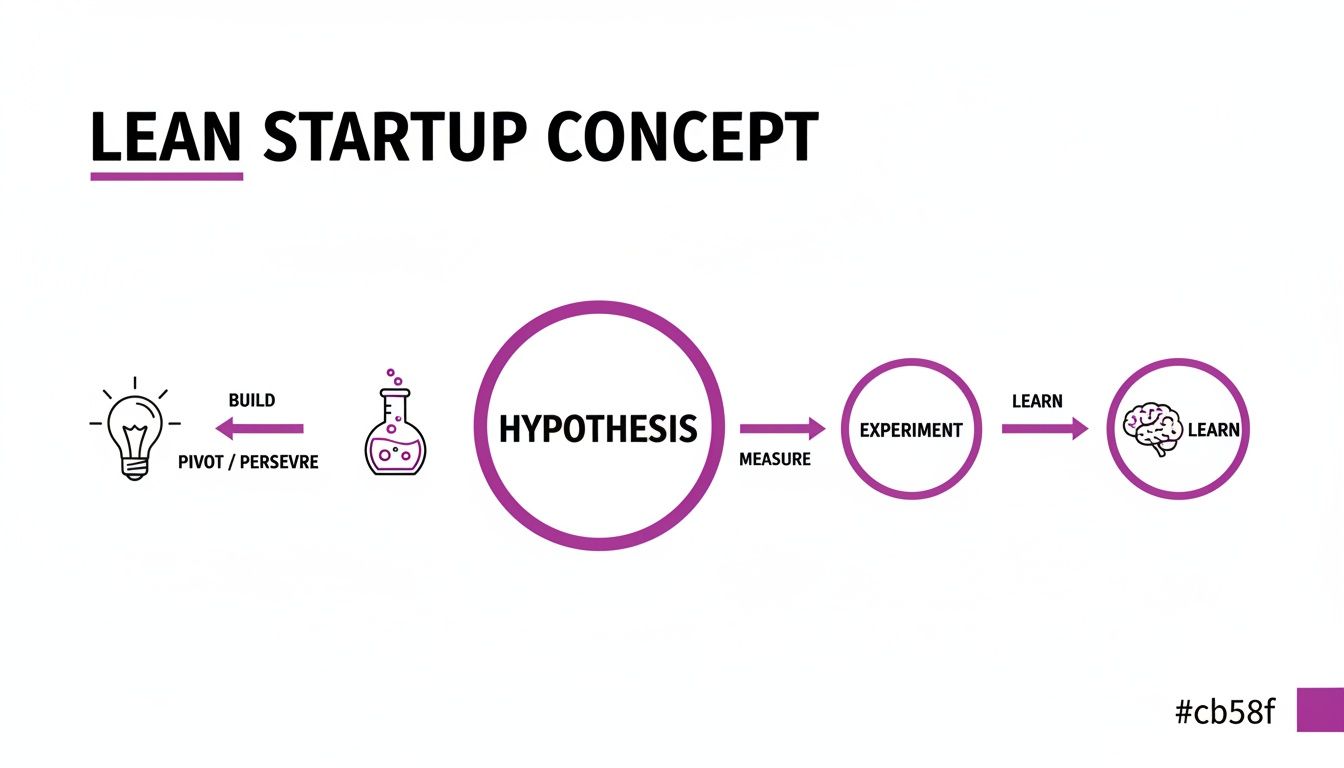
This loop ensures every action is a step towards understanding what customers genuinely want, not just building features in a void.
The Build-Measure-Learn Feedback Loop
Imagine you’re trying to find a path through a dense jungle. Instead of mapping out the entire multi-day trek in advance, you take a few steps, check your compass, and adjust your course. That’s the Build-Measure-Learn loop in a nutshell. It’s the engine of the Lean Startup, and the goal is to get through the entire loop as fast as possible.
This continuous cycle transforms a startup from an organisation that just executes a plan into one that learns and adapts on the fly. Each stage is crucial for making smart, evidence-based decisions.
Here’s a closer look at what each stage means for a SaaS founder.
The Build-Measure-Learn Feedback Loop Explained
| Stage | Core Purpose | Key SaaS Activities |
|---|---|---|
| Build | To create a minimal version of a product or feature (an MVP) to test a specific assumption with the least amount of effort. | - Create a simple landing page to gauge interest for a new feature. - Mock up a new UI flow in Figma and show it to five users. - Build a single, core feature and release it to a small beta group. |
| Measure | To collect real-world data and feedback on the MVP. The focus is on actionable metrics, not vanity stats. | - Track conversion rates on the landing page (sign-ups vs. visitors). - Record user sessions to see where they get stuck in the new UI. - Monitor feature adoption and retention rates for the beta group. |
| Learn | To analyse the data and decide whether to persevere with the current strategy or pivot to a new one based on evidence. | - Analyse feedback: “Users signed up but said the price is too high.” - Conclude: “The UI is confusing; we need to simplify step 3.” - Decide: “The feature isn’t solving the core problem. Let’s pivot to a different solution.” |
By running through this loop quickly and repeatedly, you minimise wasted time and resources, ensuring you’re always building something people actually need.
Validated Learning: The Pursuit of Truth
What’s the true measure of progress for a startup? According to Ries, it isn’t lines of code written or features shipped. It’s Validated Learning—the rigorous process of proving your fundamental business assumptions are true using hard, empirical data.
Every startup is built on a set of leap-of-faith assumptions. For a SaaS founder, these might sound familiar:
- “Customers will definitely pay £29/month for this feature.”
- “Our target audience is all over LinkedIn, not Twitter.”
- “Users will figure out our onboarding flow without needing a tutorial.”
Validated Learning forces you to treat these assumptions as hypotheses that need testing. The Build-Measure-Learn loop is the tool you use to run those tests. When you prove (or disprove) an assumption, you’ve achieved validated learning. You’ve replaced a guess with a fact, and that’s the only progress that really matters. A crucial first step here is mastering customer needs identification to form solid hypotheses.
“The only way to win is to learn faster than anyone else.” - Eric Ries
This principle forces founders to confront the brutal truth about their ideas early and often. It’s what stops you from spending months building something nobody wants.
Innovation Accounting: A New Kind of Balance Sheet
So, how do you measure progress when traditional metrics like revenue and profit are still hovering around zero? This is where Innovation Accounting comes in. It’s a structured way to measure progress for new ventures that are still figuring things out in a fog of uncertainty.
Innovation Accounting works in three stages:
-
Establish a Baseline: First, you build a simple MVP and measure how customers behave right now. This gives you your starting point for metrics like user activation rates, retention, and referrals.
-
Tune the Engine: Next, you start running experiments using the Build-Measure-Learn loop. With each iteration, your goal is to push those baseline metrics closer to the numbers your business model needs to be sustainable.
-
Pivot or Persevere: If you’re making clear, measurable progress on your key metrics, you persevere. If your experiments are failing to move the needle despite your best efforts, that’s a data-backed signal that it’s time to pivot.
This framework gives founders a clear, data-driven way to hold themselves accountable and make informed decisions, even when there’s no money coming in the door yet.
Building Your First Minimum Viable Product
The Minimum Viable Product (MVP) is easily one of the most powerful ideas from the Eric Ries Lean Startup playbook, but it’s also one of the most misunderstood. A lot of founders hear “minimum” and immediately think “buggy,” “unfinished,” or “cheap.”
That’s a massive mistake.
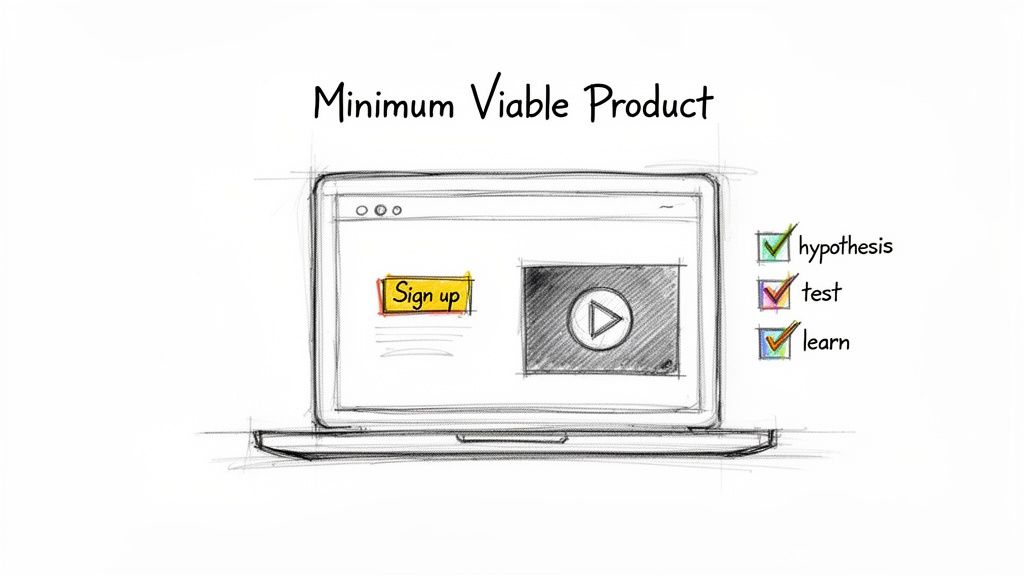
An MVP isn’t just a stripped-down version of your final product. It’s the smallest, simplest experiment you can possibly run to kickstart the Build-Measure-Learn feedback loop. Its primary job isn’t to make money or attract a million users; its job is to generate validated learning. You’re not building a product—you’re building an experiment to test your most critical assumption.
Getting that distinction right changes everything. Your mission is to find the fastest and cheapest way to get real feedback on the core problem you think you’re solving.
Identifying Your Riskiest Assumption
Before you even think about writing a single line of code, you have to pinpoint your “leap-of-faith” assumption. This is the one belief that, if it turns out to be wrong, would make your entire business idea fall apart.
So, what’s your biggest unknown? It usually falls into one of these buckets:
- Value Hypothesis: Do people actually have the problem I think they have? Will they even care about my solution?
- Growth Hypothesis: Is this something people would be willing to share with their friends or colleagues?
- Pricing Hypothesis: Are customers really willing to pay £49 a month for this?
Your MVP should be laser-focused on testing that one thing. If you try to test too many assumptions at once, you’ll just end up with muddy data and a lot of wasted time.
Choosing the Right Type of MVP
Once you know what you need to learn, you can pick the right format for your experiment. An MVP doesn’t have to be a piece of software. In fact, some of the most famous examples didn’t involve building a “product” at all. The goal here is to maximise what you learn while minimising the effort you put in.
For SaaS founders, a few types of MVPs work exceptionally well:
-
The Explainer Video MVP: This is the Dropbox classic. Instead of building a complex file-syncing beast, founder Drew Houston made a simple video showing how it would work. He posted it on Hacker News, and the beta sign-up list exploded from 5,000 to 75,000 people overnight. He validated the core idea without a single line of production code.
-
The Concierge MVP: With this approach, you deliver the service manually to your first few customers. Think of Tony Hsieh at Zappos. He started by taking pictures of shoes at local shops. When an order came through his website, he’d literally go to the store, buy the shoes, and ship them himself. This proved people would buy shoes online long before Zappos invested a penny in warehouses or inventory.
-
The Wizard of Oz MVP: This is where you create the illusion of a fully automated product, but behind the curtain, it’s all you. It’s perfect for testing complex algorithms or AI features. Your customers get a polished front-end experience, while you’re in the background manually processing their requests to see if there’s even demand for it.
Of course, building the MVP is just one step. For a look at what comes next, a comprehensive founder’s guide on launching a SaaS product offers a brilliant roadmap for the journey ahead.
Avoiding the Overbuilding Trap
The single biggest danger when building an MVP is the temptation to add “just one more feature.” It’s a trap. It wastes time, burns cash, and delays the critical learning you desperately need.
Remember, the customer determines if your product is viable, not you. You can only decide what’s minimum. The goal is to get your experiment into the market to generate real data as quickly as possible.
This takes serious discipline. Every feature idea needs to be held up against the MVP’s primary goal: testing your riskiest assumption. If a feature doesn’t directly help test that one thing, it needs to be ruthlessly cut and thrown onto the “maybe later” pile.
This entire process is a form of continuous product discovery, where each cycle gets you one step closer to what your customers actually want. It’s this relentless focus on learning that separates the startups that make it from those that burn out before they ever find their footing.
Putting Lean Principles Into Practice With HappyPanda
Knowing the theory behind the Eric Ries Lean Startup is one thing. Actually putting the Build-Measure-Learn loop into practice without going mad? That’s another beast entirely. Juggling different tools for surveys, emails, and analytics often feels like you’re creating more admin work than actual learning.
This is where a unified platform becomes a bootstrapped founder’s secret weapon. It’s about turning those abstract principles into concrete, repeatable actions.
HappyPanda was designed to be the engine for your feedback loop. It pulls all the essential tools you need for each stage into one place. This lets you move from building an experiment to measuring its impact and learning from the results, all within a single ecosystem. The real win? It dramatically shortens your cycle time, which is the key to out-learning your competition.
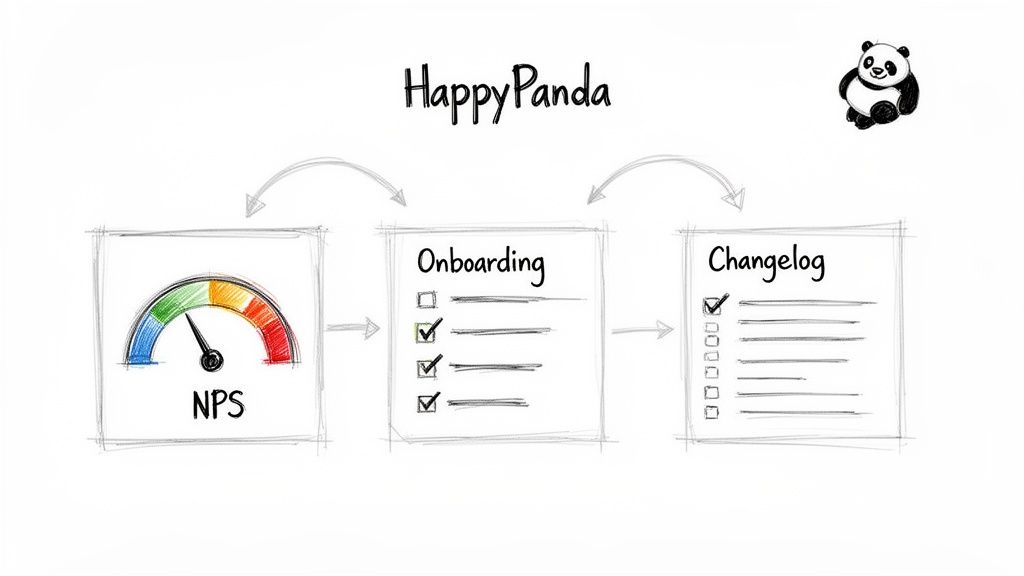
This isn’t just a pretty diagram. It’s a workflow. It shows how HappyPanda connects different touchpoints into a cohesive cycle that directly mirrors Build-Measure-Learn. Each feature is a tool built to help you run faster, smarter experiments.
Measuring What Matters With Targeted Feedback
The “Measure” phase is where so many founders get stuck. It’s not just about collecting data; it’s about collecting the right data from the right users at the right time. Vanity metrics like total sign-ups are great for your ego, but they don’t tell you why users are sticking around (or churning).
HappyPanda’s feedback tools are built for this exact job. Instead of blasting your entire user base with a generic survey and hoping for the best, you can get incredibly specific.
- Net Promoter Score (NPS) Surveys: You could trigger an NPS survey seven days after a user signs up. This gives you a baseline for early user satisfaction that you can track with every single product change.
- Customer Satisfaction (CSAT) Surveys: Why not automatically send a CSAT survey the moment a user interacts with a new feature? This delivers instant, contextual feedback on the thing you just built.
- Smart Targeting: You could even show a survey only to users who have used a specific feature more than three times. This is how you gather deep insights from your most engaged power users.
This kind of targeted approach turns measurement from a passive, data-hoarding activity into an active, strategic part of your learning process. Of course, a key part of the process, as HappyPanda itself learned, is thorough competitor research and analyzing the competition to validate your market and inform your MVP features.
Learning and Iterating With Actionable Insights
Let’s be honest: data is useless until you learn from it and actually do something. The “Learn” phase is all about turning that raw feedback into your next “Build” decision. This is where you decide whether to pivot or persevere, based on cold, hard evidence.
HappyPanda helps you connect the dots between what your users are saying and what your developers are building. It’s about closing the feedback loop so that customer voices are genuinely driving your roadmap, not just getting lost in a spreadsheet.
For a startup, the most precious resource is time. Wasting it on building something nobody wants is the single biggest threat to survival. An integrated platform accelerates learning, giving you more chances to get it right before you run out of runway.
This approach has been a powerful force globally, especially in regions like Southeast Asia where the Lean Startup movement has created thriving communities, empowering bootstrapped SaaS companies to compete. A 2023 survey in the Philippines showed that 65% of indie hackers using the build-measure-learn cycle achieved product-market fit validation 2.5x faster. For small teams, using feedback tools like CES surveys led to 70% lower churn, directly combating the 90% startup failure rate Ries famously documented.
Building and Communicating Change Instantly
Finally, based on what you’ve learned, you dive back into the “Build” phase. This might mean shipping a small improvement, a brand-new feature, or a completely redesigned onboarding flow. But building it is only half the battle. You also have to guide your users through the changes.
HappyPanda’s tools help you complete this part of the loop in minutes, not weeks.
- Onboarding Checklists: If you learn that users are dropping off during setup, you can instantly build and deploy an in-app checklist to guide them through those key first steps.
- Changelog Widgets: Announce your latest improvement directly inside your app using a “What’s New” widget. This ensures users see the changes you’re making based on their feedback, reinforcing that you’re actually listening.
- Automated Email Sequences: If you pivot your pricing model based on survey feedback, you can trigger an automated email to explain the new value to a specific segment of trial users.
By combining these tools, you transform the Build-Measure-Learn loop from a dusty textbook concept into a practical, repeatable workflow. You can run dozens of tiny experiments, gather precise feedback, and iterate on your product in days, giving your SaaS the adaptive edge it needs to not just survive, but thrive.
Debunking the Myths: What the Lean Startup Isn’t
Like any big idea, the Eric Ries Lean Startup methodology has picked up a few myths along the way. These misunderstandings can send founders down a dead-end street, causing them to misapply the core principles and wonder why nothing’s working.
Frankly, to really get the hang of this approach, you need to understand what it isn’t just as much as what it is. A lot of these myths twist the framework into a rigid, dogmatic rulebook, which is the complete opposite of the flexibility it’s meant to inspire.
Let’s clear the air and tackle some of the most common fictions head-on.
Myth 1: Lean Means Being Cheap
This is probably the biggest and most damaging one. People hear “lean” and immediately think “cheap” or “bootstrapped,” assuming the main goal is to pinch every penny until it screams. While being smart with your cash is a fantastic side effect of the lean approach, it’s not the point.
Lean isn’t about being cheap; it’s about being smart with your resources. The real enemy here is waste—specifically, the colossal waste of time, money, and passion that comes from building something nobody actually wants. The goal is to get the most validated learning out of every pound and every hour you put in.
Spending money isn’t the problem. Spending money on a guess is. This is why Ries himself has shut down myths like “lean means you don’t need funding,” often pointing to how Airbnb’s MVP eventually scaled with a hefty dose of venture capital. With SE VC funding hitting $10 billion in 2024, investors are looking for lean teams who can show real traction, not just a bare-bones budget.
For founders on their second or third attempt, we’ve seen data showing that adding lean automation layers can boost trial-to-paid conversion by 28%. That’s the kind of smart spending that prevents the massive failures Ries warns about. You can learn more about how Eric Ries addresses these common misconceptions directly from the source.
Myth 2: Lean Means No Vision or Plan
Here’s another classic critique: the focus on reacting to customer feedback means you’re just flailing around without a clear direction. Critics say that if you’re constantly pivoting, you must not have a strong vision for your product.
This couldn’t be more wrong.
The Lean Startup methodology doesn’t replace vision; it gives you a scientific framework to test that vision against reality. Your grand vision is your starting hypothesis, and every single experiment is designed to find a sustainable path toward making it real.
Without that big-picture vision, your experiments would be pointless. You wouldn’t know which assumptions to test first or which customer feedback actually matters. The idea isn’t to let customers design your product for you; it’s to discover which parts of your vision they connect with the most.
Myth 3: It Only Works for Software Startups
While the Eric Ries Lean Startup was born in the tech-heavy world of Silicon Valley, its principles are universal. The core idea of treating your business as a series of experiments to kill uncertainty applies to pretty much any industry you can think of.
It’s been used successfully in:
- Hardware: Using 3D printing for quick and dirty prototyping.
- Government: Testing new public policies on a small scale before a massive rollout.
- Large Corporations: Launching new product lines within massive, established companies.
The tools might be different—a hardware startup’s MVP is a physical prototype, not a landing page—but the underlying Build-Measure-Learn loop is exactly the same. The principles are about a mindset of learning, not a specific set of software development tricks. Thinking it only applies to SaaS is a limiting belief that ignores its true power.
Lean Startup FAQs for SaaS Founders
Alright, you’ve got the theory down. The Build-Measure-Learn loop makes sense on paper, but now you’re back in the trenches, juggling a dozen tasks as a bootstrapped founder. This is where the real questions start popping up.
Let’s tackle some of the most common “what if” and “how do I” questions that come up when you start putting these powerful ideas into practice. Think of this as your quick-reference guide for the real world.
So, When Do I Pivot or Persevere?
Ah, the million-dollar question. The gut-wrenching decision of whether to stick with your current path or make a hard turn isn’t just about gut feelings—it’s about the data. In Lean Startup terms, you rely on innovation accounting.
You persevere when your experiments are clearly moving the needle. Say you run an A/B test on your pricing page and see a 15% lift in trial sign-ups. That’s a powerful signal to double down and keep optimising that path. You’re making measurable progress.
A pivot, on the other hand, isn’t a sign of failure. It’s a structured, strategic course correction based on what you’ve learned. It’s changing your strategy without changing the vision. You should seriously think about a pivot when:
- Your metrics have flatlined. Despite tweaking and testing, your key numbers (like user activation or retention) just aren’t budging.
- Customer feedback is a wall of “meh.” If users are consistently telling you your solution doesn’t really solve a painful problem, it’s time to listen up.
- Validated learning blows up your core assumption. If you’ve proven beyond a doubt that your target customer won’t pay for your solution, it’s time to test a new hypothesis—fast.
A pivot isn’t admitting defeat. It’s a smart move based on evidence. The real failure is stubbornly persevering with a strategy that the data has already told you is a dead end.
Is an MVP Just a Rubbish Version of My Product?
Absolutely not. This is probably the most dangerous myth about the Lean Startup, and it leads to a lot of wasted effort. An MVP is not a buggy, half-finished product. It’s an experiment.
Its only job is to get you the maximum amount of validated learning about your customers with the minimum amount of effort. It’s a tool optimised for learning, not for scaling or impressing anyone with polish. And while you get to decide what’s “minimum,” it’s your customer who ultimately decides if it’s “viable.”
Here’s a better way to think about it:
- Bad Product: A car with three wheels and no engine. It looks like a car, but it’s useless.
- MVP: A skateboard. It’s definitely not a car, but it solves the core problem of “getting from A to B” and lets you learn if people even want a personal transportation device in the first place.
Your first MVP could be as simple as a landing page describing your idea with a sign-up form. It tests the value proposition before a single line of code is written. It’s a focused experiment, not a subpar product.
How Much Customer Feedback Is “Enough”?
There’s no magic number. You’re not trying to hit a survey quota; you’re looking for the point of diminishing returns on your learning. Especially in the early days, you’re searching for patterns, not statistical significance.
A good rule of thumb for qualitative feedback? Keep doing customer discovery interviews until you can predict what the next person is going to say. When you start hearing the same problems and pains repeated over and over, you’ve probably gathered enough to form a solid hypothesis.
For quantitative data from an MVP, you need just enough to see a clear signal in the noise. That might be 100 visitors to a landing page to see if the conversion rate is above zero, or 50 new users to see if anyone is actually using that key feature. The goal is to spot meaningful trends, and remember, this process never really stops. As your product evolves, so will your need for fresh feedback.
Can This Really Work for a Solo Founder with No Budget?
Yes, and honestly, the Eric Ries Lean Startup framework is practically made for solo founders. When you’re running on fumes, you literally can’t afford to waste a single hour or pound building something nobody wants. The whole methodology is about being ruthlessly efficient with your resources.
Here’s how a solo founder can make it work:
- Start with no-code MVPs. Use tools like Carrd to spin up a landing page in an afternoon or Typeform to create a “concierge” MVP where you manually fulfil requests.
- Obsess over customer discovery. Your time is your most precious asset. Spend it talking to potential users in Reddit communities, Slack groups, and forums.
- Use free analytics. Install Google Analytics or Hotjar on your landing page. They’re free and give you incredible insight into user behaviour.
- Lean on your network. Get feedback from friends, family, and former colleagues who fit your ideal customer profile.
Lean principles force you to be scrappy and creative—two skills that are non-negotiable for any bootstrapped entrepreneur.
Ready to put these lean principles into practice without the headache of juggling multiple tools? HappyPanda combines feedback surveys, onboarding checklists, email sequences, and changelogs into one simple platform for bootstrapped SaaS founders. Start your free trial and accelerate your Build-Measure-Learn cycle today.