
Blue Ocean Strategi isn’t about out-competing everyone else; it’s about making the competition completely irrelevant. The whole idea is to stop fighting over the same small pool of customers and instead create a brand new market space—a “blue ocean”—where you’re the only one swimming.
Charting a New Course Beyond the Competition
Picture a small, crowded pond jam-packed with fishermen, all casting their lines for the same few fish. This is a “red ocean.” The competition is so fierce that the water turns red with bloody battles over market share and pricing. For a bootstrapped SaaS founder, jumping into that mess is like trying to out-fish a fleet of industrial trawlers with a single fishing rod. It’s a resource-heavy fight you’re probably not going to win.
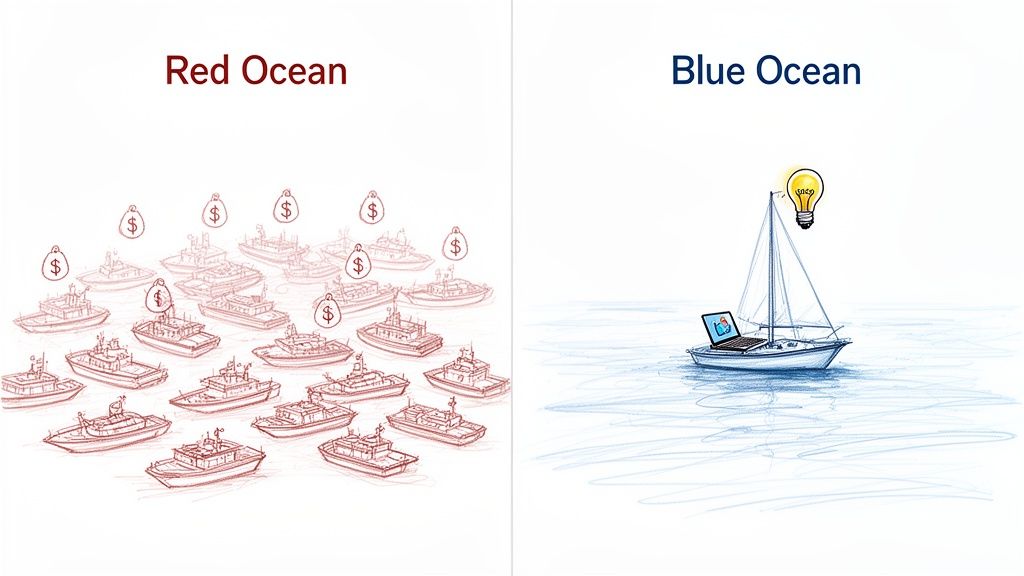
The core of Blue Ocean Strategi is simple: stop fighting in that crowded pond. Instead, go find—or better yet, create—your own pristine, well-stocked lake. This approach is all about redefining the market boundaries to unlock a whole new wave of demand by focusing on people who are currently being ignored.
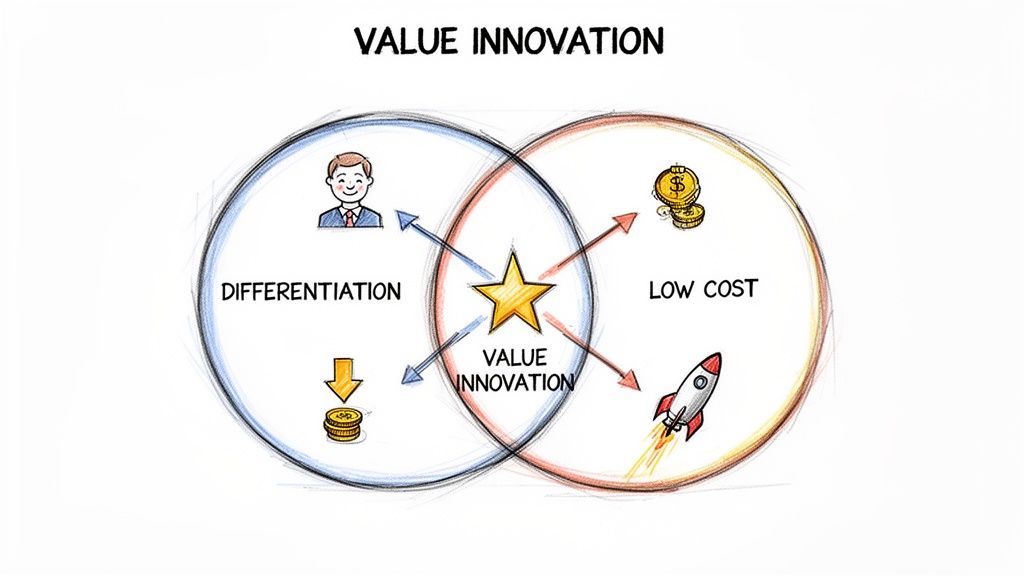
It all boils down to a principle called value innovation: the art of pursuing both differentiation and low cost at the same time. You’re not forced to choose between being unique or being affordable; you get to do both, creating a powerful new value proposition that your competitors can’t easily match.
“Think less about your current customers or employees and more about those you want to have as clients and staff. Consider the unmet needs of your current clients. What do they ask you for that you say: ‘We don’t do that.’ Maybe that is what you should do.”
This shift in mindset is a game-changer for indie hackers. Instead of building a slightly better or marginally cheaper version of a tool that already exists, you start looking for the “non-consumers.” Who is being priced out of the market? Who is underserved or stuck using clunky workarounds? Your blue ocean is waiting right there with them.
Red Ocean vs Blue Ocean At a Glance
To really get a feel for this, it helps to see the two strategies side-by-side. One is about winning a game where someone has to lose, while the other is about creating a whole new game where everyone can come out ahead.
Here’s a quick comparison to break it down.
| Characteristic | Red Ocean Strategy (Competition) | Blue Ocean Strategi (Creation) |
|---|---|---|
| Market Focus | Compete in existing market space. | Create uncontested market space. |
| Competitive Stance | Beat the competition. | Make the competition irrelevant. |
| Demand Approach | Exploit existing customer demand. | Create and capture new demand. |
| Value Proposition | Make the value-cost trade-off. | Break the value-cost trade-off. |
| Core Goal | Align with a strategic choice of either differentiation or low cost. | Align with the simultaneous pursuit of differentiation and low cost. |
This isn’t just some abstract business school theory; it’s a practical roadmap for smart, sustainable growth that doesn’t require a bottomless marketing budget. It’s about being clever, not just bigger.
Of course, some will argue there’s still plenty of opportunity in crowded businesses if you can carve out a unique angle. But for bootstrappers, understanding the principles of blue ocean thinking can be the key to building a profitable, defensible SaaS.
To see how this applies when you’re ready to launch, check out our deep-dive on building a go-to-market strategy that works.
Understanding Value Innovation: The Heart of Blue Ocean Strategy
At the core of every successful Blue Ocean Strategy lies a single, powerful idea: value innovation. It’s the engine that drives the whole approach. Forget the old-school rule that says you have to choose between being a premium brand or a budget-friendly one. Value innovation throws that rulebook out the window.
Instead of just tacking on more features or getting dragged into a race to the bottom on price, you focus on creating a massive leap in value for your customers. At the same time, you cut costs by ruthlessly eliminating or reducing the things your industry has been competing on for years. It’s a fundamental shift in perspective.
Think of it like this: the market is full of companies building slightly better, slightly more expensive mousetraps. Value innovation doesn’t inspire you to build a better mousetrap. It inspires you to create something that makes mice completely irrelevant in the first place. You’re not just tweaking the old solution; you’re redefining the entire problem.
Breaking the Value-Cost Trade-Off
Traditional competition—what we call a red ocean strategy—forces you into a corner. You can either deliver exceptional value at a high cost (the premium route) or offer decent value at a low cost (the cost-leader route). It’s a trade-off.
Value innovation makes that trade-off obsolete. You get there only when your entire system—utility, price, and costs—is perfectly aligned. This isn’t about small, incremental improvements. It’s about a complete rethink of what your buyers actually value and how you can deliver it efficiently, unlocking a brand-new market in the process.
And this isn’t just theory. A detailed study on manufacturing firms in South-East Nigeria, for instance, found that applying these principles had a statistically significant impact on reducing intense rivalry. By creating new market space through value innovation, these companies simply stepped away from the cut-throat competition.
Value Innovation in Action for SaaS
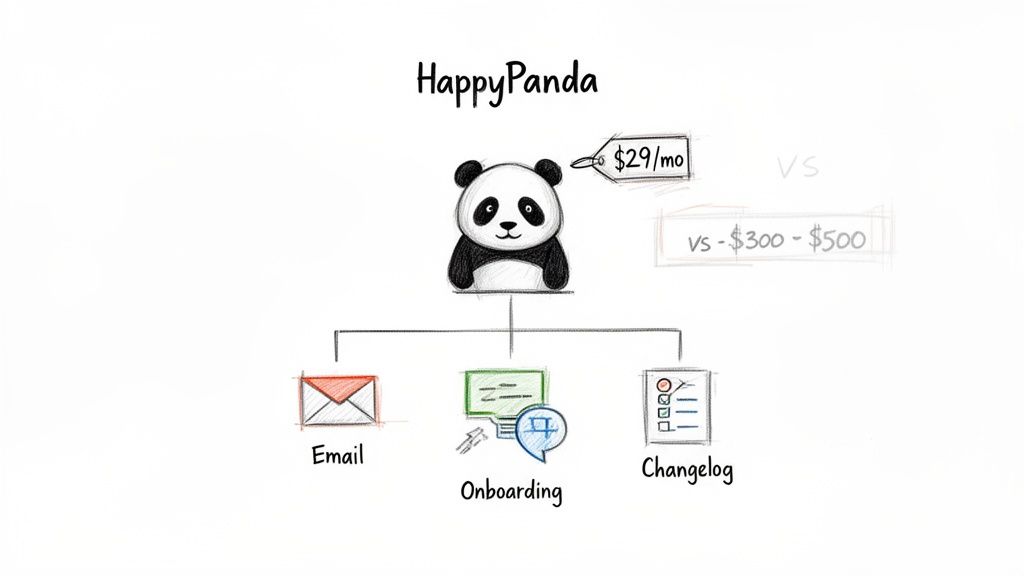
Let’s bring this down to earth with a SaaS example. Look at the ridiculously crowded market for customer communication tools. The “red ocean” is churning with companies selling separate, expensive tools for email marketing, user onboarding, feedback collection, and changelogs. A bootstrapped founder might have to stitch together four or five of these, easily costing $300-$500 per month.
A value innovation play doesn’t try to build a slightly cheaper email tool. It doesn’t create a slightly fancier onboarding widget. It steps back and re-examines the real problem for the bootstrapped founder: overwhelming complexity and crippling costs.
The goal of value innovation is to align innovation with utility, price, and cost positions. If you fail to anchor innovation with value, technology innovators and market pioneers often lay the eggs that other companies hatch.
This is exactly the thinking behind HappyPanda. It creates a huge leap in value by pulling all these essential communication tools into a single, seamless platform. That’s the differentiation.
At the same time, it slashes costs by getting rid of the need for multiple subscriptions and messy integrations. Offering this entire suite for one simple, low price (starting at $29/month) is the low-cost piece of the puzzle.
This combination of high value and low cost opens up a blue ocean. It speaks directly to bootstrappers and indie hackers who were previously priced out of the market or stuck with clunky, disconnected systems. The competition isn’t another email tool. The competition is the messy, expensive tech stack that HappyPanda makes irrelevant. That’s the goal.
To get better at spotting these kinds of customer needs, check out our guide on the process of continuous product discovery.
Using the Four Actions Framework to Reshape Your Market
So, how do you actually do Blue Ocean Strategy? Moving from a cool idea to something you can put into action needs a practical tool. That tool is the Four Actions Framework.
Think of it as a structured way to challenge all the “rules” everyone in your industry just accepts without thinking. It’s the engine that powers every successful blue ocean strategy, designed to help you stop making the tired old trade-off between value and cost. Instead of trying to be slightly better than the next guy on the same old features, it pushes you to rewrite the game completely.
It all boils down to answering four simple but powerful questions. Get these right, and you’ll carve out a fresh value curve, creating a market space where the old competition just doesn’t matter anymore.
Eliminate Factors the Industry Takes for Granted
First up, you need to question everything. What are the things your industry has been competing on for years that don’t actually add much value to customers anymore? Often, these are legacy features or services that bloat your costs but don’t move the needle for your users.
For a bootstrapped SaaS founder, this is your secret weapon for slashing costs. For instance, the established SaaS world often assumes that complex, enterprise-level integrations are non-negotiable. We at HappyPanda took a hard look at this and realised our target audience—indie hackers and solo founders—cared way more about simplicity and speed than connecting to a dozen obscure enterprise systems.
By eliminating the need for those complicated third-party integrations, HappyPanda didn’t just simplify the product; it massively cut down on development and maintenance overhead.
Reduce Factors Well Below the Industry Standard
Next, find the things that have been over-engineered to death in the endless race to one-up competitors. Are there features so packed with options they just confuse people? Are there service levels that are way too high (and expensive) for what your customer actually needs?
This is where you can trim the fat and pass the savings on. Many SaaS communication tools, for example, offer a dizzying array of niche templates and analytics dashboards that are total overkill for a solo founder.
HappyPanda decided to reduce the sheer number of features to a core, essential set. Instead of trying to win the “most complex analytics” award, we focused on delivering the most critical insights in a simple, easy-to-digest way. That directly translated into a lower monthly cost for our users.
The Eliminate-Reduce-Raise-Create (ERRC) Grid isn’t just some business school theory; it’s a hands-on framework for building a new market. It gives you a tangible way to apply value innovation and build a strategy that makes your competitors irrelevant.
Raise Factors Well Above the Industry Standard
While you’re cutting back in some areas, you need to go big in others. Pinpoint the biggest frustrations and pain points your industry has consistently ignored. What compromises are customers forced to make without even realising it?
This is your moment to deliver a massive leap in value. For bootstrapped founders, one of the biggest headaches is just getting started with new tools. The setup process for a typical software stack can be a soul-crushing slog that takes weeks.
HappyPanda chose to raise the ease of getting started far beyond anything on the market. By offering pre-built “recipes” like our ‘SaaS Starter Kit’, we cut the setup time from weeks to just 10 minutes. That intense focus on a critical pain point delivered huge value where it mattered most.
Create Factors the Industry Has Never Offered
Finally, what completely new sources of value can you introduce? This is about creating a new kind of utility for your customers, something that opens up a whole new world of demand. It’s often the most exciting and visible part of a blue ocean move.
The typical SaaS communication stack is a messy, fragmented puzzle. Founders are stuck manually connecting triggers and actions between different tools—a process that’s not only a time-suck but also incredibly error-prone. When you’re looking to truly shake things up, studying how others succeeded in creating a new market category can offer some fantastic lessons.
HappyPanda created a unified automation layer that ties all our tools together. An action in one part of the platform (like a user leaving positive feedback) can automatically trigger an action in another (like sending a request for a testimonial). This created a seamless, automated workflow that no single competitor could offer.
Here’s a practical look at how you can apply this thinking to your own SaaS, using the ERRC Grid.
Applying the ERRC Grid to a Bootstrapped SaaS
| Action | Guiding Question for Your SaaS | HappyPanda’s Blue Ocean Move |
|---|---|---|
| Eliminate | What features does the industry take for granted that my target niche doesn’t need? | Complex, third-party enterprise integrations. Our users value simplicity. |
| Reduce | Which features are over-engineered and can be simplified to lower costs and complexity? | Overwhelming analytics dashboards and dozens of templates. We focused on core insights. |
| Raise | What’s a major pain point my niche faces that I can solve 10x better than anyone else? | The painfully slow setup time for new tools. We cut it down to 10 minutes with starter kits. |
| Create | What entirely new feature or value can I offer that the industry has never seen? | A unified automation layer that connects our tools, creating seamless internal workflows. |
This grid isn’t just a checklist; it’s a roadmap. It forces you to think differently and build something that doesn’t just compete, but creates its own space to thrive.
Real-World Blue Ocean Success Stories
Theory is one thing, but seeing a blue ocean strategy in action is where the real learning happens. To truly understand its power, we need to look at companies that didn’t just compete harder—they changed the entire game. These stories prove that creating a new market isn’t about having the biggest budget; it’s about a fundamental shift in perspective.
While the usual suspects like Cirque du Soleil or [yellow tail] wine are often trotted out, the story of AirAsia offers a much more powerful and direct parallel for any bootstrapped SaaS founder looking to shake up a legacy industry.
AirAsia: Taking Flight in a New Market
Before AirAsia’s relaunch in 2001, flying in Asia was mostly for the wealthy. The market was a classic red ocean, with established, full-service airlines battling over the same pool of business and premium leisure travellers. They were all competing on perks like airport lounges, multi-class seating, and fancy in-flight meals—all of which drove up costs and ticket prices.
Meanwhile, the vast majority of the population—people who relied on slow, uncomfortable buses and trains for long-distance travel—were simply considered non-customers. The industry just assumed they couldn’t afford to fly.
This is exactly where AirAsia created its blue ocean. Instead of trying to steal customers from Malaysia Airlines, it went after this enormous, overlooked group of non-customers. Its new value proposition was radical: what if flying could be as affordable and straightforward as taking the bus?
To pull this off, AirAsia used the Four Actions Framework to completely rethink its business model.
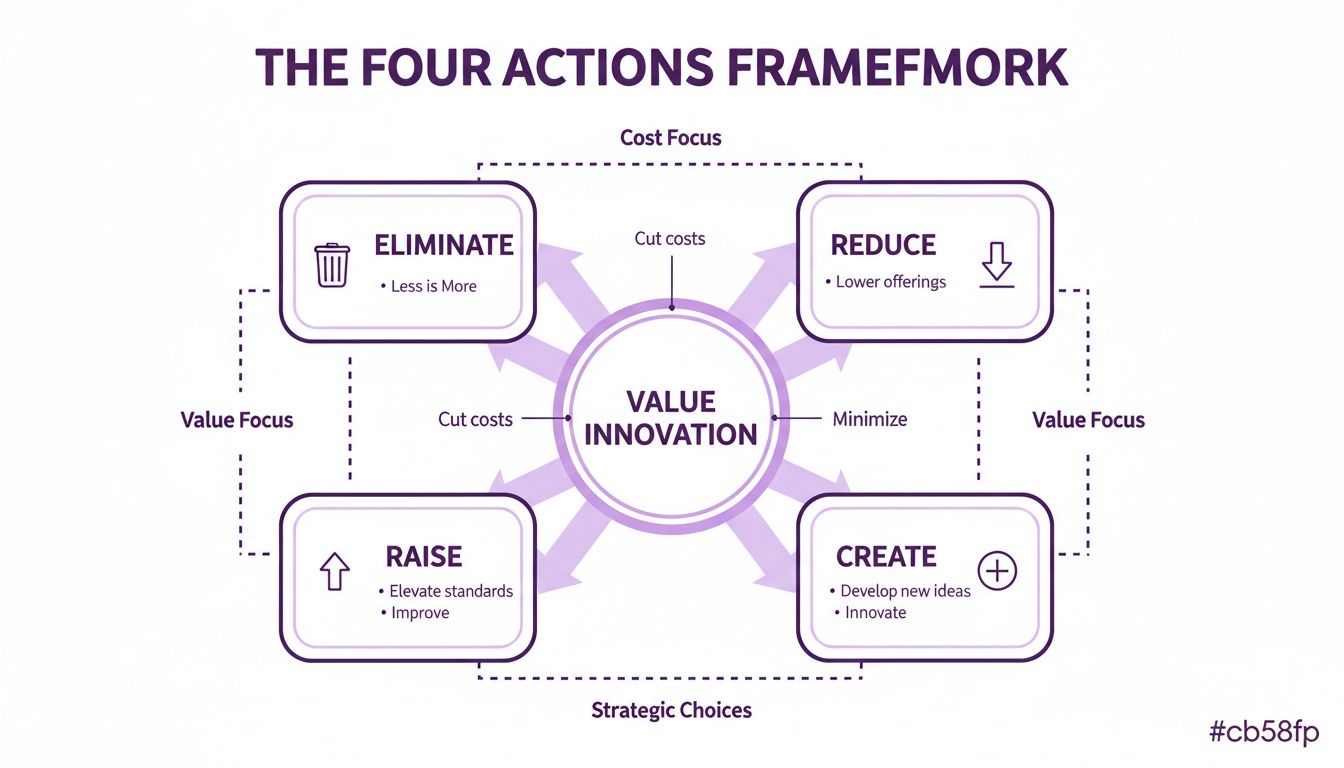
This framework is all about asking four simple but powerful questions to challenge industry norms. By systematically applying these actions, companies can break the tired old value-cost trade-off and make the competition irrelevant.
AirAsia’s Four Actions in Practice
AirAsia’s strategy was a masterclass in value innovation. They meticulously cut costs on things their new audience didn’t care about, while doubling down on what truly mattered to them.
- Eliminate: They got rid of assigned seating, airport lounges, and free in-flight meals. These were standard industry perks but were totally irrelevant to a price-sensitive customer who just wanted to get from point A to point B.
- Reduce: All the extra service frills were drastically cut. They even simplified their fleet to a single aircraft model (the Airbus A320) to slash maintenance and training costs. This laser focus on efficiency was everything.
- Raise: So what did they amplify? Flight frequency and convenience. By pioneering point-to-point routes and using less congested secondary airports, they made travel faster and more accessible than ever before.
- Create: AirAsia created an entirely new model of no-frills, ticketless, low-cost air travel. They were among the first to push online booking heavily, which cut distribution costs and put the power directly into consumers’ hands.
The results were stunning. AirAsia didn’t just offer slightly cheaper tickets; it slashed economy fares by up to 70% compared to its rivals. This move created a whole new uncontested market, rocketing passenger numbers from almost nothing to over 60 million annually by 2019 and capturing a whopping 60% market share on domestic routes. You can find more insights into AirAsia’s strategy on Paperballad.
The core lesson from AirAsia is profound: they didn’t just sell cheaper plane tickets. They created a new market by turning the non-customers of an existing industry into the customers of a new one.
For a SaaS founder, the parallel is crystal clear. Don’t just build a cheaper version of an existing tool. Instead, look for the non-customers—the people who are currently priced out, underserved, or stuck wrestling with messy spreadsheets. That’s where your blue ocean is waiting.
How HappyPanda Can Enable Your Blue Ocean Move
Moving from the theory of a blue ocean strategy to actually creating one can feel like a massive leap. This is where the right tools stop being just another expense and become the engine that gets you there. For bootstrapped SaaS founders, HappyPanda isn’t just another piece of software; it’s designed to help you execute a Blue Ocean move without needing a venture-backed budget.
The platform itself is a bit of a Blue Ocean play. Instead of forcing you to fight in the red ocean of expensive, fragmented tool stacks, it gives you everything you need to create a superior, unified customer experience at a fraction of the cost.
Consolidating Your Tech Stack to Free Up Resources
The first step in any value innovation is figuring out what to reduce and eliminate. The typical SaaS communication stack is a perfect example of a bloated, costly red ocean. Founders are often forced to pay for and stitch together separate tools for emails, onboarding, feedback, and changelogs, easily spending $300-$500 per month. This doesn’t just drain your bank account; it drains your most valuable asset: time.
HappyPanda changes this equation completely.
- It Eliminates Complexity: By bringing these functions into one platform, you can say goodbye to the integration headaches and maintenance that come with managing four or five different tools.
- It Reduces Costs: Instead of juggling multiple subscriptions, you have one affordable price point starting at just $29/month. This frees up hundreds of dollars every month that you can pour back into your product.
This consolidation is the first critical step. It lets you shift your focus from wrestling with a messy tech stack to actually building a better product and exploring that new market space.
Differentiating Through a Superior Customer Experience
With your resources freed up, HappyPanda then helps you raise and create new value for your customers. A smooth, cohesive customer journey is a powerful differentiator, especially when your competitors are delivering a disjointed experience through a patchwork of tools.
This is where HappyPanda’s unified automation layer becomes your secret weapon. You can build seamless workflows that competitors simply can’t replicate without a team of engineers.
By focusing on the unmet needs of an overlooked market—bootstrappers who value simplicity and affordability—HappyPanda provides the tools to create a differentiated experience that makes expensive, complex alternatives irrelevant.
For instance, you could set up a powerful, interconnected automation like this:
- A user gives you a high NPS score through a feedback widget.
- HappyPanda automatically triggers an email asking them for a testimonial.
- Once submitted, the testimonial can be approved and instantly displayed on your Wall of Love.
This entire sequence runs on its own, creating a delightful experience for your happiest customers while saving you hours of manual work. To get a better handle on gathering that initial feedback, you can learn more about crafting effective user surveys.
This is what it looks like in action. HappyPanda’s automation layer connects all your different customer communication tools into one unified workflow.
This visual builder is key to creating new value. It lets founders design sophisticated customer journeys without writing a single line of code.
Launching Faster with Pre-Built Blue Ocean Recipes
Finally, making a successful Blue Ocean move requires speed. You need to get your value innovation into the hands of your target non-customers quickly to test, learn, and iterate. This is another area where the friction of a traditional tool stack holds founders back.
HappyPanda tackles this with features like the ‘SaaS Starter Kit’. These are pre-built “recipes” that bundle together the essential email sequences, onboarding checklists, and feedback surveys you need to launch a new product. Instead of spending weeks setting up your communication stack, you can get everything live in about 10 minutes.
This speed is a massive strategic advantage. It allows you to:
- Test new ideas rapidly without a huge upfront investment of time or money.
- Target underserved niches with tailored onboarding and communication flows.
- Focus on product-market fit instead of getting bogged down in tool configuration.
By providing these foundational pieces out of the box, HappyPanda lowers the barrier to entry for creating new value. It gives bootstrapped founders the agility and efficiency needed to find and dominate their own uncontested market space, turning the principles of a blue ocean strategy into something you can actually do.
Stumbling Blocks on the Way to Your Blue Ocean
Setting sail on a blue ocean strategi is a brilliant move, but the waters are full of common traps that can sink even the most promising ventures. Dodging these is the difference between a clever idea and a market-dominating business. One of the biggest slip-ups? Mistaking a simple niche for a true blue ocean.
A niche strategy is about carving out a tiny, well-defended corner of a bloody red ocean. Think of a CRM built just for plumbers—that’s a niche play. A blue ocean, on the other hand, doesn’t fight for existing customers. It creates an entirely new market by roping in non-customers, the people who weren’t using a CRM at all because the current options were too bloated or expensive. It’s about redrawing the map, not just claiming a small island.
Getting Dazzled by “Create” and Forgetting to “Eliminate”
Another classic blunder is getting fixated on the shiny parts of the Four Actions Framework—“Raise” and “Create”—while completely ignoring “Eliminate” and “Reduce.” It’s fun to dream up cool new features the industry has never seen, but that’s only half the story of value innovation.
The real breakthrough happens when you slash costs by axing features and services everyone else takes for granted. When you forget to trim the fat, you end up with a product that’s different, sure, but not necessarily cheaper or simpler. You’ve just built a more complicated, expensive gadget that struggles to find an audience, failing to unlock that massive new demand you were chasing.
The magic of a blue ocean move isn’t just in what you add; it’s in having the guts to remove what everyone else considers essential. This strategic subtraction is what funds your innovation and makes your offer a no-brainer.
Chasing the Wrong Non-Customers
Finally, your strategy can fall flat if you don’t really get who your non-customers are. It’s not enough to know who isn’t buying from your competitors; you have to dig into the why.
There are three tiers of non-customers out there:
- “Soon-to-be” non-customers: These folks are at the edge of the market, using current solutions out of pure necessity but are itching to jump ship.
- “Refusing” non-customers: This crowd has taken a hard pass on the market’s offerings, finding them too pricey or overly complex for their needs.
- “Unexplored” non-customers: These people are in completely different markets and have never even been on the industry’s radar.
Imagine a SaaS founder targeting freelancers (“refusing” non-customers) who find project management tools too corporate. If you build for them without understanding their actual workflow—which is probably a chaotic mix of spreadsheets and notebooks—your “simple” solution might still feel like overkill. A winning blue ocean strategi is built on deep empathy for these overlooked groups, creating something they find truly irresistible.
Got Questions? We’ve Got Answers
Blue Ocean Strategy vs. Market Disruption: What’s the Difference?
It’s easy to mix these two up, but they’re really playing different games. While both can shake up an industry, their core philosophies are miles apart. A blue ocean strategy is all about making the competition irrelevant. You’re not trying to beat the other players; you’re creating a brand-new game in an empty stadium.
Market disruption, on the other hand, is a direct attack. It’s about storming the existing stadium and stealing the crown from the reigning champs, usually by offering something simpler or cheaper. One creates a whole new pond; the other wins the fight in the old one.
Can a Solo Founder Really Create a Blue Ocean?
Absolutely. This is one of the biggest misconceptions. Blue Ocean is about the quality of your thinking, not the size of your bank account. It’s about spotting a unique angle and pursuing value innovation—not outspending your rivals in an endless feature war.
For bootstrapped founders, this is a massive advantage. You don’t have to play by the established rules. Tools like HappyPanda help level the playing field, making it possible for a one-person show to deliver incredible value to an overlooked customer segment without needing a huge team or a venture capital war chest.
Is It a Blue Ocean… or Just a Bad Idea?
Great question. The line between genius and madness can feel thin sometimes. A true blue ocean idea pulls off two things at once: it genuinely excites a new group of customers and it’s backed by a business model that’s both viable and low-cost. A bad idea? It usually only has one of those things, or worse, neither.
The best way to tell the difference is to test both sides of the coin. First, validate the value proposition. Get out there and see if non-customers actually want what you’re offering. Then, validate the profit model. Can you actually deliver this at a price that unlocks all that new demand and still make money? If the answer to both is yes, you’re on the right track.
Ready to stop fighting in crowded red oceans and start building your own uncontested market? HappyPanda provides the all-in-one customer communication platform to help you create a superior experience and make your competition irrelevant. Start your free trial today.