
Before you can build a strategy to reduce customer churn, you need to become an expert on why customers are leaving in the first place. Simply tracking your churn rate isn’t enough; that’s like knowing you have a fever without knowing what’s causing it. The real, gritty work is in the diagnosis.
Understanding Why Your Customers Really Leave
This process, often called a root-cause analysis, is about uncovering the real story buried in your numbers. It’s what moves you from frantically reacting to individual cancellations to proactively fixing the systemic issues that cause them. It’s a game-changer.
After all, nearly 70% of customers leave because they believe a company just doesn’t care about them—a feeling often rooted in unresolved friction points they’ve experienced along the way.
Digging Deeper Than Surface Metrics
Your churn rate tells you what happened, but it doesn’t give you the juicy details on why. To get to that “why,” you need to blend your quantitative data with actual human insights. This means looking at user behaviour right alongside their direct feedback.
Start by asking some targeted questions about your churned accounts:
- When did they leave? Is there a drop-off cliff after the free trial ends? Within the first 30 days? Or is it a slow burn that happens around the six-month mark? A huge churn spike right after onboarding is a classic sign that users never hit their “aha!” moment.
- Who are they? Are you losing more customers from a particular industry, a certain company size, or who signed up through a specific marketing channel? These segments tell a story.
- What did they do (or not do)? Inside your product, what was their behaviour like? Did they never adopt that one sticky feature that correlates with long-term retention? Were their login frequencies dropping off a cliff for weeks?
For instance, a project management tool might discover that users who never create more than one project board churn at a staggering rate of 80% within their first month. That’s not a pricing problem; it’s a product adoption problem. Suddenly, they have a crystal-clear target for their onboarding and customer success efforts.
Uncovering Qualitative Insights
Data shows you the patterns, but only conversations can tell you the full story. You can’t truly understand the friction in your customer journey without hearing directly from the people who lived it. For a deeper dive, this proactive churn marketing guide is fantastic for diagnosing churn signals before they become a problem.
The real danger isn’t hearing complaints. It’s not hearing them at all. Research shows that only 1 in 26 unhappy customers actually complain. The rest just quietly disappear.
Don’t just rely on automated exit surveys. They’re a good starting point, but they often lack the context you really need.
- Conduct Exit Interviews: Whenever possible, pick up the phone and call a recently churned customer. Seriously. A five-minute chat can provide more actionable insights than a hundred survey responses. Ask open-ended questions like, “What were you hoping to achieve that you couldn’t?” or “Was there a specific moment you realised this wasn’t the right fit?”
- Analyse Support Tickets: Your support chat and email logs are an absolute goldmine. Look for recurring complaints, feature requests, or points of confusion among accounts that eventually churned. These interactions are often the earliest warning signs of dissatisfaction.
By combining the “what” from your data with the “why” from these human stories, you build a complete picture of customer churn. This isn’t just some academic exercise; it’s the strategic foundation for every retention tactic that follows. You’ll stop guessing and start implementing solutions that directly address the real reasons your customers leave.
Getting Ahead with Proactive Retention Tactics
Let’s be honest: reacting to churn is a losing game. By the time a customer hits that cancel button, you’re already on the back foot. The real victory lies in making sure they never even consider it.
Proactive retention is all about building a customer experience so valuable and seamless that leaving feels like a bad move. It’s a shift in mindset—moving away from frantic “please don’t go!” emails and toward a deliberate strategy of engagement and value, starting from the moment a customer signs up.
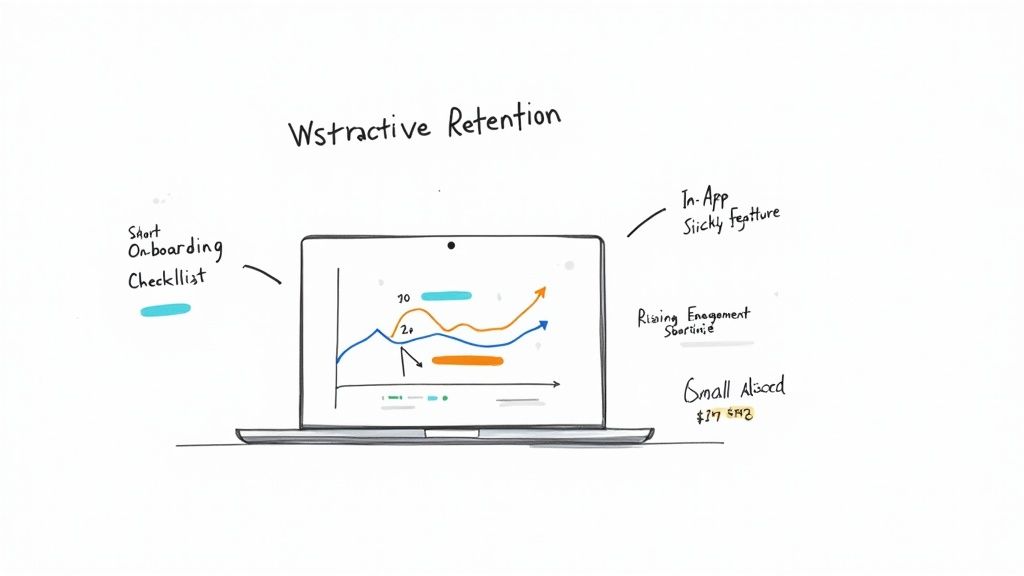
This means designing an onboarding process that delivers an “aha!” moment instantly, not weeks later. It also means digging into your product analytics to figure out what your most successful customers are doing and then gently nudging everyone else down that same path. Get ahead of the problems, and you’ll find churn starts to take care of itself.
Nail the First Impression with Flawless Onboarding
The first 30 days of a customer’s journey are make-or-break. A clunky, confusing, or underwhelming onboarding experience is one of the biggest reasons for early churn. If users don’t quickly grasp the value your product brings to their life, they’ll simply move on.
Your goal here is to get them to their first “quick win” as fast as possible. Think of it less like a product tour and more like a guided mission to success.
A great onboarding experience usually includes:
- A Clear Welcome Series: Not just a single “hello” email, but a sequence of messages guiding users toward high-value actions. For a project management tool, the first email might prompt them to create a project, the second to invite a teammate, and the third to assign their first task.
- Interactive Walkthroughs: Ditch the passive video tours. Use in-app guides that get users clicking and completing actions themselves. This hands-on approach builds muscle memory and confidence right from the start.
- Personalised Checklists: Tools like HappyPanda can help you create dynamic onboarding checklists that track progress and celebrate small wins. It gives users a real sense of momentum and accomplishment.
Remember, onboarding isn’t about showing off every feature. It’s about helping customers solve their problem as quickly as possible.
Drive Adoption of Your Stickiest Features
Every SaaS product has them: “sticky” features. These are the ones that, once a customer starts using them, make your product utterly indispensable. They’re the features that correlate most strongly with long-term retention. Your job is to identify them and then get people using them.
For instance, a social media scheduling tool might discover that users who connect more than three social accounts and set up at least one automated posting rule have a 90% lower churn rate. That’s your golden ticket right there.
The real goal isn’t just to get users to log in; it’s to get them deeply integrated into the workflows that provide the most value. Simply measuring daily active users can be a vanity metric if those users aren’t engaging with the features that create loyalty.
Once your analytics point to these key features, build campaigns around them. This could be as simple as an in-app prompt for users who haven’t tried a feature yet, or a targeted email campaign showcasing how power users get the most out of it. To really get ahead, you can even explore customer churn prediction to spot at-risk users before they drift away.
Comparing Proactive Churn Reduction Tactics
Deciding where to focus your efforts first can be tricky. Each tactic targets a different part of the customer journey and requires a different level of investment. Here’s a quick breakdown to help you prioritise.
| Tactic | Primary Impact Area | Effort Level | Key Metric to Track |
|---|---|---|---|
| Onboarding Optimisation | Early-stage retention (first 30-60 days) | Medium | Time-to-value, activation rate |
| Sticky Feature Adoption | Long-term engagement and loyalty | High | Feature adoption rate, DAU/MAU ratio |
| Pricing Alignment | Perceived value and user satisfaction | High | Churn by pricing tier, upgrade/downgrade rate |
| Customer Success Outreach | Relationship building, identifying friction | Medium | Health score, NPS/CSAT |
Ultimately, the best strategy often involves a mix of these tactics. Start with the area that seems to be causing the most friction for your users and build from there.
Align Your Pricing with Customer Value
Pricing isn’t just a number on a page; it’s a direct signal of your product’s value. When there’s a mismatch between what customers pay and what they feel they’re getting, churn is inevitable. Customers who feel they’re overpaying for a bunch of features they never touch will eventually start shopping around.
Make a habit of reviewing your pricing and packaging. Do your tiers still make sense for your target customer? Do they create a natural growth path, or does upgrading feel like a painful, expensive leap?
A classic mistake is forcing smaller customers onto a pricey plan just to access one or two critical features. Offering flexible add-ons or more granular tiers can be a powerful way to reduce churn. It allows users to pay only for what they need, which feels fair and builds a massive amount of trust.
Building a Customer Success Programme That Works
Your Customer Success (CS) team can be your most powerful retention engine, but only if it’s more than a glorified support queue. A reactive, ticket-based model just waits for problems to happen. A proactive CS programme stops them from ever starting.
It’s all about shifting from putting out fires to building fireproof relationships. This means partnering with customers to make sure they hit the goals they signed up for, turning your team from a cost centre into a revenue protection force.
Moving From Reactive Support to Proactive Partnership
The old way of thinking was simple: a customer has a problem, they file a ticket, you solve it. Done. The new model flips this entirely. Proactive CS is about spotting potential friction points and opportunities for value before the customer even knows they exist.
This isn’t about random check-ins. It demands a strategic approach, defining key moments for intentional conversations and business reviews. You stop asking, “Is everything okay?” and start asking, “How can we help you crush your next goal?” This one change reframes the entire relationship from a simple vendor to a strategic partner.
A study from Harvard Business School found that a mere 5% increase in customer retention can boost profits by as much as 95%. It’s a staggering number that really hammers home the financial power of ditching reactive support for a proactive success partnership.
Developing a Customer Health Score
You can’t be proactive without an early-warning system. This is where a customer health score comes in, and frankly, it’s non-negotiable. It’s a metric, often shown as a simple colour (green, yellow, red), that pulls together multiple data points to give you an at-a-glance read on an account’s stability.
Think of a robust health score as your churn radar, flagging at-risk accounts long before they go quiet.
Key inputs for a reliable health score usually include:
- Product Usage Data: How often are they logging in? Are they using your stickiest, highest-value features? A sudden drop in activity is a classic red flag.
- Support Ticket Volume: A big spike in support tickets can signal frustration. On the flip side, complete radio silence from a new account might mean they aren’t engaged enough to even ask for help.
- Survey Responses: Metrics like Net Promoter Score (NPS) and Customer Satisfaction (CSAT) give you a direct line into how customers are feeling. A detractor NPS score should immediately trigger a follow-up.
- Engagement with CS: Are they showing up for webinars? Opening your emails? Actually responding to check-ins from their Customer Success Manager (CSM)?
Once an account’s health score dips into “yellow” or “red,” it should automatically kick off a pre-defined playbook for your CS team, ensuring a swift, strategic intervention.
Scripts and Templates for Proactive Outreach
Knowing when to reach out is only half the battle. Knowing what to say is just as important. Arming your team with proven scripts and templates ensures every interaction is consistent, valuable, and moves the needle.
For instance, here’s a proactive email for a customer whose health score has dropped due to low product usage:
Subject: Quick question about your [Product Name] goals
Hi [Customer Name],
Just checking in from the team here at [Your Company]. I noticed you haven’t had a chance to [use key feature X] yet, which many of our top users rely on to achieve [specific outcome].
Do you have 15 minutes next week for a quick call? I’d love to share a few best practices that could help you get to your goals faster.
See? It isn’t accusatory; it’s helpful. It repositions the conversation around their success, not their lack of activity. Having a library of these resources stops your team from reinventing the wheel and empowers them to act decisively.
Running High-Impact Quarterly Business Reviews
For your most valuable customers, the Quarterly Business Review (QBR) is the cornerstone of a proactive partnership. Let’s be clear: this is not a sales pitch. It’s a strategic session dedicated entirely to the customer’s progress, challenges, and future goals.
An effective QBR should always cover these bases:
- Recap Past Wins: Kick things off by reminding them of the value they’ve already received. Use their data to show progress against the goals they set last quarter.
- Analyse Current Usage: Share insights on how their team is using the product. Highlight areas of high adoption and gently point out underused features that could unlock even more value.
- Align on Future Goals: This is the most critical part. Dig into their business objectives for the upcoming quarter and collaboratively map out how your product will help them get there.
A well-run QBR cements your role as an essential partner and makes it incredibly difficult for a competitor to get a foot in the door. By consistently proving and expanding your value, you transform a simple subscription into an indispensable alliance. To learn more about building out these processes, check out our complete guide to customer success for SaaS. It provides a deeper blueprint for turning your team into a retention powerhouse.
Using Customer Feedback to Fuel Your Strategy
If you want to get serious about reducing churn, you have to stop guessing what customers want. The most powerful retention strategies aren’t built on assumptions; they’re fuelled by a constant, automated flow of real customer feedback. It’s about building a system that listens at scale.
This turns feedback from a dusty, passive suggestion box into an active, early-warning system. It means you’re capturing insights at the most critical moments—like right after a user hits “cancel subscription” or just after they’ve chatted with your support team. These are the moments of truth where feedback is most honest and, more importantly, actionable.
Creating Automated Feedback Loops
The goal here is to build a virtuous cycle where feedback directly informs your next move.
Imagine a user cancels, telling you your UI is clunky. In a manual setup, that gem of insight probably gets lost in a spreadsheet, never to be seen again. With an automated feedback loop, that cancellation reason could instantly create a ticket in your product team’s backlog.
Suddenly, there’s direct accountability. You’ve just shortened the distance between a customer’s pain point and a developer’s to-do list. The same logic applies everywhere else.
- Post-Support CSAT Surveys: A low satisfaction score after a support ticket can trigger an immediate follow-up from a customer success manager. No more letting frustrations simmer.
- Pricing Feedback: When users mention pricing in surveys, that data should be automatically routed to the team hashing out your next packaging and marketing strategy.
- Feature Requests: Don’t let great ideas die in an inbox. Route them to a public roadmap or a feature voting board to show users you’re listening and help you prioritise what to build next.
This systematic approach makes sure every piece of feedback has a home and a purpose, turning raw data into real product improvements. For a deeper look at the tools that can make this happen, check out our breakdown of the best customer feedback tools to find the right one for your stack.
From Insight to Action
Gathering feedback is just step one. The real magic happens when you connect those insights to specific, automated actions. This is where a unified platform becomes your best friend, letting you trigger workflows based on customer responses without needing a team of engineers to stitch everything together.
By systematically collecting and acting on feedback, you’re not just solving individual problems. You’re building a customer-centric culture that continuously refines the user experience, making your product stickier and more resilient to churn.
A tool like HappyPanda, for instance, helps orchestrate these connections without breaking a sweat. You can set up simple rules like, “If a user gives a Net Promoter Score (NPS) of 9 or 10, automatically send them a request to leave a public testimonial.” Just like that, you’re capitalising on positive vibes the moment they happen.
On the flip side, if a user drops a low score, you can trigger an internal alert for your success team to reach out personally. That proactive touch can turn a detractor into a loyal fan, simply by showing you’re paying attention and care enough to do something about it.
This simple diagram shows the flow of a solid proactive strategy: it all starts with monitoring health scores, which leads to proactive outreach, and culminates in strategic business reviews.
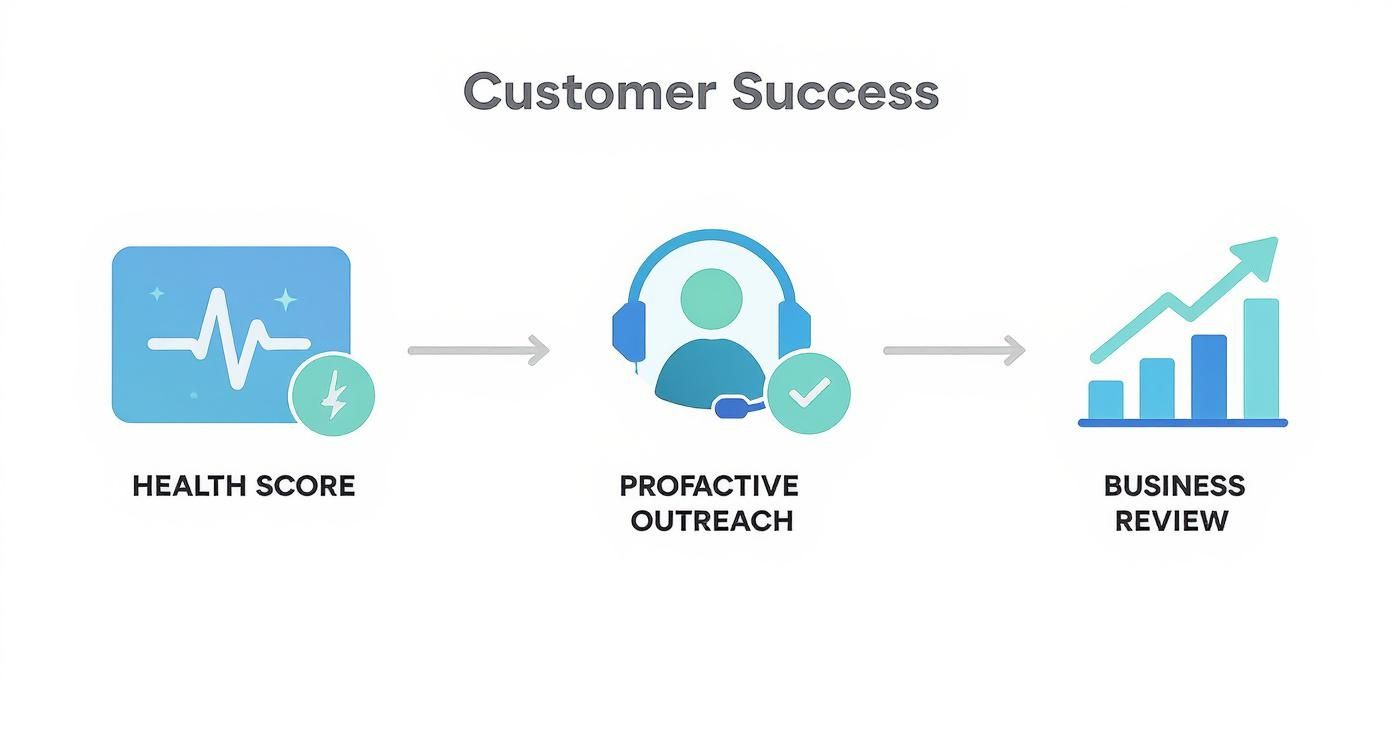
This process visualises how systematic monitoring and engagement directly improve customer relationships and stop churn in its tracks.
When you turn your customer communication into an intelligent, automated system, you move beyond just collecting data. You start anticipating needs, solving problems before they escalate, and building a product that reflects what your users actually want. That constant refinement is your ultimate defence against churn.
Measuring What Matters for Retention
You can’t fix what you don’t measure. After you’ve rolled out your proactive retention tactics and polished up your customer success programme, you need a clear way to see if any of it is actually working. This isn’t about chasing vanity metrics; it’s about connecting your team’s effort directly to results that keep everyone accountable and leadership in the loop.
To get this right, you’ll need to track both leading and lagging indicators. Lagging indicators, like your overall customer churn rate, are the final score. They’re crucial, but they’re slow to move.
Leading indicators are your early-warning system. They give you a real-time pulse on customer health and signal future churn, giving you a chance to step in before it’s too late.
Key Performance Indicators to Monitor
Your retention dashboard should tell a complete story, not just show a bunch of disconnected numbers. My advice is to focus on a handful of KPIs that genuinely reflect how engaged and happy your customers are.
Here are the essentials to get you started:
- Product Adoption Rate: This isn’t just about logins; it’s about how many users are actively using your most important features. If no one is touching those “sticky” features you spent months building, that’s a massive red flag.
- Customer Health Score: This is a composite score that rolls up usage data, support ticket volume, and survey feedback into one easy-to-read metric (think Red, Yellow, Green). It’s your at-a-glance gut check.
- Net Promoter Score (NPS) and CSAT: These surveys give you a direct line into customer sentiment. A sudden drop in NPS from a key account should set off alarm bells and trigger an immediate follow-up from your team.
For a deeper dive into how these survey metrics play together, check out our guide on the differences between CSAT and NPS.
A great product alone isn’t enough anymore. The entire digital experience—from the first moment of onboarding to the hundredth support ticket—has to be seamless. A clunky interface is a primary driver of churn, even in traditional industries.
This is especially true in fast-growing markets. In Southeast Asia, for example, digital-only banks have hit churn rates as low as 10.8%. That blows away the 19.2% churn rate for retail banks in North America, and the main reason is a far superior digital customer experience. You can see more on these banking customer retention statistics and how the lessons apply across the board.
Using A/B Testing for Data-Backed Decisions
Stop guessing which of your retention ideas will work. Start testing them. A/B testing lets you make decisions based on cold, hard data by comparing different approaches to see which one actually moves the needle.
Let’s say you’re trying to win back at-risk users. You could test two different offers:
- Group A: Gets a 20% discount for the next three months.
- Group B: Gets a free 30-minute strategy call with a customer success manager.
By tracking the churn rate for each group, you might find that the personalised help offered to Group B is way more effective than a simple discount. That kind of insight is gold. Run these experiments constantly to fine-tune your playbooks and systematically chip away at your churn rate.
Your Burning Questions About Churn, Answered
Even with a solid playbook, some questions about churn always pop up. Let’s tackle the big ones head-on with some straight-talking, practical answers to help you keep more of your hard-won customers.
What Is a Good Customer Churn Rate?
This is the million-dollar question, and the honest answer is: it depends. A “good” churn rate isn’t some universal number you can just pluck from the air. It really comes down to who you’re selling to.
If you’re in the SaaS game serving small to medium-sized businesses (SMBs), a monthly churn rate of 3-5% is generally seen as acceptable. But if you’re working with large enterprise clients, that target needs to be way, way lower—ideally under 1%.
The most important benchmark, though? Your own history. Forget obsessing over industry averages for a minute. Your real goal should be to see a consistent downward trend in your churn rate, month after month. That continuous improvement is what really signals a healthy business.
How Do You Predict Which Customers Might Churn?
Predicting churn is all about swapping guesswork for data. The best way to do this is by creating a “customer health score.” Think of it as an early-warning system that flags at-risk accounts before they go completely quiet.
It’s not as complicated as it sounds. You just need to track a few key indicators:
- Product Usage Frequency: Are they logging in less often? A sudden drop-off is a classic red flag.
- Feature Adoption Depth: Are they using the “sticky” features that deliver long-term value, or just scratching the surface?
- Support Ticket Volume: A sudden spike in support tickets can be a sign of growing frustration.
- Survey Feedback: A low Net Promoter Score (NPS) or CSAT score is basically a customer raising their hand to say they’re unhappy.
When you see a dip in any of these areas, it gives your customer success team a perfect reason to reach out proactively. It’s your chance to turn a potential churn into a saved account.
What Is the Difference Between Voluntary and Involuntary Churn?
Getting this distinction right is critical because you can’t solve both problems with the same solution.
Voluntary churn is when a customer actively decides to hit the cancel button. Maybe they’re unhappy with the product, they found a better deal elsewhere, or their budget got cut. This is the kind of churn you fight with better onboarding, proactive support, and building a product they can’t live without.
Involuntary churn is completely different—it happens by accident. Almost every time, it’s because of a failed payment. An expired credit card, insufficient funds, a block from the bank. This silent killer can account for a shocking 20-40% of your total churn, but the good news is, it’s almost entirely preventable.
Tackling involuntary churn is often the quickest win you can get. Simple things like automated payment retries and sending notifications before a card expires can recover a huge chunk of revenue that would otherwise just disappear.
By understanding these nuances, you can stop fighting churn with a one-size-fits-all approach and start creating targeted, effective strategies that actually work.
Ready to turn customer feedback into your best retention tool? HappyPanda combines feedback collection, email sequences, and onboarding checklists into one simple platform. Start listening to your customers and stopping churn before it happens. Explore the platform at https://happypanda.ai.