
If you want to get serious about customer retention, you have to stop treating it like a vague goal and start treating it like a data-driven mission. It all begins with defining what success actually looks like for your SaaS and zeroing in on the metrics that genuinely move the needle, like Net Revenue Retention (NRR) and Customer Lifetime Value (CLV).
Once you get a handle on these numbers, you’ll have an honest, unfiltered look at your business’s health. More importantly, you’ll have a clear baseline to measure everything you do from here on out.
Building a Foundation for Stronger Retention

Before you start testing a dozen different tactics, you need to lay a solid, measurable foundation. Without it, improving retention is like navigating without a compass—you’ll be busy, sure, but you’ll have no idea if you’re actually getting anywhere. The aim here is to ditch the guesswork and build a strategy on hard data.
First things first: what does a “retained customer” even mean for your business? Is it someone who logs in every day? A team that consistently uses a core feature month after month? Getting this definition right is the first domino to fall.
Identifying Your Core Retention Metrics
Look, there are dozens of metrics you could track, but only a handful are non-negotiable for any SaaS team that’s serious about growth. Focusing on the right numbers helps you see the big picture without drowning in vanity metrics.
Your essential dashboard should include:
- Customer Retention Rate (CRR): This is the most direct measure of how well you’re holding onto your customers. It’s the percentage of users you keep over a specific period. Simple, but powerful.
- Customer Churn Rate: The flip side of CRR, this tells you the percentage of customers who are walking out the door. You have to know this number to start diagnosing why they’re leaving.
- Customer Lifetime Value (CLV): This is the total revenue you can expect from a single customer over their entire relationship with you. A rising CLV is a fantastic sign of a healthy, sticky product.
- Net Revenue Retention (NRR): This one goes beyond just keeping customers. It measures your ability to grow revenue from the customers you already have through upgrades, add-ons, and expansion. For any SaaS business, an NRR over 100% means you’re growing even without signing a single new customer.
Key Takeaway: Net Revenue Retention (NRR) is the gold standard for a reason. It rolls churned revenue and expansion revenue into one number, giving you a complete, honest picture of your customer base’s financial health.
Calculating and Interpreting Your Numbers
Knowing what to track is only half the battle. You also need to understand what the numbers are telling you. Let’s walk through a quick NRR calculation.
Imagine you kicked off the month with £100,000 in Monthly Recurring Revenue (MRR). Over that month, you lost £5,000 from churned customers, but you also gained £15,000 in expansion revenue from existing customers upgrading their plans.
Your NRR calculation would be: (£100,000 - £5,000 + £15,000) / £100,000. That works out to 110%.
That’s a powerful insight. It tells you that your existing customers are more than making up for any revenue you lost to churn. A killer customer success practice for SaaS is usually what’s driving this kind of healthy expansion.
Setting Realistic Benchmarks
Once you have your core metrics dialled in, the next question is always, “So… is that any good?” The honest answer is: it depends. It varies wildly based on your industry, who you sell to (SMB vs. Enterprise), and how long you’ve been around.
A venture-backed B2B SaaS company selling to enterprise clients might shoot for an annual churn rate below 5%. On the other hand, a B2C app with a lower price point might find a 5% monthly churn rate perfectly acceptable.
The trick is to research industry averages, but more importantly, to focus on beating your own numbers, month after month. To build a solid foundation for customer loyalty, you first need to explore different strategies to reduce churn rate and boost customer retention that actually fit your business model. This foundational knowledge is what lets you set achievable goals and measure what truly matters.
Diagnosing the Real Reasons Customers Leave
To really move the needle on retention, you need to put on your detective hat. Customers rarely leave out of the blue; there’s always a backstory. And while exit surveys give you a hint, the real, actionable insights are almost always buried a layer or two deeper.
Uncovering these root causes means blending hard data with actual human stories. The goal is to get past your own assumptions and build an evidence-backed case for why churn is happening. Just guessing that your pricing is off or a competitor is stealing your lunch will send you chasing ghosts. Instead, you need to dig into what your customers do and what they say.
Uniting Quantitative and Qualitative Data
Your investigation starts by looking at two different, but equally important, types of information: quantitative and qualitative data. Think of them as the “what” and the “why” of customer churn.
- Quantitative Data (The What): This is all the numerical evidence you can pull from your product analytics. It shows you patterns in user behaviour—things like which features get ignored, where people get stuck, or if there’s a big drop-off in activity after a certain number of days.
- Qualitative Data (The Why): This is the human context behind all those numbers. It comes from support tickets, customer interviews, feedback widgets, and survey responses. This is where you find the frustration, confusion, and unmet expectations that data points alone can’t show you.
For example, your product data might show that 70% of users who churn never touched your “Advanced Reporting” feature. That’s the “what.” But a follow-up interview might reveal they didn’t even know it existed or found the setup too confusing to bother with—and that’s the “why.”
Key Takeaway: Neither data type tells the full story on its own. The real magic happens when you connect a behavioural pattern from your analytics to a specific piece of customer feedback. That’s how you pinpoint a true retention blocker.
Mapping the Journey to Find Friction
Once you start pulling in this data, the next step is to map it against the customer journey. Every user moves through phases—from onboarding and activation all the way to becoming a power user. Churn isn’t random; it often clusters around specific moments of friction.
Start asking yourself these critical questions as you analyse your data:
- Where in the journey does churn spike? Is it within the first 7 days? That smells like an onboarding problem. Or does it happen around the 90-day mark? That might signal a failure to show long-term value.
- Is churn concentrated in a specific user segment? Maybe users on a certain plan or from a particular industry are leaving at a much higher rate. This could point to a mismatch between your product and their actual needs.
- Does churn correlate with specific events? Look for spikes right after a price increase, a major UI change, or that one time your servers went down for a few hours. These events can be the final push for customers who were already on the fence.
Collecting this feedback is crucial, and it’s important to understand the nuances between different metrics. For instance, you can learn more about the differences and applications of CSAT and NPS surveys to see which is better suited for diagnosing issues at different journey stages.
By asking the right questions at the right time, you can build a clear picture of your most significant friction points. Ultimately, your investigation should leave you with a strong, evidence-backed hypothesis about your biggest retention problems, setting you up to solve the right issues effectively.
Optimising Onboarding to Create Early Wins
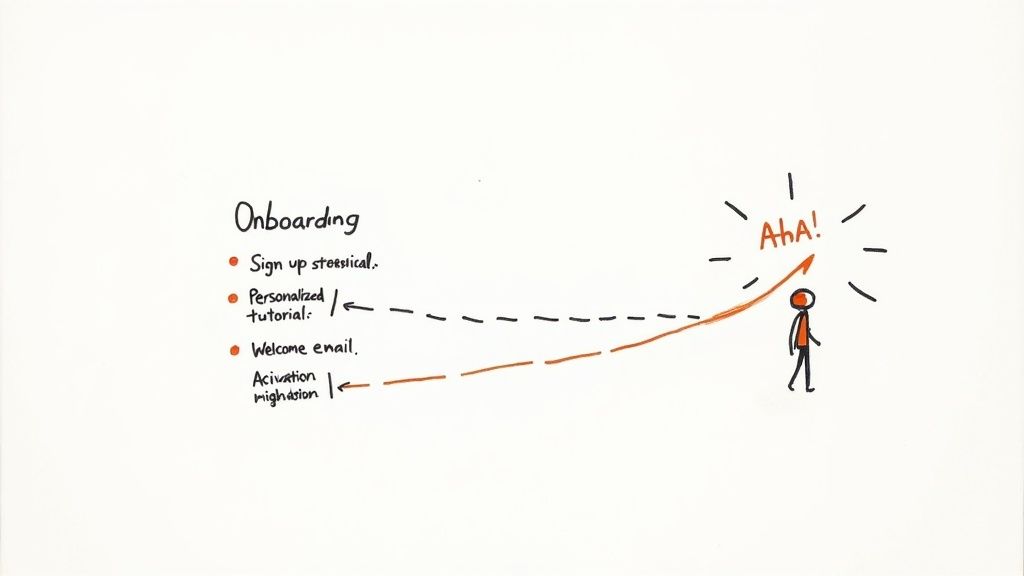
Let’s be honest: a customer’s first few days with your product can make or break the entire relationship. It’s your one shot to prove your value. If they’re met with a confusing, clunky, or aimless experience, they’ll churn. It’s that simple.
Your mission, should you choose to accept it, is to get users to their ‘Aha!’ moment as fast as humanly possible. This isn’t the time for a grand tour of every feature you’ve ever built. It’s about guiding them straight to that magical point where they see how your product solves their specific problem. That first small win is everything.
Defining and Measuring Activation
Before you can fix your onboarding, you need to know what a “win” actually looks like. We call this activation. It’s not just a sign-up or a login; it’s a specific set of actions that directly correlates with long-term retention.
Think about a project management tool. An activated user isn’t someone who just pokes around. They’re someone who has:
- Created their first project.
- Invited at least two colleagues.
- Assigned three or more tasks.
Someone who hits these milestones is far more likely to become a paying, loyal customer. Your first job is to dig into your own data. Find out what your best, longest-retained customers did in their first week. Those are your activation milestones.
Once you have that definition, you can track your activation rate—the percentage of new users who hit those milestones within a set timeframe, like the first seven days. This single metric will become your north star for every onboarding tweak you make.
Designing a Path to Quick Value
With your activation milestones defined, you can work backwards and design an onboarding flow that gets users there with zero friction. Every single step, tooltip, and email should nudge them closer to that core value.
For an email marketing platform, forget the generic tour. Instead, a killer onboarding flow would immediately prompt the user to import a small contact list and send their first campaign using a dead-simple template. They get a tangible result, fast.
This isn’t just good practice; it’s becoming essential. User expectations are higher than ever. Look at the social commerce boom in Southeast Asia, which is set to make up 25-30% of the region’s online GMV by 2026. Brands are winning by providing instant, interactive value. The lesson? Get to the point, and get there quickly.
Pro Tip: Use a simple welcome survey to ask new users what they’re trying to achieve. A marketer trying to build a newsletter needs a completely different onboarding path than a developer setting up transactional emails. Personalise the journey, and you’ll dramatically increase the odds of them hitting that ‘Aha!’ moment.
A smooth start is one of the most powerful strategies to improve customer retention.
To help map this out, here’s a look at how different onboarding elements contribute to activation and retention.
Onboarding Elements and Their Retention Impact
This table breaks down common onboarding components and clarifies their specific role in getting users activated and sticking around for the long haul.
| Onboarding Element | Primary Goal | Impact on Retention |
|---|---|---|
| Welcome Survey | Segment users by their “job-to-be-done.” | Enables personalised onboarding paths, increasing the likelihood of users finding relevant value quickly. |
| Interactive Product Tour | Guide users through the specific steps for activation. | Reduces confusion and friction, leading to higher completion rates for key actions that correlate with retention. |
| In-App Checklist | Gamify setup and provide a clear roadmap. | Creates a sense of progress and motivation, encouraging users to fully set up their account and become invested. |
| Value-Driven Emails | Nudge users toward their first meaningful win. | Re-engages users who drop off and reinforces the product’s core value proposition outside of the app. |
| Proactive Support Chat | Offer help at common points of friction. | Prevents frustration-driven churn by solving problems in real-time before the user gives up. |
By strategically combining these elements, you create a guided journey that feels helpful, not pushy, and systematically builds user confidence and commitment.
Practical Strategies for Better Onboarding
Optimising onboarding is all about being a helpful guide. It’s a mix of in-app nudges and timely communication, all designed to give users the right info at the right moment.
Here are a few tactics that just plain work:
- Interactive Product Tours: Ditch the boring, passive slideshow. Use tooltips and modals that walk users through the actual steps needed for activation. Celebrate their progress as they go.
- Value-Driven Welcome Emails: Your first email shouldn’t just be a “Hello!”. It needs a single, clear call-to-action that moves them forward, like “Create Your First Invoice in 2 Minutes.”
- Proactive Check-ins: If a user hasn’t completed a key step within 48 hours, send a friendly, automated email. A link to a short video tutorial or a relevant help doc can make all the difference.
- In-App Checklists: A simple progress bar is surprisingly powerful. It gamifies the setup process and shows users exactly what they need to do to unlock the product’s full potential.
When you relentlessly focus on guiding new users to an early, meaningful win, you turn that fragile first impression into a rock-solid foundation for customer loyalty.
Keeping Customers Hooked with Proactive Value
A killer onboarding experience is a fantastic start, but let’s be honest—it doesn’t seal the deal. The real work of keeping customers around starts after they’re all set up. It’s a marathon, not a sprint, where you have to prove your product’s worth week after week.
This means you’ve got to get out of reactive mode—just fixing problems as they pop up—and start being proactive. The goal is to consistently deliver value your users didn’t even know they were missing, turning that initial spark of interest into a deeply ingrained habit.
Build Powerful Value Loops
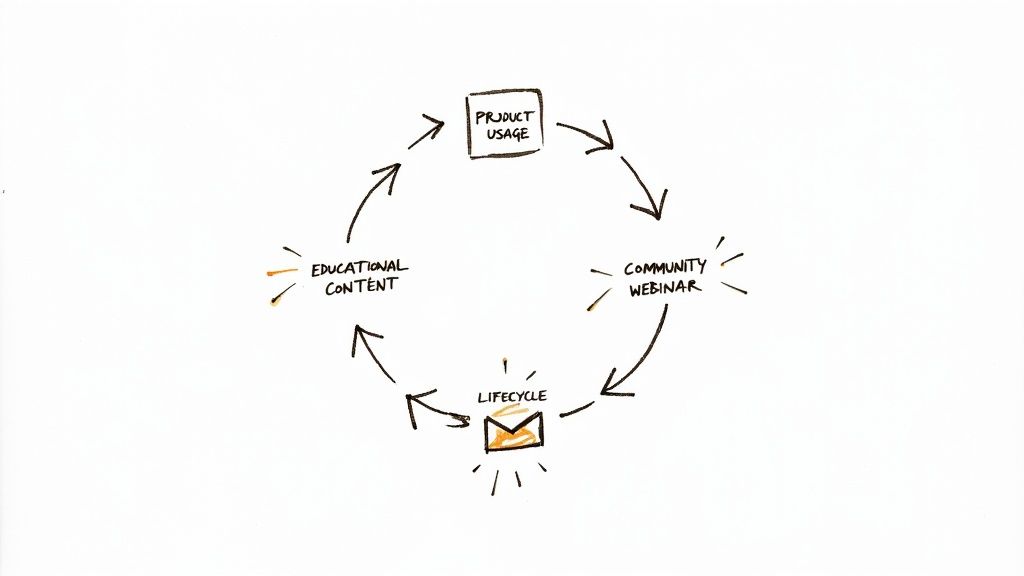
Great retention isn’t about some flashy, one-off feature. It’s about creating what we call value loops. Think of it as a cycle: a user takes an action, gets a benefit, and that benefit pulls them back in to use the product more, which creates even more value. The deeper they go, the more indispensable your product becomes.
A classic example is any analytics tool. The more data a user pumps in, the smarter and more personalised the insights get. This makes them want to track even more, which enriches the data further. That, right there, is a value loop spinning beautifully.
To create your own, ask yourself a few questions:
- What core action creates real value? Pinpoint the key activity that gives your user a tangible win.
- How does that win pull them back? Does it save time? Offer a game-changing insight? Connect them with others?
- How can we grease the wheels? Could you add smart notifications, automated reports, or social hooks that remind them of that value and get them to come back for more?
The stronger these loops, the more your product becomes a natural, can’t-live-without-it part of their workflow.
Turn Casual Users into Power Users
Most users won’t stumble upon your product’s full potential on their own. It’s your job to be their guide. Proactive education is a massive part of any solid retention strategy, helping you nudge casual users into becoming enthusiastic power users who are far, far less likely to churn.
You can do this in a few different ways:
- Lifecycle Marketing: Fire up some targeted email campaigns to wake up dormant users or introduce advanced features to your regulars. If someone hasn’t logged in for 14 days, a simple email highlighting a new, relevant feature might be all it takes to reel them back in.
- Educational Content: Go beyond the basics with webinars, tutorials, and deep-dive guides. A webinar on “Advanced Reporting Techniques” could unlock a whole new level of value for users who’ve only been scratching the surface.
- Data-Driven Personalisation: Use product usage data to show customers you’re paying attention. If a user is constantly in your scheduling feature, send them a quick tip about a little-known shortcut for that specific tool. It’s a small, personal touch that shows you get them.
These efforts aren’t just nice-to-haves; they have a huge impact on the bottom line. Research from Bain & Company found that boosting customer retention by just 5% can increase profits by anywhere from 25% to 95%.
The Stickiness of Community
Never, ever underestimate the power of belonging. Building a community around your product turns customers from passive users into active advocates. When a user feels connected to other people using your tool, they’re building relationships that tie them to your ecosystem—creating a powerful moat against competitors.
Try launching a user forum, a dedicated Slack channel, or a series of regular “office hours” webinars. These give your customers a place to share best practices, ask each other questions, and learn from their peers. Bonus: it gives your team a direct line to raw, unfiltered feedback.
A strong community doesn’t just lighten the load on your support team; it builds emotional investment. When customers feel like they’re part of something bigger, their loyalty goes through the roof.
This idea of creating supportive, seamless experiences should touch every part of your business. In Southeast Asia, for example, businesses using mobile wallets like GrabPay and OVO have seen incredible growth by focusing on user confidence. For SaaS, that translates to prioritising smooth integrations and transparent communication to build that same level of trust. You can dig deeper into these regional trends and find more detailed insights in this Southeast Asian retail outlook.
Turning Customer Feedback Into a Growth Engine
Your customers are handing you a roadmap to a better product, completely free of charge. The real challenge isn’t getting their opinions; it’s building a smart system to collect, analyse, and—most importantly—act on what they’re telling you.
Slapping a feedback button on your site isn’t a strategy. A real growth engine clicks into gear when customers see their input shaping your product’s evolution. This creates a powerful cycle: they feel heard, their loyalty deepens, and they become your best source of business intelligence.
Systematically Collecting Customer Voices
To get the full picture, you can’t just rely on one channel. You need to gather feedback from multiple angles, because each method uncovers a different kind of insight, from high-level satisfaction scores to nitty-gritty usability problems.
A solid feedback toolkit should mix a few of these:
- In-App Surveys (NPS, CSAT): These are fantastic for getting quick, contextual feedback. A Customer Satisfaction (CSAT) survey that pops up right after a user finishes a key task gives you an immediate pulse check on that specific workflow.
- “Always-On” Feedback Widgets: A simple, non-intrusive button lets users flag a bug or suggest an idea the moment it pops into their head. This captures those raw, unfiltered thoughts that are often forgotten by the time a formal survey lands in their inbox.
- In-Depth User Interviews: Honestly, nothing beats a one-on-one chat for digging into the “why” behind what users do. Make sure to talk to a mix of people—your power users, the newbies, and even folks who recently churned—to get a balanced view of your product’s highs and lows.
When you combine these methods, you stop collecting random comments and start building a constant stream of actionable data.
Closing the Feedback Loop
Right, this is where most companies completely drop the ball. Collecting feedback is only half the job. The real magic happens when you close the loop—letting customers know that you not only heard them but actually did something about it.
Imagine a user reports a frustrating bug. A month later, they get a personal email that says, “Hey, remember that issue you flagged with the dashboard? We just shipped a fix for it. Thanks for helping us improve.”
That single interaction builds more loyalty than a dozen marketing campaigns ever could. It proves you’re listening and makes the customer feel like a valued partner. This process is so critical that we’ve broken it down into a complete framework. You can learn more about the steps for closing the feedback loop in our dedicated guide.
Pro Tip: You absolutely have to automate this. Use integrations to tag users who provide specific feedback. When a related feature goes live, you can easily pull a list of those users and send them a personalised update, turning what started as a complaint into a moment of pure delight.
From Insight to Actionable Change
Getting feedback to the right people is everything. A brilliant feature request stuck in a support inbox is completely useless. You need a clear, automated workflow to route insights to the teams that can actually do something with them.
This is where data-driven strategies really shine. In Southeast Asia, for example, customer retention is now deeply tied to this kind of personalisation. The region’s CRM market is on track to hit USD 2.56 billion by 2030, a massive signal that businesses are investing heavily in tech that turns customer data into results. You can find more insights about the growing Southeast Asia CRM market on mordorintelligence.com.
For your team, this means setting up smart rules. For instance:
- Bug Reports: Automatically create a ticket in your engineering team’s project management tool.
- Feature Ideas: Route them to a dedicated Slack channel where the product team can review and prioritise them.
- Negative NPS Scores: Trigger an alert for your customer success team to follow up personally and see what’s up.
When you build this engine, feedback stops being noise. It becomes the fuel for a smarter, more customer-centric product roadmap. And that’s not just about fixing problems; it’s about building a business that learns and evolves with its customers.
Operationalizing Your Retention Strategy
Great ideas only matter if you actually execute them. All the analysis and feedback in the world won’t move the needle on your retention rate until you build a system to turn those insights into action.
The final piece of the puzzle is to weave retention into your company’s DNA. This means shifting from a series of one-off projects to a continuous, data-informed cycle of improvement. It’s about building a machine, not just pulling random levers and hoping for the best.
At its core, the process is beautifully simple: collect data, analyse it for insights, and then act on what you find.
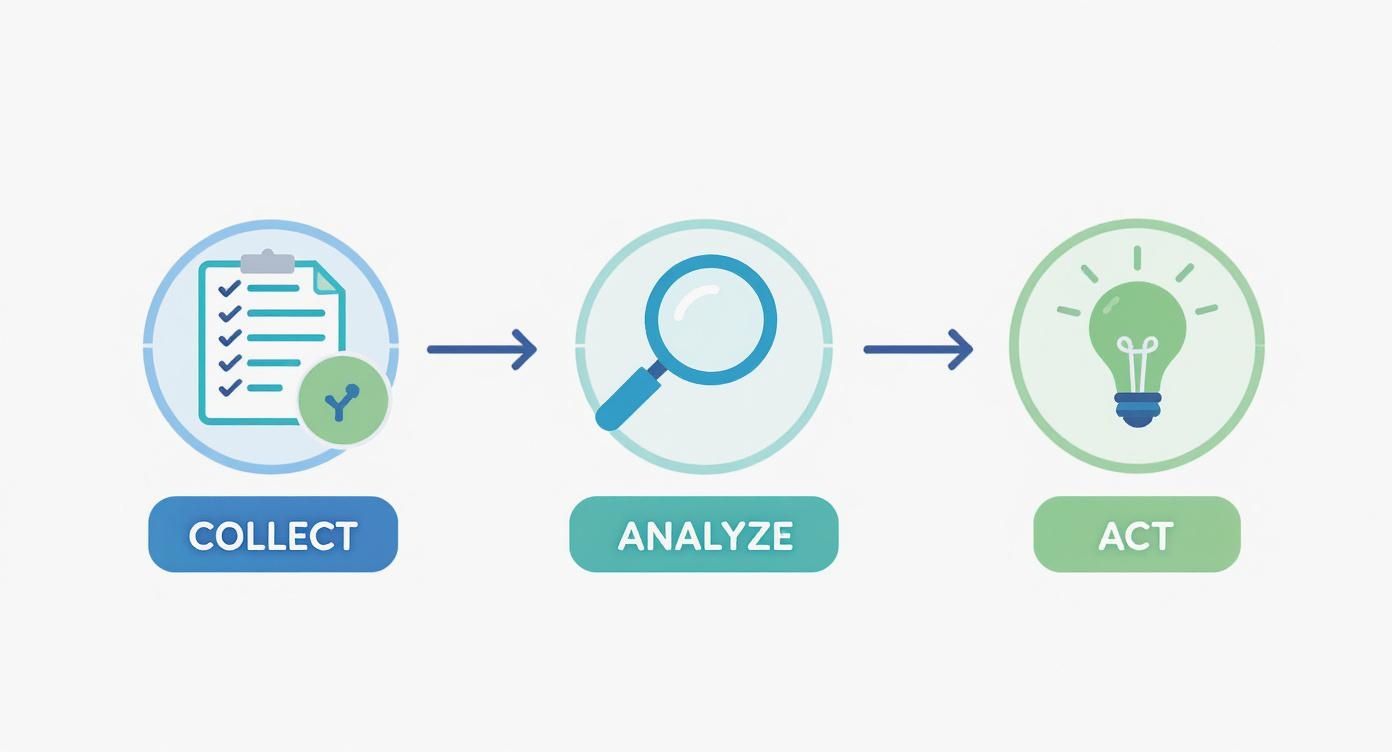
This loop isn’t a one-and-done task. It’s an ongoing cycle that should power every retention effort you make.
Adopting an Experimental Mindset
To make real, measurable progress, you need to start thinking like a scientist. Every change you want to make should start with a clear, testable hypothesis.
Instead of a vague goal like, “Let’s improve the onboarding,” frame it as an experiment: “We believe that by adding a three-step checklist to our onboarding flow, we can increase our user activation rate by 15% within 30 days.” See the difference?
This approach forces you to get specific:
- Form a clear hypothesis: State exactly what you’re changing and what outcome you expect.
- Define success upfront: Know precisely which metric will prove your hypothesis right or wrong.
- Isolate variables: Use A/B testing to compare the new experience against the old one. This is crucial for confidently attributing any changes directly to your experiment.
Test everything. Seriously. From the copy in your re-engagement emails to the structure of your onboarding tutorials, it’s all fair game. You’d be surprised how often small, iterative tests lead to the biggest long-term gains.
Creating Cross-Functional Ownership
Retention is a team sport—it can’t live solely within the customer success department. To truly operationalise your strategy, you need to create cross-functional “squads” or teams dedicated to specific retention goals.
Imagine a team focused on early-stage retention. It might include a product manager, a designer, an engineer, and a customer success manager. This group would collectively own the activation metric and have the autonomy to run experiments on the first-week user experience without endless red tape.
Key Takeaway: When you make retention a shared responsibility with clear ownership, you break down silos. The product team starts building with stickiness in mind from day one, and marketing focuses on attracting customers who are more likely to succeed long-term.
By running structured experiments and fostering this kind of collaboration, you shift from simply reacting to churn to proactively building a product that customers can’t imagine leaving. This is how improving customer retention becomes a core, sustainable part of your company’s culture.
Common Questions Answered
When you’re diving deep into customer retention, a few questions always seem to pop up. Let’s tackle them head-on, with straightforward answers to help you sharpen your strategy.
What’s a Good Customer Retention Rate, Really?
Honestly, “good” is one of those relative terms. The right number for your SaaS business hinges almost entirely on who your customers are. It’s not a one-size-fits-all metric.
If you’re selling to massive enterprise clients, you should be aiming for a retention rate of 90% or higher. Those relationships are high-touch, high-value, and built to last. On the other hand, if your world is small to medium-sized businesses (SMBs), an annual rate around 80% is a pretty solid and realistic target.
But here’s the real benchmark: your own past performance. The ultimate goal isn’t just to hit some industry average; it’s to consistently nudge your baseline retention rate up, quarter after quarter. That’s how you know you’re truly winning.
How Can a Small Team Actually Make a Dent in Retention?
You don’t need a giant team or a bottomless budget to keep customers happy. When you’re running lean, the secret is focusing on the stuff that gives you the most bang for your buck—or, in this case, the most loyalty for your effort.
Here are a few low-cost moves that pack a serious punch:
- Nail the first five minutes. Your onboarding flow is your first line of defence against churn. Obsess over it. Your mission is to get new users to that “Aha!” moment as fast as humanly possible. A smooth start makes everything else easier.
- Make feedback ridiculously easy. Pop a simple, in-app survey or a feedback widget somewhere obvious. When users can share their thoughts without friction, you get a direct line into their biggest frustrations and brightest ideas.
- Send a personalised nudge. An automated email that feels personal can work wonders. If a user seems stuck or hasn’t logged in for a week, a quick “Hey, noticed you haven’t been around—can we help?” shows you’re paying attention.
How Long Before I See Results from My Retention Efforts?
Patience is a virtue here. While some fixes—like squashing a critical bug or clarifying an onboarding tooltip—can give you a quick win and an immediate dip in support tickets, the big-picture stuff takes time to show up in the numbers.
You won’t see significant, lasting shifts in your core retention metrics overnight. Things like your cohort retention rate or Customer Lifetime Value (CLV) often take a few quarters of consistent, focused work to move in the right direction. Retention is a long game, built on steady, incremental progress. It’s the cumulative effect of all those small, thoughtful improvements that builds a truly loyal customer base.
Ready to turn customer feedback into your biggest growth driver? HappyPanda gives you the tools to collect, analyse, and act on insights with our simple, powerful survey widget. Learn more and get started.