
So, what exactly is a Customer Success Manager (CSM)?
Think of them less like a traditional support agent and more like a strategic partner or a product adoption coach. Their entire mission is to bridge the gap between a customer signing up and that same customer becoming wildly successful, loyal, and a vocal fan of your brand.
Beyond the Job Title: The Real Impact of a CSM
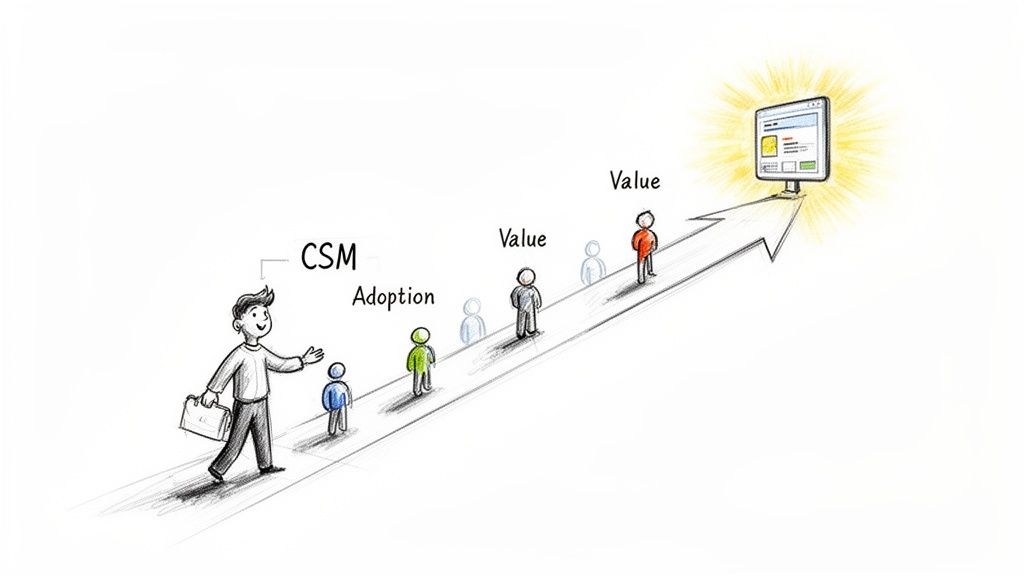
It’s a common mistake for founders to lump customer success in with customer support. While they’re definitely related, their roles are worlds apart, defined by one crucial word: proactivity.
Customer support is reactive. They’re the essential problem-solvers, the heroes who jump on tickets and fix issues as they pop up. A CSM, on the other hand, works to make sure those problems never happen in the first place. Their goal is to get customers so comfortable and capable with your software that they rarely need to contact support.
A support agent helps when a customer is stuck. A Customer Success Manager teaches the customer how to drive, shows them new destinations, and ensures they have enough fuel for the journey.
This forward-thinking approach directly fuels the most critical metrics for any bootstrapped SaaS. By chasing long-term value instead of just putting out short-term fires, a CSM becomes a powerful engine for sustainable growth.
The Proactive vs. Reactive Mindset
To really get it, just look at the difference in their daily focus. A support team asks, “How can I solve this problem?” A CSM asks, “How can I prevent this problem and unlock even more value for this customer?”
- Customer Support (Reactive): Juggles inbound tickets, troubleshoots errors, answers “how-to” questions, and aims to close conversations quickly and effectively.
- Customer Success (Proactive): Runs onboarding sessions, performs regular account health checks, spots upsell opportunities, and gathers strategic feedback to pass along to the product team.
At the end of the day, support is measured by speed and satisfaction on a case-by-case basis. Success is measured by its direct impact on retention, expansion revenue, and customer lifetime value. You can dive deeper into building a solid framework in our detailed guide to customer success for SaaS.
Why Bootstrapped Founders Need to Care
For a lean SaaS business, every single customer counts. Churn isn’t just a lost monthly payment; it’s a hole in your growth bucket that you constantly have to patch with expensive new acquisitions. A great Customer Success Manager is your best defence against that leak.
They are the human touch that guarantees your software actually delivers on its promises. A fantastic CSM transforms a simple software transaction into a genuine strategic partnership.
This deep relationship turns happy users into your most powerful marketing asset: vocal advocates who drive referral business and build your reputation from the ground up. Their work isn’t a cost centre; it’s a direct investment in net revenue retention—the absolute lifeblood of any subscription business.
A Day in the Life of a Modern CSM
So, what does a Customer Success Manager actually do all day? If you’re picturing someone just answering emails and putting out fires, think again. A great CSM is more like an architect—they’re proactively building a bridge between your product’s potential and what the customer desperately wants to achieve.
It’s less about reacting to problems and all about preventing them in the first place.
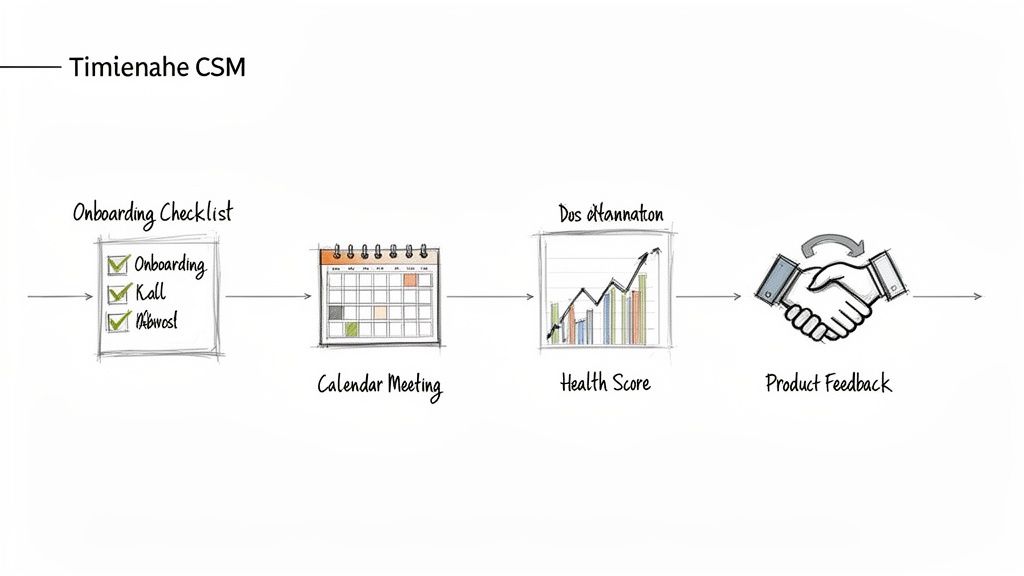
Honestly, no two days are ever identical, but there’s a definite rhythm to the work, all centred around the customer’s journey. The focus fluidly shifts from rolling out the welcome mat for new users to nurturing those long-term partnerships that feel like gold. Every single task is designed to boost value and stamp out issues before they even have a chance to sprout.
Mapping the Customer Journey
A typical CSM day is often mapped to the customer lifecycle. Think of them as a guide, making sure every user hits their milestones and moves smoothly from one stage to the next.
- Morning Onboarding Focus: The day usually kicks off with new customers. This means running welcome calls, walking users through the initial setup, and making sure they hit that first “aha!” moment as quickly as possible. The mission is simple: crush any initial friction and show them the value, fast.
- Midday Health Checks: After lunch, it’s time to check the pulse of established customers. Using health scores and product usage data, the CSM proactively spots accounts that are showing signs of drifting away—maybe logins have dropped, or key features are gathering dust. This is the time to jump in before a small issue becomes a big one.
- Afternoon Strategic Reviews: For the most important accounts, the afternoon might be spent prepping for or running Quarterly Business Reviews (QBRs). These aren’t troubleshooting calls. They’re high-level strategic sessions to align the product with the customer’s business goals and prove, without a doubt, the ROI they’re getting.
This structured flow ensures that whether a customer signed up yesterday or two years ago, they’re never left to fend for themselves.
A great CSM doesn’t just manage accounts; they orchestrate successful outcomes. Their daily rhythm is a mix of teaching, analysing, and strategising to ensure customers don’t just stay—they grow.
From Proactive Check-ins to Churn Prevention
A huge chunk of a CSM’s time is spent on outreach that’s anything but random. They aren’t sitting around waiting for a complaint ticket to land in their inbox. Instead, they’re hunting for signals that might spell future trouble.
For instance, if a customer’s main champion leaves the company, a savvy CSM is on it immediately. They’ll reach out to the new contact to build a fresh relationship and make sure the transition doesn’t derail their progress.
This forward-thinking approach is also perfect for spotting upsell opportunities that feel genuinely helpful, not like a pushy sales pitch. When a customer has mastered one part of your product, the CSM is right there to introduce the next feature that will solve their next big problem. It creates a natural, valuable path to expansion revenue.
The current economic climate has definitely put this role under the microscope. CSMs are now expected to be accountable for revenue, with top performers handling more accounts than ever. In a world where 53.5% of CSMs saw no salary increase during a period of major layoffs, the focus is shifting. Companies are looking for scalable tools to automate routine check-ins and surface critical insights, rather than just adding more people. You can read more about these trends in customer success statistics.
Becoming the Voice of the Customer
Finally, one of the most vital daily tasks for any CSM is to be the customer’s advocate inside the company. They’re on the front lines, collecting priceless feedback, feature requests, and frustrations straight from the source.
They then take all that raw, honest input and channel it directly to the product and engineering teams. This feedback loop is the secret sauce for building a product people genuinely want to use and are happy to pay for.
A CSM ensures your product roadmap isn’t just a list of cool ideas dreamed up in a meeting room. It’s a direct reflection of your customers’ real-world needs, cementing their role as a central pillar of sustainable, long-term growth.
Skills That Define a Great Customer Success Manager
Hiring your first Customer Success Manager isn’t about finding someone who’s just a “good communicator.” Honestly, that’s just the price of entry. A truly great CSM is a rare mix—part strategic consultant, part empathetic advocate, and part data-savvy analyst, all rolled into one. They aren’t just friendly account minders; they’re the architects of long-term customer value.
For a bootstrapped founder, this hire is absolutely critical. You’re not just filling a seat; you’re entrusting someone with your most valuable asset—your customer relationships. This person needs the right blend of soft and hard skills to build your customer success function from the ground up and turn your early users into lifelong fans.
The Foundation of Empathy and Strategic Thinking
At its heart, customer success is built on genuine empathy. A top-tier CSM has an almost intuitive knack for putting themselves in the customer’s shoes. They don’t just hear a feature request; they understand the underlying business pain that sparked it in the first place.
This is what allows them to build trust so quickly. When a customer feels truly understood, they stop seeing the CSM as a vendor and start seeing them as a partner who’s genuinely invested in their success.
But empathy alone won’t cut it. It needs to be paired with sharp strategic thinking. A great CSM connects a customer’s day-to-day frustrations to their bigger business goals. They ask the kind of insightful questions that help the customer see how your product fits into their grand plan, tying your software directly to their path to revenue.
A great CSM doesn’t just ask, “How are you using our tool?” They ask, “What are you trying to achieve this quarter, and how can our tool get you there faster?” This shift in perspective is what separates a good CSM from a truly exceptional one.
This strategic mindset is indispensable. In Southeast Asia’s booming SaaS market, CSMs are becoming crucial for growth. Yet, a staggering 40% of startups in the region lack dedicated customer-success talent. This skills gap, especially in key markets like Singapore and Malaysia, is actively holding businesses back, proving just how vital this role has become. You can find more insights on the talent scarcity in Southeast Asia’s tech market.
The Power of Data Literacy and Proactivity
While empathy builds the relationship, data provides the roadmap. A modern CSM has to be comfortable with numbers. They need to be able to look at a customer health score, dive into product usage analytics, and walk away with a clear plan of action.
Being data-literate is what transforms a CSM from reactive to proactive. Instead of waiting for a customer to complain or cancel, they spot the warning signs long before things go south.
- Low Login Rates: A dead giveaway that a customer is disengaged. A proactive CSM will reach out to offer a training session or figure out what’s blocking them.
- Underutilised Key Features: If a customer isn’t using the features that deliver the most value, they’re a massive churn risk. The CSM can create a tailored guide or jump on a quick demo to show them what they’re missing.
- Negative NPS Feedback: Instead of just logging the score, a data-savvy CSM digs into the “why” and works with the product team to fix the root cause.
This proactive approach, fuelled by data, is what stops churn in its tracks. It lets the CSM step in with helpful, relevant advice at just the right moment, reinforcing your product’s value and making that customer relationship even stronger.
A Practical Hiring Checklist for Founders
Finding someone with this unique blend of skills is tough, especially when you’re making your first CSM hire. To help you spot a true A-player, you need to look for specific traits and ask targeted questions during the interview. This checklist will help you cut through the noise and find someone who can truly own this role.
CSM Hiring Checklist: Key Skills and Interview Questions
Here’s a practical checklist to help you identify and vet top CSM candidates. It maps the essential skills to what you should be looking for and the kinds of questions that will reveal their true capabilities.
| Essential Skill | What to Look For | Sample Interview Question |
|---|---|---|
| Empathy & Relationship Building | A natural ability to connect, listen actively, and build trust. They should be more interested in the customer’s problem than your product’s features. | ”Tell me about a time you had to deal with a very unhappy customer. How did you turn the situation around?” |
| Strategic & Commercial Acumen | The ability to think beyond daily tasks and connect customer goals to business outcomes (like retention and expansion). They see the bigger picture. | ”A customer is using only 30% of our product’s features but seems happy. How would you approach this situation to increase adoption and deliver more value?” |
| Proactivity & Problem-Solving | A forward-thinking mindset. Look for someone who anticipates issues before they happen and takes initiative to solve them without being told. | ”Describe a situation where you identified a potential churn risk before it became a major issue. What data did you use, and what steps did you take?” |
| Data Literacy & Analytical Skills | Comfort with metrics like NPS, CSAT, and product usage data. They should be able to interpret data to tell a story and make decisions. | ”Walk me through how you would use customer data to prepare for a Quarterly Business Review (QBR) with a key account.” |
| Communication & Influence | Clear, concise communication skills. They need to be able to explain complex ideas simply and advocate for the customer internally with the product team. | ”Imagine our product team just deprioritised a feature a major customer was waiting for. How would you communicate this to the customer?” |
Using a structured approach like this moves you beyond generic questions and helps you dig into how a candidate actually thinks and operates. It’s the best way to find someone who not only has the right skills on paper but also has the mindset to build a successful customer success function from scratch.
How to Measure Customer Success Performance
You can’t fix what you don’t measure. For a Customer Success Manager, performance isn’t just about keeping customers happy; it’s about proving their direct impact on your bottom line. Tracking the right key performance indicators (KPIs) is what turns customer success from a fluffy “nice-to-have” into a core engine for your SaaS.
Think of these metrics like the dashboard on a pilot’s control panel. Some gauges tell you about your immediate situation (leading indicators), while others confirm you’re on the right long-term path (lagging indicators). A great CSM keeps a close eye on both to ensure a smooth flight and avoid any nasty turbulence.
Foundational Revenue Metrics: GRR and NRR
The two most important metrics for any subscription business are Gross Revenue Retention (GRR) and Net Revenue Retention (NRR). They are the ultimate proof that your customer success efforts are actually paying the bills.
-
Gross Revenue Retention (GRR): This shows your ability to hold onto revenue from existing customers, completely ignoring any expansions or upgrades. It answers the simple question, “How much of our revenue did we keep, not counting new sales or upsells?” A high GRR means you have a sticky product and people aren’t jumping ship.
-
Net Revenue Retention (NRR): Now, this is the holy grail. NRR takes your GRR and adds back any expansion revenue you’ve gained from upgrades, cross-sells, or add-ons. It answers, “Did our existing customer base grow or shrink in value?” An NRR over 100% means your business is growing even if you don’t sign a single new customer.
For a bootstrapped SaaS, NRR is the clearest signal you have a healthy, scalable business. It proves your CSM isn’t just plugging leaks in a sinking boat but is actively finding ways for customers to get more value—which, in turn, grows your revenue.
Leading Indicators to Watch Closely
While NRR is your destination, leading indicators are the road signs telling you if you’re even on the right motorway. These metrics give a CSM an early warning, letting them step in before a customer starts packing their bags.
Customer Health Score A Customer Health Score is a custom metric you create to predict how likely a customer is to churn or grow. It’s a bit like a credit score for your customers, rolling multiple data points into a single, colour-coded rating (think green for great, yellow for ‘uh-oh,’ and red for ‘all hands on deck’).
A typical health score might blend a few things:
- Product Adoption: Are they actually using the features you built?
- Usage Frequency: How often are they logging in? Is it becoming a habit?
- Support Tickets: Is their ticket count suspiciously high or worryingly low?
- NPS/CSAT Scores: What have they said in recent feedback?
This score lets a CSM triage their efforts, focusing on accounts turning “yellow” before they hit “red” and churn. Applying smart SaaS retention strategies is what separates a good CSM from a great one here.
Product Adoption Rate This metric gets into the nitty-gritty of how customers are engaging with your product. A customer who only uses one or two basic features is a much higher churn risk than someone who has woven your tool into their daily workflow. A CSM’s job is to drive that deeper adoption, showing users how new features can solve their real-world problems.
Net Promoter Score (NPS) NPS measures customer loyalty with one brutally simple question: “How likely are you to recommend our product to a friend or colleague?” While it’s just a survey, it’s a powerful early warning for both churn risk (Detractors) and potential case studies (Promoters). To get a better handle on this, check out our guide on how CSAT and NPS can work together.
By tracking a mix of revenue-focused lagging indicators (NRR) and proactive leading indicators (Health Scores, NPS), a Customer Success Manager can build a predictable, data-driven engine for long-term growth.
Automating CSM Workflows for Lean Teams
Hiring your first Customer Success Manager is a huge milestone. But what if you’re a bootstrapped founder and not quite ready to take that leap? Good news: you don’t have to choose between a hefty salary and letting your customers fend for themselves. You can become your own “virtual CSM” by using smart automation to build an effective customer success engine from day one.
The trick is to think in terms of an automation layer. This isn’t about replacing the human touch, but supercharging it. It ensures no customer ever falls through the cracks, even when you’re neck-deep in code or chasing down new leads. You’re essentially setting up systems to handle the repetitive, predictable parts of the job, freeing you up for the high-impact, strategic conversations that really matter.
For a lean team, this means using a unified platform to automate the core stuff. Instead of manually tracking every new signup, you can trigger onboarding checklists and welcome emails that guide users straight to their first “aha!” moment. It guarantees a consistent, top-notch experience for everyone, not just the handful of customers you have time to call.
This simple flow shows how automation helps manage the entire customer journey, starting with adoption and leading directly to retention and revenue.
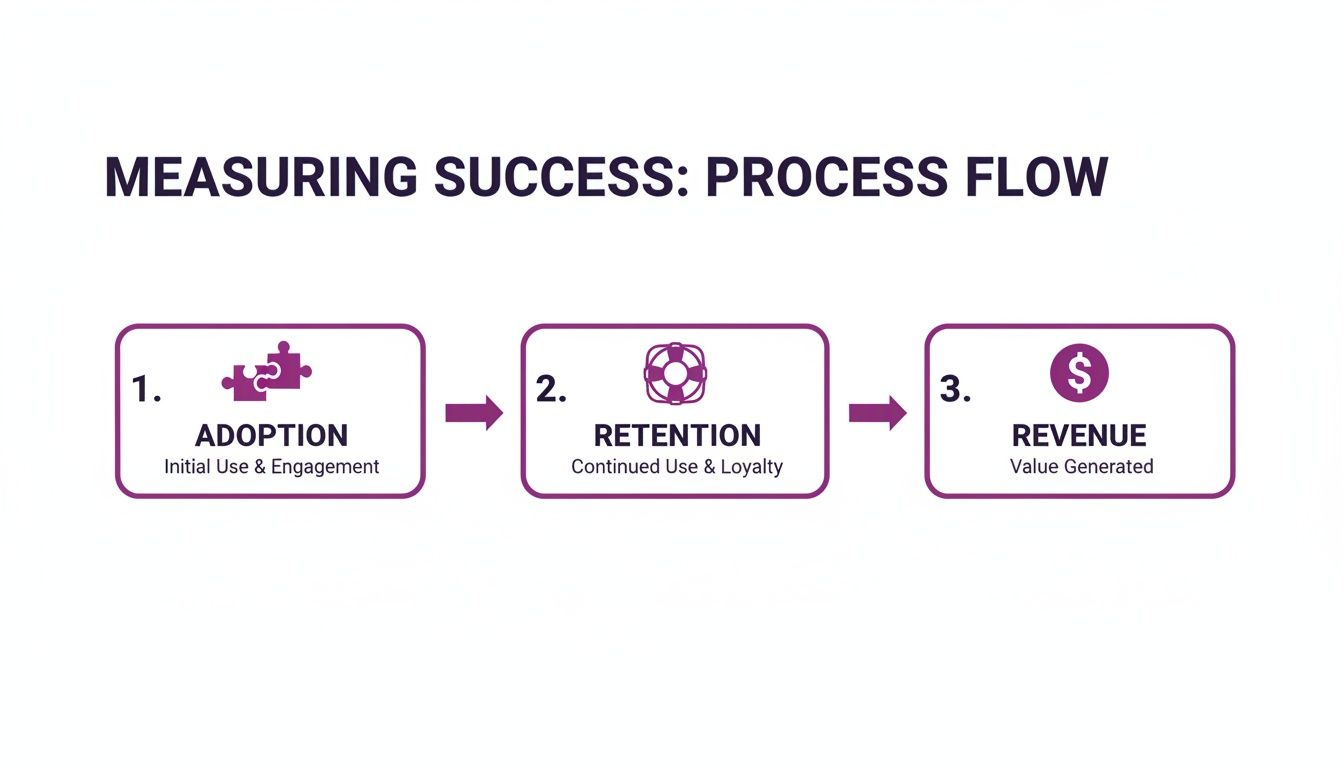
Get adoption right, and you’ll find that retention and revenue naturally follow.
The Power of If-Then Automation
The logic behind this automation layer is beautifully simple: “If this happens, then do that.” It’s all about creating rules that react to user behaviour in real-time, perfectly mimicking the proactive check-ins a human CSM would normally handle.
Automation acts as your 24/7 virtual CSM. It never sleeps, never forgets to follow up, and executes your customer success strategy flawlessly at scale. This allows a founder to deliver a world-class experience on a bootstrapped budget.
Here are a few practical “if-then” scenarios you could set up in minutes:
- If a user completes the onboarding checklist, then send them a congratulatory email with a few advanced tips.
- If a customer has been active for 30 days, then automatically send an NPS survey to see how they’re feeling.
- If a user hasn’t logged in for 14 days, then trigger a friendly “win-back” email sequence to bring them back into the fold.
This approach turns customer success from a manual, time-sucking chore into a self-running system. And the timing couldn’t be better. The ASEAN Customer Success Platforms market is booming, riding the wave of Asia-Pacific’s tech explosion. There’s a massive opportunity here for bootstrapped SaaS companies in Southeast Asia, where the digital economy is hurtling towards USD 1 trillion, yet SaaS still makes up less than 7% of it. This points to a huge, untapped market for tools that automate feedback, onboarding, and updates. You can discover more insights about the Customer Success Platform market.
Manual CSM Tasks vs. HappyPanda Automation
To really see the difference, let’s compare the old-school, manual way of doing things with a modern, automated approach using a platform like HappyPanda. This isn’t just about saving a bit of time; it’s about building a more reliable and scalable business from the ground up.
| CSM Responsibility | The Manual (Expensive) Way | The HappyPanda (Automated) Way |
|---|---|---|
| Onboarding New Users | Manually sending welcome emails and scheduling one-on-one demo calls for every single signup. Personal, but impossible to scale. | Triggered email sequences and in-app checklists guide users automatically, ensuring a consistent experience 24/7. |
| Collecting Feedback | Remembering to email a survey link weeks later, then manually copying responses into a spreadsheet. It’s often forgotten. | Automatically send NPS or CSAT surveys at key moments (like 30 days post-signup) and see results on a clean dashboard. |
| Requesting Testimonials | Searching through support tickets for happy comments, then manually emailing customers to ask for a review. It’s hit-or-miss. | Automatically send a testimonial request to any customer who gives a high NPS score (like a 9 or 10). |
| Announcing Updates | Writing a blog post or sending a one-off email blast that gets lost in the inbox. Engagement is usually pretty low. | Push targeted “What’s New” updates directly inside your app with a changelog widget, reaching users when they’re most engaged. |
By setting up these kinds of automated workflows, a solo founder can effectively do the job of a full-time customer success manager without the salary. It lets you build strong customer relationships and slash churn right from your very first user, creating a solid foundation for growth.
If you’re looking to dive deeper, we have other resources that show you how to automate business processes across your entire startup.
A Few Common Questions About the CSM Role
Even after getting the gist of what a Customer Success Manager does, most founders still have a few lingering questions before they’re ready to make that first hire. Let’s tackle the most common ones to clear up any confusion and get you ready to build out your customer success function the right way.
Think of these answers as your strategic guide to making the right moves for your growing SaaS.
What’s the Real Difference Between Customer Success and Customer Support?
The biggest difference boils down to a single idea: proactive versus reactive. Honestly, if you grasp this distinction, you understand the core of what makes each role unique and how they impact the business differently.
Think of it like this: Customer Support is your company’s emergency service. They’re the firefighters, expertly and quickly putting out fires as they pop up. A customer hits a snag, submits a ticket, and the support team swoops in to solve it. Their job is essential for fixing immediate problems and keeping customers happy in the moment.
A Customer Success Manager, on the other hand, is the fire marshal. Their job is to inspect the building, spot potential hazards, and put plans in place to stop fires from ever starting. They work with customers from the get-go to make sure they’re using the product correctly, hitting their goals, and getting so much value that they rarely need to call the firefighters in the first place.
Customer Support solves problems. Customer Success prevents them. Support is all about transactional satisfaction (CSAT), while Success is measured by long-term value, retention, and growth (NRR).
This proactive approach fundamentally shifts the customer relationship from a series of transactions to a genuine strategic partnership.
When Should a Bootstrapped SaaS Hire Its First Customer Success Manager?
There’s no magic revenue number that fits every company, but there are definitely clear signals that it’s time to bring in a specialist. The tipping point usually arrives when you, the founder, can no longer personally manage every new customer relationship without things starting to fall through the cracks.
Keep an eye out for these specific warning signs in your metrics and your own workload:
- User Activation Rates Are Dropping: New users are signing up but aren’t completing key setup steps or getting to that crucial “aha!” moment.
- You’re Seeing Preventable Churn: You’re losing customers for reasons that a bit of proactive guidance or training could have easily fixed.
- You’re Missing Expansion Opportunities: Customers are clearly outgrowing their current plan, but you just don’t have the bandwidth to guide them towards an upgrade.
- You’re Burning Out: You’re spending more time on individual customer calls than on actually growing the business.
This moment often shows up somewhere between $10k and $30k in Monthly Recurring Revenue (MRR). Before this point, founders should lean heavily on automation to act as a “virtual CSM.” But once you hit this stage, hiring a dedicated Customer Success Manager isn’t just about offloading tasks—it’s an investment in a scalable process that will fuel your next wave of growth.
What’s a Typical Career Path for a Customer Success Manager?
The CSM role is a fantastic launchpad for a career in any SaaS company. It offers an incredible view into both the customer’s world and the product’s inner workings. It’s far from a dead-end job; it’s a strategic stepping stone to some really exciting leadership paths.
The most direct career progression usually looks something like this:
- Customer Success Manager: Manages a portfolio of accounts, focusing on adoption, retention, and health scores.
- Senior or Strategic CSM: Takes on more complex, high-value accounts, starts mentoring junior CSMs, and helps shape team strategy.
- Team Lead or Manager of Customer Success: Moves into people management, responsible for hiring, training, and guiding a team of CSMs.
- Director or VP of Customer Success: Owns the entire post-sale customer journey, setting the high-level strategy for keeping and growing the customer base, and reporting directly to the exec team.
But the path isn’t always a straight line. Because a great CSM develops such a deep understanding of customer pain points, they become perfect candidates for other key roles across the organisation.
Many successful CSMs transition into:
- Product Management: Who better to help shape the product roadmap than someone who spends all day talking to the people who use it? They become the true voice of the customer.
- Account Management or Sales: Their knack for building relationships and spotting expansion opportunities makes them naturals for roles focused on growing revenue from existing customers.
- Customer Marketing: They know exactly who your happiest customers are and can work with them to generate powerful case studies, testimonials, and referrals.
This versatility makes a strong CSM a long-term strategic asset for any bootstrapped company—someone who can grow with you and add value across the entire business.
Ready to build a world-class customer experience without the enterprise price tag? HappyPanda unifies all your customer communication tools—from NPS surveys and onboarding checklists to email sequences and changelogs—into one simple, affordable platform. Start your free trial and see how easy it is to automate your customer success workflows at https://happypanda.ai.