
So, what exactly is a Customer Experience Manager? Think of them as the strategic leader responsible for shaping every single interaction a customer has with your company. This role goes way beyond just putting out fires; it’s about proactively designing the entire customer journey to build fierce loyalty and, ultimately, drive business growth.
Why a Customer Experience Manager Is Your Secret Growth Engine
Let’s reframe the conversation a bit. For a bootstrapped SaaS, especially in a crowded market, hiring a Customer Experience Manager isn’t about managing support tickets. It’s a direct investment in your growth engine. The role has evolved from a reactive problem-solver into a proactive strategist who owns the entire customer lifecycle.
Think of them as the architect of your customer journey. While a support agent is busy fixing a leaky faucet in one room, the Customer Experience Manager is redesigning the entire plumbing system to stop leaks from ever happening in the first place. They scrutinise every touchpoint—from that first website visit to onboarding emails and eventual renewal chats—to iron out friction and create moments that make customers smile.
The Big Shift: From Cost Centre to Revenue Driver
Traditionally, customer-facing roles were chalked up as a cost centre. A necessary expense. But today, a sharp CX Manager is a powerful revenue driver and your best defence against churn. They take raw user feedback, turn it into actionable product improvements, and transform happy customers into vocal brand advocates who bring in referrals.
This shift is especially critical in dynamic regions like Southeast Asia. What was once a “nice-to-have” is now absolutely essential for survival and growth.
A 2023 survey found that a staggering 50% of retail customers in Southeast Asia would likely jump ship to a competitor after just one bad experience. That stat alone highlights the massive financial risk of ignoring the customer journey.
The economic impact is impossible to ignore. The Asia Pacific customer experience management market was valued at USD 2.36 billion in 2023 and is projected to explode to USD 7.13 billion by 2030. This kind of growth points to a fundamental market truth: the companies that prioritise customer experience are the ones that are going to win. You can discover more insights about the APAC CX market’s rapid expansion right here.
Clearing Up the Modern CX Role
To really get a feel for their impact, you need to understand how a Customer Experience Manager differs from a traditional customer support lead. It boils down to this: one is reactive and focused on transactions, while the other is proactive and focused on building relationships.
To make it even clearer, let’s break down the differences.
Customer Support vs. Customer Experience: A Quick Comparison
This table really clarifies the fundamental shift in focus from a traditional support role to a strategic CX Manager. It helps founders see where the real value lies.
| Aspect | Traditional Customer Support | Modern Customer Experience Manager |
|---|---|---|
| Primary Focus | Resolving individual issues and tickets efficiently. | Designing and improving the entire customer journey. |
| Approach | Reactive – responds to problems as they occur. | Proactive – anticipates needs and prevents problems. |
| Key Metrics | Ticket resolution time, first-contact resolution. | Churn rate, Net Promoter Score (NPS), Customer Lifetime Value (LTV). |
| Goal | Customer satisfaction with a specific interaction. | Long-term customer loyalty and advocacy. |
When you look at it this way, it’s easy to see how the CX Manager role is geared towards the bigger picture.
Ultimately, investing in a Customer Experience Manager isn’t just about making customers happier—it’s an investment in sustainable, long-term growth for your SaaS.
Defining the Core Responsibilities and Skills
So, what does a great Customer Experience Manager actually do? Hint: it’s a lot more than just babysitting support tickets. Think of them as the master architect of your customer’s journey—part strategist, part data detective, and part empathetic guide. They’re obsessed with creating a smooth, memorable pathway for every user.
Their entire mission is to live and breathe the customer lifecycle, from the moment someone first hears about your product to the day they become a raving fan. They’re constantly asking questions like, “Where are people getting tripped up?” and “What tiny tweak could make a user’s day?” In short, they own the entire experience, not just the inbox.
The Strategic and Tactical Duties
The role is a fascinating blend of big-picture thinking and getting your hands dirty with the details. They’re responsible for designing and polishing every single touchpoint to make sure it’s consistent and genuinely helpful.
Here’s what that looks like day-to-day:
- Mapping the Complete User Journey: This is where they put on their cartographer hat and chart out every single step a customer takes. From signing up for a trial to getting those first few onboarding emails and finally using a key feature, they’re looking for friction points to eliminate before they turn into support headaches.
- Building Automated Onboarding Flows: A top-tier CX Manager doesn’t just wait for users to figure things out. They design clever automated email sequences and in-app guides that steer new users straight to that “aha!” moment, driving up activation rates.
- Creating and Managing Feedback Loops: They set up systems to systematically gather and make sense of user feedback, using things like Net Promoter Score (NPS) and Customer Satisfaction (CSAT) surveys. This isn’t just about collecting data; it’s about turning those golden nuggets of insight into real product improvements.
- Analysing User Behaviour Proactively: Armed with analytics tools, they hunt for patterns that scream “I’m about to churn!” For instance, they might spot that users who don’t invite a teammate within three days are 80% more likely to cancel. Boom—they now have a target for a new engagement campaign.
A huge part of their job is to implement proven strategies to increase customer retention. When done right, this transforms the CX function from a simple cost centre into a serious revenue driver for the business.
This visual nails how a CX manager connects the dots between customer feedback, product improvements, and ultimately, revenue growth.
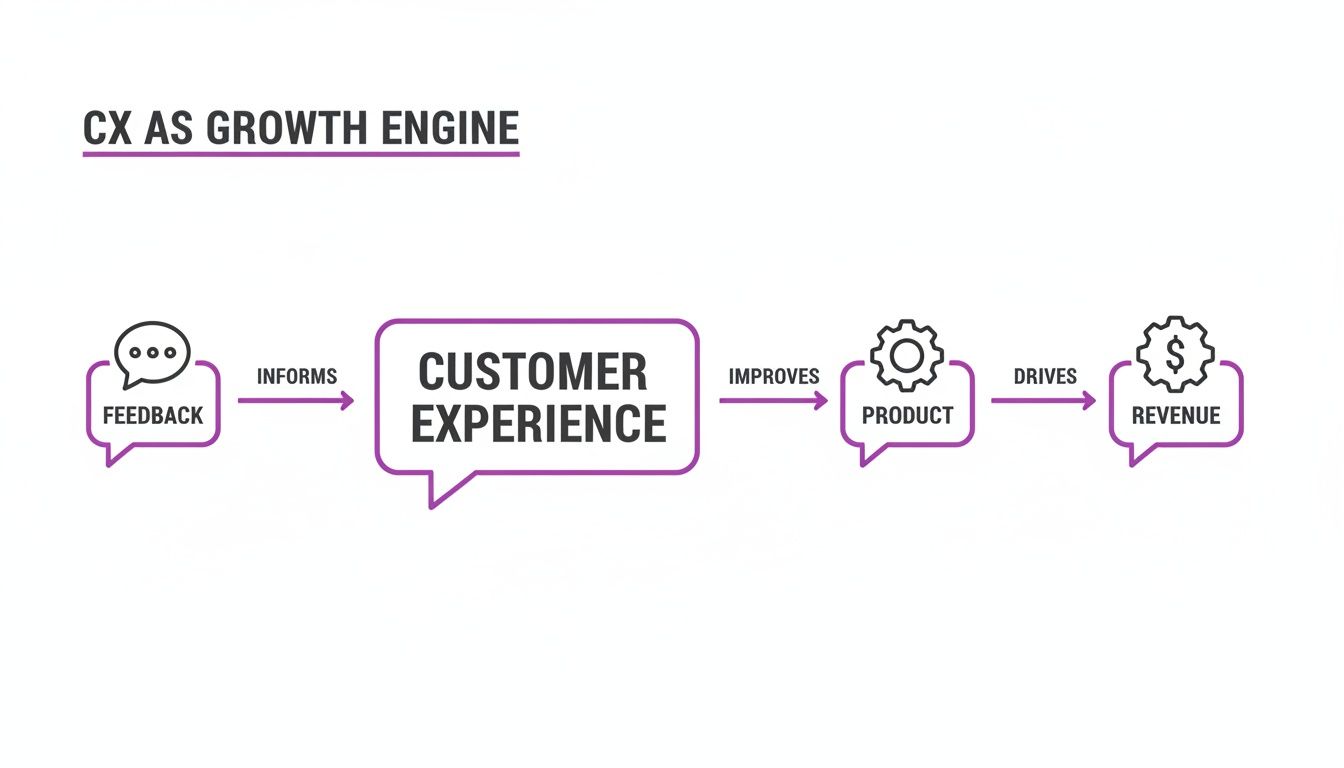
It’s a simple but powerful cycle: listen to the customer, improve the product, and watch the business grow. The CX Manager is the one keeping that flywheel spinning.
The Essential Skill Set
To really nail this role, a Customer Experience Manager needs a unique mix of soft skills and hard data chops. They have to be able to step into a customer’s shoes while also being able to stare down a spreadsheet and find the story hidden in the numbers. This blend is what separates a good hire from a great one.
The best CX professionals are part psychologist, part data analyst, and part project manager. They have the empathy to understand the ‘why’ behind customer actions and the analytical skills to prove its business impact with data.
Here are the non-negotiable skills to look for when hiring:
- Deep Empathy: This is the big one. It’s the ability to genuinely understand and feel what a customer is feeling. It goes way beyond just being nice; it’s about anticipating their needs and designing experiences that just feel right.
- Sharp Analytical Thinking: They need to be comfortable diving into data from all over the place—product analytics, survey results, support tickets—to uncover trends and make smart, informed decisions. No gut feelings allowed without data to back them up.
- Compelling Communication: This skill is absolutely crucial. They have to be able to translate customer insights into clear, persuasive arguments for other teams (like product and marketing) and write helpful, jargon-free content for customers.
- Tech-Savviness: A modern CX manager has to be fluent in a range of tools, from CRMs and feedback platforms to email automation software. They are the masters of the CX tech stack, making it all work together seamlessly.
Ultimately, this role is the bridge between your company and your customers. To see how this fits into the bigger picture, check out our in-depth guide to customer success for SaaS, which dives into related strategies for growth.
Measuring the Real Impact of Your CX Hire
So, you’ve hired a Customer Experience Manager. That’s a huge step. But how do you actually know if they’re moving the needle? To really understand their impact, you need to look past surface-level stats and focus on the numbers that actually hit your bottom line. It’s all about connecting their day-to-day work to real, tangible growth.
Think of your SaaS business as a ship and your new CX hire as the navigator. The navigator’s job isn’t just to keep the crew happy; it’s to make sure the ship actually reaches its destination—profitability and growth. KPIs are the instruments on the bridge: the compass, the speed log, the depth sounder. Without them, you’re just sailing blind.
Key Metrics That Tell the Real Story
Vanity metrics, like the number of support tickets closed in a day, can be seriously misleading. A great Customer Experience Manager zones in on numbers that reflect customer health and loyalty. These are the metrics that should live on their dashboard and in the reports they send you.
Here are the essential KPIs to track:
- Net Promoter Score (NPS): The classic. It measures customer loyalty by asking one simple question: “How likely are you to recommend our product to a friend or colleague?” This sorts your customers into Promoters, Passives, and Detractors, giving you a clear pulse on how people really feel about you.
- Customer Satisfaction (CSAT): This one’s more immediate. Usually measured right after a specific interaction (like a support chat or an onboarding call), CSAT gauges short-term happiness. It helps your manager pinpoint specific moments in the journey that are either brilliant or just plain frustrating.
- Customer Churn Rate: For any SaaS, this is the ultimate bottom-line metric. It’s the percentage of customers who cancel their subscriptions over a set period. A core mission for any CX manager is to drive this number down, consistently.
These metrics give you a solid framework for understanding customer sentiment, but they’re just the start. The real magic happens when your CX manager connects these scores to real-world actions and business outcomes. For a deeper dive into these core metrics, check out our guide on the differences and synergies between CSAT and NPS.
Connecting KPIs to CX Activities
A great CX manager doesn’t just report the numbers; they tell you the story behind them. They’ll connect a sudden dip in CSAT scores to that confusing new feature you just released, or link a nice uptick in NPS to the slick new onboarding sequence they implemented.
This connection is everything. It transforms data from a passive report into an active tool for making smart decisions.
The goal isn’t just to measure customer happiness, but to operationalise it. A skilled Customer Experience Manager translates feedback and scores into a concrete action plan that guides product development, marketing, and sales.
For example, let’s say the latest NPS survey reveals that a bunch of “Detractors” are all complaining about the lack of a specific integration. The CX manager’s job is to take that feedback and champion it with the product team. They can build a business case showing exactly how many customers are at risk of churning over this one issue, turning a simple score into a powerful catalyst for product improvement.
From Data Points to a Unified View
For a bootstrapped team, trying to track these KPIs across a mishmash of different tools can be a total nightmare. One tool for NPS, another for support tickets, and a spreadsheet for churn tracking creates data silos that hide the full picture. This is where an integrated platform becomes a game-changer.
A tool like HappyPanda pulls all this data into a single, real-time dashboard. Your Customer Experience Manager can instantly see how a low CSAT score from a support interaction might correlate with that same customer’s recent NPS response. This unified view empowers them to spot trends, predict churn risks, and act before small problems become big ones.
By centralising your data, you empower a single hire to manage the entire customer journey efficiently. They’ll spend less time hunting for information and more time creating the kinds of experiences that turn everyday users into lifelong fans of your brand.
Building a Lean CX Tech Stack That Wins
You don’t need an enterprise-sized budget to deliver a world-class customer experience. In fact, for bootstrapped founders, figuring out how to build a powerful yet affordable tech stack is often one of the biggest hurdles. The old-school approach usually means patching together a bunch of different specialised tools, which quickly turns into a financial and operational headache.
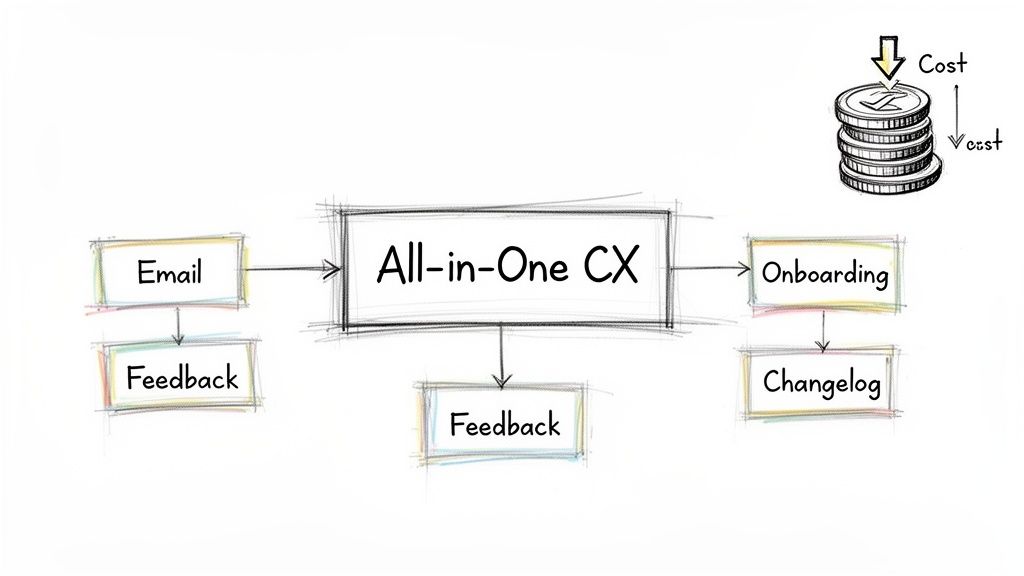
Just imagine juggling separate subscriptions for your welcome emails, in-app onboarding checklists, NPS surveys, and your product changelog. Not only do the monthly costs stack up—often hitting £300-£500 per month before you know it—but your customer data gets trapped in disconnected silos. Your customer experience manager is left trying to piece together a coherent picture from scattered fragments of information. It’s a mess.
This fragmented approach creates friction you just don’t need. Your CX manager wastes precious time switching between tabs, manually exporting data, and trying to connect the dots. For a lean team, that inefficiency is a silent killer, pulling them away from what actually matters: proactively making the customer journey better.
The Smarter, Integrated Approach
Luckily, there’s a much leaner way to operate. Instead of wrestling with a chaotic bundle of separate apps, you can consolidate your entire CX workflow into a single, all-in-one platform. Shifting from a fragmented toolkit to an integrated one is a genuine game-changer for bootstrapped SaaS companies.
An integrated platform like HappyPanda brings all your essential customer communication tools under one roof. Suddenly, your email sequences, feedback collection, onboarding flows, and changelog announcements all live in the same ecosystem. This doesn’t just simplify your workflow; it fundamentally changes what’s possible for your CX strategy.
This move is part of a bigger trend, especially in growing digital economies. In Southeast Asia, for example, the economics of CX management heavily favour centralised, SaaS-first platforms. The regional CRM software market is on track to hit around USD 1.25 billion in revenue by 2025, a surge driven by companies ditching the chaos of spreadsheets and emails for unified CX stacks. With so many small businesses just starting their digital journey, the potential for modernisation is huge, as you can read in the full research about the SEA CRM market.
Fragmented vs Integrated CX Stack Cost Comparison
When you look at the numbers, the financial argument for an all-in-one platform becomes crystal clear. A fragmented stack doesn’t just drain your time; it drains your bank account. Here’s a typical breakdown of what you might pay for individual tools compared to a single, integrated solution.
| Tool Category | Typical Standalone Tool Cost (Monthly) | Included in HappyPanda |
|---|---|---|
| Email Marketing / Drip Campaigns | £50 - £150+ | ✅ |
| Customer Feedback & Surveys (NPS/CSAT) | £70 - £200+ | ✅ |
| In-App Onboarding & Checklists | £100 - £300+ | ✅ |
| Public Changelog & Release Notes | £20 - £50+ | ✅ |
| Total Estimated Monthly Cost | £240 - £700+ | One simple price |
The table speaks for itself. Consolidating these functions into one platform doesn’t just tidy up your workflow—it can slash your monthly software bill by hundreds of pounds, freeing up cash for other critical areas of your business.
Unlocking a Unified Customer View
The real magic of an integrated stack, though, is the unified customer view. When every interaction happens within one system, your customer experience manager gets a complete, 360-degree perspective of every single user. They can see a customer’s entire history in one clean timeline. No more guesswork.
An integrated platform transforms your CX manager from a data wrangler into a strategic powerhouse. They stop chasing information across different apps and start using a single source of truth to make faster, smarter decisions that prevent churn and drive loyalty.
For instance, they can see that a user just gave a low CSAT score, previously submitted a feature request, and has only completed 40% of their onboarding checklist. This kind of holistic context is pure gold. It allows the CX manager to reach out with a perfectly timed, highly personalised message that addresses the user’s specific friction points, turning a potential churn risk into a success story. For more ideas on how to leverage user input, check out our list of the best customer feedback tools available.
Turning Lean into a Competitive Advantage
Adopting an all-in-one CX platform does more than just save you a few quid on software subscriptions. It empowers a single, dedicated customer experience manager to have the impact of an entire enterprise team. By automating the routine stuff and providing deep, actionable insights, the right tech stack turns your lean structure into a serious competitive advantage.
You can move faster, build deeper customer relationships, and deliver a consistently excellent experience that your bigger, slower competitors simply can’t match.
Alright, let’s get this done. Hiring your first customer experience manager can feel like a massive distraction when you’re already juggling a million other things. You’re not alone in thinking that. But trust me, getting this right is one of the most powerful moves a founder can make. It’s not just another hire; it’s an investment in your company’s future.
This isn’t some theoretical HR guide. It’s a practical, no-fluff playbook designed to cut through the noise. I’m handing you the exact tools you need: a job description template you can actually use and a set of interview questions that get to the heart of what matters. The goal? To find someone with that perfect mix of big-picture thinking and roll-up-your-sleeves scrappiness that every lean startup desperately needs.
We’re ditching the generic qualifications. We’re looking for a pro who doesn’t just put out fires but actively seeks out friction points to build a better customer journey from day one.
Crafting the Perfect Job Description
A great job description does more than list tasks—it tells a story. It should sell your company’s vision and act as a magnet for people who are genuinely excited by the chaos and opportunity of a growing SaaS. Think of it as a filter, weeding out those who need a rigid corporate structure to feel safe.
Kick it off with a compelling summary that paints a vivid picture of the impact this role will have. Don’t just list responsibilities; frame it as a mission.
Here’s an opener to get you started:
“We’re looking for a passionate Customer Experience Manager to be the ultimate advocate for our users. You won’t just be answering tickets; you’ll be the architect of our entire customer journey, turning feedback into our most valuable growth asset. If you love digging into data to understand user behaviour and thrive on creating ‘aha!’ moments for customers, this role is for you.”
Next, break down the core responsibilities. Be crystal clear about the blend of strategic and hands-on work they’ll be doing.
- Journey Mapping: Get in the weeds designing, analysing, and constantly tweaking the end-to-end customer lifecycle—from their first visit to the website to becoming a die-hard fan.
- Onboarding Optimisation: Build and manage automated onboarding flows (think emails and in-app guides) that actually get users to stick around for the long haul.
- Feedback Loops: Set up and own our feedback systems (NPS, CSAT) to gather real insights and be the voice of the customer in product meetings.
- Proactive Support: Dive into user data to find the snags and create resources (help docs, quick tutorials) that solve problems before they even happen.
- Retention Strategy: Keep an eye on customer health scores and create playbooks to engage at-risk users, slash churn, and boost that all-important lifetime value.
Finally, list the skills and qualifications, but focus as much on mindset as you do on experience. You want someone resourceful, autonomous, and obsessed with data.
Insightful Interview Questions to Ask
Once the applications roll in, you need to dig deeper than their CV. The right questions will show you how they think, how they solve problems, and whether they can handle the unique pressures of a bootstrapped startup. Forget the standard stuff and throw some real-world scenarios at them.
The best interview questions don’t have a single “right” answer. They’re designed to peel back the layers and reveal a candidate’s thought process, resourcefulness, and ability to think strategically when the budget is tight.
Here are a few powerful questions designed to separate the good candidates from the great ones.
Scenario-Based Questions
-
The Budget Challenge: “Okay, imagine our churn rate has ticked up by 2% this quarter. You have next to no budget. Walk me through the first three things you’d do to figure out what’s going on and start turning things around.”
- What you’re looking for: A data-first mindset. Do they start by talking to users and digging into analytics, or do they immediately jump to expensive solutions?
-
The Onboarding Design: “You need to build a new user onboarding flow from scratch, but you can’t get any time from a designer or engineer for the next month. How would you build a ‘minimum viable’ onboarding experience using only lightweight tools?”
- What you’re looking for: Resourcefulness and creativity. Are they talking about tools like email automation, simple checklist widgets, or even recording a few Loom videos?
Strategic and Cultural Fit Questions
- “Tell me about a time you used customer feedback to influence a product roadmap decision. What was the situation, what data did you bring to the table, and what was the outcome?”
- “How do you balance giving customers a fantastic, personalised experience with the need for efficiency and scalability in a tiny team?”
- “If you could only have three metrics on your personal dashboard to measure your own success in this role, what would they be and why?”
By combining a killer job description with these kinds of targeted questions, you stop seeing hiring as a chore. It becomes a strategic tool to find the exact person who won’t just support your customers, but will actively help you grow the business.
Get Your New CX Manager Firing on All Cylinders with this 30-Day Plan
So, you’ve hired your Customer Experience Manager. Great move. But the real work starts now. Leaving them to just “figure things out” is a recipe for a slow start. You need them making an impact, fast.
A structured 30-day plan is your secret weapon here. It’s not about hand-holding; it’s about giving them a clear roadmap. Think of it as a guided tour that transforms them from a fresh face into a strategic force who knows your product, your customers, and your tech stack inside and out.
This plan is all about progressive immersion. It guides your new manager from understanding the product to mastering the tools and, finally, building a data-backed strategy. Let’s ditch the guesswork and get them delivering value from day one.
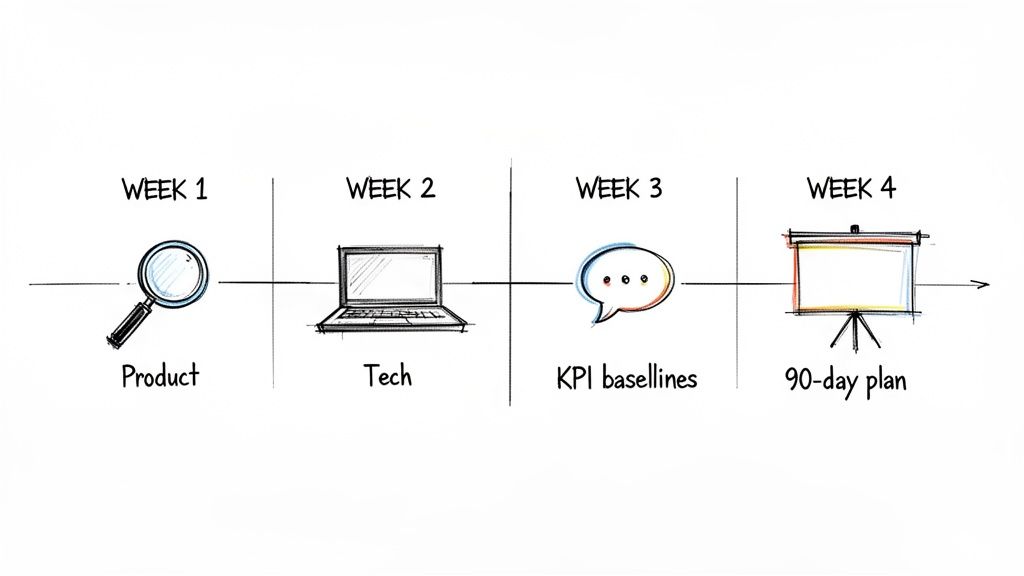
Here’s a practical, week-by-week checklist you can steal and adapt for your own SaaS.
Week 1: Full Immersion into Product and Customers
The first week is for listening and learning. No grand strategies, no big changes. The goal is simple: total immersion. They need to understand the product, the company vision, and most importantly, the customer journey as it exists right now. They should live a day in the life of a user.
- Become a Power User: Get them to sign up for your product, go through the onboarding, and use every single core feature. No shortcuts.
- Dive into Support Tickets: There is absolutely no better way to find customer pain points than by spending a day (or two) in the support inbox.
- Map the Current Journey: Ask them to create a visual map of all customer touchpoints, from the very first ad they see to their 10th login.
Week 2: Master the Tech Stack
Once they have a solid feel for the customer’s world, it’s time to pull back the curtain on the tech that runs it. Week two is all about mastering the tools you use for customer communication, feedback, and analytics.
- A Deep Dive into the Tools: Give them access and training on your entire CX stack. This means your HappyPanda account, your CRM, your analytics software—everything.
- Review the Automation: Have them analyse every automated email sequence, in-app message, and survey trigger you have running.
- Spot the Gaps: Encourage them to look for opportunities. Where could tools be integrated better? What could be automated to make life easier for customers (and your team)?
Week 3: Taking Ownership and Setting Baselines
In week three, the training wheels come off. Your new CX Manager starts shifting from observing to doing. They’ll begin actively managing customer interactions and establishing the key performance indicators (KPIs) that they will own from now on.
This is the turning point. The role moves from reactive learning to proactive management. By setting clear baselines for metrics like NPS and CSAT, they create the foundation to measure every future success and prove their impact.
- Take Over Comms: They should start managing the customer feedback channels and responding directly to surveys and comments.
- Establish KPI Baselines: Their job is to document the current NPS, CSAT, and churn rates. This gives everyone a clear, honest starting point.
Week 4: The 90-Day Strategic Plan
By now, your new hire has a deep, holistic view of the product, customers, tools, and data. The final week is for putting it all together. Their last task for the month is to present a data-backed, 90-day CX strategy.
This isn’t a vague wish list. It’s a concrete plan outlining their proposed priorities, experiments they want to run, and the outcomes they expect to achieve. This final deliverable sets a clear course for the next quarter, ensuring their efforts are perfectly aligned with your business goals right from the start.
Your Burning Questions About Hiring a CX Manager
Bringing on your first customer experience manager is a big step, especially when you’re bootstrapping and every penny counts. It’s totally normal to have questions. Here are the straight answers to the ones we hear most from founders in your shoes.
When Is the Right Time to Hire a CX Manager?
There’s no magic revenue number, but there’s definitely a tell-tale sign: you, the founder, are spending more than 20% of your week putting out customer fires instead of building the business.
Think of it this way: if you’re so bogged down in reactive support tickets that you can’t even think about mapping the customer journey or digging into feedback, you’ve waited too long. The goal is to make the hire before customer friction starts showing up in your churn rate.
Do They Need to Be a Tech Whiz?
They don’t need to be a developer, but they absolutely need to be tech-savvy. A great customer experience manager lives comfortably in a modern tech stack. They should be able to figure out email automation, make sense of product analytics, and not break into a cold sweat when you mention an API.
They’re the crucial bridge between your customers and your product team. To do that job well, they need to speak both languages fluently.
A classic mistake is hiring a pure “people person” who wilts when faced with a spreadsheet. The best candidates blend genuine empathy with a data-driven mind. They don’t just feel what customers want; they can prove the ROI of fixing it.
How Much Should I Budget for This Role?
Salaries are going to swing depending on location and experience, so do your homework. But the bigger picture here isn’t just the salary—it’s the toolkit you give them.
Think about it: a single hire armed with the right, integrated platform can deliver the impact of an entire team. Budgeting for the right tools from day one makes your investment in their salary ridiculously more efficient.
One hire can genuinely change your business, but only if they have the right tools to succeed. HappyPanda brings your entire CX stack—from onboarding and feedback to emails and changelogs—into one affordable platform. It empowers your new manager to start delivering results from the moment they walk in the door. https://happypanda.ai